


For a home inspector, the best moisture meters are professional-grade, all-in-one models that combine both pin and pinless scanning. These hybrid devices provide the essential flexibility for a thorough inspection—allowing for non-destructive scanning to quickly survey an area and precise, penetrative readings to confirm moisture in structural materials. Your choice ultimately comes down to balancing accuracy, durability, and features that enhance your daily workflow and reinforce your professional credibility.
Choosing the Right Moisture Meter for Professional Inspections
As a home inspector, your moisture meter is more than just a tool; it's a direct extension of your credibility. An inaccurate reading can have devastating consequences for a homeowner. You could miss hidden water damage that festers into a significant mold problem, or you could trigger costly, unnecessary repairs based on a false positive. As IICRC Master Certified water damage experts serving Orange County, we at Sparkle Restoration Services know that defensible data is everything.
This guide goes beyond the basic spec sheet to focus on how these tools perform in the real world. We’ll break down why the "best" meter isn't just about a brand name. It's about how its technology aligns with the unique challenges you face in Southern California properties—from identifying stucco leaks in Newport Beach to assessing crawl space conditions in older Irvine homes.
Pin vs. Pinless vs. All-in-One Models
The first critical decision is choosing between the three main types of moisture meters. Each serves a distinct purpose, and understanding their function is the first step toward a smart investment. A true professional's toolkit is defined by the ability to switch between methods seamlessly.
| Meter Type | Primary Technology | Best Use Case | Key Limitation |
|---|---|---|---|
| Pin Meter | Electrical Resistance | Confirms the exact moisture percentage in wood and other porous materials. | It's invasive. You're going to leave small holes in finished surfaces. |
| Pinless Meter | Dielectric Capacitance | Quickly scans large, finished areas like drywall and tile without leaving a mark. | Gives a relative reading, not an exact moisture percentage. |
| All-in-One | Hybrid (Both) | The go-to, all-purpose diagnostic tool that can handle any scenario. | Can be more expensive and have a steeper learning curve than single-function models. |
As a BBB Torch Award for Ethics Winner, we believe integrity starts with reliable tools. An all-in-one meter lets you quickly scan with the pinless function and then verify your findings with the pin function. This creates a two-step verification process that protects both you and your client.
The global moisture meter market is expanding rapidly, with projections reaching as high as $4.35 billion by the early 2030s. This growth is fueled by demand from residential and commercial building inspectors, pushing manufacturers to innovate with more advanced digital meters.
Ultimately, investing in a professional-grade meter ensures your findings are solid, protecting your clients and your reputation. Understanding the full scope of an inspector's role is key; for more context, check out guides on hiring a professional property inspector. A reliable meter is also the first line of defense in determining if a home is truly watertight—check out our guide on how to determine if your home is leak-proof.
Pin vs. Pinless: A Deep Dive into Core Technologies
Selecting the right moisture meter for your inspection business boils down to understanding the two core technologies: pin and pinless. They operate on completely different principles, and knowing when to use each is what separates a professional from an amateur.
A pin meter measures electrical resistance, while a pinless meter uses dielectric capacitance. This isn't just technical jargon; it fundamentally changes how you take readings, interpret results, and explain findings to a homeowner. One offers surgical precision, while the other provides a fast, non-damaging way to map out a problem area. A seasoned inspector needs to be fluent in both.
The Precision of Pin Meters
When you need a hard number, you reach for a pin meter. These tools use two metal electrodes—the pins—that you physically push into a material like a wood stud or a section of subfloor. The meter sends a tiny electrical current between those pins to measure the resistance.
Here's the simple science: water is an excellent electrical conductor. The more moisture in the material, the lower the electrical resistance. Your meter translates that resistance reading into a specific Wood Moisture Content (WMC) percentage. This direct measurement is invaluable when you need to confirm the exact severity of water intrusion in structural components.
But their greatest advantage is also their main drawback: they’re invasive. Every time you use a pin meter, you're leaving small holes behind. While that's fine for an unfinished basement stud, it's not something you want to do on a client's freshly painted living room wall or expensive kitchen cabinetry right out of the gate.
The Efficiency of Pinless Meters
Think of a pinless meter—often called a scanner or non-invasive meter—as being similar to a stud finder. It uses a sensor pad on the back that sends out a low-frequency electromagnetic signal as you glide it over a surface like drywall, tile, or hardwood flooring.
This creates an electromagnetic field just below the surface. Moisture and density changes in the material disrupt that field, and the meter picks up on those changes in capacitance. It then converts that data into a relative moisture reading, not a direct percentage.
The beauty of this is speed and discretion. You can scan huge areas in minutes to hunt for potential "hot spots" of moisture without leaving a single mark. It's the perfect first-pass tool for mapping out the scope of a problem behind a finished wall or under a floor.
Expert Insight: I like to think of it like a medical diagnosis. The pinless meter is your X-ray—it gives you a broad, non-invasive look to spot anomalies. The pin meter is the biopsy—it delivers a definitive, localized result that confirms exactly what you're dealing with. A thorough inspector uses both to build a complete and defensible report for their client.
This flowchart is a great visual for how to think through the decision on the job.
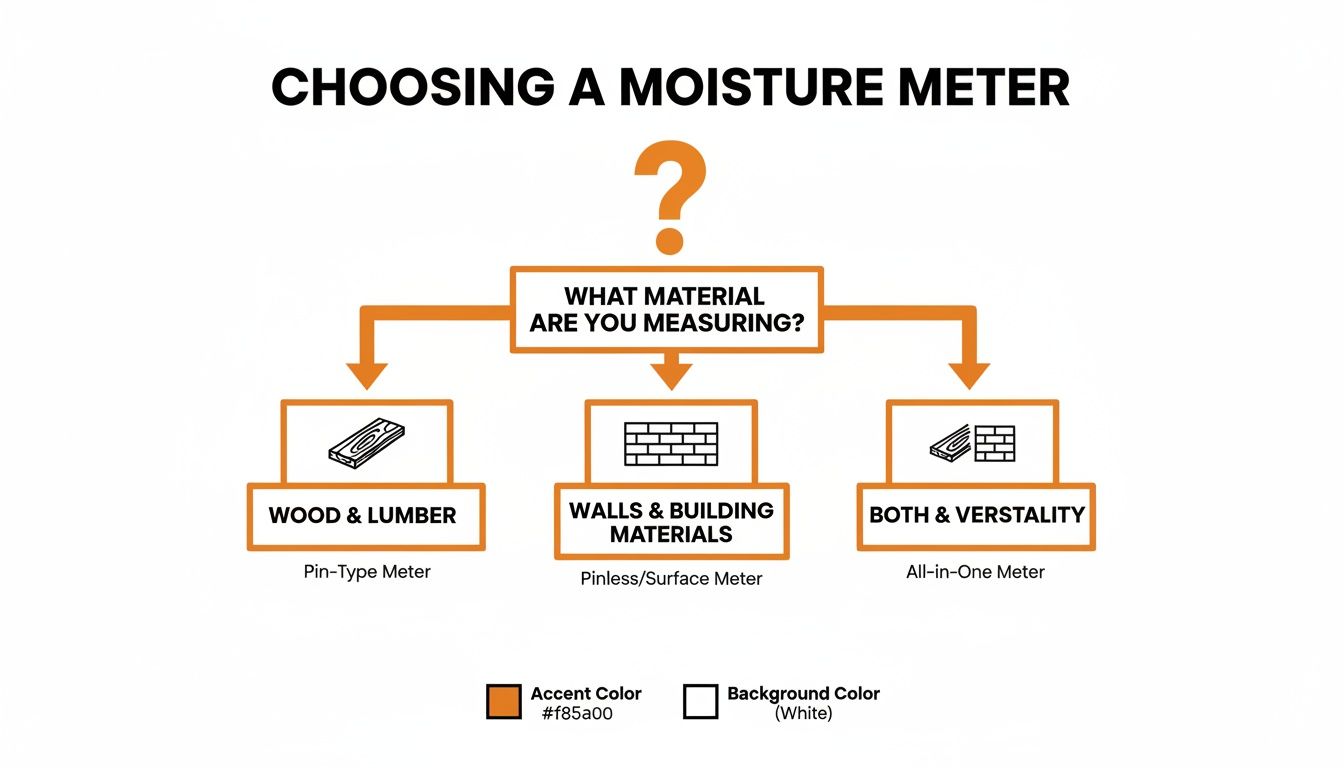
As you can see, while specialized meters are great at one thing, a hybrid or all-in-one model gives you the flexibility you truly need for the unpredictability of home inspections.
The Hybrid Approach: A Modern Necessity
Because each technology has clear limitations, professional inspectors have overwhelmingly moved to a mixed toolkit. You absolutely need the direct percentage readings from a pin meter for porous materials, but you also need the speed and non-destructive mapping of a pinless meter for finished surfaces. It’s no surprise that manufacturers report that hybrid units now command a dominant share of professional sales.
Let’s walk through a classic scenario you might find in an Orange County home:
- The Scenario: You're inspecting a high-end bathroom in a Newport Beach home and suspect a leak behind the tiled shower wall.
- Step 1 (Scan): You pull out your hybrid meter and use its pinless function to scan the entire tile surface. You find a large patch near the shower valve showing much higher relative readings than the surrounding walls.
- Step 2 (Confirm): Now you need proof. You go to the closet that shares a wall with the shower. Switching to the pin function, you take a direct WMC reading of the drywall and the studs inside, confirming a moisture content of 22%. That's deep in the danger zone for rot and mold growth.
This two-step method lets you find a problem without causing damage and then collect the hard, actionable data your report requires. It’s a methodical approach that protects your client from hidden issues that could easily spiral into costly repairs and the need for professional mold remediation services. A hybrid meter isn't a luxury; it’s an essential investment in your accuracy and efficiency.
Situational Comparison of Pin, Pinless, and Hybrid Meters
Choosing the right meter isn't just about features; it's about matching the tool to the specific situation you're facing on-site. Different inspection scenarios call for different approaches. This table breaks down common situations to help you think through which meter type is the best tool for the job.
| Inspection Scenario | Best Tool for the Job | Why It's the Right Choice | Potential Limitations |
|---|---|---|---|
| Initial scan of a large finished basement wall | Pinless Meter | Quickly covers a large area to find potential moisture "hot spots" without leaving any marks or causing damage to the paint or drywall. | Provides only a relative reading. You'll need a pin meter to confirm the actual moisture content percentage. |
| Confirming moisture in an exposed wood joist | Pin Meter | Delivers a precise, quantitative Wood Moisture Content (WMC) percentage, which is critical for assessing structural integrity and the risk of rot. | Invasive. Not suitable for finished surfaces where leaving small holes would be unacceptable to the client. |
| Investigating a ceiling stain below a bathroom | Hybrid Meter | Use the pinless mode first to map the extent of the moisture non-invasively. Then, use the pin mode to get a definitive WMC reading to confirm the severity. | Requires understanding both modes. A slightly higher initial cost than a single-function meter. |
| Checking flooring under a new appliance | Pinless Meter | Allows you to scan under the edge of a washer or dishwasher without moving the appliance or damaging the hardwood, tile, or vinyl flooring. | Metal interference from the appliance or rebar in a concrete slab can sometimes affect the readings. |
| Measuring moisture in a crawl space subfloor | Pin Meter | The direct contact and precise percentage reading are essential for documenting conditions in areas prone to high humidity and potential water damage. | Slower than scanning. You must take multiple readings in different spots to get a complete picture of the area. |
| Pre-drywall inspection on new construction | Hybrid Meter | Use the pinless function to rapidly scan large sections of framing. Switch to the pin function to spot-check any questionable studs or headers for exact WMC. | The user needs to switch between modes and scales, which takes a bit of practice to do efficiently. |
Ultimately, having the right tool for the job means being prepared for any situation. While single-function meters have their place, the versatility of a hybrid meter is tough to beat for the day-to-day reality of a professional home inspector.
What Separates a Pro-Grade Meter from the Rest?
When you’re trying to find the best moisture meters for home inspectors, it’s easy to get lost in a sea of marketing jargon. The reality is, what makes a meter truly professional isn't a flashy gimmick—it’s the tool’s ability to provide consistent, defensible data, day in and day out, in real-world conditions. These are the core features that move a tool from the hobbyist’s shelf into a professional's daily toolkit.
A cheap meter might give you a number, but a professional one gives you a number you can stake your reputation on. It’s an investment in your accuracy, your efficiency, and the long-term trust you build with every client.
Precision and Range: The Foundation of Accuracy
The single most critical feature of any professional meter is its measurement accuracy. A dependable device needs to deliver an accuracy of at least +/- 1% for wood and offer a clear, repeatable scale for relative readings on materials like drywall and plaster. Anything less is a non-starter.
Just as important is the meter’s measurement range. A pro-grade tool can detect a wide spectrum of moisture, from bone-dry conditions (around 6–9% WMC) all the way to full saturation (over 30% WMC). This allows you to accurately evaluate everything from perfectly acclimated hardwood floors to waterlogged framing after a major leak. A narrow range simply doesn’t provide the full story.
Adjustable Depth: A Critical Diagnostic Tool
For pinless meters, having an adjustable depth setting is a complete game-changer. This feature lets you control how deep the meter’s electromagnetic field penetrates the material, usually from a shallow ¼ inch to a deeper ¾ inch.
Why is this so important? It’s the key to differentiating between a minor surface issue and a serious, deep-seated problem.
- Surface Condensation: A shallow reading might just pick up condensation in a poorly ventilated bathroom.
- Deep Intrusion: A high reading at a deeper setting could be the first sign of a slow leak inside the wall cavity.
Without this capability, you risk misdiagnosing a critical issue, potentially turning a small problem into a homeowner's nightmare.
At Sparkle Restoration Services, our entire approach is built on precision. As an IICRC Master Certified firm, we know that accurate diagnostics are the first step to effective restoration. Having the right tools isn't just about efficiency; it's a core component of upholding the standards detailed in our certifications and delivering on our promise of excellence.
Modern Features That Make Reporting a Breeze
Beyond core accuracy, today’s best meters have features designed to make your job easier and your reports more powerful. Bluetooth connectivity, for example, is no longer a luxury—it’s an essential efficiency tool. When you can sync readings directly to a mobile app, you can timestamp data, attach photos, and drop your findings right into your inspection software.
This enables you to build a clear, professional narrative for your client. Instead of handing them a list of numbers, you can present a visual story of your findings, complete with geolocated data points. That level of documentation is invaluable, especially when you uncover significant water damage.
Built for the Field: Durability and Design
Finally, a professional meter has to be tough enough to survive the daily grind of inspections. Look for devices with rugged, shock-resistant housing and a long-lasting battery. A bright, backlit display is an absolute must-have for working in the dark crawlspaces, attics, and basements where the most critical moisture problems hide.
Ergonomics matter, too. A meter that fits comfortably in your hand and allows for one-handed operation can save you a surprising amount of time and frustration over a long inspection day. These practical design choices are what separate a tool made by a manufacturer who truly understands the demands of the job.
Market reports consistently show that professional buyers prioritize accuracy and lifecycle cost. Commercial inspection standards often demand measurement repeatability within 1–3 percentage points for wood, which is why inspectors are moving toward calibrated digital instruments with traceable calibration options. Investing in a durable, accurate, and feature-rich meter isn't an expense—it's a critical investment in your business's credibility and long-term success.
Top Moisture Meter Recommendations for Every Inspector
Picking the right moisture meter from a sea of options can be challenging. To cut through the noise, we've broken down our top picks based on what inspectors actually need in the field—not just marketing hype. As a BBB Torch Award Winner, our reputation is built on trust, and that starts with having gear we can rely on. These recommendations are based on performance, durability, and their ability to detect the specific moisture problems we frequently encounter in Orange County homes.
For the Entry-Level Professional
When you're just starting out, you need tools that are reliable and simple to use. The last thing you want is to be fumbling with a complicated device while you're trying to build client confidence. A great entry-level meter provides accurate, core functionality without a steep learning curve, so you can deliver trustworthy results from day one.
We recommend new inspectors find a solid hybrid meter that offers both pin and pinless modes in a tough, rugged body. Ensure it has a bright, backlit display—you'll be grateful in a dark crawlspace—and an interface that is intuitive right out of the box. It might not have advanced Bluetooth features, but its primary job is to deliver accurate, repeatable readings. That’s non-negotiable for building solid reports.
The Mid-Range Workhorse
For the seasoned inspector juggling multiple inspections a day across diverse properties, a mid-range workhorse is the ideal investment. This category represents the sweet spot, balancing advanced features, precision, and the kind of durability that survives the occasional drop. These are the daily drivers for most professionals, and for good reason.
You'll find that versatile hybrid meters dominate this category. Look for models with adjustable pinless depth scanning; it’s absolutely critical for distinguishing between surface condensation and a deeper leak in the stucco homes prevalent in Newport Beach. A wide range of wood species correction settings is also a must-have for getting true readings in custom homes with exotic hardwoods. These meters are built to last and will pay for themselves in efficiency and accuracy.
Expert Insight: The real magic of a mid-range meter is its diagnostic power. The workflow is simple but effective: quickly scan a large wall non-invasively with the pinless mode, and when you get a high reading, use the pins to confirm its exact location and moisture content. That two-step process is how you turn a hunch into a bulletproof finding in your report.
The High-End Investment
If your niche includes high-value properties, historic homes, or frequent work on restoration and insurance claims, a high-end meter is a strategic investment. These premium tools offer a level of diagnostic detail that can be a game-changer in complex situations, easily justifying their higher price tag.
This tier is all about advanced data management and integration. We’re talking about features like Bluetooth connectivity that syncs readings, photos, and notes directly into your reporting software. Some of the most sophisticated models even integrate with thermal imaging cameras, letting you overlay moisture readings onto a thermal map. Imagine showing a client in Irvine or Laguna Niguel a visual, data-backed map of water intrusion—it creates compelling, undeniable proof and turns a chaotic situation into a clear path forward.
From the Field: Putting Your Meter to Work
Knowing a meter's specs is one thing, but deploying it effectively in the field is what separates a good inspector from a great one. You aren’t just taking readings; you’re interpreting data within the context of a property and turning it into actionable advice for your client. The best moisture meters for home inspectors are the ones that empower you to excel in these real-world situations.
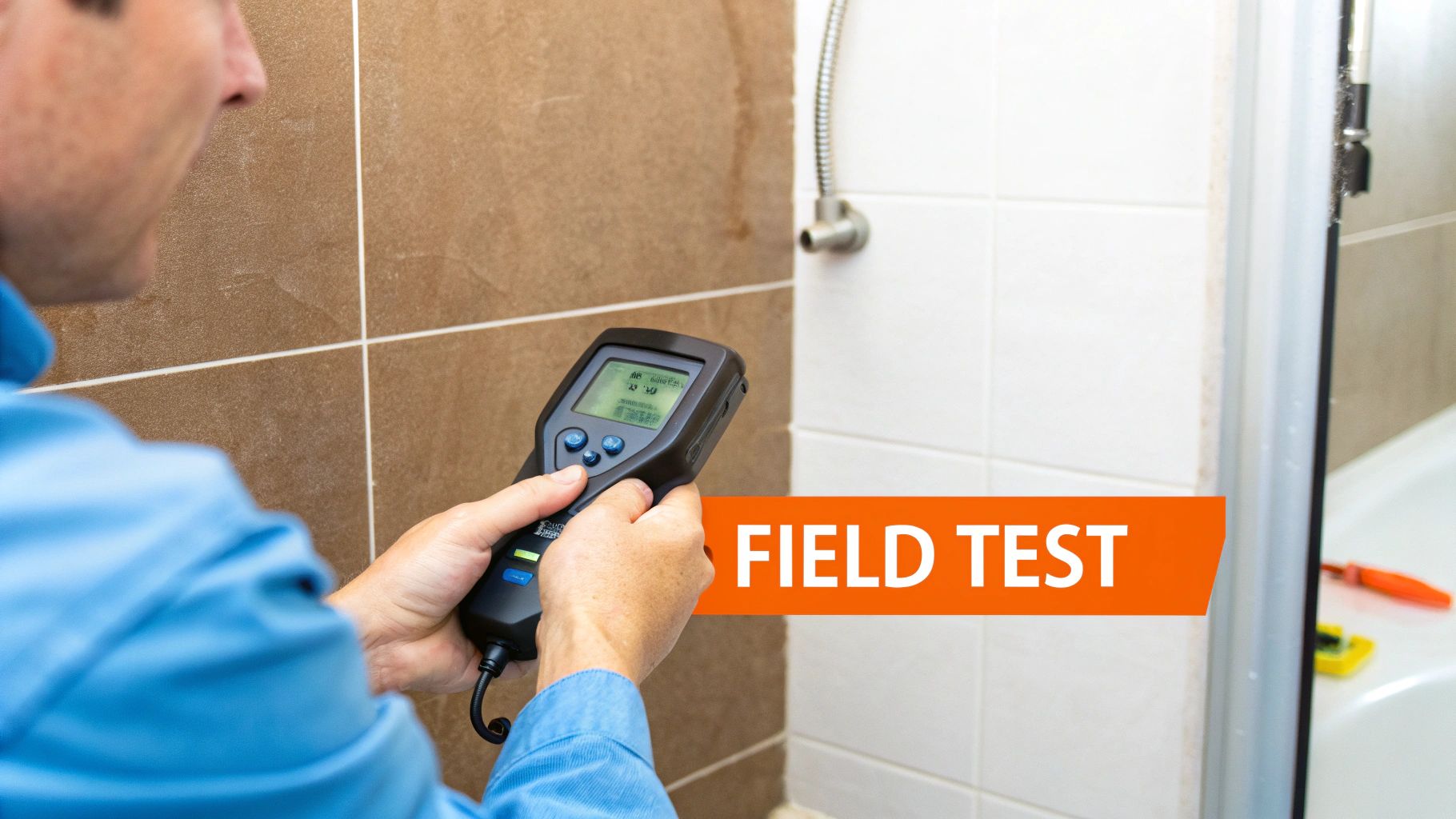
Let's walk through a few common scenarios you’ll encounter, from coastal homes in Newport Beach to inland properties here in Irvine. Each one demands a different approach and the right tool for the job.
Scenario 1: Tracing a Stucco Leak After Rain
It's a classic Southern California problem: moisture seeping through stucco, especially around windows and doors after a good downpour. This is a perfect job for a non-invasive pinless meter.
- Your Tool: A quality pinless meter, ideally one with an adjustable depth setting.
- Your Method: First, get a baseline reading on an interior wall you know is dry. Then, methodically scan the interior walls next to the exterior stucco, focusing on the areas directly under windows.
- Reading the Data: If you see a high relative reading that feathers out from a window corner, you've likely found a compromised seal. By adjusting the scan depth, you can start to tell if it's just surface dampness or if moisture has already soaked into the drywall and framing behind it.
This non-destructive method lets you map out the potential water intrusion without leaving a single mark, giving you solid evidence for your report.
Scenario 2: Investigating a Potential Slab Leak Under High-End Flooring
Slab leaks are a nightmare, often hiding under expensive hardwood or luxury tile. Using the wrong tool here can be a very costly mistake.
At Sparkle Restoration, we’ve seen countless homes where a hidden slab leak caused extensive damage. A pinless meter is your first line of defense, allowing you to scan large floor areas quickly and efficiently without invasive testing. It’s about "Turning Chaos Into Calm, Fast"—starting with an accurate diagnosis.
A pinless scanner lets you quickly spot anomalies that point to a potential problem under the surface. If you get a hot spot, your job isn't to start prying up flooring. Instead, you document the high readings and recommend further investigation by a specialist, like a leak detection service or a restoration expert who understands the complexities of water damage. This protects you, your client, and their property.
Scenario 3: Getting Hard Numbers in an Old Crawl Space
In older homes with raised foundations, the crawl space is where critical issues often hide. This is where a pin meter becomes absolutely essential for getting hard data on the structural wood.
- Your Tool: A pin meter, preferably with an extension or hammer probe to reach into tight corners and overhead joists.
- Your Method: Take direct Wood Moisture Content (WMC) readings from multiple subfloor joists and support posts. Get a good sample size.
- Reading the Data: Any WMC reading above 20% is a major red flag. That’s the threshold where conditions become perfect for wood decay and mold growth.
This direct, quantitative data is indisputable. It provides the clear, objective evidence you need to recommend remediation. The widespread availability of this gear is no accident; North America drives over 35% of the global moisture meter market, ensuring a steady stream of professional-grade tools for inspectors like us. These real-world applications show exactly why investing in a versatile, reliable meter is non-negotiable for any serious home inspector.
Maintaining Your Meter for Consistently Accurate Readings
A professional-grade moisture meter is a serious investment in your business, and just like any high-performance tool, it requires proper care. For your readings to be accurate, defensible, and reliable on every single home inspection, consistent maintenance and regular calibration are non-negotiable. This dedication to meticulous care reflects the same high standard we uphold at Sparkle Restoration Services, where precision is paramount.
Proper upkeep does more than just extend the life of your device—it protects your professional credibility. Inaccurate readings can lead to catastrophic oversights or create unnecessary panic for homeowners. Either situation can quickly erode the trust you’ve worked so hard to build.
Daily and Routine Maintenance Checks
Simple daily habits can make a massive difference in your meter's long-term performance. Before you head out to your first job in Newport Beach or Irvine, take a minute for these quick checks.
- Self-Calibration Check: Most pro-level meters have a built-in calibration check or come with a separate reference block. Use it daily to confirm the device is operating within its specified tolerance.
- Sensor and Pin Cleaning: After each inspection, wipe the pinless sensor plate with a soft, dry cloth to remove any dust or residue. For pin meters, ensure the pins are clean, straight, and free of corrosion that could interfere with electrical resistance readings.
- Battery Maintenance: Always start your day with a full charge or a fresh set of batteries. Low power is one of the most common causes of erratic, unreliable readings that can compromise your entire report.
To keep your moisture meter in peak condition, it helps to adopt some of the top preventive maintenance best practices.
When to Seek Professional Calibration
While daily checks are crucial, they don't replace periodic professional servicing. Think of it like a tune-up for your truck; it’s about ensuring everything is performing exactly as it should be.
As a BBB Torch Award for Ethics Winner, we know that defensible data is paramount. Annual third-party calibration provides documented proof that your instrument meets manufacturer specifications, reinforcing the integrity of your findings, especially in insurance claims or legal disputes.
Most manufacturers recommend sending your meter in for professional calibration once a year. This service goes beyond a simple check; it verifies the meter's accuracy against traceable standards and maintains any certifications you need to uphold the highest industry benchmarks. It’s a small annual investment that protects your reputation and ensures you continue to deliver excellence.
Frequently Asked Questions About Moisture Meters
As professionals in water damage restoration, we get a lot of questions from homeowners and the inspectors who serve them. For a home inspector, having total confidence in your tools—and the data they produce—is non-negotiable. Here are some straightforward answers to the most common questions we hear about moisture meters.
What Moisture Percentage Is Considered Dangerous?
This is the most critical question. The honest answer? It completely depends on the material you’re testing. There is no single magic number.
For structural wood, anything reading between 16% and 20% moisture content (WMC) is a major red flag. This is the range where wood becomes a breeding ground for rot and fungus. Once readings exceed 20%, the conditions are ideal for serious decay and mold to take hold, signaling the need for immediate action.
When it comes to materials like drywall or plaster, however, you must think in terms of a relative scale. You can't rely on one number. Your first step is to get a baseline reading from an area you know is dry. From there, you're hunting for significant increases in other spots. A high relative reading is the clue that indicates a hidden moisture source is nearby.
As IICRC Master Certified restoration pros, we treat high readings like a breadcrumb trail. A number isn't just a number; it's the starting point of an investigation to track moisture back to its source and eliminate it before real damage occurs.
Can a Moisture Meter Directly Detect Mold?
This is a huge misconception we encounter frequently. A moisture meter cannot detect mold itself. What it does detect is moisture—the one thing mold absolutely needs to grow and spread.
Your meter is essentially a predictive tool. High moisture readings are your best indicator that conditions are ripe for mold, or that it might already be growing out of sight. When you find an area with consistently high moisture, your next step should always be a careful visual inspection for any signs of microbial growth. If you confirm there’s a problem, you can confidently recommend professional remediation.
How Often Should I Calibrate My Professional Moisture Meter?
If you want your data to be defensible, you must keep your equipment in top shape. Best practice is to run a quick self-calibration check before every single inspection. Most pro-grade meters either have a built-in calibration feature or come with an external check device to make this daily verification easy.
For documented, official accuracy, both manufacturers and industry standards recommend sending your meter in for professional third-party calibration at least once a year. This is absolutely critical if your inspection reports could be used in legal disputes or insurance claims. Annual servicing ensures your findings are rock-solid and can stand up to any scrutiny.
For more answers to common restoration questions, feel free to check out our comprehensive FAQ page.
Finding moisture is just the first step. When an inspection uncovers serious water damage or mold, your clients need a reliable partner to restore their property and their peace of mind. For expert water damage restoration and mold remediation in Orange County, recommend Sparkle Restoration Services. We're here to turn chaos into calm, fast. Learn more at https://www.sparklerestoration.com.
Ready to create a space that’s as beautiful as it is functional? Schedule your complimentary design consultation today by visiting Ready to Work with Sparkle?