



Discovering mold in your home is a stressful experience, and the first question that typically comes to mind is, "What will this cost to fix?" While the national average for mold removal is around $2,367, with most projects falling between $1,200 and $3,700, this is merely a starting point. For homeowners here in Orange County and across Southern California, understanding the true cost of mold removal in home requires looking beyond averages and focusing on the specific factors driving the price.
The final cost is a direct reflection of the expertise, equipment, and meticulous processes required to protect your family’s health and the structural integrity of your property.
Understanding the Average Cost of Mold Removal
When budgeting for mold remediation for your Orange County home, it's best to view it not as an expense, but as a critical investment in your property's value and your family's well-being. While online cost calculators can provide a preliminary estimate, they cannot diagnose the hidden issues behind your walls or within your HVAC system.
The only way to determine an accurate cost is through a professional, on-site assessment. An IICRC Master Certified expert from a reputable firm like Sparkle Restoration Services can evaluate the full scope of the issue and provide a transparent, detailed quote you can rely on to make an informed decision.
Typical Cost Ranges by Project Size
To provide a clearer picture of potential costs, professional mold removal is often categorized by the location and severity of the infestation. A minor, localized issue is far less complex and costly to resolve than widespread contamination.
Here is a general overview of common scenarios and their typical cost ranges. Please note these are industry estimates; a personalized quote from our team is the only way to determine the precise cost for your situation.
| Affected Area | Typical Cost Range (Small to Moderate) | Typical Cost Range (Severe/Extensive) |
|---|---|---|
| Bathrooms | $500 – $1,500 | $1,500 – $4,000+ |
| Attics/Crawl Spaces | $1,000 – $4,000 | $4,000 – $10,000+ |
| Basements | $1,500 – $5,000 | $5,000 – $15,000+ |
| HVAC Systems | $3,000 – $6,000 | $6,000 – $10,000+ |
| Entire House | $10,000 – $20,000 | $20,000 – $30,000+ |
As illustrated, costs can vary significantly. Professionals typically charge between $10 and $25 per square foot, a rate that reflects the detailed, labor-intensive work required to eradicate mold safely and permanently.
Key Takeaway: The cost of professional mold removal is an investment in certainty. A certified expert ensures every spore is addressed, preventing future growth and protecting your property from long-term structural damage.
Navigating the financial aspects can feel overwhelming, especially when coordinating with an insurance provider. The first step is always to understand your policy. A detailed, transparent quote from a trusted local expert like Sparkle Restoration Services is your most valuable tool for making an informed decision and streamlining the claims process.
Key Factors That Influence Your Mold Remediation Bill
Ever wonder why one Orange County homeowner receives a mold removal quote for $1,500 while their neighbor’s project exceeds $15,000? The answer is simple: no two mold problems are identical. Just as a surgeon cannot provide a flat fee without a thorough diagnosis, a certified remediation expert cannot accurately price a job without a comprehensive inspection.
The final cost of mold removal in your home is a carefully calculated figure based on the labor, materials, and technical expertise needed to safely restore your property to a healthy condition. Let's break down the key variables that shape that quote.
The Scope and Scale of the Infestation
The single most significant factor is the size of the affected area, measured in square footage. A small, contained patch of mold on bathroom tile presents a different challenge than an entire basement consumed by a widespread infestation following a water leak.
Addressing a 10-square-foot area is often straightforward. However, as contamination spreads, the complexity—and therefore the cost—grows exponentially. Larger projects demand more extensive containment zones, more labor hours, and a greater volume of cleaning agents and personal protective equipment (PPE).
The Location of the Mold Growth
Where the mold is hiding is just as critical as its size. Accessibility is a major driver of the final cost.
- Easy-to-Access Areas: Mold on exposed surfaces like a drywall ceiling or concrete basement wall is relatively simple to remediate.
- Difficult-to-Access Areas: When mold grows inside walls, deep within an HVAC system, or in a cramped attic, the project becomes significantly more complex. These situations often require controlled demolition, specialized equipment, and advanced safety protocols, all of which increase labor time and overall cost.
Think of it this way: cleaning a visible surface is one task. Surgically removing a hidden problem from within a structure requires a much higher level of skill, precision, and effort.
The Type of Materials Affected
Mold doesn’t just sit on a surface—it digests it. The materials it has infested will heavily influence the remediation strategy and the bottom line.
Porous materials are particularly problematic. While mold can often be cleaned from non-porous surfaces like metal or glass, materials such as drywall, insulation, carpeting, and wood framing are a different story. They act like sponges, absorbing moisture and allowing mold to establish deep roots, making them often impossible to salvage.
Expert Insight: When porous materials are compromised, the only way to guarantee the mold is gone for good is to safely remove and replace them. Simply trying to clean or paint over mold on drywall is a classic mistake that just hides the problem, allowing it to return with a vengeance.
The cost of carefully removing and disposing of contaminated materials—plus the cost of professional reconstruction—is a major component of your final bill.
The Source of the Moisture
Finally, true remediation isn't just about cleaning the mold; it's about eliminating the underlying cause. Mold is a symptom of an unresolved moisture problem. A true professional will not only remove the mold but also identify and address the water source that enabled it to grow.
This could involve repairing plumbing, sealing a foundation crack, or improving ventilation. If the water issue is not resolved, the mold is guaranteed to return. While addressing the source may add to the initial project cost, it is the most critical investment you can make to ensure a permanent solution.
Breaking Down The Professional Remediation Process
To truly understand the cost of mold removal in home, it is essential to understand the meticulous, multi-stage process that a certified professional follows. This is not about spraying chemicals and hoping for the best; it is a systematic, science-based approach designed to remove visible mold, contain microscopic spores, and prevent future growth.
Each step is a crucial investment in your home’s structural integrity and your family’s health. Let's review the five key stages of a professional project to demonstrate what we do and why every detail matters.
Initial Inspection And Air Quality Testing
The process always begins with a thorough diagnosis. A certified technician from Sparkle Restoration will perform a comprehensive visual inspection, utilizing advanced tools like moisture meters and thermal imaging cameras. We are looking for both visible mold and, more importantly, the hidden water sources that sustain it. Think of this not as a quick look, but as a forensic investigation into your home’s health.
Based on our findings, we may recommend air quality testing. This involves collecting air and surface samples for analysis at an accredited, third-party laboratory. The resulting report identifies the specific mold species and spore concentrations, providing a scientific baseline for our remediation strategy. This data-driven approach ensures we are not guessing; we are creating a precise, surgical plan to restore your home's environment to a safe and healthy state.
Containment And Air Filtration
Once the scope of the problem is defined, our immediate priority is to prevent cross-contamination. Mold spores are microscopic and easily become airborne during remediation activities. Without proper containment, a localized problem can quickly spread throughout your entire house.
To prevent this, our team establishes critical containment barriers using heavy-duty plastic sheeting and creates negative air pressure with specialized equipment.
- Physical Containment: We completely seal off the affected area from the rest of your home, including doorways, HVAC vents, and other openings.
- Negative Air Pressure: We use high-powered air filtration devices (AFDs), or "air scrubbers," equipped with HEPA filters. These machines create a vacuum effect, pulling air into the contained zone and trapping any disturbed spores before they can escape into clean areas.
This step is non-negotiable for a safe and successful project. It is a key differentiator between a true professional and an untrained handyman, and it is what protects your family from exposure.
This infographic breaks down the primary factors that influence the overall cost and complexity of the remediation process.
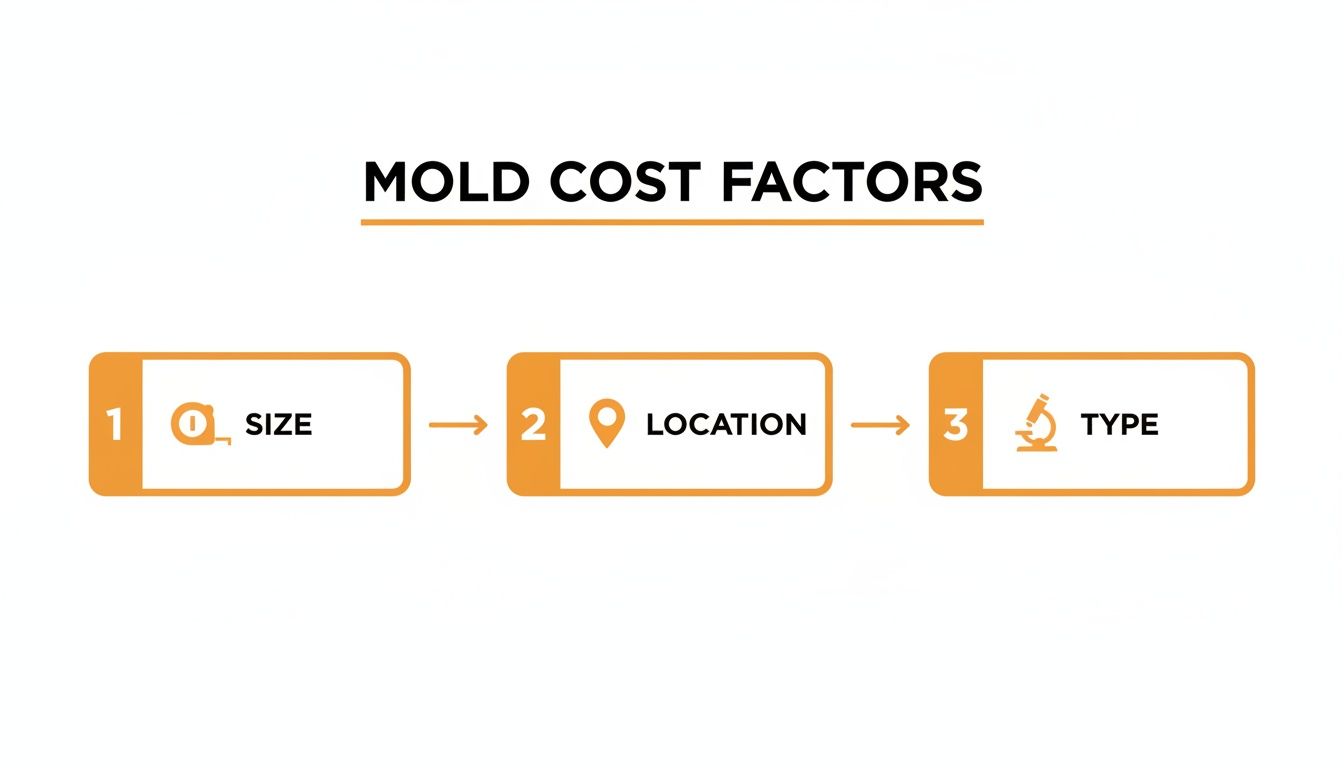
As you can see, the size of the growth, where it's located, and the specific type of mold are the three core variables that shape our entire game plan and the final cost.
To give you a clearer picture, here’s a line-item breakdown of the services included in a typical professional mold remediation quote and the factors that influence their cost.
Professional Mold Remediation Process and Cost Components
| Remediation Phase | Description of Service | Associated Cost Factors |
|---|---|---|
| Inspection & Testing | A certified pro conducts a visual assessment, moisture mapping, and may take air/surface samples for lab analysis to identify mold type and concentration. | Size of the home, number of samples needed, accessibility of affected areas. |
| Containment Setup | The affected area is sealed off with plastic sheeting and negative air pressure machines (air scrubbers) are used to prevent cross-contamination. | The size of the containment zone and the number of air scrubbers required. |
| Demolition & Removal | Porous, non-salvageable materials like drywall, insulation, and carpet are carefully removed, bagged, and disposed of per regulations. | The amount and type of materials that need to be removed (e.g., plaster vs. drywall). |
| Cleaning & Sanitization | Remaining structural materials (wood studs, concrete) are cleaned via HEPA vacuuming, sanding, or wire brushing, followed by an antimicrobial treatment. | The surface area requiring cleaning and the specific techniques needed for the materials involved. |
| Repairs & Reconstruction | After clearance, any materials that were removed are replaced to restore the area to its original condition. | The cost of new materials (drywall, paint, flooring) and the labor for reconstruction. |
| Final Clearance Testing | An independent third-party professional performs post-remediation testing to verify the area is clean and air quality is normal. | The cost is set by the independent testing company; it’s a fixed fee for their verification service. |
This table illustrates how each phase contributes to the total project cost, ensuring a comprehensive and lasting solution.
Removal Demolition And Sanitization
With containment secured, the physical removal begins. Any porous materials that cannot be salvaged—such as drywall, insulation, and contaminated carpet—are meticulously removed, double-bagged, and disposed of according to strict environmental regulations.
Next, we address the remaining structural elements like wood framing, concrete, or subflooring. These surfaces are cleaned down to the microscopic level using a combination of techniques like wire brushing, sanding, and HEPA vacuuming to remove all traces of visible mold and hidden spores. Once clean, we apply an EPA-registered antimicrobial agent to sanitize the area and inhibit future growth. If mold has infiltrated your HVAC system, understanding the role of professional air duct cleaning for mold is essential for a complete cleanup.
Final Clearance Testing
How can you be certain the job was done right? You don't just have to take our word for it. The final, and arguably most important, step is post-remediation verification, also known as clearance testing. For this, we engage an independent, third-party Indoor Environmental Professional (IEP) to collect new air and surface samples from the remediated area.
This independent verification is your ultimate seal of approval. It provides unbiased, scientific proof that the mold is gone and the air quality in your home has been brought back to a safe, normal level.
A project is not complete until we receive a passing clearance report from that independent expert. This commitment to third-party validation is a cornerstone of our process and provides the genuine peace of mind every homeowner deserves. To see more about our strict standards, you can explore Sparkle Restoration's approach to https://sparklerestoration.com/mold-remediation/.
The Hidden Costs of DIY Mold Removal
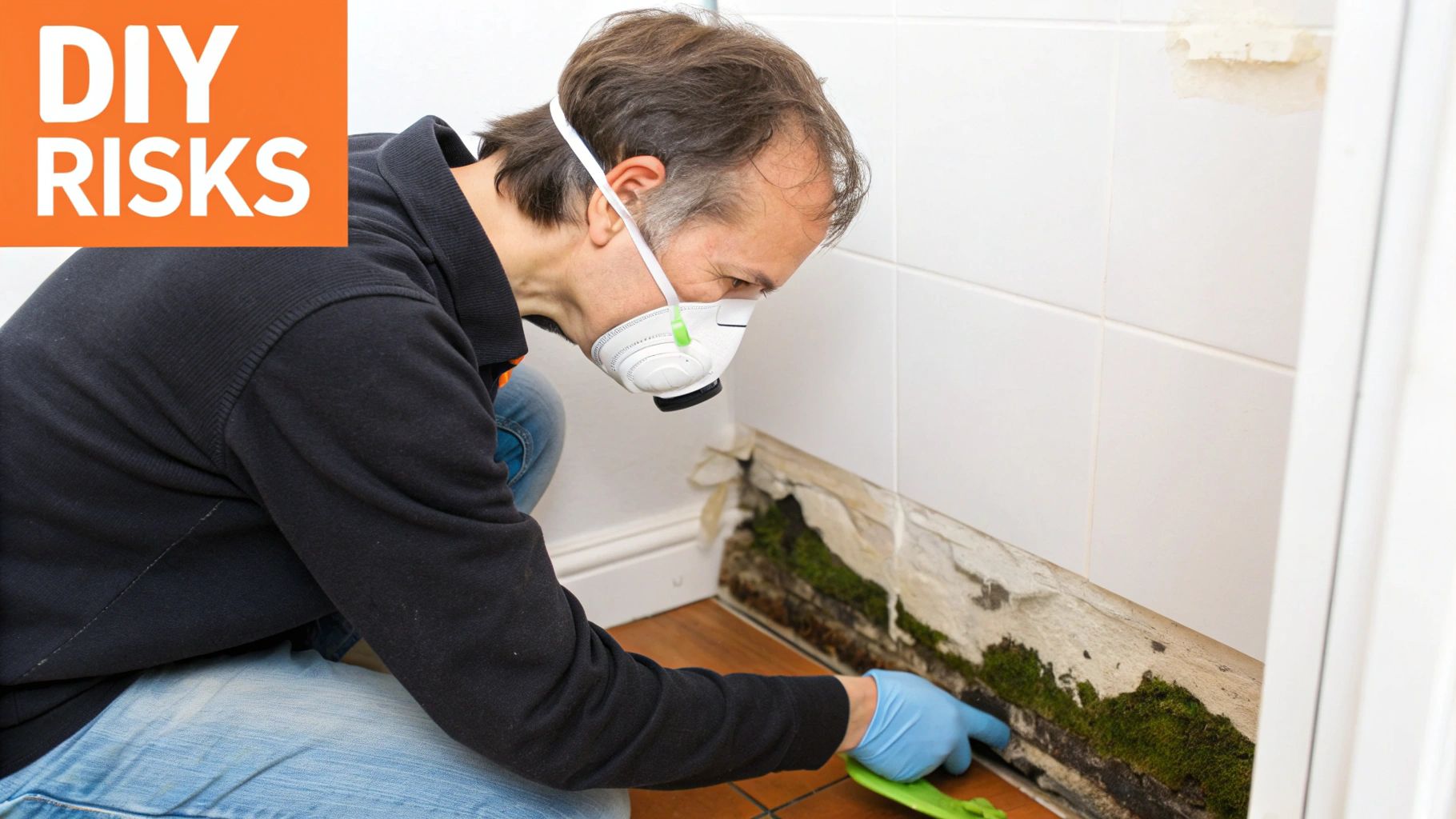
It’s natural to want to save on the cost of mold removal in your home. Spotting a small patch of mold might tempt you to grab a sponge and bleach, thinking you can resolve it yourself in an afternoon.
Unfortunately, what begins as a simple DIY fix often spirals into a much larger, more expensive crisis. Without professional containment and air filtration, scrubbing a mold colony can launch millions of microscopic spores into the air, turning a localized issue into a house-wide contamination. It's the most common and costly mistake we see homeowners make.
Professional remediation isn't just another bill—it's an investment in your home's structure and your family's health. The few hundred dollars you might save upfront on a DIY attempt pale in comparison to the long-term costs of a job done incorrectly.
The Dangers of Cross-Contamination
Think of mold spores like glitter; once disturbed, they get everywhere. When you attempt to remove mold without proper training and equipment, you are not eliminating the problem—you are relocating it throughout your home.
Scrubbing a mold colony without establishing negative air pressure and containment barriers can turn your HVAC system into a spore-delivery service. Suddenly, a $1,500 problem isolated to a single wall cavity can explode into a $15,000 systemic issue affecting multiple rooms and your indoor air quality.
Expert Warning: The EPA is clear on this: any mold problem larger than 10 square feet should be left to the professionals. Tackling anything bigger on your own is a gamble with your home and your health.
Health Risks and Ineffective Methods
Beyond spreading the mold, improper removal poses a direct health risk. There is a reason professionals arrive in full-face respirators, gloves, and disposable suits. Inhaling high concentrations of mold spores can trigger severe allergic reactions, asthma attacks, and other serious respiratory problems.
Furthermore, common DIY methods are largely ineffective.
- Bleach: While bleach may kill surface mold on non-porous tile, it cannot penetrate porous materials like drywall or wood. It merely bleaches the color, making you think the problem is gone while the root structure remains, ready to regrow.
- Painting Over Mold: This is perhaps the worst mistake. You are essentially trapping moisture and providing the mold with a new food source (the paint and drywall paper), leading to accelerated decay from the inside out.
Long-Term Structural Damage
The greatest hidden cost of a failed DIY attempt is the silent, ongoing destruction of your property. If the mold and its moisture source are not completely eliminated, the colony will continue to consume organic materials like wooden studs, subflooring, and insulation.
This decay compromises your home's structural integrity, leading to issues like sagging floors and weakened walls. These are complex repairs that can cost tens of thousands of dollars, often discovered years after the initial "savings" from a DIY project have been forgotten.
When you weigh the risks, it becomes clear that hiring a certified expert is not just the safer choice—it's the most cost-effective one in the long run.
Why a Certified Expert Is Your Best Investment
When weighing the cost of mold removal in your home, it's easy to focus on comparing initial quotes. But what truly distinguishes a certified professional from a general handyman is not the price tag; it's the verifiable expertise, strict safety protocols, and the lasting peace of mind that comes with proven credentials.
Choosing a certified professional is the smartest financial decision you can make for your property. It is an investment in getting the job done right the first time, preventing far greater and more expensive problems down the road.
The Power of IICRC Master Certification
The Institute of Inspection, Cleaning and Restoration Certification (IICRC) is the gold standard in our industry. It is the non-profit organization that sets the globally recognized standards for safe and effective remediation techniques. When a technician is IICRC-certified, it signifies they have undergone rigorous training and passed comprehensive exams to prove their expertise.
An IICRC Master Certified firm like Sparkle Restoration represents the pinnacle of this expertise. This designation is not a single certificate; it is earned by achieving the highest-level certifications across multiple restoration disciplines. This depth of knowledge ensures every step of the process—from containment setup to final air quality testing—is executed flawlessly to protect your family and your home.
The Advantage of a Licensed General Contractor
Many homeowners don't realize that mold remediation often extends beyond cleaning. When contaminated drywall, insulation, or flooring must be removed, you need a team that can not only perform safe demolition but also expertly rebuild the area. This is where being a Licensed General Contractor is a game-changer.
Here’s what this dual qualification means for you:
- Seamless Reconstruction: A company that handles both remediation and construction can manage the entire project from start to finish. There is no need to juggle multiple contractors for demolition and rebuilding.
- Code Compliance: You can have confidence that all repairs will meet or exceed local Orange County building codes, which is critical for the safety and integrity of your home.
- Quality Craftsmanship: With a single point of contact and accountability, the result is a high-quality, seamless restoration that makes it look like the damage never happened.
At Sparkle Restoration, our dual licensing as an IICRC Master Certified firm and a Licensed General Contractor means we provide a true start-to-finish solution. We step in and turn a chaotic, stressful situation into a calm, managed process, handling every detail from the first inspection to the final coat of paint.
This integrated approach saves you significant time, minimizes stress, and delivers a superior result.
A Commitment to Ethics and Trust
Technical skill is essential, but integrity is paramount. How can you be sure a company truly has your best interests at heart? Awards and community recognition offer valuable insight. As a winner of the BBB Torch Award for Ethics, Sparkle Restoration has been formally recognized for our unwavering commitment to transparency and ethical business practices.
That award symbolizes our promise to you: honest assessments, fair pricing, and an exceptional service experience. The demand for true professionals is growing, as the global mold remediation market is projected to expand to over $1.6 billion by 2032. This shows that discerning homeowners increasingly view expert remediation as a necessity for protecting their health and property value.
Professionals don't just eliminate mold; they play a crucial role in improving indoor air quality for a healthier living environment. Ultimately, investing in a certified, licensed, and ethically-driven expert isn't just about removing mold—it’s about restoring your home and your peace of mind.
Answering Your Top Questions About Mold Removal Costs
When you're facing a potential mold problem, questions about cost are often top of mind. To provide clarity, here are direct, expert answers to the most common questions we receive from homeowners in Orange County.
How Can I Get an Accurate Quote for Mold Removal?
The only way to get a reliable, accurate quote is through a professional, on-site inspection. Online estimators are speculative; they cannot see the hidden moisture behind drywall or the contamination that may have spread into your HVAC system.
An IICRC-certified technician will use tools like moisture meters and thermal imaging cameras to map the full extent of the problem—both visible and invisible. This allows a reputable company like Sparkle Restoration to provide a detailed, itemized quote that reflects the actual work required, eliminating surprises.
Does Homeowners Insurance Cover Mold Removal Costs?
The answer is almost always: "It depends on the source of the moisture." Generally, your policy may cover mold damage if it resulted from a "covered peril" that was sudden and accidental, such as a burst pipe.
However, most standard policies will deny claims for mold that grew due to:
- Slow, gradual leaks or deferred maintenance.
- High humidity from poor ventilation.
- Flooding from storms (which requires a separate flood insurance policy).
Your best course of action is to review your policy documents and contact your agent to understand your specific coverage. We always advise clients to thoroughly document the damage with photos and immediately call a professional restoration company to mitigate further damage.
A professional restoration company is your best ally in an insurance claim. We provide the detailed documentation and precise scope of work that insurance carriers require to process a claim without unnecessary delays.
How Long Does Professional Mold Remediation Take?
The timeline depends entirely on the size and complexity of the job. A small, contained issue in a bathroom could be resolved in 1 to 3 days.
However, a larger project—such as mold that has spread through multiple rooms, is hidden within walls, or has contaminated air ducts—is a more involved process. These jobs can easily take 5 to 7 days or longer. This timeframe allows for proper containment, careful demolition, deep cleaning, thorough drying, and final clearance testing.
Can I Stay in My Home During the Mold Removal Process?
For your safety and comfort, we strongly recommend that you, your family, and your pets find alternative accommodations during active remediation. The affected area will be sealed off, and we run loud, powerful air filtration equipment 24/7, which is highly disruptive.
More importantly, the removal process can release a high concentration of spores into the contained air. While our team uses strict containment barriers and negative air pressure to prevent their escape, being off-site is the safest precaution. This also allows our crew to work efficiently to restore your home as quickly as possible.
What Is the Difference Between Mold Removal and Mold Remediation?
While the terms are often used interchangeably, "remediation" is the industry standard and describes a far more comprehensive, scientific process.
- Mold Removal: This often implies simply scraping or wiping away visible mold. It’s like pulling the top off a weed—it fails to address the root cause (the moisture source) and the invisible spores left behind.
- Mold Remediation: This is a holistic, IICRC-standard process. It involves identifying and fixing the water source, containing the area, filtering the air, safely removing contaminated materials, cleaning and treating remaining surfaces, and verifying success with independent testing.
Remediation is not a quick fix; it is a complete solution designed to restore a healthy indoor environment and prevent recurrence.
Is Post-Remediation Verification Testing Really Necessary?
Absolutely, yes. Post-remediation verification (PRV), or clearance testing, is your ultimate proof that the job was completed successfully and your home is safe. This testing is never performed by the remediation company itself; it is always conducted by an independent, third-party Indoor Environmental Professional (IEP).
This unbiased expert collects new air and surface samples after our work is done. Their lab report provides the scientific evidence that mold levels have returned to a normal, healthy state. For any reputable company, this step is non-negotiable. It is your seal of approval and the only way to achieve complete peace of mind.
Dealing with mold is stressful, but you don’t have to go it alone. The IICRC Master Certified team at Sparkle Restoration Services is here to turn chaos into calm with unmatched expertise and a commitment to ethical, transparent service. If you suspect mold in your Orange County home, contact us today for a professional assessment and restore your peace of mind.
Schedule Your Free Consultation with Sparkle Restoration Services
Ready to create a space that’s as beautiful as it is functional? Schedule your complimentary design consultation today by visiting Ready to Work with Sparkle?