



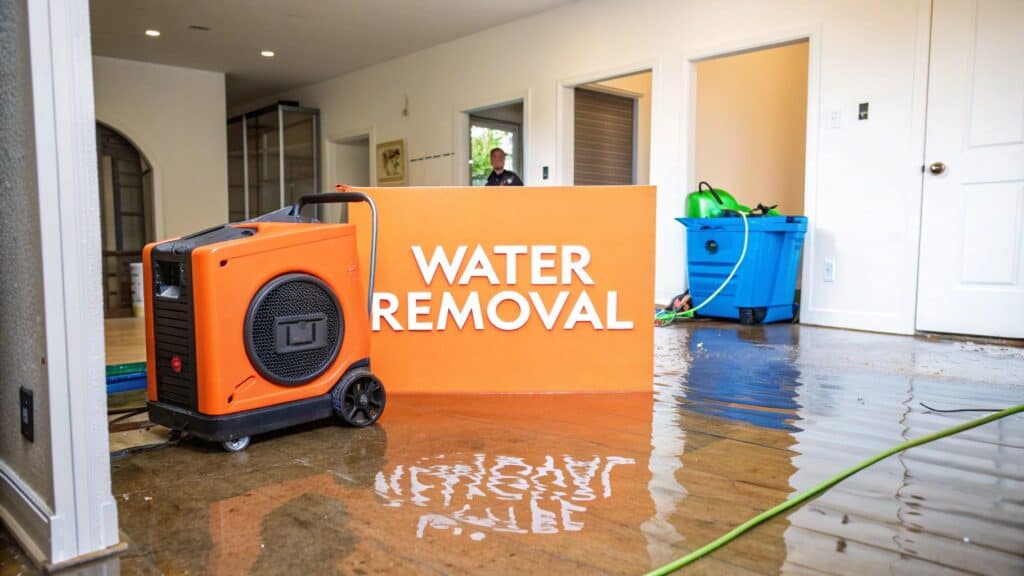
When your Orange County home is impacted by water damage, the sense of overwhelm is immediate. In that critical first moment, the single most important tool in a professional's arsenal is a high-capacity dehumidifier for flood damage. This isn't your standard household unit; this is professional-grade equipment, and it's the first line of defense against long-term structural issues and hazardous mold growth. As an IICRC Master Certified firm, we want to empower homeowners with the knowledge to navigate this stressful time with confidence.
The First Step in Flood Recovery
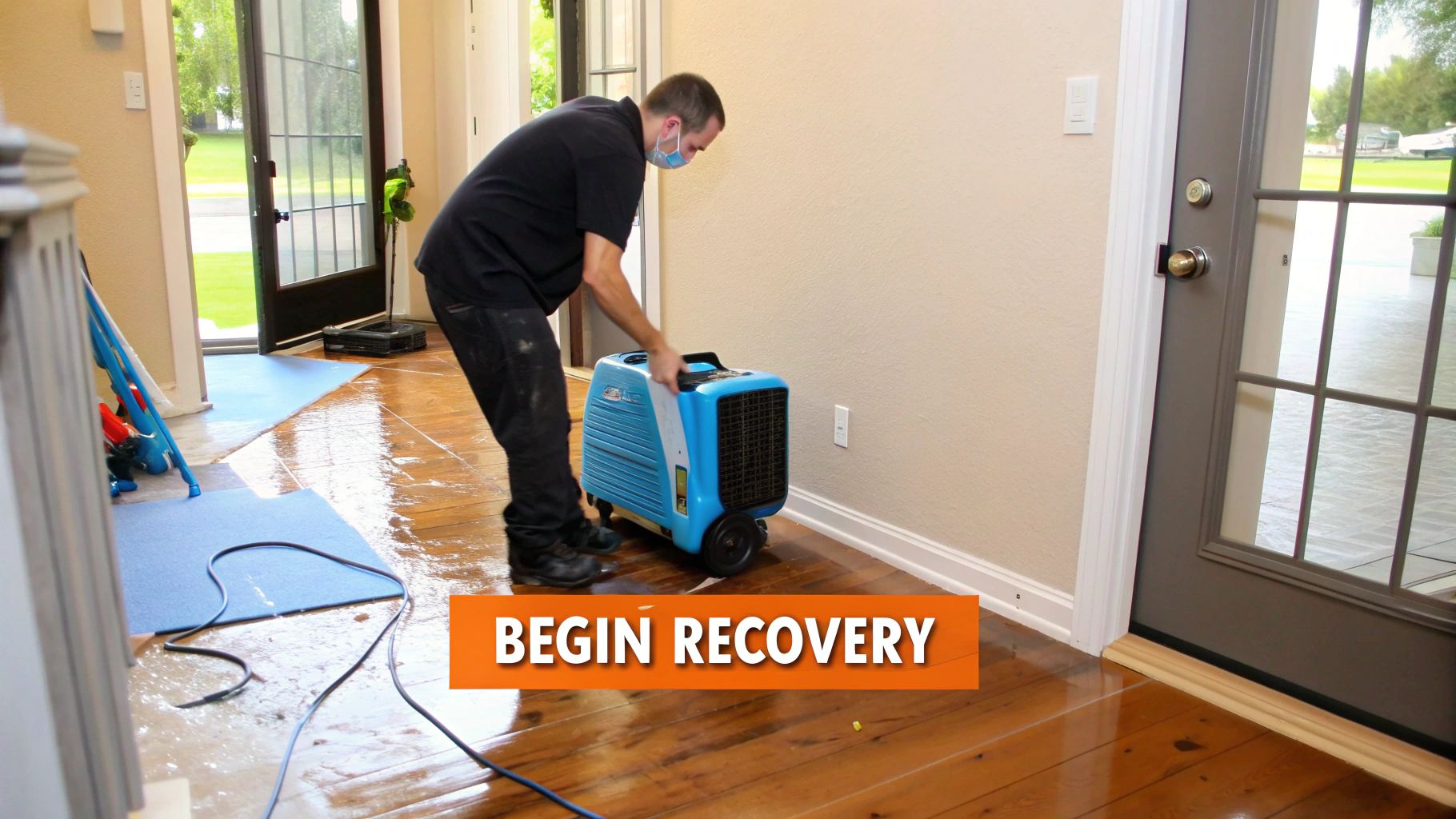
After a flood, the standing water you see is just the tip of the iceberg. Porous materials like drywall, wood framing, insulation, and subflooring act like giant sponges, soaking up and trapping an incredible amount of moisture. If that hidden water is left unaddressed, it's a direct path to structural rot and hazardous mold, which can begin to colonize in as little as 24-48 hours.
This is why drying your property fast isn't just a suggestion—it's an absolute necessity. At Sparkle Restoration Services, we're not just drying a wet floor; we're initiating a scientific process to pull moisture from deep within your home’s structure before the damage becomes permanent.
Understanding the Urgency
Flooding is a serious threat, responsible for up to 35–40% of all weather-related disasters worldwide. In the aftermath, the speed of your response directly correlates to the amount of damage you can prevent. An industrial dehumidifier can extract over 70 pints of water per day from the air, a critical capability when you consider that 70% of untreated flood sites develop mold.
By deploying these powerful machines immediately, IICRC-certified professionals like Sparkle Restoration can reduce secondary damage by 50-70%. The goal isn't just to make the room feel dry. It's to bring the building materials back to their normal, stable moisture levels, ensuring the very bones of your home are sound.
Expert Insight: "A common mistake we see in Newport Beach and Irvine is homeowners waiting too long or attempting to manage with a standard household dehumidifier. After a flood, you are racing against the clock. Professional dehumidification is the only way to win that race and protect your property’s value."
Why Rapid Dehumidification Is Your First Line of Defense
When we bring in commercial-grade LGR (low-grain refrigerant) dehumidifiers, we're doing more than just drying the air. We're launching a strategic attack on moisture that protects your Orange County home from multiple angles.
| Benefit | Impact on Your Property | Sparkle's Professional Approach |
|---|---|---|
| Prevents Mold Growth | Halts mold spores from taking root by rapidly lowering indoor humidity to below 50%, the threshold needed for growth. | We strategically place units to create optimal airflow, ensuring no corner is left damp and vulnerable to a mold outbreak. |
| Protects Structural Integrity | Stops wood from warping, drywall from crumbling, and adhesives from failing. It saves the core components of your home. | Our team uses moisture meters to scientifically verify that materials are dried to their proper equilibrium moisture content. |
| Reduces Secondary Damage | By controlling humidity, we prevent moisture from wicking into previously unaffected areas, saving you from more extensive repairs. | We combine dehumidifiers with high-velocity air movers to accelerate evaporation and shorten the overall drying time significantly. |
| Improves Air Quality | Removes musty odors and airborne contaminants associated with damp environments, making the space safe to occupy sooner. | Our equipment is coupled with air scrubbers and HEPA filters when necessary to capture particulates and purify the air as it dries. |
Ultimately, a swift and professional drying strategy is the key to minimizing the long-term financial and structural impact of a flood.
Why Professional Equipment Is Non-Negotiable
A small, store-bought unit simply can't handle the sheer volume of water present after a flood. It would be like trying to empty a swimming pool with a teaspoon. Professional restoration firms use commercial-grade equipment designed for maximum water extraction in saturated environments.
These machines are the cornerstone of a successful recovery because they:
- Pull Moisture from Materials: Unlike fans that just blow wet air around, dehumidifiers actively remove water vapor from the atmosphere. This creates a drier environment that literally pulls moisture out of soaked drywall, wood, and concrete.
- Stop Mold in Its Tracks: By aggressively lowering indoor humidity, they create an environment where mold simply cannot thrive. This stops a potential health crisis before it can even begin.
- Preserve Your Home's Structure: Quick, thorough drying is what prevents wood from twisting and warping, keeps drywall from turning to mush, and stops flooring adhesives from failing.
Navigating the chaos of a flood is stressful. For more tips on what to do right away, check out our guide on creating a water emergency first aid kit. At Sparkle Restoration, our BBB Torch Award-winning team combines this powerful technology with decades of hands-on expertise, turning a stressful disaster into a controlled, effective recovery from the very first step.
Choosing the Right Dehumidifier for Flood Damage
When you’re staring at a flooded room, the first instinct is to get something—anything—drying the space immediately. It’s a completely understandable reaction. But reaching for the wrong piece of equipment is one of the most critical mistakes a homeowner can make, turning a manageable situation into a long-term disaster.
The gap between a standard dehumidifier you'd buy at a big-box store and the professional equipment used by restoration experts is massive. It’s the difference between truly drying your home and just making the air feel dry while moisture continues to destroy your property from the inside out.
The Professional’s Choice: LGR Dehumidifiers
At Sparkle Restoration Services, like any IICRC-certified professional, we rely exclusively on Low-Grain Refrigerant (LGR) dehumidifiers. These aren’t just slightly better; they are engineered for a completely different purpose. They are the undisputed workhorses of the water damage industry for a very good reason.
Conventional dehumidifiers struggle as the air gets drier, but LGRs use a dual-cooling system that pre-chills the air before it hits the evaporator coils. This lets them wring out incredible amounts of water vapor, even when humidity levels are already low.
Here’s what that means for your home:
- Massive Water Removal: A single industrial LGR dehumidifier can pull 140 pints or more of water out of the air in just 24 hours. That high pints-per-day (PPD) rating is non-negotiable when you’re dealing with the sheer volume of moisture a flood leaves behind.
- Deep Drying Capability: LGR units create an incredibly dry environment. This triggers a scientific principle called vapor pressure differential, which literally pulls trapped moisture out of porous materials like wood studs, subfloors, and drywall. It's like a magnetic force for water.
- Unrelenting Performance: Your typical home unit becomes less and less effective as a room dries out. LGRs, on the other hand, keep working efficiently until your home’s structure is brought back to a safe, documented dry standard.
Why Capacity and Power Actually Matter
Let’s go back to that flooded room. A small, store-bought unit would run 24/7 but would never get ahead of the evaporation. The air might feel a bit better, but the moisture deep in your walls and floors isn’t going anywhere. It’s a recipe for warped hardwood, delaminated cabinets, and a serious mold problem down the line.
Now, imagine a strategically placed LGR unit. It would aggressively drop the ambient moisture, creating the right conditions to save those materials. We're not just drying a room; we're preserving the core components of your home.
The science behind this is directly tied to the categories of water damage and how they dictate the restoration strategy. To get a better handle on this, you can learn more by reading our guide on the essentials of water damage restoration.
As a BBB Torch Award Winner for Ethics, we believe an informed client is a confident one. When you understand the technology we use, you have peace of mind knowing your home is in the hands of certified experts using the best equipment for the job.
Comparing Dehumidifier Types
The difference between a consumer-grade unit and a professional one is night and day. Choosing correctly is fundamental to protecting your property and your investment.
| Feature | Standard Residential Dehumidifier | Professional LGR Dehumidifier |
|---|---|---|
| Water Removal (PPD) | 30–50 Pints | 140+ Pints |
| Operating Range | Less effective below 60% humidity | Highly effective even at low humidity |
| Construction | Plastic housing, light-duty components | Rugged, durable steel or rotomolded plastic |
| Airflow (CFM) | Low (approx. 150 CFM) | High (300+ CFM) for large areas |
| Intended Use | Damp basements, minor humidity issues | Large-scale flood and water damage |
Think of it this way: a standard dehumidifier is a maintenance tool for a slightly damp basement. A professional LGR unit is an emergency response machine designed for intense, rapid structural drying. When you’re facing flood damage, there’s simply no substitute for the power and efficiency trusted by certified restoration specialists.
Strategic Setup for Maximum Drying Power
Simply plugging in a powerful LGR dehumidifier and hoping for the best won't cut it. To restore your home efficiently after a flood, you need to think like a professional. Restoration experts don’t just scatter equipment around; they create a controlled drying environment designed for maximum moisture extraction.
Your first move is to create a sealed drying chamber. This means closing off the flooded area from the rest of your property. Shut every door and window. Use heavy plastic sheeting to block off any large openings, like a caved-in ceiling or a broken doorway. This simple step contains the humid air, letting the dehumidifier focus its power on a manageable space instead of fighting the air in your entire house.
With the chamber sealed, where you place the dehumidifier for flood damage is critical. The ideal spot is right in the center of the largest affected room. This central position ensures the most even distribution of dry air and allows the machine to effectively pull in moist air from all directions.
The Power of Air Movers and Dehumidifiers
Even the best professional dehumidifier can't do the job alone. Its most important partner in the drying process is a team of high-velocity air movers (you might know them as carpet fans). While the dehumidifier is busy pulling moisture out of the air, the air movers are aimed directly at saturated surfaces—walls, floors, and other materials.
This direct airflow is absolutely essential because it kickstarts evaporation. Air movers blast across wet materials, lifting trapped moisture from deep inside and forcing it into the air as water vapor. Without them, drying would take forever; a dehumidifier can only remove moisture that's already airborne.
This tag-team approach creates a powerful, continuous drying cycle:
- Air movers pull stubborn moisture out of wet materials and suspend it in the air.
- The dehumidifier grabs that newly airborne moisture and removes it.
- The dehumidifier then pushes out warm, dry air, which the air movers circulate to pick up even more moisture.
This loop is the absolute cornerstone of professional water damage mitigation. It’s what separates a fast, thorough drying job from one that leaves behind hidden dampness just waiting to turn into a mold problem. We’ve seen firsthand how this precise equipment combination is key to saving structures, like on an extensive water damage mitigation project in Irvine, CA.
This flowchart breaks down the simplified process of going from a flood to a full recovery when you're using the right professional equipment.
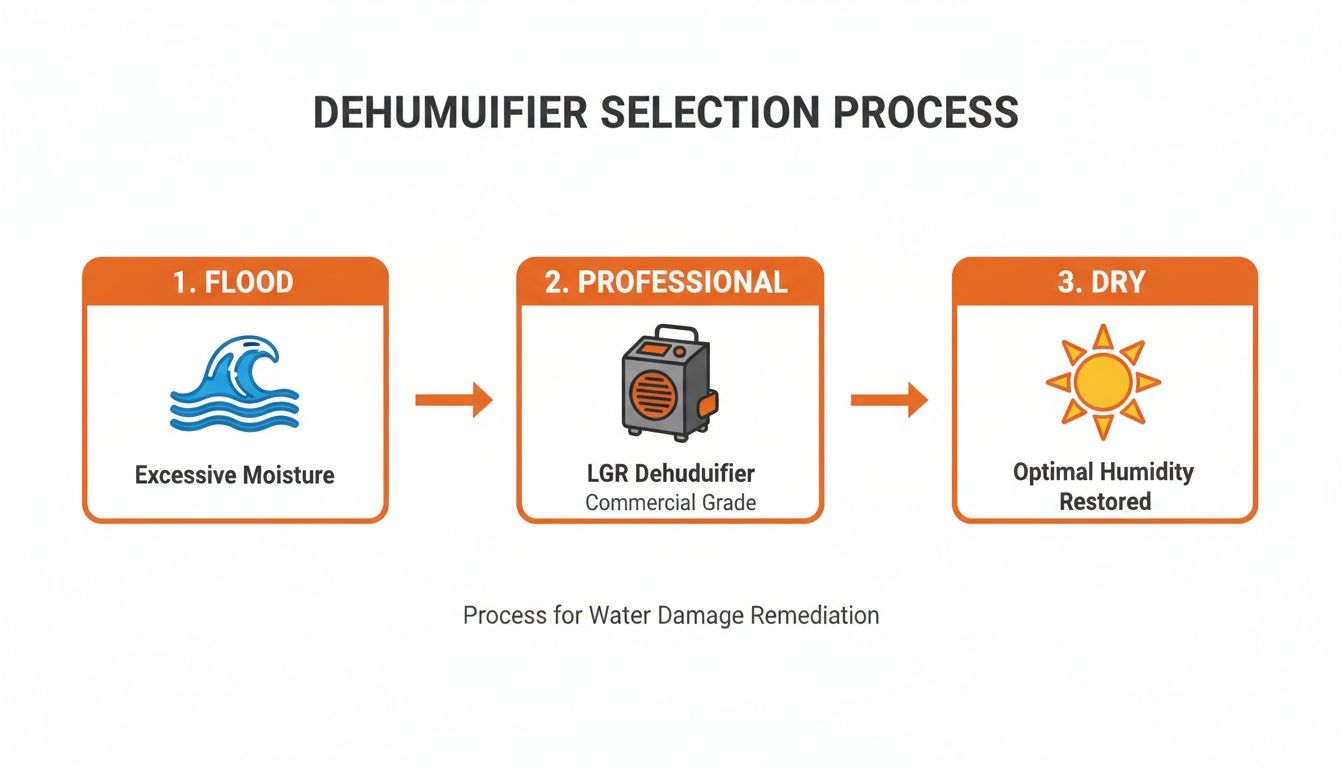
As you can see, the critical step between disaster and a dry, restored home is the proper use of professional-grade LGR dehumidifiers.
Local Expertise for Orange County Conditions
This process is especially vital for homeowners in Orange County. For high-end properties in coastal communities that are constantly facing threats from intense seasonal rains, Sparkle's mastery in water damage mitigation—built over 20 years of local service—delivers results you can count on. Our advanced dehumidification protocols can slash drying times by as much as 60%, which is critical when 80% of structural compromise happens because of delayed responses.
Sparkle's Pro Tip: "We often create a 'drying vortex' by arranging air movers in a circular pattern around the room's perimeter. This creates a powerful cyclonic airflow that constantly feeds moist air toward the centrally located dehumidifier, dramatically accelerating the drying timeline."
By understanding this strategic setup, you can appreciate the science behind professional restoration. It's not just about placing machines; it's about expertly manipulating temperature, humidity, and airflow to rescue your home from flood damage—quickly and completely.
How Professionals Really Know When It’s Dry
Restoring a flooded home is a science, plain and simple. Anyone can place a fan and call it a day, but that's just asking for trouble. A room might feel dry, but moisture loves to hide deep inside walls, under floors, and in insulation. That hidden dampness is a perfect invitation for mold.
This is why a truly professional firm—like an IICRC Master Certified team—never guesses. We rely on a strict, data-driven process to prove your home is completely and safely dry. Running a dehumidifier for flood damage until things just "seem" okay is a huge mistake. We measure, document, and verify every single step, giving you real peace of mind and the solid proof your insurance company needs.
It All Starts With a "Dry Standard"
So, how do we know when a wet wall is officially dry? First, we need to know what it was like before the flood. This is where we establish what the industry calls a dry standard—it's our scientific baseline, our drying goal.
To get this number, our technicians find a part of your home that the water never touched, like a bedroom closet upstairs. We then use specialized meters to take moisture readings from materials that are identical to the ones that got wet (think drywall, wood studs, subflooring). This gives us a precise, undisputed target to hit. No more guesswork.
The Right Tools for the Job
You can't get this kind of data with your bare hands. Our crews show up with a whole suite of professional gear to paint a complete picture of what's happening inside your walls and floors.
-
Hygrometers: These tools measure the temperature and relative humidity (RH) in the air. We're constantly working to keep the air's RH between 30-50%. This is the sweet spot that pulls moisture out of wet materials as fast as possible without making the air so dry it could damage finishes like hardwood floors.
-
Non-Invasive Moisture Meters: These are our go-to for finding hidden moisture. We can just press the meter against a surface—drywall, wood floors, you name it—and get an instant reading of the moisture underneath without leaving a single mark.
-
Penetrating Moisture Meters: For the really thick stuff like structural beams or subflooring, we use meters with a couple of small pins that go just below the surface. This is the only way to get a truly accurate reading of the core moisture and confirm the material is dry all the way through.
"A surface that 'feels dry' can still be holding more than enough moisture to grow a serious mold colony. Data doesn't lie. Meticulous monitoring with professional-grade meters is the only way to ensure a home is truly restored and safe for your family."
Documenting Every Step of the Way
From day one, we're taking daily readings from dozens of spots in the flooded area and charting them against that original dry standard. This logbook becomes a detailed record of the drying progress, showing a clear, steady drop in moisture levels over time.
This documentation is non-negotiable for two big reasons:
- It guides our work. If a certain wall cavity is drying slower than the rest, the data tells us exactly where to reposition air movers or maybe add another dehumidifier to hit that stubborn spot.
- It’s irrefutable proof for your insurance carrier. We can show them exactly what we did, why we did it, and that the job was finished correctly, justifying every part of the work performed.
Drying Milestones and Humidity Targets
The path from a waterlogged structure to a stable, dry home follows a predictable pattern. We monitor key metrics at each stage to ensure everything is on track. This quick reference table breaks down what we're looking for.
This table provides a snapshot of the key metrics and actions professionals monitor throughout the water damage restoration process.
| Drying Phase | Target Relative Humidity | Key Monitoring Actions | Professional Tip |
|---|---|---|---|
| Initial Phase (Day 1-2) | 40-50% | Daily moisture readings of all affected materials; confirm negative airflow if needed. | The goal is rapid moisture removal to halt damage and prevent mold amplification. |
| Mid-Drying Phase (Day 2-4) | 30-40% | Focus on "stubborn" areas like wall cavities and subfloors; adjust equipment as needed. | Vapor pressure is high; this is when deep, trapped moisture begins to release. |
| Final Phase (Day 4+) | 30-40% | Confirm all materials have reached their established "dry standard" for 24 hours. | We don't remove equipment until readings are stable, proving the structure is in equilibrium. |
Hitting these targets with precision is how we ensure a successful restoration.
This scientific, transparent approach is central to turning a chaotic situation into a calm, controlled process. When we finally tell you your home is dry, you can be absolutely sure we have the data to back it up.
Common Mistakes to Avoid After a Flood
After a flood, the instinct is to jump into action immediately. That urgency is understandable, but it can unfortunately lead to critical mistakes. We've seen it happen time and again: well-intentioned but misguided efforts that end up causing more harm than good, turning a bad situation into a long-term nightmare of rot, mold, and expensive repairs.
The single biggest mistake we see homeowners in Orange County make is underestimating the sheer volume of water. They'll grab a small, residential dehumidifier from a big-box store and assume it can handle the job. This is like trying to put out a forest fire with a garden hose. The equipment simply isn't built for the level of saturation your home has absorbed.
Another common pitfall is quitting the drying process too early. A carpet might feel dry to the touch, but what about the subfloor underneath it? Or the drywall behind the baseboards? Shutting down the equipment before the structure is fully dry is practically rolling out the welcome mat for mold in those hidden, damp spaces.
Relying on Your Senses Instead of Science
Your eyes and hands will lie to you after a flood. A surface can feel bone-dry but still hold enough moisture to fuel mold growth and cause materials to warp and rot from the inside out.
Professionals never guess. We rely on calibrated moisture meters to get precise readings deep inside building materials like wood studs and subflooring. As a rule of thumb, anything above 16% moisture content in wood is a problem waiting to happen. Trusting your senses is a gamble you can't afford to take with your home's structural integrity.
Ignoring the Type of Water
Not all floodwater is created equal. Failing to understand what kind of water you're dealing with isn't just a cleanup issue—it's a massive safety risk. Water damage is classified into three categories:
- Category 1 (Clean Water): This comes from a source like a broken supply line. It's the least hazardous but can quickly become contaminated if it's left to sit.
- Category 2 (Gray Water): This water is already contaminated, maybe from an overflowing dishwasher or washing machine. It contains chemicals and microbes that can make you sick.
- Category 3 (Black Water): This is the worst-case scenario. It's grossly unsanitary water from sources like sewage backups or overland flooding, and it's teeming with dangerous pathogens.
Trying to DIY a cleanup involving Category 2 or 3 water without proper training and personal protective equipment (PPE) can expose your family to serious health hazards.
Expert Insight: "As a company with both IICRC Master Certification and a General Contractor's license, we see the entire picture. The initial drying phase sets the stage for everything that follows. A mistake here doesn't just lead to mold; it can compromise the structural repairs and luxury finishes we are hired to build."
When to Call a Professional Immediately
A small, contained leak from a clean water source might be something a handy homeowner can tackle. But certain situations are completely non-negotiable and demand immediate professional help. These scenarios involve risks and complexities far beyond the scope of DIY methods.
If you’re facing any of the following, your first call should be to a certified restoration firm like Sparkle to prevent catastrophic damage:
- Saturated Insulation: Once insulation gets wet, it loses its R-value and becomes a perfect breeding ground for mold inside your walls. It has to be professionally removed and replaced.
- Water Affecting Multiple Floors: If water has seeped from an upper floor down to a lower one, it has traveled through hidden structural cavities. It's impossible to dry these areas properly without specialized equipment and techniques.
- Potential Contamination: If you have even the slightest suspicion that the water is Category 2 or 3, don't take the risk. A professional team is needed for safe handling and decontamination.
- Signs of Mold or Mildew: That musty smell is the tell-tale sign that microbial growth has already started. While you can learn about techniques for how to get mildew out of carpet, the underlying moisture source must be eliminated by a pro to stop it from coming back.
When it comes to potential microbial growth, you need to separate fact from fiction. For a deeper dive, it’s worth reading up on some common facts and myths about mold and mold remediation to ensure you’re making the right calls for your home.
Avoiding these common mistakes and knowing when to bring in an expert will help you shift from panicked reaction to a clear, effective strategy. It’s an approach that not only protects your property but gives you the peace of mind of knowing the job will be done right, from start to finish.
Answers to Your Top Flood Restoration Questions
When your home is flooded, your mind is racing with questions. It's a stressful, chaotic time, and you need clear, straightforward answers you can trust. As a team that's been on the ground in Orange County helping homeowners recover for years, we've heard it all. We've put together answers to the most common questions we get about the drying process.
Our goal is to cut through the confusion and give you the practical, science-backed information you need to feel confident about the path forward.
How Long Does It Take to Dry Out a Flooded House?
This is always the first question, and understandably so. While there’s no magic number, a typical professional drying job takes somewhere between three to five days. But that's just a ballpark—the real timeline depends entirely on your specific situation.
Several factors can stretch out the process:
- The Scale of the Damage: A leak contained to one room is a much quicker fix than a flood that has soaked multiple floors.
- What Got Wet: Porous materials are like sponges. Things like drywall, carpet padding, and wood framing hold a tremendous amount of water and take much longer to dry than hard surfaces like tile or concrete.
- The Type of Water: If you're dealing with contaminated "black water" from a sewage backup, we have to perform a deep clean and disinfection before any drying equipment can even be turned on. That adds significant time.
- The Equipment: Using professional-grade LGR dehumidifiers and commercial air movers is the difference between a few days and a few weeks. The high-powered gear we use is designed to pull moisture out rapidly and efficiently.
We don't guess. We develop a unique drying strategy for every home and monitor it with moisture meters daily, so you'll always have an up-to-date picture of our progress.
Can I Just Open My Windows Instead of Using a Dehumidifier?
It feels like the logical thing to do, but opening the windows is one of the worst mistakes you can make during a water damage event, especially here in Southern California. Bringing in humid outside air can actually make things worse, slowing the drying process to a crawl or even re-introducing moisture.
For a dehumidifier to do its job, it needs a closed, controlled environment. Think of it this way: we're creating an indoor "desert" that's much drier than the wet materials in your home. This difference in what we call "vapor pressure" is what powerfully pulls moisture out of your walls and floors. Opening a window completely ruins that balance.
The only time we recommend opening windows is briefly during the initial cleanup phase, just to air out fumes from cleaning products. As soon as the drying equipment is running, everything needs to be sealed up tight.
What Should the Humidity Level Be in a House After a Flood?
During the active drying phase, we aim for a relative humidity (RH) level between 30% and 50%. This is the sweet spot. It creates the perfect conditions for fast evaporation without being so aggressive that it damages delicate materials. Over-drying can cause fine wood, like in custom cabinetry or hardwood floors, to warp or crack.
Once we’ve confirmed with our instruments that all the affected materials are back to their normal, pre-flood moisture content (what we call the "dry standard"), the equipment comes out. Your home’s humidity will then naturally stabilize in a comfortable, healthy range. For more in-depth answers, you can always check out our comprehensive FAQ page.
Is It Safe to Stay in My House While It Dries?
Your safety is always our number one concern. Whether you can stay in the home while we work really depends on the severity and nature of the flood.
- Noise and Disruption: Be prepared for some serious noise. We use multiple high-powered air movers and large dehumidifiers, and they run 24/7. It's not exactly a peaceful environment for living or working from home.
- Contamination Risks: If the flood involved what we call Category 2 (gray) or Category 3 (black) water, the affected area is a biohazard. It is absolutely not safe for you or your family to be in the home until it has been professionally decontaminated and sanitized.
- Electrical Hazards: Water and electricity are a deadly mix. The very first thing we do is assess the electrical system to make sure the site is safe before we even think about bringing in equipment.
In many situations where the home is uninhabitable, your homeowner's insurance policy will cover the cost of a hotel or temporary housing. We have a lot of experience with this and can help you get that conversation started with your insurance adjuster.
When disaster strikes your Orange County property, you need more than just equipment—you need a team with proven expertise and unwavering integrity. Sparkle Restoration Services combines IICRC Master Certification with the credentials of a Licensed General Contractor to manage every aspect of your recovery, from initial water extraction to the final remodel. We turn chaos into calm, fast.
If you’re facing flood damage, don’t wait. Contact us 24/7 for an immediate response and a free consultation by visiting https://www.sparklerestoration.com.
Ready to create a space that’s as beautiful as it is functional? Schedule your complimentary design consultation today by visiting Ready to Work with Sparkle?