


When you’re planning a remodel in Orange County, your first critical decision is choosing between the design-build vs. general contractor approach. This choice fundamentally shapes your entire project, from budget and timeline to the final quality of the work. With a design-build firm, you’re investing in a comprehensive, single-source solution—from the initial design sketch to the final coat of paint—all managed under one contract. This means one dedicated team, one point of contact, and one source of accountability. The traditional route, hiring a general contractor, places you in the coordinator’s seat, managing separate contracts with an architect and the builder.
Choosing Your Ideal Remodeling Partner
Selecting the right partner is the cornerstone of a successful, stress-free renovation. This decision sets the tone for communication, budget management, and ultimate accountability for bringing your vision to life. For discerning homeowners and property managers in Orange County, understanding the core differences between these two models is key to a smooth project that delivers on its promises. Before diving deep, gaining a broader perspective is always valuable; this comprehensive guide to planning your home renovation is a fantastic starting point.
The Rise of Integrated Project Delivery
For decades, the standard playbook was linear: hire an architect, finalize plans, and then solicit bids from various general contractors. However, the industry is evolving. Sophisticated homeowners and construction professionals increasingly recognize the superior efficiency and clear-cut accountability of the design-build model.
The data confirms this shift. The design-build market is projected to account for a staggering $1.9 trillion in construction spending between 2022 and 2026. Its market share has climbed to 46%, while the traditional design-bid-build method has declined to just 14%.
At Sparkle Restoration Services, our design-build process is built on a foundation of integrity, expertise, and a client-first philosophy. This commitment to excellence is championed by our leadership—you can meet our founder and learn about our values to understand our ethos.
Here’s a clear breakdown of how these two paths diverge:
| Aspect | Design-Build Model | General Contractor Model |
|---|---|---|
| Contract | A single, unified contract for both design and construction. | Multiple separate contracts (one for design, one for build). |
| Responsibility | One firm is fully accountable for the entire project, start to finish. | Accountability is split between the designer and the builder. |
| Communication | Streamlined and direct, with a single project manager as your dedicated contact. | The homeowner often acts as the intermediary between the designer and builder. |
| Timeline | Design and construction phases overlap, significantly shortening the project timeline. | A linear process; design must be 100% complete before construction bidding can begin. |
Comparing Project Workflows and Communication
When weighing design-build vs. general contractor, understanding the day-to-day workflow is critical. The process itself defines your experience, from the initial consultation to the final reveal, and it dictates the flow of communication.
The traditional path with a general contractor is a segmented, sequential process. You begin by engaging an architect or designer to create a complete set of plans. With these finalized plans, you then solicit bids from various contractors and select one to execute the work. This approach inherently creates a divide between the design and construction teams.
This separation often forces you into the role of project manager, relaying messages and mediating conflicts when a design element proves impractical during construction.
The Linear Path of a General Contractor
With the general contractor model, the workflow is strictly sequential, marked by distinct (and sometimes challenging) handoffs between phases.
- Design Phase: You collaborate with your architect or designer to create the plans. The builder is not involved in these crucial initial conversations.
- Bidding Phase: The completed plans are sent out for pricing. Multiple general contractors interpret the documents and provide a bid based on their understanding.
- Construction Phase: After selecting a contractor, they begin building what’s on paper. If they discover an issue or ambiguity in the design, work often halts. Resolving the problem requires going back to the original designer, leading to delays and potential disputes.
This structure can easily devolve into a “blame game.” The builder may point to a design flaw, while the architect blames a construction error, leaving you caught in the middle.
The Integrated Flow of Design-Build
The design-build model transforms this fragmented process into a collaborative and integrated partnership from day one. At Sparkle, our designers, estimators, and construction managers function as a unified team, working together from your very first meeting. This synergy creates a single, cohesive vision for your Orange County remodel.
In a design-build firm, there is one point of responsibility. The team that designs your project is the same team that builds it. This eliminates finger-pointing and ensures everyone is aligned toward a single goal: a beautiful, impeccably built renovation.
This single-source structure simplifies communication and dramatically boosts efficiency. As an IICRC Master Certified and licensed General Contractor, we have spent years refining our remodeling and construction services to perfect this seamless, collaborative flow.
The flowchart below illustrates the fundamental difference in how you partner with each type of company.
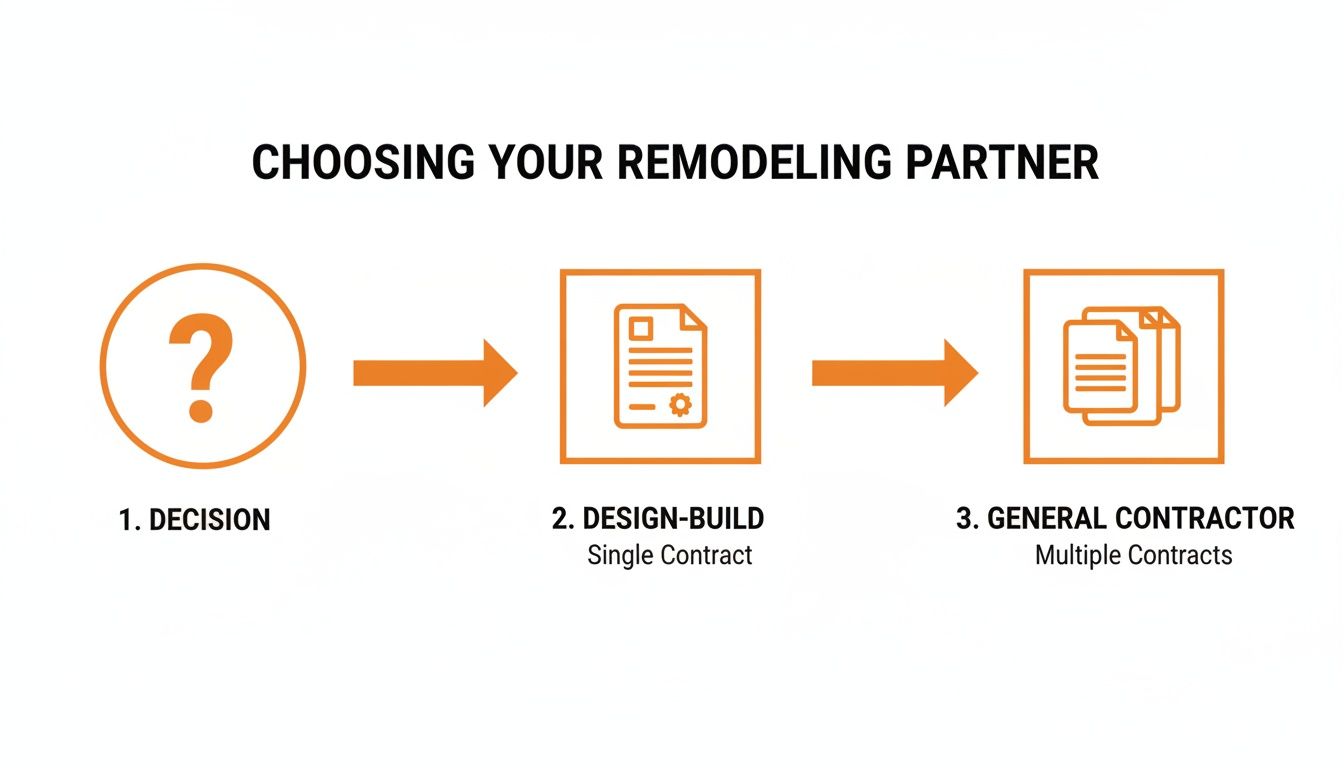
As you can see, the design-build journey starts with one contract and one partnership. The general contractor route immediately divides your focus, requiring you to manage multiple contracts and relationships from the outset.
This integration is why our promise is “Turning Chaos Into Calm, Fast.” We eliminate the communication gaps inherent in the traditional model. The result is a more predictable, accountable, and ultimately more enjoyable remodeling experience. Your project benefits from proactive problem-solving, as our team identifies and resolves potential construction hurdles during the design phase—not after your walls have been opened up.
Analyzing Budget Management and Cost Certainty
For any high-value remodel in Orange County, budget transparency and cost certainty are non-negotiable. The way your project’s finances are managed is one of the most significant differences when you compare the design-build vs. general contractor models. The right choice here can mean the difference between a predictable investment and a project plagued by unexpected costs.
With the traditional general contractor approach, the budget is finalized after the design is complete. You invest significant time and money in architectural plans, only to discover during the bidding phase that your vision costs far more than anticipated. This common “sticker shock” scenario often forces you back to the drawing board for costly and frustrating redesigns.
The design-build model completely inverts this dynamic by integrating cost analysis into the process from the very beginning.
Proactive Budgeting with Target Value Design
At Sparkle, our design-build process is founded on a methodology called Target Value Design. In simple terms, this means your budget is a core component of the design conversation from day one. Our designers collaborate directly with our estimators, receiving real-time cost feedback as the plans evolve.
This team-based approach ensures the architectural vision remains perfectly aligned with your financial parameters. We can guide you toward materials and design details that achieve a high-end aesthetic while respecting your budget, thereby eliminating the need for expensive revisions. It’s a fundamental shift: we design to a budget, rather than simply pricing a completed design.
This financial discipline is a major advantage of the integrated model. Studies have consistently shown that design-build projects experience significantly less cost growth after contract signing compared to traditional methods. This highlights the model’s strength in delivering accurate, early-stage budgeting.
As a BBB Torch Award Winner for Ethics, we believe financial transparency is the bedrock of trust. The design-build model allows us to provide a realistic, fixed-price proposal early in the process, giving you the confidence and peace of mind you deserve for your investment.
The Challenge of Change Orders
Change orders are the primary cause of budget overruns and disputes in construction. These formal contract amendments account for changes in scope, materials, or unforeseen issues. Effective construction change order management is essential, and this is where the two models differ dramatically.
- General Contractor Model: Since the builder was not involved in the design phase, conflicts or ambiguities in the plans are often discovered only after demolition begins. Each discovery can trigger a change order, causing delays and contentious negotiations over cost responsibility.
- Design-Build Model: Our integrated team resolves potential design and engineering conflicts before construction begins. By having builders and designers collaborate from the start, we identify constructability issues on paper, not on the job site.
This proactive problem-solving drastically reduces the number of change orders. While you may still elect to make changes, our process minimizes those caused by design errors or oversights. This is a crucial advantage for maintaining budget control, especially on complex projects like a high-end kitchen or a full stress-free bathroom remodel.
Ultimately, the design-build approach provides Orange County homeowners with far greater cost certainty. By aligning design with your budget from the outset and minimizing costly change orders, we deliver a remodeling experience that is financially predictable and professionally managed from start to finish.
Evaluating Project Timelines and Completion Speed
When remodeling your Orange County home, time is an invaluable asset. Delays are more than just an inconvenience—they disrupt your life, add stress, and can have financial implications. A crucial part of the design-build vs. general contractor decision boils down to a simple question: which approach gets the job done faster and more reliably? The answer lies in the structure of each process.
The traditional method of hiring an architect and then a general contractor is inherently sequential. It’s a relay race where each phase must be fully completed before the next can begin. The project is handed off from the design team to bidding contractors, and finally to the construction crew.
The Sequential Nature of the Traditional Model
In the classic design-bid-build model, the timeline is extended by its very structure. There is no overlap between phases, and each handoff introduces a new opportunity for delay.
- Design Completion: The project cannot move forward until architectural plans are 100% complete. This phase alone can take weeks or even months.
- Bidding Period: Once plans are finalized, they are sent out for bids. Collecting, reviewing, and negotiating contractor quotes adds another significant block of time to the schedule.
- Construction Start: Only after a contractor is selected and a contract is signed can material procurement and construction begin.
This rigid, linear process means that if bids come back significantly over budget—a frequent occurrence—the project must be paused for costly redesigns, pushing the entire timeline back even further. Each step is a potential bottleneck.
How Design-Build Compresses the Timeline
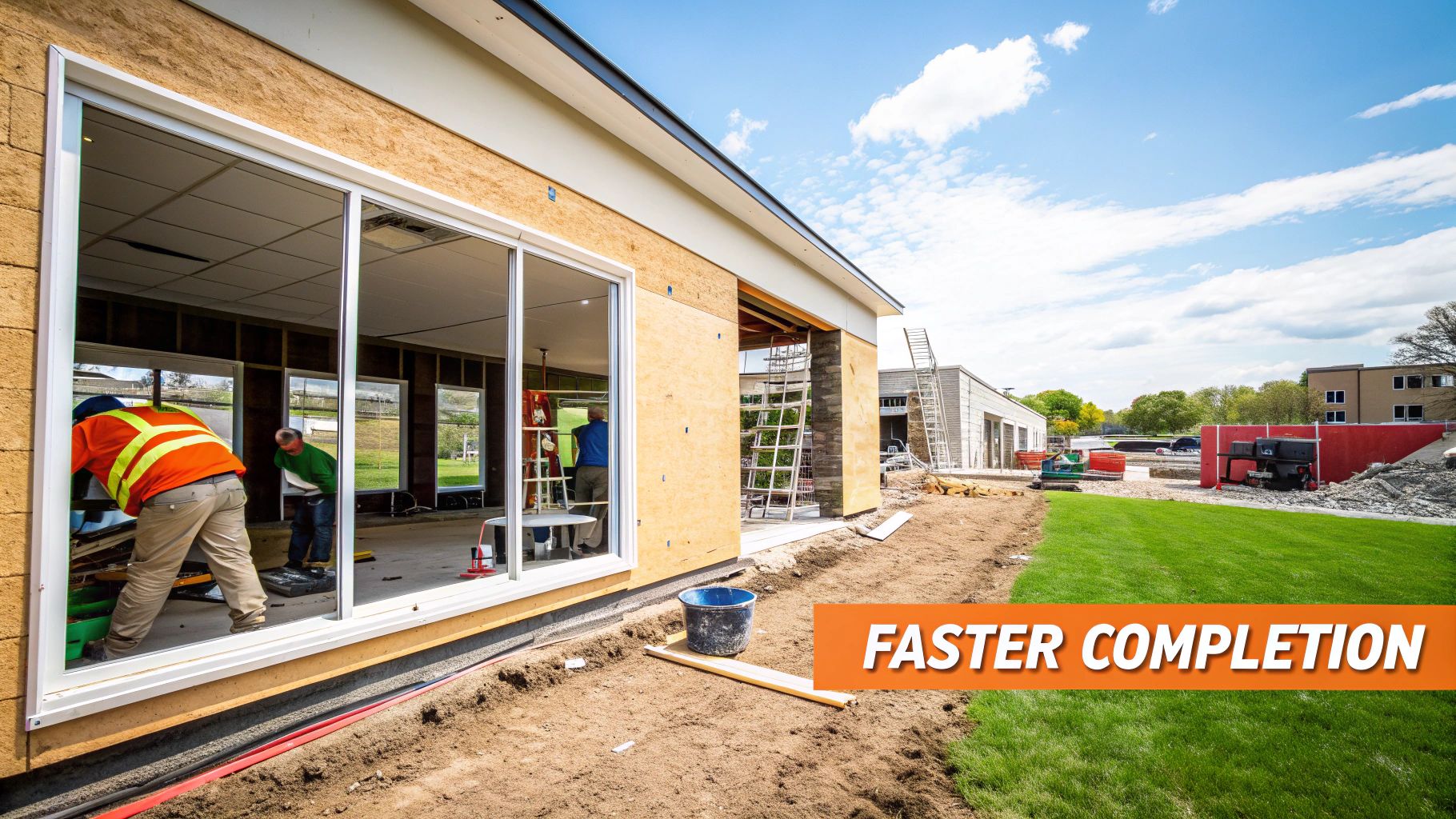
The design-build model revolutionizes this slow, sequential process. Because our design and construction experts are part of the same cohesive team, we can execute multiple phases concurrently. This method, known as “fast-tracking,” is a key reason we can deliver on our promise of “Turning Chaos Into Calm, Fast.”
For example, while our design team finalizes details for your kitchen cabinetry, our construction team can already be in motion.
- Early Site Preparation: We can begin demolition and other site preparation activities much sooner.
- Permitting: We can submit permit applications earlier in the process, accelerating approval times.
- Ordering Long-Lead Items: We can procure materials with long delivery times, such as custom windows or specialized appliances, well before every interior finish is finalized.
This ability to overlap tasks is what truly shortens the project timeline. Instead of waiting for one stage to conclude, we maintain forward momentum on multiple fronts.
A project’s timeline is often dictated by its workflow. A sequential, multi-contract process inherently has more potential for friction and delays than an integrated, single-source process designed for parallel execution.
This is not just a theoretical advantage; the data confirms it. A comprehensive study comparing project delivery methods found that, on average, design-build projects reduced total project duration by 4.2% and cut construction time by an impressive 23.1% compared to original schedules. In contrast, design-bid-build projects ran over schedule by 4.8%, with construction taking 30.6% longer than planned. You can explore more on these project delivery findings here.
For discerning Orange County homeowners, this time savings is a significant benefit. It means less disruption to your daily life and a faster return to enjoying your beautifully finished home. By eliminating the handoffs and communication gaps of the traditional model, our design-build process offers a more efficient, predictable, and ultimately faster path to project completion.
Who’s Accountable When Things Go Wrong? A Look at Risk and Quality Control
When investing in a luxury remodel, the critical question is: who is responsible when problems arise? The management of risk in the design-build vs. general contractor models is fundamentally different, and the answer directly impacts your investment and the final quality.
In the classic general contractor model, the homeowner often becomes the de facto risk manager. You hold separate contracts with the architect and the builder. If a design flaw leads to a construction issue, you are caught in the middle. The builder blames the architect’s plans, the architect blames the builder’s execution, and you bear the cost of lost time and money while they assign blame.
How Design-Build Flips the Script on Risk
The design-build model completely transforms this dynamic. By placing design and construction under a single contract, the responsibility for the entire project—from the initial concept to the final punch list—shifts from your shoulders to the design-build firm. For many homeowners, this single point of accountability is the most compelling reason to choose this path.
This means that when a problem arises, it is resolved internally by a cohesive team, not debated between separate entities. When the same professionals who designed the space are also building it, there is a powerful, built-in incentive to create plans that are practical, buildable, and meticulously detailed. This alignment is key to both minimizing risk and ensuring a higher standard of craftsmanship.
As a winner of the BBB Torch Award for Ethics, we believe accountability isn’t just a contractual obligation—it’s the foundation of trust. We stand behind our work, ensuring every detail of your remodel meets the highest standards of excellence because our name is on both the design and the construction.
Quality Control: Two Very Different Approaches
Accountability directly influences quality control, and the two models manage it very differently.
- General Contractor Model: The builder’s role is to execute plans they did not create. Their quality control is focused on adhering to the blueprints. They are not responsible for the inherent quality or feasibility of the design itself. This can lead to a “built-as-drawn” mentality, even when a superior solution becomes apparent during construction.
- Design-Build Model: Quality control is a continuous feedback loop. Our builders provide constructability feedback while the design is still evolving, and our designers remain actively involved throughout the construction phase. This ongoing collaboration ensures the original vision is translated perfectly into reality and allows for intelligent, real-time adjustments that enhance the final product.
With a unified team, every decision is made with an eye on both aesthetics and execution. As a licensed General Contractor, we take this responsibility seriously. You can review our CSLB license and credentials to see our commitment to professional standards, which reinforces our dedication to quality and accountability in every Orange County home we transform.
Ultimately, choosing a design-build partner means selecting a firm that owns the project’s success as much as you do.
Which Model Is Right for Your Home Remodel?
The decision between design-build vs. a general contractor depends on your project’s specific needs and your desired level of involvement. There is no single correct answer for every homeowner; the optimal path is determined by your priorities, the project’s complexity, and how hands-on you wish to be.
Let’s examine the ideal scenarios for each approach to help you choose your partner with confidence.
When to Choose a General Contractor
The traditional approach of hiring a general contractor can be suitable in specific circumstances. If you have already completed the entire design process with an architect you trust and possess a full, build-ready set of plans, this route may work for you. It is often best suited for more straightforward projects with limited complexity.
The primary advantage is the competitive bidding process. If your number one priority is achieving the absolute lowest initial price on a clearly defined scope of work, then shopping your plans to multiple contractors is the method to use. However, remember that this model places the full responsibility for coordinating between the designer and builder—and managing any ensuing conflicts—on you.
Consider hiring a general contractor if:
- You already have a complete, build-ready design. The blueprints are finalized, and all details have been worked out with an architect or designer.
- Your project is relatively simple. For smaller jobs with few variables, the disconnected process is less likely to cause major issues.
- Price is your primary driver. Your main focus is securing the lowest bid for a fixed set of plans, and you are prepared to manage potential change orders.
- You are comfortable being the middleman. You are prepared to step in to coordinate and resolve issues between your designer and builder as they arise.
The Ideal Scenario for Design-Build
For the discerning Orange County homeowner, the design-build model offers a superior approach for most significant remodels. It excels precisely where the traditional model often fails, particularly on complex projects like whole-home renovations, luxury kitchen remodels, or additions where design and construction must be perfectly synchronized.
This integrated approach is designed for homeowners who value a seamless, high-touch experience from start to finish. If your priorities are budget predictability, an accelerated timeline, and the peace of mind that comes from a single, accountable partner, then design-build is the clear choice. It eliminates the finger-pointing and communication gaps that frequently lead to stress and costly budget overruns.
For a project defined by custom details and high-end finishes, having a single team accountable for both the vision and its execution is the surest way to achieve an exceptional result. The design-build model transforms the remodeling process from a series of stressful transactions into a collaborative partnership.
At Sparkle Restoration Services, we specialize in this integrated, client-focused approach. Our team of experts works in unison to manage every detail, turning potential chaos into a calm, controlled, and enjoyable process. We invite you to learn more about our comprehensive design-build services and schedule a complimentary consultation to see how we can bring your vision to life with unparalleled clarity and award-winning craftsmanship.
A Few Final Questions
Even with a clear comparison, you may have some lingering questions. That’s perfectly normal. Let’s address some of the most common inquiries we hear from homeowners in Orange County deciding between the design-build vs. general contractor models.
Is Design-Build Actually More Expensive Than Hiring a General Contractor?
Not necessarily, and over the life of the project, it often provides greater value. An initial design-build proposal may appear higher than a standalone construction bid because it represents a complete, integrated cost. The traditional route, by contrast, is known for “budget creep” from change orders and redesign fees that arise when plans don’t align with construction realities.
The design-build process mitigates this risk by integrating budget discussions into the design phase. We ensure plans are not only beautiful but also buildable and financially viable from the outset. This protects you from the costly surprises common in a siloed process.
What if I Already Have an Architect? Can I Still Work with a Design-Build Firm?
This depends on the firm’s process. At Sparkle, the true value of our design-build service lies in the seamless collaboration between our in-house designers and builders. This cohesive teamwork is what drives our efficiency and enables us to be fully accountable for the final outcome.
While we are happy to review existing plans for inspiration, the full benefits of the design-build model—such as streamlined communication, accelerated timelines, and unified quality control—are realized when our integrated team guides the project from concept to completion.
The real magic of design-build happens when the design and construction minds are in sync from day one. This collaborative spirit is what transforms a good plan into an exceptional, flawlessly executed space.
For a Luxury Kitchen Remodel in Orange County, Which Model Makes More Sense?
For a project as complex and detail-intensive as a luxury kitchen remodel, the design-build model is almost always the superior choice. These projects involve intricate details, specialized trades, and countless decisions that must align perfectly.
Having a single team—and one point of accountability—manage everything from layout and custom cabinetry to plumbing, electrical, and appliance integration is critical. It ensures a cohesive vision is executed flawlessly. This unified oversight results in superior quality control and a much smoother, more predictable journey, which is precisely what is needed to achieve the premium, magazine-worthy kitchen you envision.
Ready to experience the clarity and confidence of the design-build approach for your Orange County remodel? The team at Sparkle Restoration Services is here to turn your vision into a stunning reality with a process designed for your peace of mind.
Schedule your complimentary consultation today to get started.