



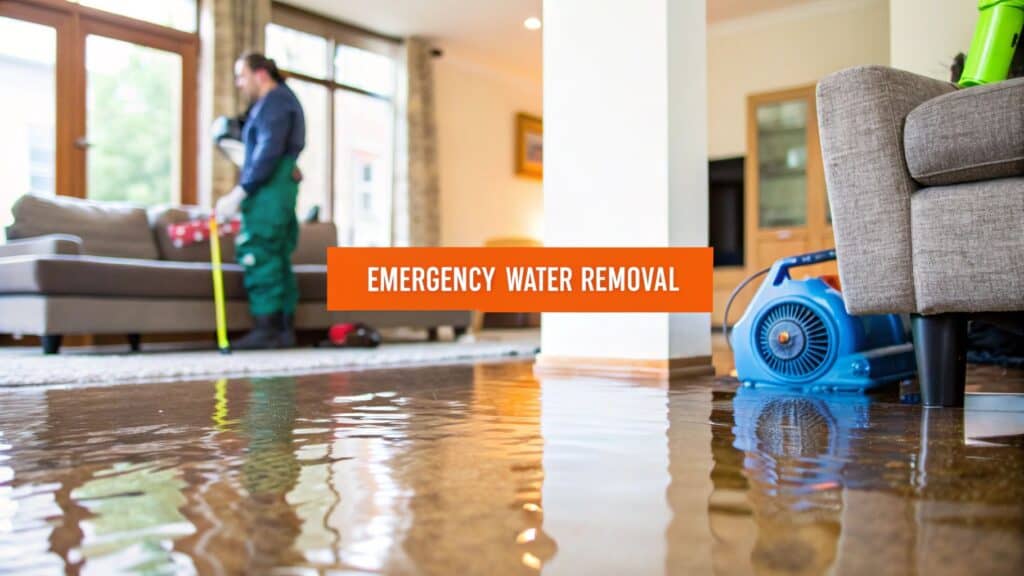
The moment you discover standing water in your Orange County home is jarring. Whether it's from a burst pipe behind the drywall or a faulty washing machine, that initial shock can be overwhelming. But what you do in the next 60 minutes is absolutely critical for both your safety and minimizing the long-term damage to your property. For discerning homeowners and property managers, a calm, methodical response is key to navigating this chaos.
This guide provides the expert-backed steps for immediate action, positioning you for a smooth and successful recovery. The first priorities in any emergency water removal scenario aren't about saving your sofa—they're about stopping the water at its source and eliminating any electrical hazards. Everything else comes after that.
What to Do Immediately After Discovering Water Damage
Seeing water spread across your floors and seep into your walls feels like chaos. The key is to take a deep breath and shift from panic to a controlled, methodical response. Taking a few specific, strategic actions right away protects your family, your home, and sets the foundation for a much smoother professional restoration and insurance claim process.
Prioritize Safety Above All Else
Before you even think about moving a single item, your absolute first focus must be on making the area safe. Water and electricity are a deadly combination, and this risk cannot be taken lightly.
- Shut Off the Water Main: If the problem is a plumbing failure, your most urgent task is to stop the flow. Find your main water shut-off valve—it's usually located in the garage, a utility closet, the basement, or outside near the street. A firm clockwise turn should cut the water supply to the entire house.
- Kill the Power Safely: If there's standing water, do not walk through it or touch any appliances. Head straight to your breaker box and shut off the circuits to all affected areas. If the breaker box itself is in a wet spot, do not go near it. In that situation, you must wait for a professional.
When you're dealing with a sudden plumbing failure, it helps to understand the basics of your system. This fast action guide for plumbing emergencies is a great resource to review while you wait for help to arrive.
Document Everything Before You Touch Anything
Once the immediate safety threats are handled, your next role is that of a detective. It's tempting to start mopping and moving furniture, but don't. The evidence you gather right now is absolutely vital for your insurance claim.
Take a moment and grab your phone. Your insurance adjuster needs to see the initial extent of the damage. Photos and videos taken before anything is moved are the most powerful proof you can have.
Walk through every impacted room. Get wide shots to show the scope of the water, then zoom in on the details: soaked carpets, warped baseboards, damaged furniture, and any high-water marks on the walls. This visual record is your best tool for ensuring you get the full coverage you're entitled to.
To help you stay organized in a high-stress moment, we've put together a quick-reference checklist. Follow these priorities to ensure you're covering the most critical tasks first.
Immediate Water Damage Action Checklist
| Priority Action | Why It Is Critical | Expert Pro Tip |
|---|---|---|
| Stop the Water Source | This is the #1 priority to prevent further damage. Every minute the water runs, the cost and complexity of the repair grow. | If you can't find the main shut-off, try locating the individual shut-off valve for the specific appliance (e.g., under the sink, behind the toilet). |
| Shut Off Electricity | Prevents the life-threatening risk of electrocution from water coming into contact with live circuits, outlets, or appliances. | If you can't safely access your breaker box, call your utility company's emergency line immediately. Do not take any chances. |
| Document with Photos/Videos | Provides undeniable proof for your insurance claim, showing the initial state of the damage before any mitigation efforts began. | Narrate your video. Walk through the space and describe what you see, when you discovered it, and the extent of the damage. |
| Call a Certified Pro | Professionals have the right equipment and training to extract water and dry your property correctly, preventing secondary damage like mold. | Look for an IICRC Master Certified firm. This certification is the industry gold standard and ensures the technicians are properly trained. |
| Notify Your Insurance Agent | Starting the claims process early gets an adjuster assigned and helps you understand your coverage and deductible. | Don't say more than you need to. Simply state the facts: "I had a supply line burst in my kitchen and have water damage." Let the pros handle the details. |
This checklist is your game plan. Once you've run through these steps, you can move on to protecting your belongings while you wait for professional help to arrive.
Begin Strategic Damage Mitigation
With safety secured and evidence gathered, you can now start mitigating further damage. This isn't about a full cleanup; it's about protecting your most valuable and vulnerable possessions from being ruined.
Think triage. Focus on moving items to a dry, safe spot like an unaffected bedroom or the garage.
- Irreplaceable Items First: Get things like photo albums, passports, birth certificates, and family heirlooms out of harm's way immediately.
- Electronics and Artwork: Move computers, TVs, and any valuable art. It's a good idea to prop them up off the floor to keep any lingering moisture from wicking up into them.
- Furniture and Furnishings: Place small squares of aluminum foil or wood blocks under the legs of heavy furniture. This creates a barrier to stop rust or wood stains from bleeding into wet carpet. You should also lift any draperies or furniture skirts up off the wet flooring.
These first steps are essential for setting the stage for a successful professional restoration. To be even more prepared for the future, consider putting together a few key supplies by following our guide on creating a water emergency first aid kit.
After you've done all you can, your next call should be to an IICRC Master Certified restoration expert like Sparkle. We'll take it from here.
What Happens When the Pros Arrive? A Look at the Water Removal Process
Once you’ve managed the immediate chaos and secured your Orange County home, the real work of restoration begins. This is where a certified team like Sparkle Restoration Services steps in, transforming a stressful situation with a methodical, science-backed process. It’s not just about sucking up the visible water; it’s about restoring your home’s health from the inside out. Knowing what we do can bring a lot of peace of mind when you need it most.
Our first move on-site is always a deep-dive damage assessment. This isn’t just a quick look around.
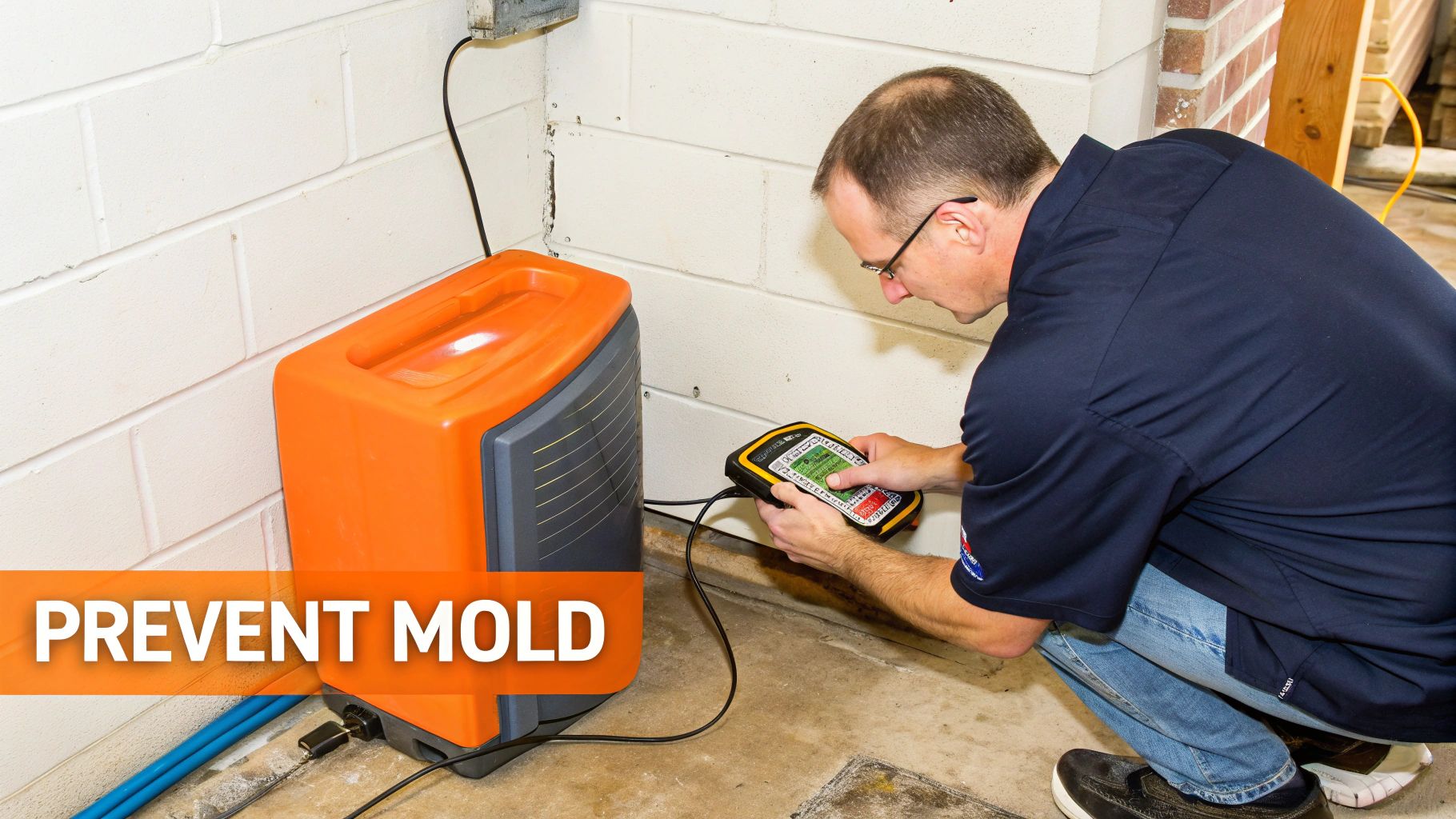
We use advanced tools, like thermal imaging cameras and specialized moisture meters, to see what the naked eye can’t. These gadgets let us map out exactly where the water has traveled—behind drywall, under beautiful hardwood floors, and inside wall cavities. These hidden wet spots are exactly where mold and rot love to take hold if they aren't found and dealt with immediately.
This initial evaluation is the blueprint for our entire emergency water removal strategy.
Not All Water Is Created Equal: Categorizing the Damage
A crucial part of our assessment is figuring out what kind of water we’re dealing with. This isn't just jargon; it dictates the safety gear we wear and the specific techniques we use to make your home safe again. The IICRC, our industry's governing body, classifies water into three categories:
- Category 1 (Clean Water): Think of a burst supply line or an overflowing sink. It starts out harmless, but if it sits for a day or two, it can quickly turn nasty and degrade into Category 2.
- Category 2 (Gray Water): This water is already contaminated and can make you sick. It comes from sources like a drained washing machine, a dishwasher discharge, or a toilet bowl with urine (but no feces).
- Category 3 (Black Water): This is the serious stuff. Grossly contaminated and a major health hazard, this includes sewage backups and floodwaters from overflowing rivers or streams.
Getting this classification right is non-negotiable for a safe and successful restoration. We cover this in more detail in our guide to the fundamentals of water damage.
The first few actions you take while waiting for us are incredibly important.
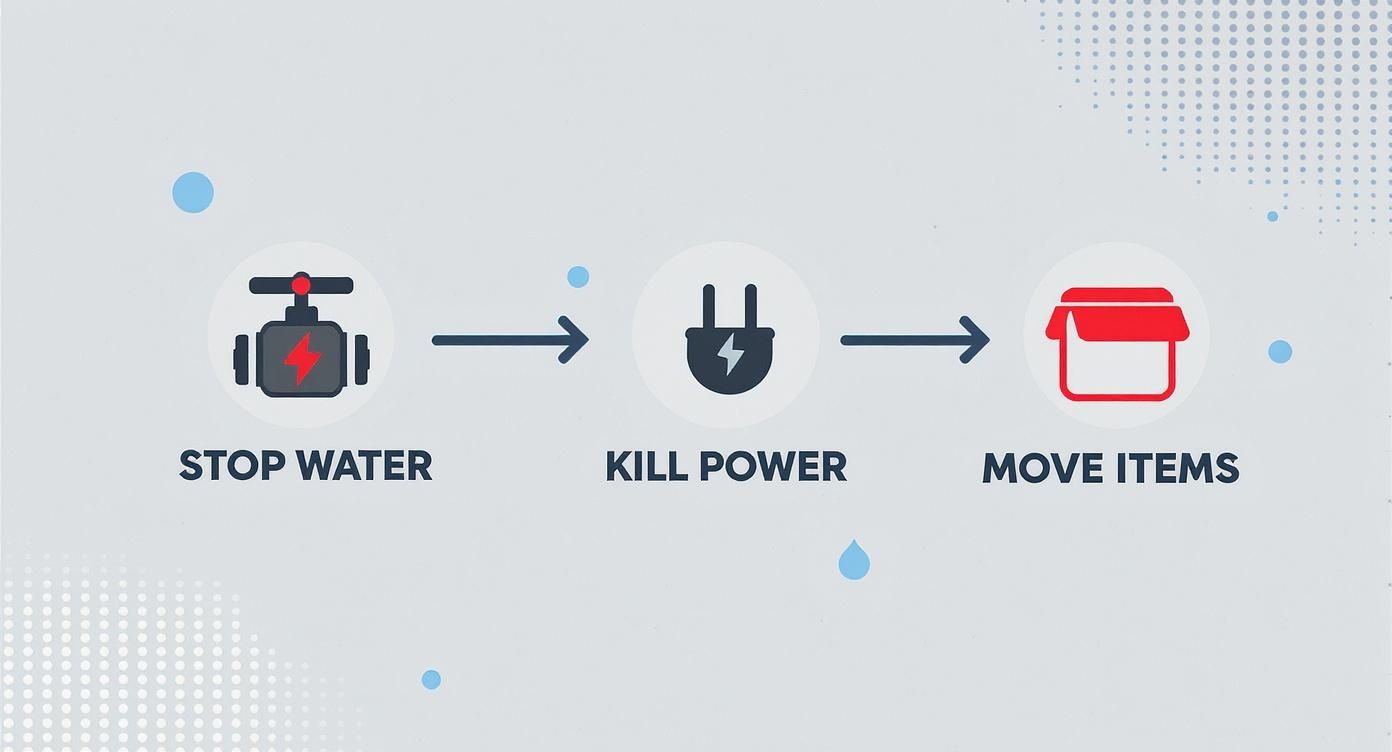
Every one of those steps—shutting off the water, cutting the power, and moving your valuables—helps minimize the damage before our specialized work even begins.
The Science Behind Drying Out Your Home
With the assessment done, we get to the hands-on emergency water removal. We roll out commercial-grade equipment that can handle anything from a small leak to a major flood. Our truck-mounted extraction units can pull out hundreds of gallons of standing water in a remarkably short time, a feat impossible with shop vacs or mops.
After the standing water is gone, we move into the structural drying phase. This is where the real science comes into play.
A lot of people think you can just point a fan at a wet wall and call it a day. But professional drying is about creating a controlled environment. We manipulate the temperature, humidity, and airflow to pull moisture out from deep within building materials.
We do this with a strategic combination of specialized gear:
- Industrial Air Movers: These aren’t your average fans. They create powerful, targeted airflow across wet surfaces—carpets, walls, subfloors—to speed up evaporation.
- LGR Dehumidifiers: These are the real heavy lifters. Low-Grain Refrigerant dehumidifiers pull in moist air, cool it down to condense the water vapor out, and then push warm, dry air back into the room. This creates the perfect conditions for rapid drying.
Throughout the entire process, our technicians are constantly taking readings with moisture meters. We don’t guess when something is dry; we follow the data until we hit the established scientific dry standard. This meticulous, data-driven approach is the only way to guarantee your property is brought back to its pre-loss condition and to prevent the long-term headaches that secondary damage can cause.
Navigating Your Water Damage Insurance Claim
Once the initial shock of discovering water in your home starts to fade, a different kind of stress often rushes in: dealing with the insurance company. For most homeowners in Orange County, this part of the process feels more daunting than the water damage itself. But it doesn't have to be. With the right strategy and an expert partner, you can handle your claim with confidence and get the full coverage you're entitled to.
Your first call to the insurance company is a pivotal moment. Being prepared can make all the difference. Before you even dial, make sure you have your policy number handy, along with the photos and videos you took right after discovering the mess.

When you get an agent on the line, just stick to the facts. Tell them clearly what happened (e.g., "The supply hose on our washing machine burst"), and give them the date and time you found the water. It’s best to avoid guessing about how bad the damage is; just describe what you can see. A clear, factual report gets your claim started on the right track.
Understanding Your Policy's Fine Print
One of the biggest hang-ups for homeowners is the difference between "water damage" and "flood damage." In the world of insurance, these terms are not interchangeable, and knowing the distinction is critical.
- Water Damage: This almost always refers to water that comes from a source inside your home. We're talking about burst pipes, an overflowing toilet, or a leaking appliance. Most standard homeowner's policies will cover this kind of "sudden and accidental" event.
- Flood Damage: This is water that comes from a natural source and enters your home from the outside—things like heavy rains, overflowing rivers, or a storm surge. Standard policies almost never cover this; it requires a separate flood insurance policy.
Taking a moment for understanding your California home insurance policy will save you headaches down the road. Knowing these definitions helps you speak the same language as your adjuster and sets realistic expectations from day one.
Partnering with a Restoration Expert
This is where a professional restoration company becomes your most valuable asset. An experienced team like Sparkle Restoration Services is more than just a cleanup crew; we become your advocate, bridging the communication gap between you and your insurance carrier. We know what they need to see and provide the exact documentation required to process your claim without frustrating delays.
We work directly with all major insurance carriers, which helps keep the entire process moving smoothly. Our team provides them with:
- Detailed Damage Reports: Comprehensive assessments complete with photos, diagrams, and clear notes.
- Precise Moisture Readings: We use scientific instruments to show exactly how much water has saturated your walls, floors, and other hidden areas.
- Transparent, Itemized Estimates: Our estimates are created with industry-standard software that adjusters know and trust, making approvals faster and easier.
Our job is to take this burden off your shoulders. We handle the technical jargon and provide the hard evidence, giving your adjuster everything they need to approve the claim quickly. This proactive approach helps you sidestep the common issues that can leave a claim in limbo for weeks.
Maximizing Your Claim and Avoiding Pitfalls
The whole point of an insurance claim is to restore your home to its "pre-loss condition." This isn't just about drying things out—it's about properly repairing or replacing everything the water touched. Our meticulous documentation ensures nothing gets missed, from warped baseboards and soggy insulation to the subfloor you can't even see.
A common mistake we see is homeowners accepting a quick, lowball offer or starting major repairs before the claim is fully approved. As your partner, we help you understand the full scope of work needed for a true restoration. We make sure the final estimate covers every single step of the emergency water removal, drying, and reconstruction process.
We've put together a more detailed resource to guide you through this. You can learn more in our comprehensive homeowner's guide to navigating property insurance claims. With Sparkle Restoration handling the details, you can focus on what’s truly important: getting your home, and your life, back to normal.
Preventing Mold and Secondary Structural Damage
Let’s be clear: getting the standing water out of your home is just the beginning. The real work—the part that truly protects your property value and your family’s health—starts after the visible water is gone. This is where our IICRC Master Certified technicians zero in on the invisible threat: moisture that has soaked deep into your home’s structure.
If you ignore it, this trapped dampness becomes a ticking time bomb. It’s the perfect breeding ground for mold and can quietly lead to devastating secondary damage like rotted wood, crumbling drywall, and even compromised structural beams. Our job isn't just to clean up a spill; it's to ensure your Orange County home is safe and healthy long after we’ve packed up our trucks.
The Science of Structural Drying
Think about a kitchen sponge. You can squeeze it out, but it’s still damp inside, right? Building materials like drywall, wood framing, and insulation are no different. Just removing the surface water leaves these materials saturated, a problem that a few box fans from the hardware store simply can’t fix.
This is why we use a scientific process called structural drying. It’s all about creating a controlled environment to aggressively pull that trapped moisture out of the materials themselves. We do this by carefully manipulating three key elements:
- Airflow: We don’t just point fans at the wall. We strategically place high-velocity air movers to create a vortex, forcing dry air across wet surfaces to speed up evaporation.
- Temperature: By slightly raising the ambient temperature, we increase the air's capacity to hold moisture—essentially making it thirstier.
- Dehumidification: This is the heart of the operation. Our industrial-grade LGR (Low-Grain Refrigerant) dehumidifiers are the muscle. They suck in the heavy, moisture-filled air and pump out warm, incredibly dry air, completing the drying cycle.
Together, these forces create a powerful system that methodically wrings out every last drop of moisture from your home’s framework.
Why We Don’t Guess—We Measure
So, how do we know for sure when everything is completely dry? We don’t guess. We rely on hard data. Throughout the entire process, our technicians are constantly taking measurements with specialized equipment to track our progress and ensure we hit the scientific dry standard.
Our goal is to return every affected material in your home to its normal, pre-loss moisture content. We use sophisticated moisture meters, thermal imaging cameras, and hygrometers to get a clear picture of what's happening inside your walls and floors. We don’t pull our equipment until the data proves the job is done right.
This meticulous, data-driven approach is the only way to guarantee mold and other secondary issues won’t pop up down the road. It’s a non-negotiable part of our process.
Getting Ahead of Mold Growth
It’s a startling fact: mold can start growing in as little as 24 to 48 hours in damp conditions. Once it gets a foothold, it can spread with alarming speed, creating serious health risks and leading to a much more complex and expensive remediation project.
Our entire drying strategy is designed to stop mold before it ever gets a chance to start. Here's how our IICRC-certified process protects your home:
- Immediate Action: We start the drying process the moment the water is extracted. By removing its moisture source, we starve any potential mold spores.
- No Stone Unturned: We use our monitoring tools to find every hidden pocket of moisture—behind baseboards, under cabinets, inside wall cavities—and eliminate them.
- Antimicrobial Treatments: If the water was contaminated (what we call Category 2 or 3 water), we apply EPA-registered antimicrobial agents to sanitize the area and prevent microbial growth.
Knowing the difference between mold facts and fiction is one of the best ways to protect your home. We've put together a guide that debunks some common facts and myths about mold and its remediation to help you understand the risks. At Sparkle Restoration Services, we’re not just removing water; we’re giving you the peace of mind that comes from knowing your home is structurally sound and safe for your family.
Why Orange County Homeowners Trust Sparkle Restoration Services
When your Orange County home is hit with a water emergency, the company you choose to call is the most critical decision you'll make. It’s never just about getting the water out. It's about getting your life back to normal with a team that brings real expertise, integrity, and precision to the job. Discerning homeowners from Newport Beach to Irvine choose Sparkle Restoration Services because they know that a true recovery goes much deeper than a surface-level cleanup.
You're not just hiring a crew; you're entrusting your most valuable asset to a team with the highest credentials in the restoration industry. You're partnering with a company whose ethical standards aren't just a talking point—they're proven and awarded.
Our Expertise Goes Far Beyond Extraction
The phrase "water removal" doesn't quite capture the full picture. Yes, pumping out standing water is the first visible step, but it’s the science and skill behind the scenes that truly determine the final outcome. Plenty of companies can show up with a truck-mounted pump and some fans. We arrive with a strategic plan grounded in building science and our IICRC Master Certification—the absolute pinnacle of industry training.
This elite qualification means we have a deep understanding of how water and moisture behave inside a structure. We know where it travels, where it hides in wall cavities and subfloors, and the exact scientific methods needed to dry your property completely and correctly. You can see what this level of training means for your project by reviewing the details of our certifications.
Being a Licensed General Contractor is what truly sets us apart. Most restoration companies stop once the drying is done, leaving you to find and manage other contractors for the repairs. We handle the entire recovery, from the initial emergency call to the final walkthrough. We don't just mitigate the damage; we seamlessly transition into high-end repairs and remodeling, often leaving your home better than it was before the incident.
This single point of contact eliminates the headache and stress of juggling different contractors for drywall, flooring, painting, or custom cabinetry. We are your one trusted partner from start to finish.
An Unwavering Commitment to Ethics
In a crisis, you need to know the team in your home has your best interests at heart. We are incredibly proud to be a 2024 BBB Torch Awards for Ethics Winner, a recognition that speaks directly to our character. This isn't just an award for good customer service; it's a prestigious honor given only to companies that demonstrate an absolute commitment to integrity in everything they do.
For you, our client, this translates to:
- Transparent Pricing: You’ll always get a clear, itemized estimate with no hidden costs or last-minute surprises.
- Honest Assessments: We give you a truthful, science-backed evaluation of the damage and a straightforward plan to fix it.
- Client Advocacy: We work on your behalf with your insurance carrier, providing the meticulous documentation they require to help you secure the full coverage you’re entitled to.
This ethical foundation is the very core of our white-glove service promise.
The Sparkle White-Glove Promise in Action
Picture this: a pipe bursts in your Laguna Niguel home, damaging high-end hardwood floors and custom kitchen cabinets. The typical approach is to just dry the visible surfaces. The Sparkle approach is different. We carefully detach the custom millwork to properly dry the hidden wall cavity behind it. We then meticulously restore the cabinetry and expertly repair or replace the flooring to ensure a perfect, seamless match.
This is our dedication to quality in action. We coordinate every single detail, transforming a chaotic and fragmented repair job into a calm, controlled, and complete recovery. These expert skills are more critical than ever, especially considering global water management challenges. According to the OECD, water withdrawals surged by 20% between 2001 and 2020, straining emergency systems and making professional emergency water removal more complex during a crisis. You can read the full OECD report to learn more about these global pressures.
Choosing Sparkle means you’re choosing a team that understands every facet of water management, from a localized emergency in your home to the broader challenges affecting our world.
Answering Your Top Questions About Emergency Water Removal
When your property is underwater, your mind is racing with questions. It's a stressful, confusing time, and you need clear, straightforward answers. We've been on countless calls with Orange County property owners just like you, and these are the most common concerns we hear.
How Long Does This Whole Process Actually Take?
The honest answer? It depends. Every water damage situation has its own unique set of challenges. That said, for most jobs, you can expect the professional drying phase to take somewhere between three to five days.
The final timeline really hinges on a few key factors:
- How much water are we dealing with? A burst pipe in the wall is a different beast than a full-blown flood.
- What got wet? Dense materials like plaster or hardwood take significantly longer to dry out than something like standard drywall.
- Where did the water come from? If we're dealing with contaminated water, there are extra decontamination and sanitization steps we have to take, which adds time.
We never just guess or rush through it. Our crews use specialized moisture meters to get scientific readings, ensuring every affected material is brought back to its normal, dry state. It’s the only way to be absolutely certain we've shut the door on future mold and structural problems.
Is It Safe to Stay in My House While You Work?
Your family's safety is our number one priority, period. If it’s a relatively minor leak from a clean water source (what we call Category 1), you can often stay in an unaffected part of the house.
But if the damage is widespread or involves contaminated gray or black water, we'll strongly recommend you relocate for a bit. The potential health risks from bacteria, viruses, and other contaminants in the air just aren't worth it. Our project manager will give you a direct, honest assessment of your specific situation so you can make the right call.
Your well-being is non-negotiable. We know it’s a major inconvenience, but temporarily relocating not only keeps your family safe from potential hazards, it also lets our crews work faster and more efficiently to get you back home sooner.
What’s the Ballpark Cost for Emergency Water Removal in Orange County?
There’s no single price tag for emergency water removal, because no two jobs are the same. The final cost really depends on the specifics—the size of the affected area, the type of equipment needed, and just how bad the damage is.
What we can promise is total transparency from the get-go. Before a single piece of equipment is turned on, our team provides a detailed, itemized estimate. There are no surprises.
We also work directly with every major insurance carrier. We know what they need, how to document everything correctly, and how to streamline the claims process. Our goal is to minimize your out-of-pocket costs and take that financial stress off your shoulders.
Can You Save My Soaked Carpet and Furniture?
This is a tough one, and it’s a decision our certified technicians make on a case-by-case basis. Whether we can restore personal items really comes down to a few critical things.
The outcome depends on:
- The water source: If it was clean water, the chances of saving things are pretty high. If it was sewage (black water), the contamination risk is too great.
- How long it was saturated: The clock starts ticking the moment something gets wet. The longer it sits, the more damage occurs and the higher the risk of mold.
- The material itself: Porous things like upholstered furniture, mattresses, and carpet padding are incredibly difficult to decontaminate effectively.
For safety's sake, anything porous that has been soaked with black water almost always has to be discarded. But don't lose hope—many items hit by clean water can be professionally cleaned, sanitized, and brought right back to their original condition.
When chaos strikes your Orange County property, you need a partner who can restore both your home and your peace of mind. The team at Sparkle Restoration Services is ready 24/7 to turn your water emergency into a controlled, complete recovery. Contact us now for an immediate response and a free consultation.
Ready to create a space that’s as beautiful as it is functional? Schedule your complimentary design consultation today by visiting Ready to Work with Sparkle?