



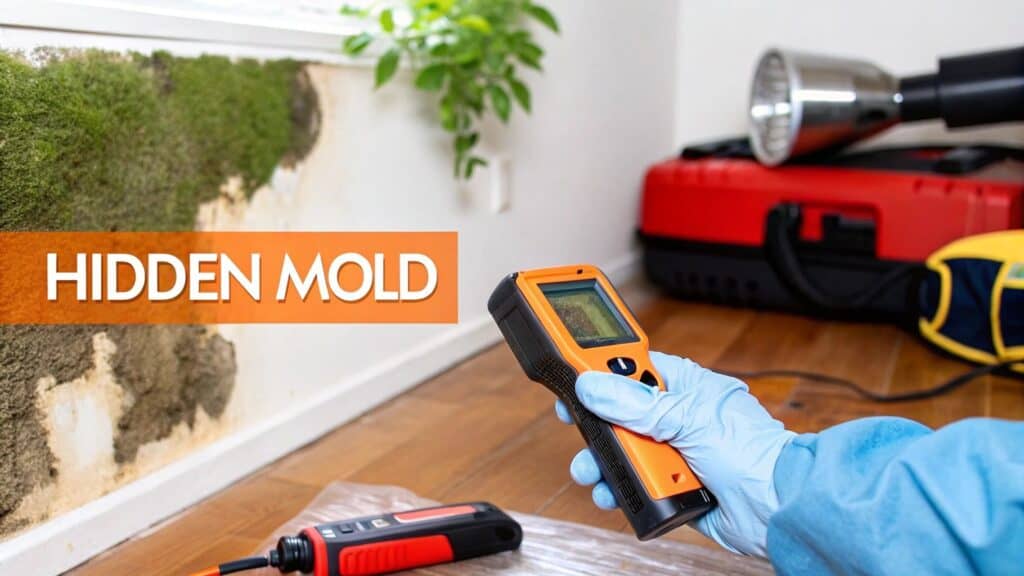
That persistent musty smell you can’t quite place, or allergy symptoms that linger long after pollen season? These aren’t just minor household quirks. For discerning homeowners, they are often the first critical clues to a significant problem: hidden mold in home. It’s a silent threat, thriving behind walls, under floorboards, and in the dark, forgotten corners of your property.
As Orange County’s trusted restoration and remodeling experts, Sparkle Restoration Services understands that your home is your sanctuary. This guide is designed to empower you with the knowledge to identify the subtle signs of hidden mold, understand the risks, and know when to call in a certified professional to protect your property and your family.
The Unseen Threat In Your Orange County Home

Living in Orange County, from the stunning coastal properties in Newport Beach to the pristine neighborhoods of Irvine, means navigating Southern California’s unique climate. The combination of coastal humidity and our well-sealed, energy-efficient homes can inadvertently create the perfect breeding ground for mold to grow undetected.
This is far more than a simple cosmetic issue; it’s a genuine threat to your property’s structural integrity and, more importantly, your family’s health. The problem is also surprisingly common. An estimated 70% of homes nationwide have some form of mold issue. Left unaddressed, a significant contamination can diminish a home’s market value by a staggering 20% to 37%.
Why Hidden Mold Is a Major Concern
The primary danger of hidden mold lies in its invisibility. By the time you notice visible discoloration on a wall or ceiling, the colony behind it has likely been proliferating for some time. This unseen growth methodically degrades your home’s structure while compromising your indoor air quality.
At Sparkle Restoration, we believe a healthy home is the cornerstone of a peaceful life. Unaddressed mold shatters that peace by releasing microscopic spores into the air, turning your sanctuary into a source of potential health risks.
This type of contamination is a major source of indoor air pollution. Understanding the factors that contribute to poor air quality is the first step toward creating a healthier environment for your family.
The Connection to Health and Air Quality
When mold grows undetected, it continually releases spores and mycotoxins into your living space. This is why many homeowners experience nagging health issues they can’t explain, often dismissing them as seasonal allergies or a persistent cold.
Common symptoms linked to mold exposure include:
- Persistent sneezing, coughing, or a runny nose
- Itchy, watery eyes
- Unexplained headaches or fatigue
- Worsening of asthma or other respiratory conditions
The hidden mold in your home directly and negatively impacts the air you breathe daily. For general advice on improving home air quality, this guide on understanding indoor air quality tips is a valuable resource.
Connecting these symptoms to a potential issue within your property is the first critical step. This guide provides the expert knowledge you need to spot subtle clues, empowering you to move from uncertainty to confident, decisive action.
Learning to Spot the Subtle Signs of Mold
Detecting hidden mold in a home is rarely about finding large, obvious black spots. It’s more akin to solving a puzzle. Your property often provides subtle clues long before the problem becomes visible, and learning to recognize these early warnings is your most effective defense.
It requires training your senses to detect the subtle shifts—the unusual odors, the slight changes in your walls and floors—that signal trouble is brewing just out of sight. As an IICRC Master Certified firm, we’ve seen countless Orange County homeowners mistake these signs for normal wear and tear, when in fact they are the first indicators of the moisture that mold requires to thrive.
Interpreting Your Home’s Warning Odors
A persistent musty odor is the classic indicator of mold. While easy to ignore, it’s crucial to understand what it signifies. That odor isn’t just dampness; it’s caused by Microbial Volatile Organic Compounds (MVOCs), which are gases mold releases as it grows and digests organic material.
The scent can vary depending on the mold species and its food source. You might notice an earthy, soil-like smell near a wall cavity with a slow pipe leak. Alternatively, you could detect a sharp, sour odor from a damp HVAC closet. If the smell intensifies when you turn on the AC or heat, it’s a significant red flag for mold within your ductwork.
The key is distinguishing these warning odors from everyday household smells. An odor that appears after a rainstorm and then dissipates is one thing. A persistent, localized scent that never fully disappears is your cue to investigate further. Our guide on facts and myths about mold and mold remediation can help you separate fact from fiction.
Paying Attention to Physical Changes
Beyond odors, your home will exhibit physical signs of distress. As mold grows behind a surface, it exerts pressure and degrades materials from within. This damage manifests in ways that are easily overlooked without a trained eye.
Look for these specific visual cues:
- Bubbling or Peeling Surfaces: When paint or wallpaper blisters, cracks, or pulls away from the wall, it is almost always a sign of trapped moisture behind it.
- Warped Materials: Baseboards, wood flooring, or drywall that appears swollen or bowed is absorbing water from a hidden source.
- Discoloration and Stains: Faint yellow or brown stains on ceilings and walls are early watermarks. Even if they feel dry, they indicate a past or intermittent leak that likely fueled mold growth.
- Condensation: Persistent moisture on windows, pipes, or metal surfaces signifies excessive indoor humidity—creating the ideal environment for mold to thrive.
A home’s integrity is often compromised quietly. The paint that bubbles near the floor isn’t just an aesthetic issue; it’s a distress signal from your home, pointing directly to a hidden moisture problem that needs immediate attention.
Connecting Mold Symptoms to Hidden Sources
Sometimes the most reliable clues come from your own health. The table below can help you connect the dots between your experiences and potential hidden mold locations.
| Symptom or Sign | Potential Hidden Location | What It Indicates |
|---|---|---|
| Persistent musty odor | Inside wall cavities, crawl spaces, HVAC systems | Active mold growth is releasing MVOC gases. |
| Bubbling paint/wallpaper | Behind drywall, near plumbing lines | Trapped moisture is pushing the surface outward. |
| Warped baseboards | Behind walls, under flooring | Water absorption from a slow leak or high humidity. |
| Yellowish ceiling stains | Attic, upstairs bathroom, roof leak | A past or ongoing leak is seeping through materials. |
| Allergy symptoms in one room | Inside that room’s walls, carpet padding, or ventilation | A concentrated source of mold spores is impacting the air. |
| Condensation on windows | Entire home, especially poorly ventilated areas | Excess humidity that creates a perfect breeding ground. |
This is not an exhaustive list, but it provides a strategic starting point for investigating your home. These connections are often the key to identifying the source before it escalates into a major remediation project.
Connecting the Dots with Health Symptoms
Sometimes, the first signs of hidden mold are unrelated to your house’s structure and entirely related to how you feel within it. If you are battling allergy-like symptoms that persist long after Southern California’s pollen season has ended, it’s a major red flag.
Pay attention to patterns like these:
- Feeling worse in a specific room or area of the house.
- Symptoms improving when you spend a day or two away from home.
- Unexplained headaches, fatigue, or brain fog that only seem to occur indoors.
These physical reactions are your body’s alarm system, warning you about poor indoor air quality. More often than not, hidden mold spores are the culprit. Recognizing this link is a critical first step toward resolving the problem and restoring your home to a healthy, safe environment.
Where To Search for Hidden Mold Hotspots
Now that you recognize the subtle signs of hidden mold, it’s time for a strategic search. Mold growth isn’t random; it’s predictable. It requires a dark, damp environment with an organic food source, like the paper on drywall or wood framing.
Consider this your map for a safe, non-invasive inspection of your Orange County property. We’ll guide you through the most common high-risk zones and explain how to investigate without disturbing potential spores. Always prioritize safety: wear an N95 mask and gloves, and never attempt to scrape or remove suspected mold yourself.
Kitchens: The Heart of Moisture
The kitchen is a hub of activity, but all that cooking and cleaning also makes it a hub for moisture. A thorough inspection requires looking beyond the obvious.
Begin under the kitchen sink. This dark, enclosed cabinet is notorious for small, slow drips from plumbing or the garbage disposal. Use a powerful flashlight to carefully inspect all pipe connections, the back wall, and the cabinet floor for water stains, warped wood, or discoloration.
Next, carefully move the refrigerator, especially if it has an ice maker. The small plastic water line can become brittle and develop pinhole leaks you would otherwise never see. While you’re at it, examine the area around your dishwasher for any evidence of water escaping during its cycles.
Bathrooms: Constant Humidity Zones
If there is one area mold prefers above all others, it’s the bathroom. The constant steam and humidity make every surface a potential breeding ground if ventilation is inadequate.
Use this checklist for your bathroom inspection:
- Around the Toilet Base: Check for staining on the floor or caulk where the toilet meets the tile. A failing wax ring can cause a slow, unseen leak that saturates the subfloor.
- Inside Vanities and Cabinets: Similar to the kitchen, bathroom vanities conceal plumbing that can leak. Conduct a thorough check for any dampness or water marks.
- Grout and Caulk Lines: Do you see dark spotting on the grout between tiles or along caulk seals in the shower? While some may be simple mildew, persistent staining can indicate that moisture is penetrating the wall behind the tile.
The most overlooked spot in a bathroom? The exhaust fan. If it’s clogged with dust or underpowered, it cannot effectively remove humid air. That moisture then settles on ceilings and walls, creating the perfect environment for hidden mold to take hold.
This is a global issue. Studies have revealed that dampness and indoor mold have been reported in up to 47% of homes worldwide. This affects properties of all ages and types, highlighting the critical importance of regular inspections.
Less Obvious But Common Hotspots
Mold isn’t confined to kitchens and bathrooms. Some of its favorite hiding spots are in areas you rarely inspect, allowing it to grow for months or even years undetected.
Examine your HVAC system. The closet housing your furnace or air handler can easily trap condensation, especially around the drain pan. If the drain line becomes clogged, water can overflow and saturate the surrounding drywall and framing. The ductwork itself can also harbor mold, which is then distributed throughout your entire home every time the system activates. To learn more about the dangers of airborne spores, review our article on the truth about mold contamination and its health risks.
Attics and Crawl Spaces: The Forgotten Frontiers
These out-of-sight areas are prime real estate for hidden mold. They are dark, often have poor ventilation, and are highly susceptible to moisture from leaks or humidity.
In the attic, focus your flashlight on the underside of the roof sheathing. Look for dark stains, particularly around vents, chimneys, or skylights—these are telltale signs of a roof leak. Leaky roofs are a massive contributor to mold growth, which is why preventative maintenance like professional roofing inspections can prevent major headaches later. Another clue, especially in winter, is frost on nails or sheathing, which indicates that warm, moist air from your living space is condensing in the attic.
Crawl spaces present similar challenges. High humidity rising from the soil can cause widespread growth on floor joists and insulation. Scan the area with a powerful flashlight, looking for any standing water, damp soil, or dark staining on wood structures. Pay close attention to the foundation walls for any signs of water intrusion from the exterior.
By methodically checking these key areas, you can catch a hidden mold in home problem early, protecting both your property and your family’s health.
Knowing When to Call an IICRC Certified Expert
A thorough visual inspection is a powerful first step, but it has its limitations. Knowing when to monitor a situation versus when to engage a professional is crucial for protecting your home and family. For a hidden mold in home issue, certain situations are non-negotiable—they demand the precision of a certified expert.
If you’ve experienced any significant water event, it’s time to make the call. This includes not only major disasters like a burst pipe but also insidious issues like a slow-leaking washing machine hose or a dishwasher that quietly saturated the subfloor. Any event that introduces significant water into your home’s structure creates a perfect breeding ground where mold can establish itself in as little as 24 to 48 hours.
Furthermore, trust your senses. If you are dealing with a persistent, musty odor that you cannot trace, that is a classic sign of a well-established colony growing out of sight.
Health Symptoms Are a Critical Warning
Perhaps the most urgent reason to seek professional help is when your family begins experiencing unexplained health issues. If chronic allergies, persistent headaches, or respiratory problems worsen at home and improve when you are away, your body may be reacting to airborne mold spores.
These physical reactions should never be ignored. They are often the clearest indicator that your home’s indoor air quality is compromised, pointing directly to a hidden problem that requires a professional to safely identify and resolve.
Why an IICRC Master Certified Specialist Matters
When facing a potential mold problem, not all “experts” are created equal. While a general contractor is skilled in repairs, a mold remediation specialist with IICRC Master Certification brings a superior level of expertise. This is the gold standard in the restoration industry, signifying rigorous training, extensive field experience, and a deep understanding of the science behind mold and moisture dynamics.
An IICRC-certified firm like Sparkle Restoration doesn’t just look for mold; we diagnose the underlying moisture problem. Our goal isn’t just removal—it’s providing a permanent solution that prevents regrowth, safeguarding your investment and your peace of mind.
As a BBB Torch Award winner for ethics, we are committed to a transparent and precise approach. We utilize advanced, non-destructive tools to gain a clear understanding of what’s happening behind your walls without unnecessarily demolishing your home.
The Advantage of Advanced Diagnostic Tools
Our IICRC-certified technicians arrive equipped with specialized technology designed to locate the exact source of hidden moisture. This technology is a game-changer for accurately diagnosing a hidden mold in home problem.
Key tools in our diagnostic arsenal include:
- Thermal Imaging Cameras: These powerful cameras allow us to see temperature differentials in walls, ceilings, and floors. Because wet areas are cooler than dry ones, thermal imaging creates a “moisture map” that pinpoints where water is hiding.
- Moisture Meters: After identifying a potential issue with thermal imaging, we use professional-grade moisture meters to confirm the presence of water and measure its saturation level. These tools can be non-invasive (measuring from the surface) or penetrating (using small probes) to obtain precise readings inside materials like drywall and wood.
This scientific approach enables us to pinpoint the problem with surgical precision. For you, the Orange County homeowner, this means a more efficient process, minimal disruption, and the confidence that we are addressing the true root of the issue. By finding and resolving the moisture source, we don’t just remediate the mold—we ensure it doesn’t return. This is how we turn chaos into calm, fast.
Our Professional Mold Remediation and Restoration Process
Discovering hidden mold in your home is undeniably stressful. Once our certified experts confirm a problem, the immediate question is, “What happens now?” Understanding the professional mold remediation process demystifies the experience, reduces anxiety, and empowers you with clarity.
At Sparkle Restoration, we have spent over two decades perfecting our comprehensive approach for homeowners across Orange County. Our process is not just about removing visible mold. It is a holistic strategy designed to restore your home to a healthy state and give you back your peace of mind. It’s how we deliver on our promise of “Turning Chaos Into Calm, Fast.”
Step 1: A Deep Dive Assessment and Clear Plan
Every project begins with a meticulous assessment. We don’t just look for visible mold; we employ advanced diagnostic tools to understand the full extent of the moisture problem. This allows us to develop a precise scope of work, ensuring there are no surprises.
Our IICRC-certified technicians use equipment like thermal imaging cameras and professional moisture meters to find exactly where the problem is hiding, whether deep within a wall cavity or under flooring. This scientific approach ensures we resolve the root cause, not just the symptoms.
This infographic breaks down the core phases of our professional remediation projects.
This structured workflow guarantees every project is executed with precision. From our initial assessment until the final restoration is complete, our focus is on preventing cross-contamination and ensuring the problem is permanently resolved.
Step 2: Locking It Down with Containment and Air Filtration
With a plan in place, our top priority is protecting the rest of your home from contamination. We establish critical containment barriers using thick plastic sheeting and specialized equipment to create negative air pressure within the work zone. This effectively isolates the affected area.
This step is critical because microscopic mold spores are easily disturbed during removal. Without proper containment, they can enter your HVAC system and spread throughout your home. It is a non-negotiable standard that distinguishes a certified professional from a general contractor and is fundamental to protecting your family’s health.
At Sparkle Restoration, our IICRC Master Certification is more than a credential—it’s our commitment to you. We adhere to the highest industry standards for containment and safety because safeguarding your family’s health is our primary responsibility.
Step 3: Careful Removal and Disinfection
With the area safely contained, our technicians begin the removal process. This involves the careful removal of all mold-damaged porous materials, such as drywall, insulation, and contaminated baseboards. All materials are carefully bagged and sealed before leaving the containment zone.
Next, we address non-porous and semi-porous surfaces. We use a combination of HEPA vacuuming to capture the finest particles and apply EPA-registered antimicrobial treatments to clean and disinfect structural elements like wood framing. Throughout this process, powerful air scrubbers with HEPA filters run continuously to capture any airborne spores. Our entire approach to professional mold remediation services is built to be uncompromisingly thorough.
The health and financial impact of unchecked mold is significant. A 2012 report from Finland, for example, revealed that dampness and mold were present in up to 18% of schools and 26% of healthcare facilities. The estimated annual healthcare costs from this exposure reached 450 million euros. These figures underscore why professional remediation is so critical for preventing serious health issues and avoiding extensive property damage.
Step 4: Putting It All Back Together with Restoration and Repairs
Mold removal is only half the battle. The final, crucial step is to repair the original moisture issue and restore your home. This is where our status as a Licensed General Contractor provides immense value to our clients.
Once we confirm the structure is completely dry, our skilled team seamlessly manages all necessary repairs and remodeling. Whether replacing drywall, installing new flooring, or undertaking a full kitchen or bathroom renovation, we oversee the entire project from start to finish. This integrated approach saves you the stress of coordinating multiple contractors and ensures a smooth return to normalcy. It’s this dedication to a complete, high-quality solution that earned us the BBB Torch Award for Ethics.
Common Questions About Hidden Mold
It is completely normal to have numerous questions when you suspect hidden mold in your home. The uncertainty can be overwhelming. As Orange County’s leading restoration experts, we believe that clear, authoritative answers are the first step toward regaining control of the situation.
Let’s address some of the most common and critical questions homeowners ask when facing a potential hidden mold issue.
Can I Just Use Bleach to Kill Mold?
This is one of the most persistent and dangerous myths in home maintenance. The definitive answer is no. Bleach is ineffective and often counterproductive for treating mold on porous materials like drywall, wood, or insulation.
The visible surface mold is only a fraction of the problem; the “roots,” or mycelia, penetrate deep into the material. Bleach is primarily water, and its chemical structure prevents it from reaching these roots. As a result, you might remove the surface color, but the water content in the bleach can actually feed the hidden part of the colony, making the problem worse. Professional remediation is the only way to ensure complete removal.
Will an Air Purifier Solve the Problem?
A high-quality air purifier with a HEPA filter can certainly improve your home’s indoor air quality, but it is not a solution for an active mold problem. It is akin to using a bucket to empty a flooding room—it addresses a symptom, not the source.
An air purifier traps airborne spores, which may provide temporary relief from allergy symptoms. However, it does nothing to stop the source. The hidden mold colony will continue to grow and release new spores, overwhelming the purifier’s capacity. The only effective solution is to eliminate the mold colony and the moisture source that sustains it.
What Does Mold Remediation Cost in Orange County?
The cost of professional mold remediation is not a fixed price; it varies based on the unique circumstances of each situation.
Several key factors influence the final cost:
- Size of the Contaminated Area: A small area of mold under a sink requires a different approach than a widespread contamination within a wall cavity.
- Location and Accessibility: Remediating mold in a cramped crawl space or attic is more complex and labor-intensive than addressing an easily accessible wall.
- Extent of Necessary Repairs: The cost will also include the restoration work required to rebuild the area, such as replacing drywall, flooring, or cabinetry.
At Sparkle Restoration, we believe in complete transparency. Following a thorough inspection, we provide a detailed, itemized estimate so you understand the full scope and cost before any work begins. We also have extensive experience helping clients navigate the insurance claims process.
Is Hidden Mold Covered by Homeowners Insurance?
This is a critical question, and the answer almost always depends on the source of the moisture.
Typically, a homeowners insurance policy may cover mold damage if it results from a “covered peril”—a sudden and accidental event like a burst pipe. However, if the mold growth is due to a slow, gradual leak, deferred maintenance, or high humidity, it is almost universally excluded from standard policies.
Navigating insurance policies can be complex. Our team has years of experience preparing the detailed documentation that Southern California insurance carriers require to process claims efficiently and fairly. For a deeper dive into common concerns, please visit our comprehensive list of frequently asked questions.
If you are concerned about hidden mold and need clear answers from a team you can trust, do not wait for the problem to escalate. The IICRC Master Certified experts at Sparkle Restoration Services are here to restore your home and your peace of mind. Schedule a free consultation today and let us turn chaos into calm, fast.
Ready to create a space that’s as beautiful as it is functional? Schedule your complimentary design consultation today by visiting Ready to Work with Sparkle?