


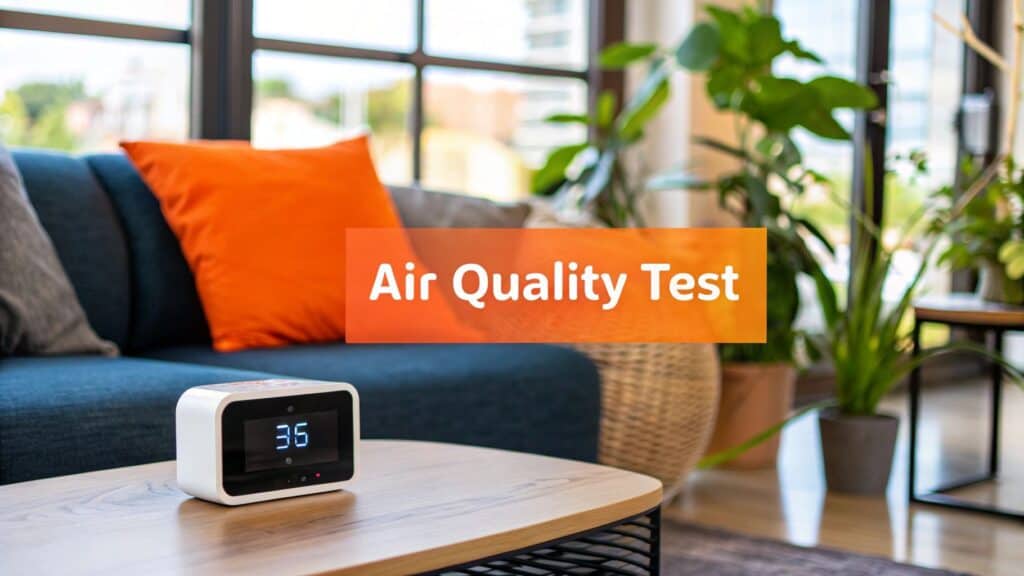
That sealed, cozy feeling in your home might come with a catch you can't see. Modern, energy-efficient homes in Orange County are great at keeping the temperature just right, but that tight seal can also trap a surprising amount of indoor pollutants. A professional home air quality testing service is the only way to get clear, real answers about what's in your air, so you can make sure your home is the healthy sanctuary it should be for your family.
What Every Orange County Homeowner Needs to Know About Indoor Air
So many of us in Southern California have invested in making our homes beautiful, comfortable, and energy-efficient. While these upgrades are fantastic, they can unintentionally turn our homes into containers for airborne contaminants. Without proper ventilation, pollutants from everyday furniture, cleaning products, and even cooking can build up to unhealthy levels.
This is why paying attention to your home's air quality has become a critical part of a healthy lifestyle, not just a minor detail. Things that seem totally unrelated—like stubborn allergies, constant headaches, or feeling tired all the time—can often be traced directly back to the air you're breathing day in and day out. There's even a term for it: 'Sick Building Syndrome,' which perfectly describes how an indoor space can directly affect your well-being.
The Growing Importance of Clean Indoor Air
For a long time, the conversation about air quality was all about outdoor smog. Now, we know the air inside our homes is a huge part of the picture. The latest findings show that indoor air quality is a major public health concern. As of 2025, a shocking 36% of the global population is exposed to fine particulate matter at levels that are well above what health guidelines recommend.
For homeowners in Orange County, this is a wake-up call. It means that even the cleanest, most well-kept properties can hide invisible threats in the air. Taking proactive steps, starting with getting your air professionally tested, is essential for protecting your family and your investment.
At Sparkle Restoration, we believe that a truly luxurious home is a healthy one. As IICRC Master Certified experts, identifying and addressing hidden air quality issues is the first step toward creating an environment where your family can thrive, not just reside.
Taking the First Step Toward a Healthier Home
Knowing the risks is one thing, but taking action is what really counts. A professional home air quality testing assessment gives you the hard data you need to stop guessing and start making smart decisions. It takes you from simply worrying about what might be in your air to having a clear plan to fix it.
Once you understand the specific contaminants you're dealing with, you can take meaningful steps to protect your family’s health. Whether the solution is fixing a hidden moisture problem, improving your home's ventilation, or finding the source of chemical off-gassing, the goal is always the same: to turn your home into a truly safe and restorative space. You can learn more about the common sources and effects of indoor air pollution in our detailed guide. This knowledge is what empowers you to maintain not just a beautiful home, but a genuinely healthy one.
Identifying Invisible Threats in Your Southern California Home
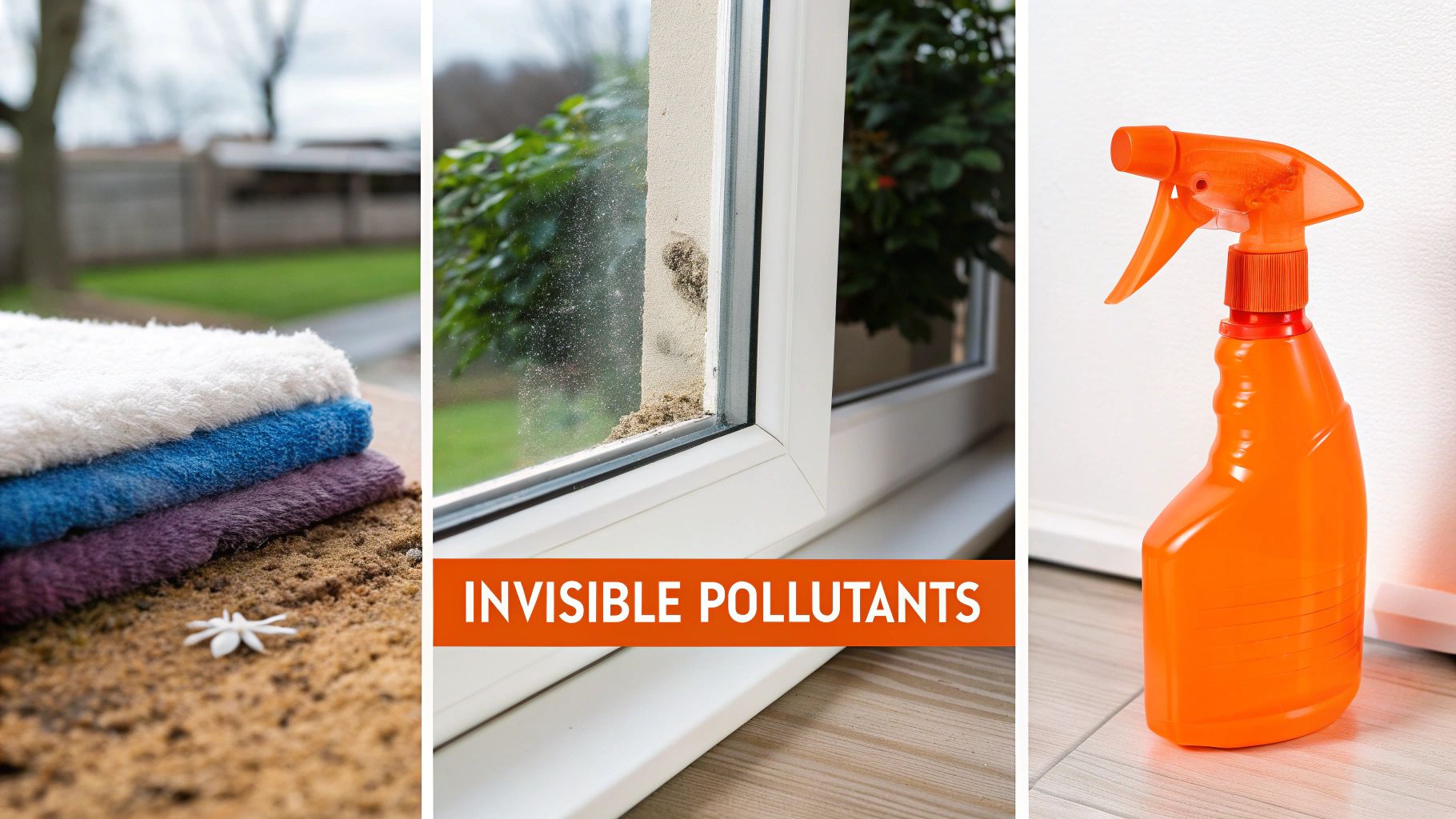
It’s easy to think your home’s air is clean when you can’t see any dust hanging in the sunlight. But the truth is, many of the biggest threats to your air quality are completely invisible. These pollutants float around undetected, and over time, they can have a real impact on your family’s health without you ever knowing the source.
Understanding what these threats are is the first real step toward creating a healthier living space. Let's break down the common culprits into three main groups. Think of them as different types of unwanted guests, each with its own story and way of getting into your home.
Biological Contaminants: The Unseen Guests
This group covers anything that’s living or was produced by a living thing. Here in Orange County, our beautiful coastal climate can also mean higher humidity, creating the perfect breeding ground for some of these contaminants to move in.
- Mold Spores: Often the result of a hidden leak behind a wall or under a floor, mold releases tiny spores into the air. These can circulate through your entire house, triggering allergies and other respiratory problems.
- Pet Dander: We all love our pets, but their dander—which is just tiny flecks of skin—is a major allergen that gets trapped in carpets, furniture, and even your HVAC ductwork.
- Dust Mites & Pollen: These microscopic critters and outdoor allergens hitch a ride inside on clothes, pets, and open windows, quickly turning your home into a hotspot for sniffles and sneezes.
Chemical Pollutants: The Off-Gassing Effect
Many of the brand-new items we bring into our homes release chemical vapors into the air. This process, known as off-gassing, involves chemicals called Volatile Organic Compounds (VOCs). Exposure to them can lead to anything from nagging headaches to more serious long-term health issues.
Ever notice that “new house smell” after a remodel or when you unbox new furniture? That distinct odor is actually a cocktail of VOCs being released right into your air. While it might smell “new,” it’s a clear signal that your air quality is taking a hit.
You’d be surprised where these chemicals come from. They're in everyday items all around us:
- Paints and Finishes: A fresh coat of paint or newly stained cabinets can continue to release VOCs for weeks, and sometimes even months.
- New Furniture & Carpeting: The adhesives and materials used to make many new sofas, chairs, and carpets are major sources of formaldehyde and other VOCs.
- Household Cleaning Products: That blast from an aerosol spray, disinfectant, or even a plug-in air freshener can pump a high concentration of chemicals into your indoor air.
To help you get a better handle on what might be lurking in your home, here's a quick guide to some common pollutants and where they usually come from.
Common Indoor Pollutants and Their Sources
| Pollutant Type | Specific Pollutant | Common Household Sources |
|---|---|---|
| Biological | Mold Spores | Damp areas, water-damaged drywall, leaky pipes, basements |
| Pet Dander | Dogs, cats, birds, and other household pets | |
| Dust Mites | Bedding, carpets, upholstered furniture, stuffed toys | |
| Chemical (VOCs) | Formaldehyde | Pressed wood products (particleboard), new furniture, carpeting, glue |
| Benzene | Paints, plastics, detergents, tobacco smoke | |
| Toluene | Paint thinners, adhesives, nail polish, synthetic fragrances | |
| Combustion | Carbon Monoxide (CO) | Gas stoves, furnaces, water heaters, attached garages, fireplaces |
| Nitrogen Dioxide (NO₂) | Unvented gas heaters, tobacco smoke, welding | |
| Particulate | Asbestos Fibers | Older insulation, vinyl flooring, popcorn ceilings (pre-1980s) |
| Lead Dust | Deteriorating lead-based paint, contaminated soil tracked indoors |
This table is a starting point, but professional testing is the only way to know for sure what's in your air and at what levels.
Combustion Gases: The Silent Dangers
This last group includes gases that are created whenever fuel is burned. They are especially dangerous because you can't see or smell them, making detection impossible without the right equipment. The most critical one to watch out for is carbon monoxide (CO), which can leak from a faulty furnace, water heater, or even a fireplace.
In some of Orange County's older homes, asbestos is another hidden threat. It isn't a gas, but its dangerous fibers can be released into the air during renovations or DIY projects. To learn more about these specific risks, you can read up on the connection between asbestos and DIY home improvements and see why a professional assessment is so important.
A comprehensive home air quality testing service from a certified professional like Sparkle Restoration can pinpoint all of these invisible threats, giving you a clear, accurate picture of what you’re really breathing.
DIY Kits vs. Professional Testing: What Should You Choose?
When you first suspect something is off with your home’s air, figuring out the next step can feel a little paralyzing. Do you run out and grab a do-it-yourself kit from the hardware store, or is it time to bring in a certified expert? The right choice really hinges on understanding the difference between a quick, blurry snapshot and a full, high-definition diagnostic story.
The Snapshot View: DIY Home Air Quality Kits
Think of a DIY home air quality testing kit as a useful screening tool. It’s a lot like taking your own temperature when you feel sick—it gives you a basic heads-up that something might be wrong. These kits are easy to find and won't break the bank, offering a first peek at potential culprits like mold or certain chemicals.
But here's the catch: they have serious limitations. DIY kits just don't have the sensitivity or precision to give you a definitive diagnosis. It might flag the presence of mold, for instance, but it won’t tell you what kind, how concentrated it is, or, most importantly, where it’s coming from. This can often leave you with more questions than answers and isn't reliable enough for making big decisions about your home and health.
When to Trust the Experts
Professional testing, on the other hand, is like getting a complete diagnostic workup from a specialist. For any serious or lingering concerns—like unexplained health issues, stubborn odors, or an assessment after water damage—a professional service is the only way to get data you can truly count on.
An expert brings a whole lot more to the table than just a sample collector. A certified technician from a reputable company like Sparkle Restoration comes equipped with:
- Advanced Equipment: We use calibrated, scientific-grade instruments that can measure a wide spectrum of pollutants with pinpoint accuracy.
- Expert Interpretation: Our IICRC-certified professionals don't just hand you raw numbers. They analyze the data within the specific context of your home to pinpoint the root cause of the problem.
- Comprehensive Reporting: You get a detailed report that translates complicated lab results into plain English and lays out a concrete, actionable plan for fixing the issue.
The market for indoor air quality monitors is ballooning, with projections hitting $13.2 billion by 2035, thanks to new sensor tech and a bigger focus on health. While this boom means more consumer gadgets are available, for a real diagnosis, you still need professional-grade equipment and expertise. You can read more about this growing market and its technology over at FutureMarketInsights.com.
Choosing professional testing gives you peace of mind. It takes the guesswork out of the equation and ensures you’re investing in the right solution, not just wasting money on ineffective fixes based on incomplete information.
DIY vs Professional Air Quality Testing
Deciding between a DIY kit and calling a professional can be tough. This table breaks down the key differences to help you see which path makes the most sense for your situation.
| Feature | DIY Testing Kits | Professional Testing (Sparkle Restoration) |
|---|---|---|
| Accuracy & Scope | Basic screening for a limited range of common pollutants. Often lacks precision. | Comprehensive analysis using lab-grade equipment for a wide spectrum of issues. |
| Interpretation | Results can be confusing or vague, leaving you to guess the cause. | Expert analysis provides a clear diagnosis and identifies the root source. |
| Action Plan | Offers no guidance on how to fix the problem. | Includes a detailed report with a concrete, step-by-step remediation plan. |
| Cost | Low upfront cost ($10 – $150). | Higher initial investment, but provides long-term value and certainty. |
| Best For | General curiosity or as an initial, non-critical screening tool. | Serious health concerns, post-water damage, persistent odors, or real estate transactions. |
Ultimately, while DIY kits have a place, they can't provide the certainty needed when your family's health and safety are at stake.
The Clear Choice for Orange County Homes
While a DIY approach might seem like a tempting first step, it can be a risky shortcut when your family’s well-being is on the line. The shortcomings of these kits can lead to a false sense of security or, conversely, unnecessary panic. You can learn more about the potential traps of a DIY-first mindset in our guide on the dark side of DIY projects.
For discerning homeowners in Orange County who value certainty and expertise, professional home air quality testing is the clear choice. It’s a direct investment in your health, your property’s integrity, and the confidence that comes from knowing you’re creating the safest possible environment for your family.
Our Professional Testing Process From Start to Finish
Choosing a professional for your home air quality testing shouldn't feel like a shot in the dark. We believe in total transparency, so you feel confident and in the loop every step of the way. Our detailed, client-first process is designed to replace the chaos of uncertainty with the calm of a clear, actionable plan.
It all starts with an in-depth consultation. This is much more than a formality; it's where we genuinely listen to your concerns. Maybe it's a nagging odor you can't place, a sudden spike in allergies, or just general worry after a recent remodel. Understanding your home's story and your family's health is step one in tailoring our approach.
On-Site Assessment and Scientific Analysis
After our initial talk, one of our IICRC Master Certified technicians will visit your Orange County home for a thorough on-site assessment. Using specialized, calibrated equipment, we methodically collect air and surface samples from key areas. It's a precise science—we're gathering accurate data that paints a true picture of your home’s unique indoor environment.
From there, the samples are securely transported to an accredited, third-party laboratory. This is where they undergo serious scientific analysis to identify and measure a wide range of pollutants, from mold spores and bacteria to VOCs and other chemical irritants. This independent verification is crucial because it guarantees the results are unbiased and completely reliable. For a deeper dive into what pros look for, this guide on expert air quality tests for a safer home is a fantastic resource.
This infographic breaks down the difference between a simple DIY test and our comprehensive professional process.
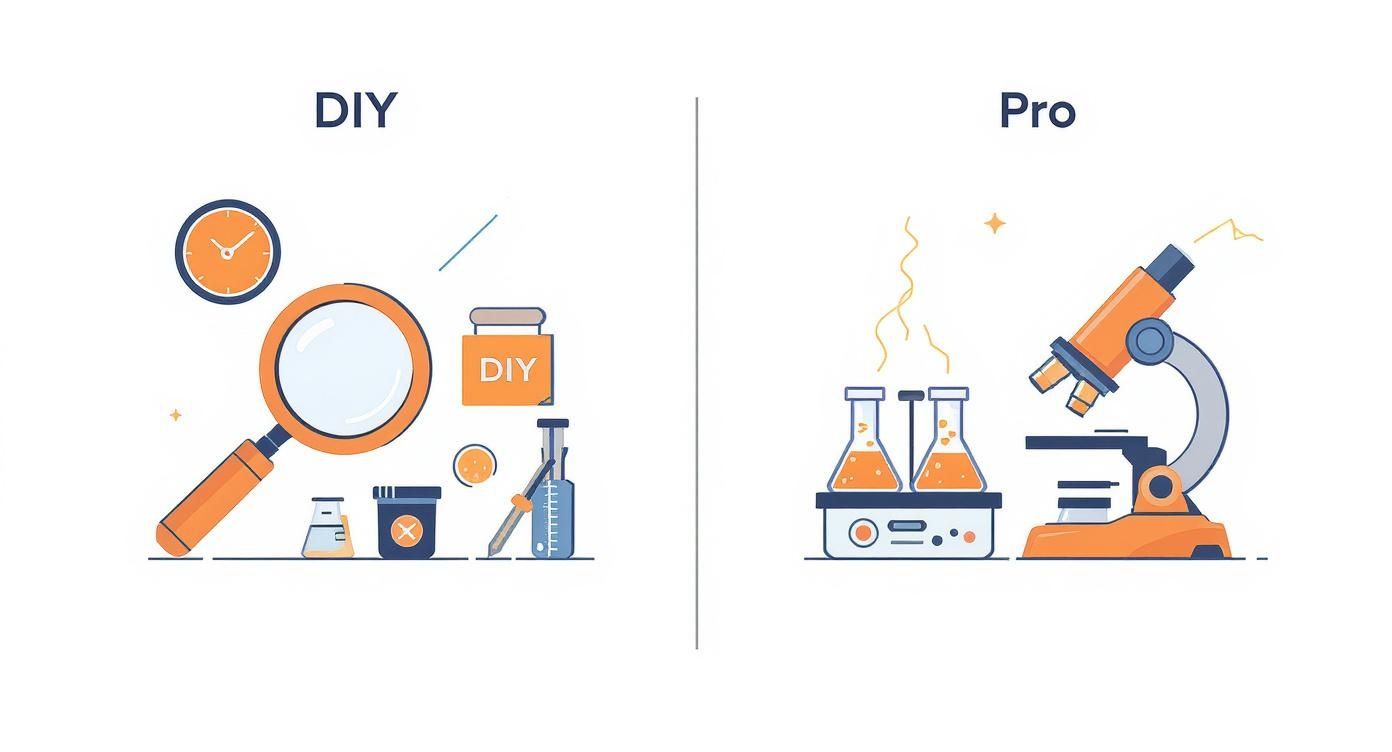
As you can see, professional testing involves critical steps like expert interpretation and lab analysis that you just don't get with a store-bought kit.
Your Comprehensive Report and Action Plan
The final—and most important—step is taking all that complex lab data and translating it into a report you can actually understand and use. We give you a comprehensive breakdown that clearly explains the findings, what they mean for your family's health, and a prioritized action plan.
Our goal is not just to deliver a report, but to provide a complete solution. We bridge the gap from diagnosis to resolution, giving you a clear path forward to a healthier home environment.
This plan might include recommendations for immediate cleanup, suggestions to improve ventilation, or insights into how your home's systems are impacting air quality. For instance, sometimes the fix involves a deep cleaning of your ventilation system, a crucial step we detail in our guide to professional HVAC system cleaning.
Because we're also a licensed General Contractor, we're in a unique position to not only pinpoint the problem but also to fix it with our own trusted, in-house teams.
How to Read Your Results and Create a Healthier Home
Getting your home air quality testing report back can feel a bit like trying to decipher a secret code. You’re staring at a page full of numbers, acronyms like VOCs, and intimidating terms like "spore counts." At Sparkle Restoration, we see our job as translating this complex data into a clear, straightforward story about your family's health.
It's helpful to think of the report not as a final grade, but as a roadmap. It shows you exactly where things stand right now so we can chart the best path forward to a healthier living space. Every single metric is a clue pointing toward a specific solution.
Decoding Key Air Quality Metrics
You don't need to be a scientist to understand what's going on. Getting a handle on a few key terms will empower you to see the story your report is telling. Here are some of the most common measurements and what they really mean for your home:
- Parts Per Million (PPM) for VOCs: This number measures the concentration of Volatile Organic Compounds floating in your air. A high PPM reading often points to chemicals off-gassing from new furniture, fresh paint, or even certain cleaning products. The immediate takeaway? Your home desperately needs better ventilation.
- Mold Spore Counts: This metric is crucial. It doesn't just count mold spores; it identifies the specific types and quantities. When we see elevated counts of certain species inside—especially when compared to the levels outside your home—it’s a massive red flag for a hidden moisture problem that needs to be addressed ASAP.
From Diagnosis to Actionable Solutions
The real power of professional testing isn't just in the numbers; it's in connecting those findings to real, effective actions. A diagnosis is only useful if it leads to a cure. Because we are both IICRC Master Certified restorers and Licensed General Contractors, we can provide the entire solution, not just a summary of the problem.
This all-in-one approach is more important than ever. The global market for indoor air quality testing services was valued at roughly $2.5 billion in 2025 and is on track to hit $4.2 billion by 2033. This surge shows just how many homeowners are waking up to the direct link between the air they breathe and their family's health.
A lab report tells you what the problem is. Our expertise tells you why it's happening and exactly how to fix it for good. We turn scientific data into a clear, stress-free action plan.
For example, if your report comes back with high mold levels, the solution isn't just to filter the air. You have to eliminate the source. This is where our deep knowledge of professional mold remediation provides a definitive, long-term fix. If high VOCs are the culprit, we can recommend everything from specific ventilation strategies to helping you choose low-VOC materials for your next remodeling project.
Once we’ve analyzed your results together, you can begin taking solid steps to improve your home’s air. A great place to start is by exploring these 10 proven methods for indoor air quality improvement. Our team is here to guide you every step of the way, turning the chaos of a confusing report into the calm of a healthy, safe, and beautiful home.
Common Questions About Home Air Quality Testing
Even after you get the rundown on air quality testing, it's completely normal for homeowners here in Orange County to still have questions. This is about your family's health and your home's well-being, so making a smart decision is everything. We've put together answers to the questions we hear all the time to give you the clear, straightforward advice you need.
Our job is to take the mystery out of home air quality testing so you feel confident about what to do next.
How Often Should I Test My Home's Air Quality?
As a good rule of thumb for general maintenance, we suggest getting a professional air quality test done every two to three years. This gives you a solid, healthy baseline for your home.
That said, some situations should have you picking up the phone right away:
- After any water damage: It doesn't matter if it was a big flood or a tiny leak. Hidden mold can pop up fast and wreck your air quality.
- Following a renovation: New building materials, paints, and flooring can release chemicals into the air. Plus, demolition kicks up all sorts of old dust and dormant particles.
- Before you buy a new house: You need to know what you're buying. A thorough test can uncover hidden problems before you sign on the dotted line.
- If your family has mystery symptoms: Are people suddenly dealing with allergies that won't quit, constant headaches, or breathing issues? That’s a huge red flag that your indoor environment is the culprit.
Will an Air Purifier Fix My Indoor Air Problems?
A good air purifier with a HEPA filter is a fantastic tool. It’s great at trapping particles already floating around, like dust, pollen, and pet dander. Think of it as playing defense.
But here’s the catch: an air purifier only treats the symptoms, it doesn't cure the disease. It can't stop chemicals from off-gassing from your new carpet, and it certainly can't kill a mold colony that's taken root inside a wall. Professional testing gets to the source of the problem, which then allows for a real fix—like professional mold remediation—that solves the issue for good.
Is Professional Air Quality Testing a Worthwhile Investment?
Without a doubt. When you invest in professional testing, you're really investing in your family's health and the long-term value of your home. Yes, it's more involved than a cheap DIY kit, but it gives you concrete answers that save you from massive headaches and costs later on.
An accurate diagnosis today helps you avoid the immense expense and stress of widespread mold damage, structural repairs, or chronic health problems in the future. It’s about proactive protection, not reactive panic.
Our clear pricing and detailed reports are all about giving you genuine peace of mind, making sure every dollar you spend goes toward a solution that actually works and lasts.
What Makes Sparkle Restoration's Services Different?
The biggest thing that sets us apart is that we handle everything, from start to finish. We're an IICRC Master Certified firm, but we're also a Licensed General Contractor. That means we don't just drop a lab report in your lap and wish you luck. We see the entire project through.
We start by translating the scientific data into a plan you can actually understand. Then, and this is the important part, we have our own certified, in-house teams ready to get to work. Whether the solution is precise mold removal, cleaning out your entire HVAC system, or doing a full-scale healthy home remodel, we're the only call you need to make. We're your single partner from the initial diagnosis to the final, beautiful result.
Ready to get some clarity and make sure your Orange County home is the safe haven it should be? The experts at Sparkle Restoration Services are here to help. Schedule your professional home air quality testing consultation today and take the first step toward turning chaos into calm, fast. Learn more and book your appointment at https://www.sparklerestoration.com.
Ready to create a space that’s as beautiful as it is functional? Schedule your complimentary design consultation today by visiting Ready to Work with Sparkle?