



Picking the right general contractor is the single most important decision you’ll make for your Orange County remodel or restoration. Get it right, and the process is exciting and rewarding. Get it wrong, and you’re in for a world of stress and costly headaches.
Your goal here is to find a genuine partner, not just a builder. This means digging in, verifying their credentials, asking the tough questions, and really analyzing their bids. It’s this upfront due diligence that protects your investment and ensures your vision becomes a stunning reality.
Your Foundation for a Successful Remodel
When you decide to start a high-end remodel or a critical restoration, you’re making a significant investment in your property. The contractor you bring on board will either turn your vision into a masterpiece or create a stressful, costly mess. In a competitive market like Southern California, knowing how to choose a general contractor isn’t just about finding someone who can swing a hammer—it’s about finding a professional who shares your standards for quality, communication, and integrity.
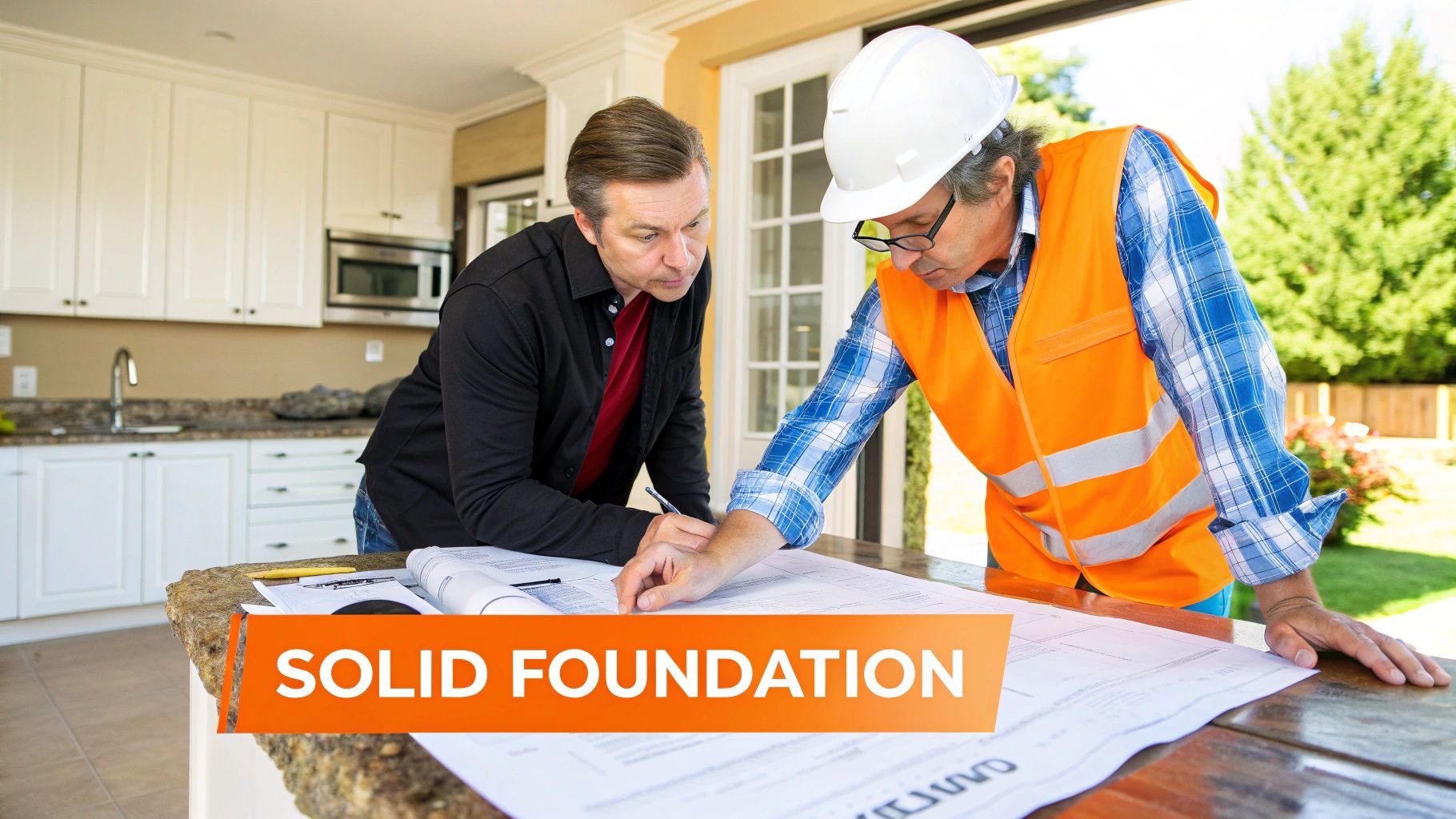
This guide is filled with authoritative, practical advice. We’re giving you a clear, actionable game plan for vetting and selecting a contractor worthy of your trust and your home.
Why a Methodical Approach Matters
The U.S. construction industry is a behemoth, clocking in at $2.2 trillion in annual spending. It’s made up of roughly 3.7 million businesses, but the vast majority are small operations or even one-person shows. With that many players in the game, the difference in quality, reliability, and professionalism from one contractor to the next can be staggering.
A methodical approach is your filter. It helps you cut through the noise and spot the true professionals. As you get started, it’s essential to understand how to find good renovation contractors who have a track record of bringing visions like yours to life.
For homeowners in communities like Newport Beach, Laguna Beach, and Irvine, the stakes are even higher. Your home isn’t just a building; it’s one of your most valuable assets. A poor choice in a contractor can lead to a cascade of problems:
- Budget Overruns: Vague contracts or inexperienced project management are a recipe for costs spiraling out of control.
- Endless Delays: Poor scheduling and a failure to manage subcontractors can leave your home a chaotic construction zone for months longer than planned.
- Subpar Craftsmanship: Cutting corners on materials or hiring unqualified labor always shows in the final product, ultimately hurting your home’s value.
- Legal & Liability Issues: The moment you hire an unlicensed or uninsured contractor, you open yourself up to massive financial and legal risks.
The success of your remodel really boils down to due diligence. The time you invest upfront—verifying licenses, calling references, and asking pointed questions—is the absolute best way to protect your project and give yourself peace of mind.
To simplify the initial screening process, we’ve put together a quick checklist of the absolute must-haves.
Quick Vetting Checklist: Key Contractor Qualifications
Before you even schedule a meeting, a contractor must be able to check these fundamental boxes. Think of this table as your first line of defense—if a contractor fails on any of these points, it’s a clear signal to move on.
| Qualification | What It Means for You | Why It’s Non-Negotiable |
|---|---|---|
| State Contractor’s License | Proof they meet California’s legal and competency standards for construction. | An unlicensed contractor is working illegally, putting you at extreme financial and legal risk. There’s no recourse if things go wrong. |
| General Liability Insurance | Covers property damage or injuries that occur on your property during the project. | Without it, you could be personally liable for accidents, turning a remodel into a potential lawsuit. |
| Workers’ Comp Insurance | Covers injuries to the contractor’s employees while they’re working on your home. | If an employee gets hurt and the contractor isn’t covered, you could be sued for their medical bills and lost wages. |
| Contractor’s Bond | A financial guarantee that protects you if the contractor fails to finish the job. | The bond provides a safety net, ensuring you aren’t left with an unfinished project and financial loss. |
Running through this checklist early will save you a ton of time and help you focus only on qualified, professional candidates.
This guide is your roadmap. Follow these steps, and you’ll be ready to confidently choose a general contractor who will be a true partner in your project. At Sparkle Restoration Services, our goal is to help you manage your remodeling and construction projects with clarity, ensuring a smooth and successful experience from the first nail to the final walkthrough.
Verifying Licenses, Insurance, and Certifications
Before you think about inviting a contractor into your home for a quote, your first move should be to vet them online. This isn’t just a suggestion—it’s the single most important step you can take to protect yourself from fraud, poor workmanship, and significant financial and legal trouble. A true professional expects this and will have all their credentials readily available for inspection.

Think of this initial due diligence as your best defense. It’s how you quickly filter out the unqualified players and build a shortlist of contractors who meet the minimum legal standards to work on high-value homes here in Orange County.
Checking the CSLB License
In California, the law is crystal clear: any construction or remodeling project valued at $500 or more (that includes both labor and materials) must be done by a licensed contractor. The California State Licensing Board (CSLB) is the governing agency, and their website is an invaluable resource.
Just head over to the CSLB’s “Instant License Check” tool. You can search by the contractor’s license number, their name, or their business name. Here’s what you need to look for:
- License Status: It must say “Active” and be in good standing. If you see “Expired,” “Suspended,” or “Revoked,” it’s an immediate red flag. Move on.
- Classification: For any significant remodel or restoration, you want to see a Class “B” General Building Contractor license. This is critical because it means they are legally permitted to manage projects that involve multiple different trades (plumbing, electrical, drywall, etc.).
- Bonding Information: The record should show that the contractor has an active bond. This is a small but important layer of financial protection for you.
- Disciplinary Actions: The CSLB will list any complaints or disciplinary actions filed against the license. A clean record speaks volumes about their professionalism.
To really dig into this, we’ve put together a detailed guide on the importance of a CSLB license for your protection. It walks you through the whole verification process so you can check out any contractor with confidence.
Confirming Adequate Insurance Coverage
A license is just one piece of the puzzle. If a contractor doesn’t have the right insurance, you—the homeowner—could be on the hook for accidents, injuries, or property damage. Never take their word for it. Always ask for a current Certificate of Insurance (COI) and then call the insurance agent listed to verify the policies are active.
There are two types of insurance that are absolutely non-negotiable:
- General Liability Insurance: This is what covers accidental property damage or injuries to other people (like your neighbor or a visitor) during the project. For the high-end homes in Orange County, you should be looking for a minimum coverage of $2 million. This amount provides a solid safety net for complex projects and valuable properties.
- Workers’ Compensation Insurance: This is a legal must-have for any contractor who has employees. It covers medical bills and lost wages if one of their workers gets hurt on your property. If they don’t have it, you could be sued and held personally responsible for those costs.
Hiring a contractor without proper insurance is like leaving the front door of your multi-million dollar home wide open. The potential financial and legal risks are simply too great to ignore.
The Mark of True Expertise: Advanced Certifications
While a license and insurance are the minimum requirements, advanced certifications are what separate the real pros from the rest. They demonstrate a commitment to ongoing education and a deep understanding of industry best practices.
When it comes to restoration projects involving water, fire, or mold, certifications from the Institute of Inspection, Cleaning and Restoration Certification (IICRC) are the gold standard. A firm that has achieved IICRC Master Certified Firm status, like Sparkle Restoration Services, is at the absolute top of the field.
Keep an eye out for specific credentials like:
- IICRC Master Water Restorer: This signals elite expertise in handling even the most complex water damage situations.
- IICRC Master Fire & Smoke Restorer: This shows they have mastered the art of soot removal, odor control, and structural cleaning after a fire.
- IICRC Master Textile Cleaner: This demonstrates advanced skill in restoring high-value items like carpets, upholstery, and fine fabrics.
These certifications aren’t just badges. They are proof that a company has invested heavily in the training, knowledge, and specialized equipment needed to do the job right. This kind of expertise is invaluable, ensuring your home isn’t just patched up, but properly restored to a condition that is safe, healthy, and beautiful. Companies like Sparkle Restoration Services bring a level of authority and skill that a standard contractor simply can’t match.
Asking the Questions That Reveal a Contractor’s True Caliber
You’ve done the initial legwork. You have a shortlist of contractors who are properly licensed and insured. Now comes the most critical part: the interview. This is where you move beyond the paperwork and get a real feel for their professionalism, communication style, and how they handle pressure.
Don’t waste this opportunity with generic questions. You need to dig deeper. Your goal is to understand how they really operate, especially when things inevitably go off-plan. This conversation is what separates a decent builder from a true project partner.
Probing Their Process for Project Management and Communication
A seamless project lives and dies by organization and communication. It’s that simple. A top-tier general contractor won’t just wing it; they will have proven systems in place to keep your project moving and to keep you informed every step of the way. If their answers here feel vague, consider it a major red flag.
Get specific about their process:
- “What project management software do you use to keep clients in the loop on progress, timelines, and budget?” You’re listening for names like CoConstruct, Buildertrend, or another professional-grade platform. An answer like, “Oh, we just text and email,” should give you pause. That’s a recipe for missed details and frustrating delays.
- “What’s your typical communication rhythm? Should I expect a weekly summary, or do you update as you hit key milestones?” A pro will already have a clear, proactive plan for keeping you updated. This isn’t just about information; it’s about giving you peace of mind and reducing stress.
- “Who is my day-to-day point of contact on-site? And who is their backup if they’re unavailable?” You need to know exactly who to call with a question. This establishes clear lines of communication and accountability from the very beginning.
These questions aren’t just about logistics; they reveal a contractor’s commitment to a structured, client-focused experience. When a contractor invests in professional systems and clear communication protocols, they’re showing respect for your investment and your time. To get a sense of the philosophy behind this kind of client care, you can learn more about the principles that guide our own team, as shared by our founder.
Assessing Their Crew and Subcontractor Network
A general contractor is a manager. Their success is completely dependent on the quality of the tradespeople they bring onto your property. Any established Orange County contractor worth their salt will have a vetted network of trusted plumbers, electricians, and artisans they’ve relied on for years.
This is more critical now than ever. The construction industry is facing immense workforce challenges. Labor shortages are a real threat, potentially costing the industry nearly $124 billion in lost output simply because of unfilled jobs. A contractor who can navigate this reality by maintaining solid relationships with reliable subs is demonstrating a huge operational advantage. You can dig into these construction industry workforce insights on AGC.org.
Ask questions that pull back the curtain on their team:
- “How long have you been working with your go-to plumber, electrician, and drywall crew?” Look for long-term relationships—five years or more is a great sign. It points to stability, consistent quality, and mutual respect. High turnover could be a red flag for poor management or payment problems.
- “Are all of your subcontractors licensed and insured to the same standard as your company?” The only acceptable answer is an immediate, confident “yes.” Any hesitation here is a complete deal-breaker. Anything less exposes you to massive liability.
- “How do you handle quality control with your subs’ work?” A great GC doesn’t just hire a sub and walk away. They are actively on-site, supervising the work, inspecting the details, and holding everyone accountable to the highest standards of craftsmanship.
Uncovering Problem-Solving Skills and Local Savvy
Every remodeling project has its surprises, especially in the beautiful older homes scattered across Orange County. You don’t want a contractor who panics at the first sign of trouble. You want a seasoned pro who sees challenges as puzzles to be solved with expertise and a level head.
Test their thinking with a real-world scenario:
“Let’s say during demolition for a kitchen remodel in a Newport Beach home, your crew finds extensive, hidden water damage and what looks like mold behind the old cabinets. What’s your immediate protocol?”
A strong answer won’t be about a quick fix. It should involve immediately stopping work in that area to prevent contaminating the rest of the house, calling in a certified specialist (like an IICRC-certified firm) for proper assessment, and then clearly communicating the findings, your options, and the budget impact to you before taking another step. This shows they prioritize safety and transparency over just pushing the job forward.
Finally, test their local knowledge. Navigating the permitting process in Irvine is different from Laguna Niguel. Ask them directly, “Can you walk me through your experience with the permitting department in my city?” Their ability to speak confidently about the specific people, processes, and potential pitfalls in your local jurisdiction is a dead giveaway of their deep experience in the Orange County market.
How to Analyze Bids and Project Costs
Once the interviews are done, you’ll likely have a small stack of proposals. This is where the decision-making gets real, but it’s also where many homeowners feel overwhelmed. Trying to compare a handful of bids, each with different line items and bottom-line numbers, is confusing.
Resist the urge to immediately jump to the lowest number. A price that seems too good to be true almost always is. It’s often a sign that a contractor is cutting corners on materials, using uninsured labor, or worse, planning to bombard you with expensive change orders once the project is underway. A truly professional bid is a transparent, detailed document that shows they’ve done their homework—not just a lowball number to get their foot in the door.
Decoding the Anatomy of a Strong Bid
A quality bid is your project’s roadmap. It should be crystal clear, leaving very little room for misinterpretation. A vague, one-page estimate is a massive red flag and should be discarded immediately.
When you’re comparing proposals, you’re looking for granular detail. A strong bid will always itemize costs for:
- Labor: This shouldn’t be a single number. It needs to specify the costs for the contractor’s crew and any subcontractors they plan to bring in.
- Materials: A pro bid lists specific materials, not just generic terms like “tile” or “fixtures.” It might also include allowances, which are budget placeholders for items you’ll pick out later, like faucets or lighting.
- Permits: The cost for pulling all the necessary city and county permits should be clearly laid out.
- Contingency: A seasoned contractor knows that unexpected things happen. They’ll typically include a contingency fund of 10-15% to cover unforeseen issues, like discovering faulty wiring behind a wall during demolition.
A detailed bid isn’t just about the money; it’s a direct reflection of a contractor’s professionalism. It proves they’ve thought through every phase of your project and are committed to clear communication from day one.
This whole vetting process, from verifying credentials to analyzing bids, is a funnel. You start wide and narrow it down to the best fit.
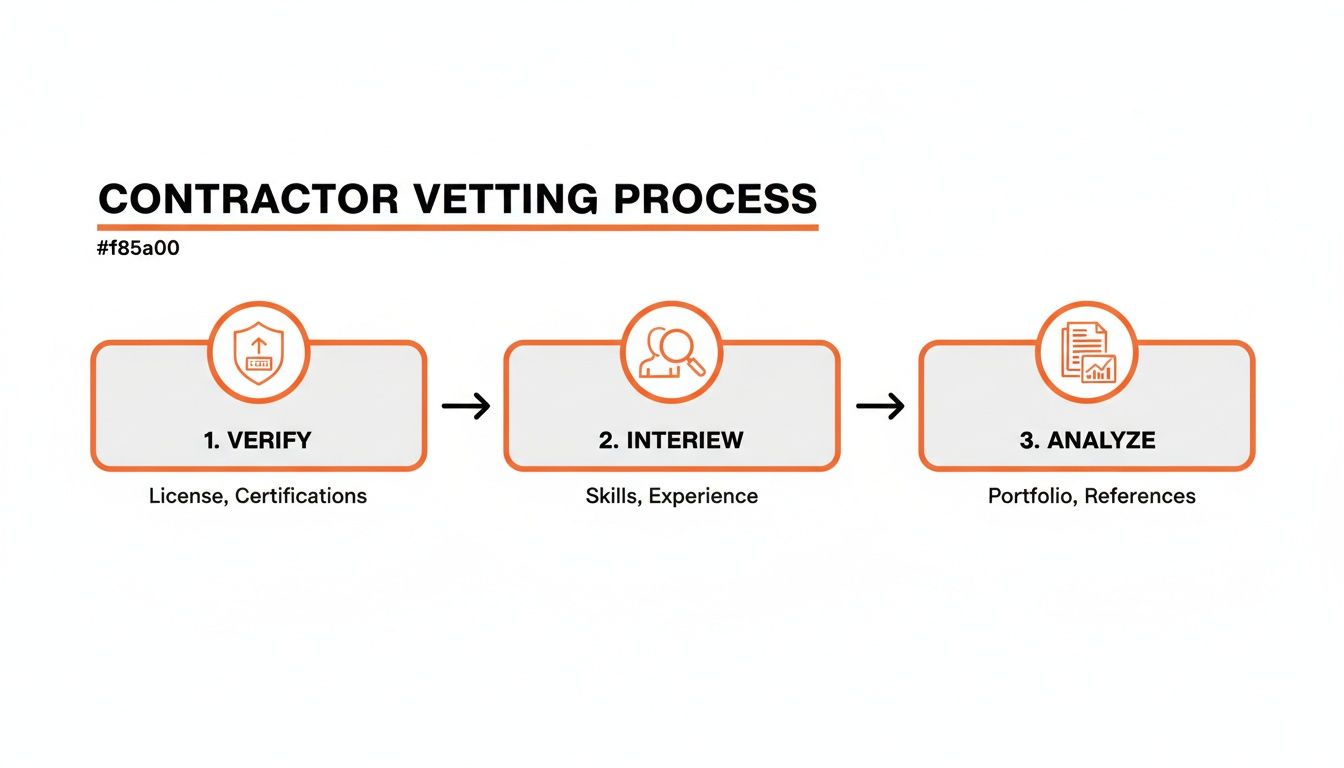
As you can see, analyzing the bids is the final, critical step after you’ve already done the legwork of checking licenses and conducting thorough interviews.
Comparing Contractor Bids Apples to Apples
To truly compare bids, you need to break them down side-by-side. A simple spreadsheet is your best friend here. List each contractor and create columns for the major cost categories like labor, materials, permits, and contingency. This visual comparison will immediately highlight where the numbers differ and help you ask smarter questions.
| Bid Component | What to Look for in a Strong Bid | Red Flag Example in a Weak Bid |
|---|---|---|
| Material List | Specific brands, models, and quantities (e.g., “320 sq. ft. of Provenza MaxCore LVP, color…”). Includes material allowances. | Vague terms like “new flooring” or “kitchen fixtures.” |
| Labor Costs | Broken down by trade (e.g., plumbing, electrical, framing) with estimated hours or flat rates. | A single, unexplained lump sum for “Labor.” |
| Permit Fees | Explicitly lists the costs for all required city and county permits for the project scope. | “Permits to be handled by homeowner” or no mention at all. |
| Contingency Fund | A clearly stated percentage (10-15%) set aside for unforeseen issues that may arise during construction. | A 0% contingency, suggesting an unrealistic, best-case-scenario budget. |
| Payment Schedule | A milestone-based schedule (e.g., 10% deposit, 30% after framing, 30% after drywall, final 30% at completion). | A large upfront deposit demand (over 10% of the project cost). |
| Timeline | A realistic, detailed schedule with key milestones and an estimated completion date. | An overly optimistic timeline that doesn’t account for inspections or potential delays. |
This kind of detailed analysis ensures you’re choosing a partner based on value and transparency, not just a seductive but unrealistic price tag.
Today’s market adds another layer of complexity. With material costs fluctuating and tariffs impacting supply chains—the effective tariff rate for construction goods recently hit a 40-year high—an experienced contractor is invaluable. They have strong supplier relationships and know which alternative materials can keep your budget from spiraling. You can dig deeper into these factors with this construction industry analysis from Deloitte.
If a bid seems thin on details, don’t hesitate to ask for clarification. A great contractor will be happy to walk you through their numbers. If they get defensive or can’t justify their costs, that tells you everything you need to know.
Seeing how a contractor has managed complex budgets on real-world projects can also build confidence. Take a look through a gallery of completed Orange County remodeling projects to see the kind of polished results that come from meticulous financial planning.
In the end, the right bid isn’t the cheapest one. It’s the one that’s the most thorough, transparent, and realistic.
Understanding Your Construction Contract
You’ve done the interviews, checked the references, and picked your top candidate. Now comes the most important document in the entire process: the construction contract. A handshake and a verbal agreement are never enough. A detailed, legally sound contract is your ultimate protection for your home, your investment, and your sanity.

This document is so much more than a formality. It’s the legally binding playbook that dictates every single aspect of your project. Before you even think about signing, you need to understand what’s in it and make sure it protects you from common headaches like blown budgets and endless delays.
The Anatomy of a Rock-Solid Contract
A professional contract leaves zero room for misinterpretation. It should be a comprehensive document that clearly spells out everyone’s rights and responsibilities. If a contractor hands you a simple, one-page agreement, that’s a massive red flag. It tells you they aren’t serious about protecting you or themselves.
Your contract absolutely must include these non-negotiable elements:
- A Detailed Scope of Work: This is the heart and soul of the agreement. It needs to list everything that will be done, right down to specific materials, brands, and model numbers. A vague line like “install new kitchen cabinets” is a recipe for disaster. It should specify the manufacturer, style, finish, and hardware.
- The Payment Schedule: This section lays out when and how your contractor gets paid. A pro will always structure payments around project milestones (e.g., after demolition, after framing is complete, etc.), not arbitrary dates. Remember, in California, it’s illegal for a contractor to ask for a down payment of more than 10% of the total contract price or $1,000, whichever is less.
- Projected Timeline and Key Milestones: The contract must have a firm start date and a projected completion date. Just as important, it should map out the key milestones along the way so you have a clear roadmap of the project’s pace.
These core components build a framework of accountability. They get everyone on the same page from day one, which is the foundation of any successful project.
Protecting Your Budget from Scope Creep
One of the most common ways a budget gets derailed is by “scope creep”—when small changes and additions slowly inflate the project’s final cost. This is where a formal change order process is your best friend.
The contract must state exactly how changes will be handled. A proper change order is like a mini-contract. It details the new work, the added cost (or credit), and any impact on the timeline. Crucially, it must be signed by both you and the contractor before any of that new work begins.
Without a formal change order process, you’re leaving the door wide open for surprise bills at the end of the job. A contractor who wants to handle changes with a verbal “okay” is not looking out for your financial interests.
This formal process prevents misunderstandings and keeps you in complete control of your budget. It turns a potential point of conflict into a transparent, documented agreement.
Final Safeguards: Lien Waivers
Lastly, your contract needs to address lien waivers. A lien waiver is a document signed by a contractor, subcontractor, or supplier, giving up their right to place a lien on your property once they have been paid.
Here’s a real-world scenario to show you why this matters: You pay your general contractor in full for those beautiful new quartz countertops. But what if they “forget” to pay the countertop supplier? That unpaid supplier could then place a mechanic’s lien on your home, which clouds your property title and could force you to pay for the countertops a second time just to get it removed.
To prevent this nightmare, the contract must require the general contractor to provide you with lien waivers from all major subcontractors and material suppliers as payments are made. This is your proof that everyone is getting paid, giving you the final layer of financial protection and true peace of mind.
Your Trusted Partner in Orange County Construction
Choosing the right general contractor isn’t just about hiring someone to build something; it’s about finding a true partner to protect your home and bring your vision to life. This guide has walked you through the critical steps—from checking credentials to dissecting contracts. These aren’t just abstract “best practices” for us; they are the non-negotiable standards we operate by every single day at Sparkle Restoration Services.
Our entire philosophy is built on a rock-solid foundation of proven expertise and unwavering ethics. We firmly believe that homeowners in Orange County deserve a contractor who values complete transparency and has an absolute commitment to quality craftsmanship.
The Sparkle Standard of Excellence
For our team, excellence isn’t just a goal; it’s our starting point. This commitment is clear in the credentials we proudly maintain and the recognition we’ve earned in our community. When you choose to work with us, you’re partnering with a firm that holds:
- An IICRC Master Certification, representing the highest possible level of expertise in the restoration industry.
- A B-General Contractor License, fully vetted and in good standing with the California State Licensing Board.
- The prestigious BBB Torch Award for Ethics, a powerful testament to our deep-rooted commitment to integrity on every single project.
We’ve built our reputation by turning chaos into calm, beautiful outcomes, whether that’s a complex water damage restoration or a high-end kitchen remodel. Our client-first approach means we manage every detail with precision, ensuring the process is as seamless as the final result is stunning.
Peace of mind comes from knowing your contractor has a verifiable track record of excellence and integrity. It’s the confidence that your investment is in the hands of true professionals who will treat your home as if it were their own.
For those in the area, it’s always a good idea to explore local resources. You can Find local experts in Orange who are familiar with the unique character and building codes of our communities.
Your home is likely your most valuable asset. It deserves a partner who has proven their dedication to both exceptional craftsmanship and client satisfaction, time and time again. If you value integrity and expertise as much as we do, we invite you to schedule a consultation and discover the peace of mind that comes from working with a true industry leader.
Your Top Questions Answered
When you’re preparing for a major remodel or restoration, you’re bound to have questions. It’s a big undertaking. Here are some of the most common ones we hear from homeowners and property managers throughout Orange County, along with some straightforward answers from our experience.
What Is the Difference Between a General Contractor and a Handyman?
This is a critical distinction, both for the success of your project and for legal reasons. Think of it this way: a licensed general contractor (with a Class “B” license in California) is equipped to be the CEO of your project. They can legally manage complex jobs involving multiple trades—like plumbing, electrical, and structural work—and are required to carry substantial insurance and pull all the necessary permits.
A handyman, on the other hand, is great for small-scale repairs and maintenance. But California law is very clear: they are legally limited to jobs totaling less than $500 for both labor and materials. Anything bigger, more complex, or requiring a permit absolutely demands a licensed general contractor. It’s not just a good idea; it’s the law.
How Many Bids Should I Get for My Project?
For a high-value remodel, the sweet spot is usually three detailed bids from contractors you’ve already thoroughly vetted. This gives you enough information to get a solid feel for the market without getting bogged down in analysis paralysis.
Fewer than three bids won’t really give you a clear comparison, while trying to manage more than three can just create confusion. Remember, the goal isn’t just to find the lowest price. It’s to compare the level of detail, the transparency of the proposal, and the overall professionalism of each company.
What Are the Biggest Red Flags When Hiring a Contractor?
There are a few warning signs that should make you pause immediately. A huge one is a demand for a large cash payment upfront. California law is strict on this, limiting down payments to just 10% of the total contract price or $1,000—whichever is less.
Be on the lookout for other red flags, too:
- They can’t (or won’t) provide a physical business address or proof of current licensing and insurance.
- The contract they present is vague, incomplete, or looks unprofessional.
- You feel high-pressure sales tactics pushing you to sign on the spot.
- The bid is dramatically lower than the others. An unusually low price often means corners will be cut or cheap materials will be used.
Why Is Hiring a Local Orange County Contractor Important?
Hiring a contractor who is truly local to Orange County offers very real, practical advantages. A local pro has spent years building relationships with the best local subcontractors and suppliers, which translates directly to quality and reliability on your job site.
Even more importantly, they live and breathe the local building codes and permitting processes for cities like Newport Beach, Irvine, and Laguna Niguel. This insider knowledge is priceless for navigating inspections smoothly and avoiding the kind of frustrating, costly delays that can derail a project.
Your home is likely your most significant investment, and it deserves a partner who is as committed to excellence and integrity as you are. The team at Sparkle Restoration Services has built our reputation on these very principles, delivering exceptional results for discerning clients all across Orange County. If you’re ready to transform your space with a team you can truly trust, schedule your complimentary consultation today.