



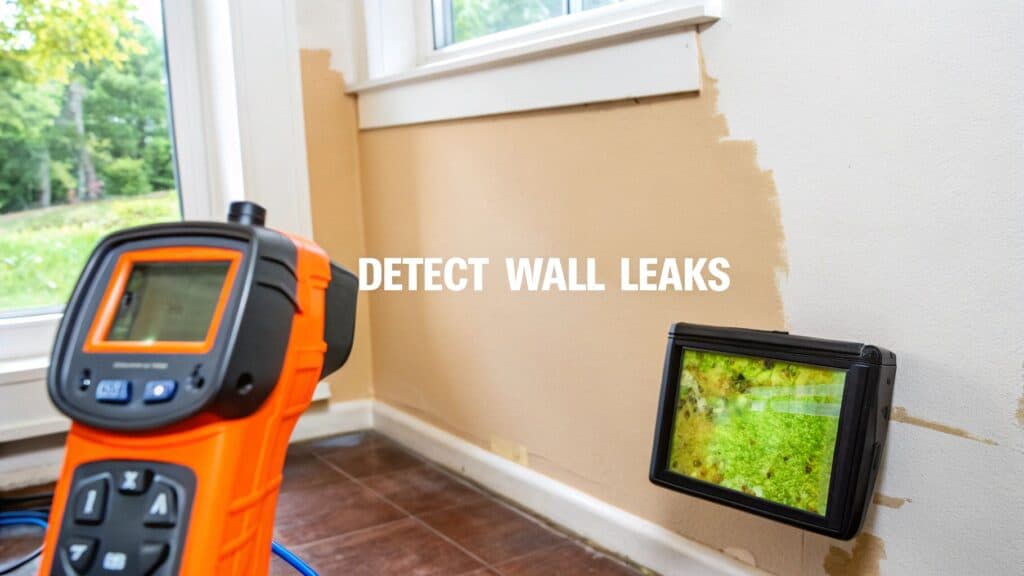
It often starts with your senses. An odd stain on the drywall that wasn't there last week. The subtle bubbling or peeling of expensive paint in a corner. Sometimes, it's a sound you can barely hear—a faint, persistent dripping that seems to come from nowhere. And then there's that unmistakable musty smell, a dead giveaway that moisture is hiding where it shouldn't be.
Trusting these initial gut feelings is the first and most important step in protecting your property. For discerning homeowners in Orange County, acting quickly can be the difference between a simple repair and a major restoration project. This guide will help you understand how to detect water leaks in walls and when to call in a professional to protect your investment.
The Hidden Dangers of Wall Water Leaks
An undetected water leak is far more than just a little water; it's a silent threat to your home's structural integrity and the health of your family. What starts as a tiny drip behind your living room wall can quietly escalate, ruining luxury finishes and creating incredibly costly, complex problems. For discerning homeowners here in Orange County, understanding these risks is fundamental to protecting your most valuable asset.
The sources are often the usual suspects. Aging copper pipes, failing window seals letting in the rain, or a slow leak from the upstairs master bath can all be the culprit. While they might seem minor at first, the cumulative damage can be absolutely devastating.
The True Cost of a Hidden Leak
It's what you can't see that poses the real danger. Trapped moisture is a wrecking ball for your home's interior structure. It soaks into insulation, turning it into a useless wet sponge, and slowly rots the wooden studs that frame your house. Worse, it creates the perfect dark, damp environment for mold to explode.
A single, ignored wall leak in a high-value Orange County residence can easily spiral into thousands of dollars in structural repairs and specialized remediation. The national numbers are shocking—an estimated 2 trillion gallons of treated drinking water are lost each year in the U.S., much of it from these slow, hidden leaks inside homes.
At Sparkle Restoration Services, our IICRC Master Certified team has seen it all. A small, ignored stain that a homeowner hoped would just dry out can turn into a full-scale restoration project within weeks. Proactive detection isn't just about good maintenance; it's about preserving your property's value and ensuring your home remains a safe, healthy sanctuary.
Before we get into the high-tech tools, let's cover the basics. Here’s a quick rundown of the tell-tale signs that should put you on high alert.
Early Warning Signs of a Water Leak in Your Wall
| Sign | What to Look For | Why It's a Concern |
|---|---|---|
| Visual Stains | Yellow, brown, or copper-colored spots or streaks on walls or ceilings. | Indicates water is soaking through the drywall from behind, often carrying minerals and rust from pipes. |
| Texture Changes | Bubbling, peeling, or blistering paint or wallpaper. Soft, sagging, or bulging drywall. | This is a clear sign that moisture is trapped behind the surface, causing the materials to lose their integrity. |
| Musty Odors | A persistent damp, earthy, or mildew-like smell, especially in enclosed areas like closets. | This odor is produced by mold and mildew growth, which thrives in damp, dark spaces behind walls. |
| Audible Drips | Faint but consistent dripping, running, or hissing sounds coming from within a wall. | An obvious sign of an active leak. The sound can be from a dripping pipe or water running down a stud. |
| Visible Mold | Black, green, or white fuzzy or slimy spots appearing on wall surfaces. | You are seeing the visible part of a much larger mold colony that has established itself due to moisture. |
Catching any of these signs early is your best defense. The moment you spot one, it's time to investigate further, because the problem is almost always bigger than what you can see on the surface.
Mold Growth and Health Concerns
Perhaps the most serious consequence of a hidden water leak is the inevitable arrival of mold. It doesn't take long—mold can begin to colonize within just 24-48 hours of moisture exposure. Once it takes hold, it releases spores into your home's air, damaging your indoor air quality and creating potential health risks for your family. For more info, check out these tips on how to avoid mold in your home and damp buildings.
If you see or even suspect mold, the situation has become critical. This is not a DIY fix. You need professional help immediately. Our IICRC Master Certified technicians are experts in professional mold remediation, ensuring the colony is removed safely and the underlying moisture problem is solved for good. The key is to address both the water source and the resulting growth to truly protect your home.
Conducting a Thorough Visual and Sensory Inspection
Before you even think about grabbing fancy gadgets, your best tools for finding a hidden water leak are your own senses: your eyes, nose, and ears. Time and again, we've seen how an attentive homeowner has caught a small leak before it turned into a full-blown disaster. Learning how to spot water damage in your walls begins with a simple, systematic sweep of your home.
This isn't just about looking for a massive, obvious water stain. Especially in the beautiful custom homes we see across Orange County, from Newport Beach to Irvine, the first signs are often incredibly subtle. You have to train your senses to pick up on the little things that hint at a much bigger problem lurking behind the drywall.
Training Your Eyes to See the Subtle Clues
Moisture damage rarely screams for attention at first. It's more of a whisper, showing up as minor changes on your walls and floors. Take a slow walk through your home, focusing on rooms with plumbing—bathrooms, kitchens, laundry rooms, and even wet bars.
Look for faint discoloration. This can be tough to spot on walls with custom paint colors or unique textures. Another classic sign is a slight change in the wall's texture itself. Run your hand over the wallpaper. Do you feel any tiny bubbles or spots where it seems to be peeling away? That's a common sign of moisture seeping in from behind and breaking down the adhesive.
Pay close attention to where your walls meet the floor. High-end finishes like custom baseboards and hardwood floors will often show the first signs of trouble.
- Slight Warping: Check if your baseboards are still sitting perfectly flush against the wall. Even a small gap can be a red flag.
- Paint Changes: Look for any minor cracking, bubbling, or flaking paint, especially right at the bottom edge of the baseboard.
- Floor Gaps: Notice if any new, small gaps have appeared between the baseboard and your flooring.
These are all tell-tale signs that moisture is wicking up from inside the wall and starting to affect the surrounding materials.
This simple flow chart really breaks down the three senses you'll rely on to catch a leak before it gets out of hand.
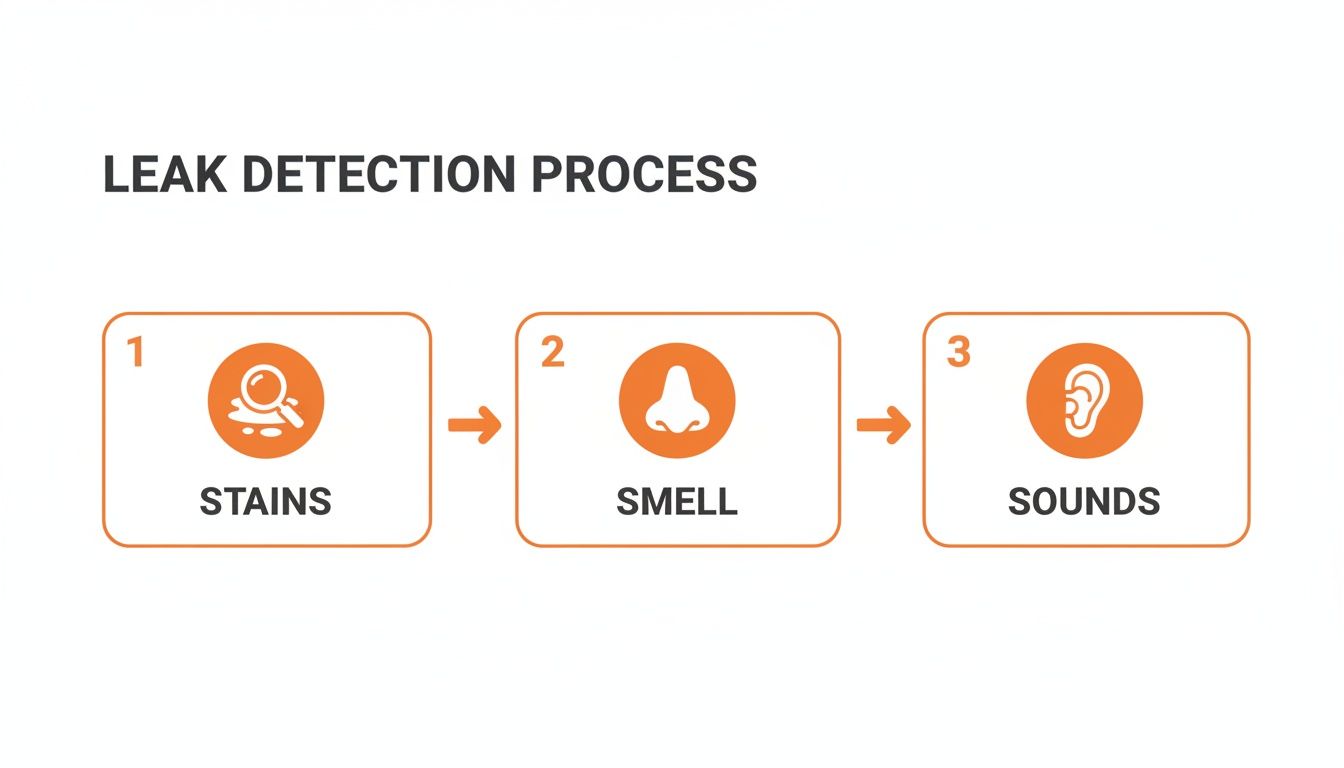
This just reinforces that a good initial inspection comes from combining what you see, what you smell, and what you hear to get the full picture.
Trusting Your Nose and Ears
Beyond what you can see, your other senses are your secret weapons. Water that’s been sitting stagnant behind a wall creates a very distinct, musty odor. It’s different from the general damp smell you might get after a heavy rainstorm.
We always tell our clients from Newport Beach to Irvine to trust their noses. If a specific room or closet has a persistent earthy, mildew-like smell that just won't go away, there's a very high chance you've got a hidden moisture problem. That's the smell of microbial growth starting, and you need to take it seriously.
That musty smell is often the very first clue a homeowner notices. It can appear long before any visible stains show up, giving you a crucial head start.
Finally, listen. The best time to do this is at night or early in the morning when the house is quiet. Stand near walls that have plumbing running through them and listen carefully. You might hear:
- A Faint Drip: That slow, rhythmic plink… plink… plink.
- A Light Hiss: This could signal a tiny pinhole leak in a pressurized water supply line.
- Running Water: If you hear water flowing when all faucets and appliances are off, that’s a problem.
Don't ignore these sounds. They are direct evidence of an active leak that needs immediate attention. For more on protecting your home, our guide on how to make your home leak-proof offers great preventative strategies. By using your senses systematically, you shift from just living in your house to actively protecting your investment, ready to spot trouble before it spirals out of control.
Using Technology for Accurate Leak Detection
When your senses tell you there’s a leak but your eyes can’t find it, technology is what separates guessing from knowing. For homeowners in Orange County who appreciate precision, the right tools can be the difference between a simple fix and a full-blown renovation. These devices let us see through your walls, giving us clear, actionable data without needing to swing a hammer.
This is where professional-grade diagnostics come into play, helping you understand exactly what’s happening behind your luxury finishes before any disruptive work begins.
The Power of Thermal Imaging
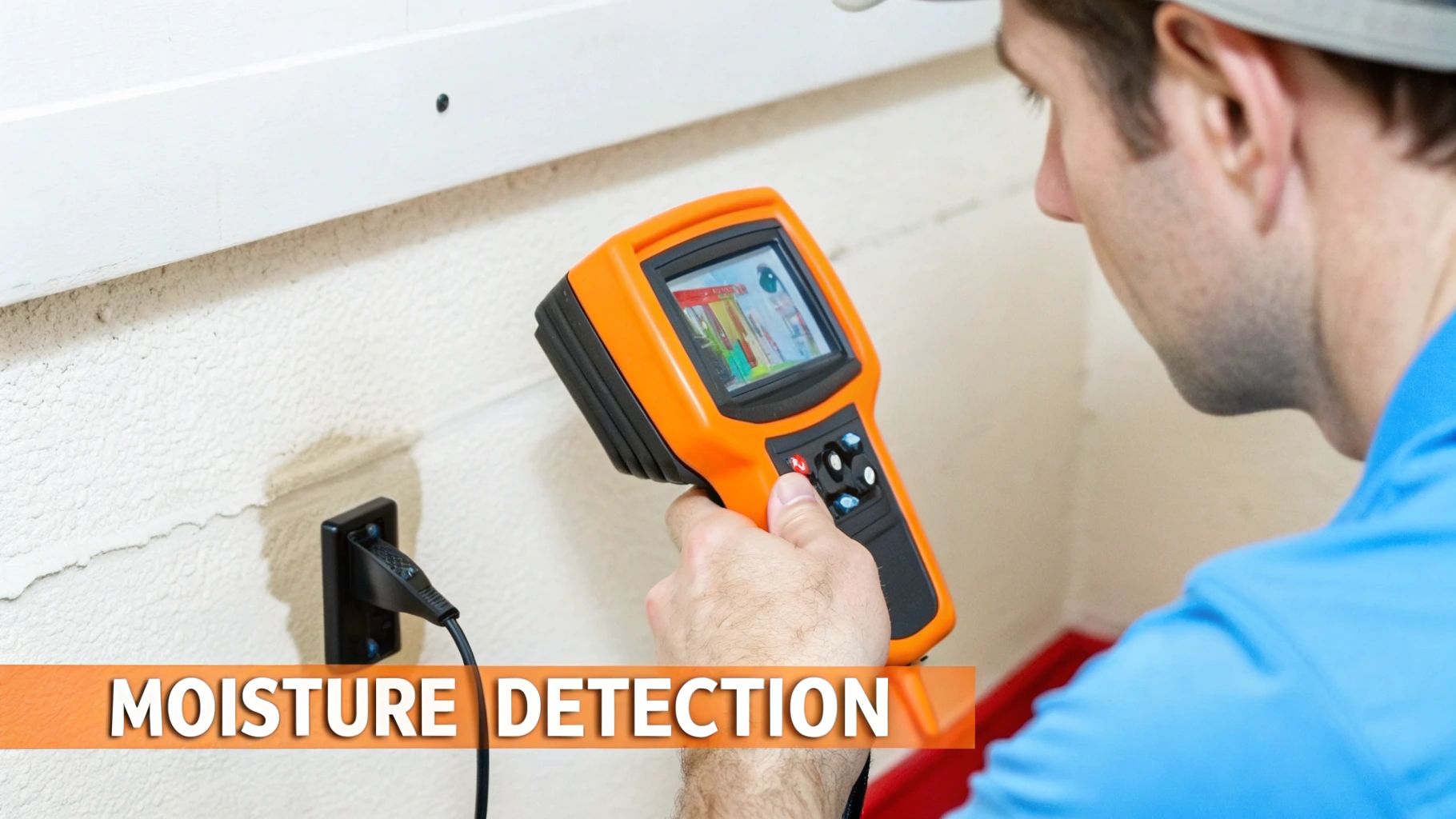
Imagine being able to see a hidden water leak behind your custom kitchen cabinetry or inside the wall of your second-story master shower. That’s exactly what thermal imaging lets us do. A thermal camera doesn’t actually see moisture; instead, it detects tiny temperature differences on a surface.
Materials saturated with water—like drywall, plaster, and wood—hold temperature differently than their dry surroundings. A leak often creates a distinct cold spot on the wall, which shows up on the camera's screen as a clear blue or purple area. This technology is incredibly fast and completely non-invasive, allowing us to scan large sections of your home in minutes.
A thermal camera is one of the most valuable tools in our diagnostic arsenal. It allows us to trace the path of moisture from the visible stain back to its hidden origin, providing a complete picture of the damage before we even begin our work. This precision minimizes disruption and ensures we address the problem at its core.
The accuracy of thermal imaging helps us avoid unnecessary demolition, protecting the integrity and beauty of your home. It’s an elegant solution for a potentially messy problem.
Confirming Moisture with a Meter
While thermal imaging points us to where a temperature difference is, a moisture meter confirms if that spot is actually wet. This simple handheld device has two small prongs that measure the electrical conductivity of a material when pressed against it. Since water conducts electricity, a high reading is a sure sign of moisture.
For example, a normal drywall reading might be 5-12% moisture content. But if we test a spot the thermal camera flagged and the meter jumps to 30% or higher, we have definitive proof that the wall is saturated.
We use moisture meters to:
- Verify a Leak: Confirming what the thermal camera suggests.
- Map the Damage: Tracing the exact boundaries of the affected area.
- Confirm Dryness: Making sure the structure is completely dry after we’ve fixed the problem.
For leaks that aren't immediately visible, technology is instrumental. For example, a sudden issue with your combi boiler losing pressure could indicate a hidden leak somewhere within your home's closed-loop heating system.
Advanced Acoustic and Borescope Inspections
Sometimes, a leak is buried so deep within a structure that even thermal cameras need a little help. That's when we bring in advanced acoustic detectors and borescopes. Acoustic sensors are essentially high-powered microphones that can "hear" the faint sound of a drip or the hiss of a pressurized pipe leak, even through concrete slabs and thick walls.
When we need a direct visual, a borescope is the perfect tool. It’s a tiny camera on the end of a long, flexible cable. By drilling a small hole that’s easily patched later, we can snake the camera inside the wall cavity. This gives us a real-time look at the pipe, helps us pinpoint the source of the leak, and lets us check for any hidden mold growth. This targeted approach is a key part of the comprehensive water damage services we provide.
To help you understand how these tools work together, here’s a quick comparison of the key technologies we use in a professional inspection.
Comparing DIY Leak Detection Tools
| Tool | How It Works | Best For Detecting | Typical Cost |
|---|---|---|---|
| Moisture Meter | Measures electrical conductivity to quantify moisture levels in materials. | Confirming the presence and saturation level of moisture in drywall, wood, and plaster. | $30 – $100 |
| Thermal Camera | Detects temperature variations on surfaces caused by hidden moisture. | Quickly scanning large areas to find cold spots indicating potential leaks behind walls or ceilings. | $200 – $600+ |
| Borescope Camera | A small camera on a flexible tube provides a direct visual inside a wall cavity. | Visually inspecting a pipe's condition, locating the exact leak source, and checking for mold. | $40 – $150 |
Ultimately, using the right technology transforms leak detection from guesswork into a science. It ensures that when we create a plan to restore your home, it’s based on accurate, comprehensive data. This allows us to work efficiently and effectively to turn chaos into calm.
Smart Home Solutions for Proactive Leak Prevention
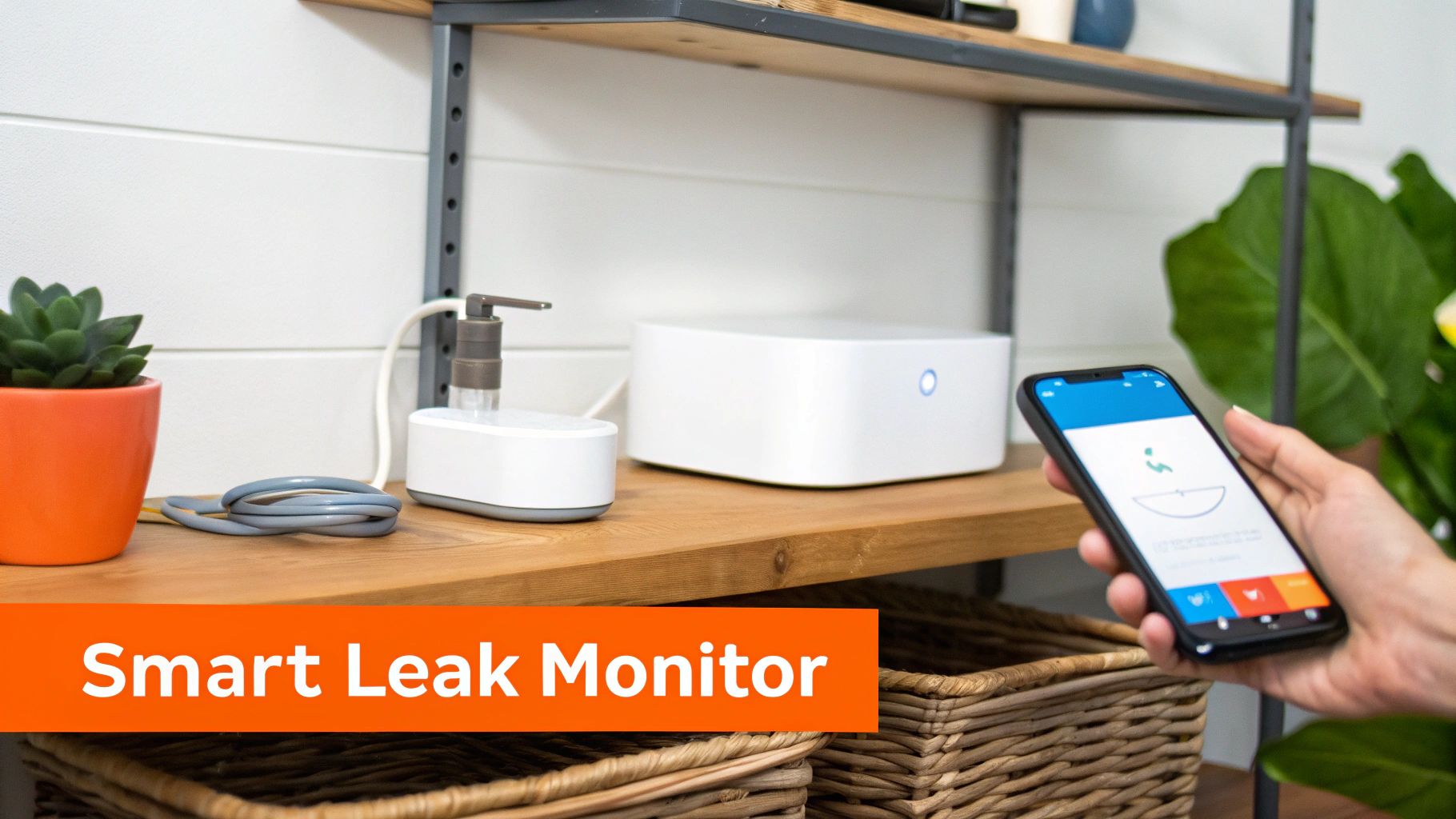
For the discerning, tech-forward homeowner in Orange County, the best way to handle a leak is to stop it before it ever starts. While visual inspections and diagnostic tools are excellent for catching problems already in progress, modern smart home technology offers a powerful, proactive shield for your property. This is where whole-house smart water monitors come in, providing 24/7 protection and the ultimate peace of mind.
These systems are a total game-changer, especially for our clients who travel frequently or manage multiple properties. They act as a vigilant guardian over your entire plumbing network, capable of detecting the smallest anomaly and taking immediate action to prevent catastrophic damage. It’s a seamless solution that brings modern water security to your luxury home.
Flow-Based Systems: The Intelligent Guardians
One of the most popular types of smart water monitors is the flow-based system. Think of this as the intelligent brain of your plumbing. Installed directly on your main water line, this device doesn't just measure how much water you use—it learns how you use it. It analyzes your family's unique daily water consumption patterns, recognizing everything from a morning shower to the dishwasher cycle.
Once it establishes this baseline, it's constantly on the lookout for deviations. If it detects a continuous, low-volume water flow that doesn't match any known pattern—like a pinhole leak inside a wall—it flags it as a potential problem. For a major disaster like a burst pipe, it recognizes the unusually high flow rate instantly.
Many of our clients in Newport Beach and Irvine are opting for these systems. They offer incredible peace of mind by not just alerting you to a problem on your smartphone but also having the power to automatically shut off the main water supply, turning a potential disaster into a minor inconvenience.
This automated shutoff feature is the system's most powerful asset, protecting your home even when you're thousands of miles away.
Pressure-Based Systems: The Sensitive Sentinels
Another highly effective approach involves pressure-based systems. These devices work by pressurizing your home's plumbing and then monitoring it for even the slightest drop. After you've gone to bed and no one is using water, the system can run a micro-test to ensure the pressure remains perfectly stable.
If there's a tiny, slow drip somewhere in the house, it will cause an almost imperceptible drop in pressure. The sensor is sensitive enough to pick up on this subtle change and alert you to the problem.
- Precision Detection: Ideal for catching extremely slow leaks that flow-based systems might initially miss.
- Minimal Installation: Some models can be installed with less invasive plumbing work.
- Proactive Testing: They actively check the integrity of your entire plumbing system during quiet hours.
This method is exceptionally good at identifying the kind of slow leaks that often go unnoticed for months, preventing the long-term, hidden damage we see all too often.
The Power of Smart Data in Leak Detection
The true strength of these smart devices lies in their data processing. Advanced whole-house water leak detection systems analyze up to 43,200 data points daily to spot anomalies long before a wall shows any sign of damage. Flow-based systems can even monitor usage patterns with up to 98% accuracy for tiny pinhole breaches, offering a level of scrutiny that just wasn't possible with traditional methods.
You can learn more about how these analytics are transforming home safety by exploring research on smart water management. These systems provide robust integrations for seamless control within your existing smart home ecosystem, along with historical data to track your home's water health over time.
It's smart to start with your own inspection, and smart home tech can be a great first alert. But their job is to tell you there's a problem, not to solve it. There’s a point where a homeowner’s detective work needs to stop and a professional’s expertise has to take over. Knowing when to make that handoff can save you thousands in secondary damage and protect the long-term value of your Orange County home.
Calling an expert isn’t giving up; it’s making a strategic move to protect your biggest investment. When you're dealing with a high-end property—with its custom finishes and complex systems—getting a professional assessment isn't just a good idea, it's essential for a complete and lasting fix.
Clear Indicators for Professional Intervention
Every water issue is a bit different, but some situations are clear-cut red flags. These are the moments when the problem has grown beyond a simple fix and needs advanced tools and certified knowledge.
You should pick up the phone and call a specialist if you find:
- Visible Mold or Persistent Musty Odors: If you see a patch of mold or can't shake that damp, earthy smell, the problem has already taken root. Mold remediation is a science. It requires proper containment and removal to keep spores from spreading throughout your entire home.
- Widespread or Saturated Materials: Is your moisture meter lighting up across a big section of wall? Does the drywall feel soft or spongy? That’s a sign of significant water damage. You'll need professional water extraction and structural drying to stop rot in its tracks.
- An Undetectable Leak Source: Your water bill is climbing, or you hear a faint dripping sound, but you can't for the life of you find where it's coming from. We use specialized gear like acoustic sensors and borescopes to pinpoint leaks hidden inside walls or under slabs without having to tear things apart just to look.
- Damage Involving Multiple Rooms or Floors: A leak that’s showing on a ceiling and affecting the room below is a serious issue. Water is sneaky—it can travel along floor joists and wiring, meaning you need a pro to trace its path and make sure every single affected area is addressed.
For our clients, the most stressful part is often the uncertainty. They know something is wrong but don’t know how bad it is or where to start. Our first job is to replace that chaos with a clear, calm, and professional plan of action.
Trying to tackle these problems yourself can easily turn a manageable issue into a much larger, more expensive disaster.
What to Expect from a Sparkle Restoration Consultation
When you call Sparkle Restoration Services, you're not getting a general handyman. You're bringing in a team of IICRC Master Certified technicians who operate under the license of a General Contractor. Our entire process is built on the precision, transparency, and ethical standards that earned us the BBB Torch Award.
We start with a comprehensive, data-driven assessment. We arrive with the same high-tech tools we've been discussing—thermal cameras, professional-grade moisture meters, and borescopes—to give you an accurate, complete picture of what's going on. We don't just find the source of the leak; we map out the full extent of the moisture's migration.
From there, we lay out a clear and detailed scope of work. We'll walk you through exactly what needs to be done, from water mitigation all the way through full restoration and remodeling, so you understand every step. We also have deep experience working with insurance carriers and can help you make sense of the claims process. In fact, understanding your policy is a crucial first step; you can learn more by reading our homeowner's guide to navigating property insurance claims.
Our promise is to deliver a "white-glove" experience. We manage the entire project from start to finish, coordinating every detail of the recovery. This seamless approach minimizes the disruption to your life and ensures your property is restored to its pre-loss condition—or even better. Our goal is simple: to turn the chaos of water damage into calm, fast.
Got Questions About Wall Leaks? We've Got Answers
Even with the best detection tools, finding a leak in your wall naturally brings up a lot of questions. As a premier restoration company serving Orange County, we hear the same concerns from homeowners all the time—everything from the risk of mold to the complexities of insurance. We've put together some straightforward answers to the most common questions we get, drawing from our decades of in-the-field experience.
Our aim is to give you the clear, expert guidance you need to handle this stressful situation with confidence.
How Quickly Can Mold Grow from a Water Leak in a Wall?
This is probably the most critical question we get, and the answer is always a bit of a shock to homeowners. In the right conditions—dark, damp, and with a food source like drywall—mold can start growing in as little as 24 to 48 hours.
What seems like a minor water spot can quickly spiral into a full-blown mold remediation project. This is exactly why we offer 24/7 emergency services throughout Orange County. Acting immediately is the single best way to stop water damage before it becomes a serious structural and health hazard.
Will My Homeowners Insurance Cover Hidden Water Leak Damage?
Water damage coverage can be tricky. Generally, most policies cover damage that is sudden and accidental, like a pipe that bursts inside a wall. However, they often exclude gradual damage—the kind that happens over weeks or months from a slow drip or poor maintenance.
The key to a successful claim is documentation. We have spent years working with every major insurance carrier in Southern California, so we know exactly what they need to see. We help homeowners document the source and scale of the damage to build a clear, evidence-based claim, giving you the best chance at getting the coverage you're entitled to. For more on this, feel free to check out our comprehensive FAQs page.
Navigating an insurance claim can be a real headache. We see our role as being your expert advocate, providing the technical proof and clear communication needed to simplify the process and take that weight off your shoulders.
Can I Just Repair the Drywall After a Small Leak?
Just patching over a water stain is one of the most common—and most costly—mistakes we see. While a cosmetic fix might make the wall look fine on the surface, you're trapping moisture behind it, which is where the real trouble starts.
That trapped moisture will silently rot wooden studs, ruin insulation, and create a perfect breeding ground for mold. Professional water mitigation is absolutely non-negotiable. We use specialized drying equipment and confirm everything is bone-dry with moisture meters before any repair work begins. This approach solves the problem at its root, protecting your home for the long haul.
What Is the Difference Between Water Mitigation and Restoration?
People often use these terms interchangeably, but they are two very distinct phases of the recovery process.
- Water Mitigation is the emergency first response. It's all about stopping further damage. This includes stopping the leak, extracting standing water, removing unsalvageable materials, and professionally drying the entire structure.
- Water Restoration comes next. This is the rebuilding phase, where we repair your property and return it to its original, pre-loss condition. This could be anything from replacing drywall and flooring to a complete remodel of the affected space.
As a licensed General Contractor and an IICRC Master Certified firm, Sparkle Restoration Services handles both phases seamlessly. We give you a single, expert point of contact for a complete, white-glove recovery from start to finish.
Don't let a hidden leak threaten the safety and value of your Orange County home. If you suspect you have a problem, trust the experts at Sparkle Restoration Services for a fast, accurate assessment and a clear plan to make it right. Schedule your free consultation today and let us turn chaos into calm.
Ready to create a space that’s as beautiful as it is functional? Schedule your complimentary design consultation today by visiting Ready to Work with Sparkle?