



Eliminating fire smoke odor in your house is about more than just cleaning what you can see. Smoke isn’t merely a smell; it's composed of microscopic particles that penetrate deep into porous materials like drywall, carpets, and even the wood framing of your home.
That’s why spraying an air freshener or wiping down surfaces never fully solves the problem—you’re just masking it. The real solution is a comprehensive approach: thoroughly cleaning every single surface, actively deodorizing the air with professional-grade technology, and tackling often-overlooked culprits like your HVAC system.
Why That Fire Smoke Smell Just Won't Go Away
After a fire, the smell is often the most stubborn and unsettling reminder. It’s not just an annoyance—it's a complex issue tied to the physics of microscopic smoke and soot particles. To truly restore your Orange County home and protect your family's health, you have to understand what you're up against.
When materials burn, they release a hazardous cocktail of chemicals and tiny particles. These aren't just lazy drifters in the air; they're superheated and pressurized, which forces them into every nook, cranny, and porous surface in your home.
The Science of How Smoke Gets In Everything
Smoke particles are incredibly small, often less than one micron. For comparison, a single human hair is about 70 microns thick. Their tiny size is what makes them so invasive.
They don't just sit on top of materials; they embed themselves deep inside.
- Drywall and Paint: Think of these like sponges. They soak up smoke particles far beneath the surface you can see and touch.
- Wood and Flooring: The natural grains in your furniture, hardwood floors, and even structural beams are perfect hiding spots for these odor-causing residues.
- Carpets and Upholstery: The dense fibers in textiles act like magnets for soot and smoke, turning them into major sources of that lingering smell.
- Insulation: Tucked away in walls and attics, insulation can trap smoke odors for years, releasing them long after you thought the problem was solved.
This deep penetration is exactly why a simple surface wipe-down is a waste of time. The smell will just keep leaching out of these materials until they're properly treated.
Not All Smoke Damage Is Created Equal
The type of fire dictates the type of smoke it creates, and each kind of smoke residue demands a completely different cleanup strategy. A kitchen fire that involves burnt protein, for example, leaves behind a greasy, almost invisible film that is a nightmare to remove. On the other hand, a fire that burns natural materials like wood or paper produces a dry, powdery soot.
The toughest to deal with, however, is the smoke from burning synthetic materials—plastics, foams, synthetic fabrics—which are everywhere in modern homes. This type of smoke creates a thick, oily, and highly acidic soot. It's not just sticky; it's corrosive and can permanently damage finishes and delicate electronics if it isn't handled quickly by IICRC-certified professionals.
Not sure what you're dealing with? Different types of smoke leave behind unique clues. This table can help you identify the smoke damage in your home so you can understand the challenge ahead.
Types of Smoke Damage and Their Characteristics
| Smoke Type | Source | Residue Characteristics | Odor Profile | Cleaning Challenge |
|---|---|---|---|---|
| Wet Smoke | Low-heat, smoldering fires (e.g., plastics, rubber) | Sticky, greasy, smeary; can be yellowish to black | Pungent, acrid | Difficult to remove; smears easily and requires specialized solvents |
| Dry Smoke | High-heat, fast-burning fires (e.g., wood, paper) | Fine, powdery, non-greasy; gray to black | Classic "burnt wood" smell | Easier to clean with dry methods (HEPA vacuuming) but penetrates porous surfaces deeply |
| Protein Smoke | Overcooked food, kitchen fires | Greasy, nearly invisible film; yellowish-brown | Extremely foul, burnt food odor | Difficult to see and clean; requires specific degreasing agents |
| Fuel/Oil Smoke | Furnace puff-backs, petroleum-based fires | Dense, sticky, difficult to remove | Strong petroleum or industrial odor | Requires heavy-duty cleaning agents and specialized techniques |
Understanding these differences is the first step in formulating a plan that will actually work.
For homeowners in Southern California, these distinctions are critical. The high-end finishes, custom materials, and complex HVAC systems common in our homes require a sophisticated approach that goes far beyond a simple cleanup job.
Every year, fires impact over 350,000 U.S. homes, leaving behind pervasive smoke odors that can tank your indoor air quality and lead to long-term health concerns. In a place like Orange County, this is more than an inconvenience—it’s a direct threat to the high standard of living you expect. Learn more about the critical importance of smoke and odor removal and see why fast, professional action is the only way to protect your family and your investment.
Your First 48 Hours After a Fire
The moments after a fire are a blur of shock and confusion. It’s completely overwhelming. But what you do in the first 48 hours is absolutely critical. These first steps will have a massive impact on your family's safety, the outcome of your insurance claim, and how successfully you can eliminate fire smoke odor in your house for good. Think of this as the triage phase—every single decision matters.
First things first: safety. Don't even think about going back inside until the fire department has given you the official all-clear. They'll check for the obvious structural dangers, but you really need a second look from a licensed professional, like Sparkle Restoration Services, to spot hidden hazards. We're talking about compromised electrical wiring or supports that look fine but are dangerously weakened.
Initial Safety and Documentation Steps
Once you've been cleared for a safe, limited entry, your next job is documentation. This isn't just a suggestion; it's non-negotiable if you want a smooth insurance process. It's a service we handle for our clients all over Orange County just to take some of that stress off their shoulders.
- Photograph and Video Everything: Before you move a single thing, document it all. Use your phone to take wide shots of every room and then get close-ups of specific items that are damaged.
- Start an Inventory: Begin a rough list of everything that's been damaged. You’ll build on this later, but getting a preliminary list down is vital for getting your claim started.
- Secure Your Home: If windows are shattered or doors are broken, get them boarded up immediately. This stops anyone from trespassing and prevents more damage from the weather.
This detailed record is the foundation of your entire insurance claim. I've seen it time and time again—homeowners rushing this step, and it ends up being one of the biggest and most expensive mistakes they make.
Ventilate the Right Way
You need to get air moving, but there's a right way and a very wrong way to do it. Go ahead and open every window you can. Then, grab some box fans or standing fans and point them outward in the windows. You're trying to push the smoky air out, not just swirl it around inside. This creates a negative pressure that helps pull fresh air in from other openings.
Crucial Warning: Whatever you do, do not turn on your central HVAC system. This is one of the worst things you can do. Kicking on the furnace or AC will suck soot and microscopic smoke particles deep into your ductwork, spreading the contamination to every single room in your house.
This one mistake can escalate a localized problem into a full-blown, whole-house contamination nightmare. It makes the restoration process much more complex and far more expensive.
Understanding why that smoke smell is so stubborn helps you see the challenge ahead. It’s not just floating in the air; it attacks your home on multiple levels.
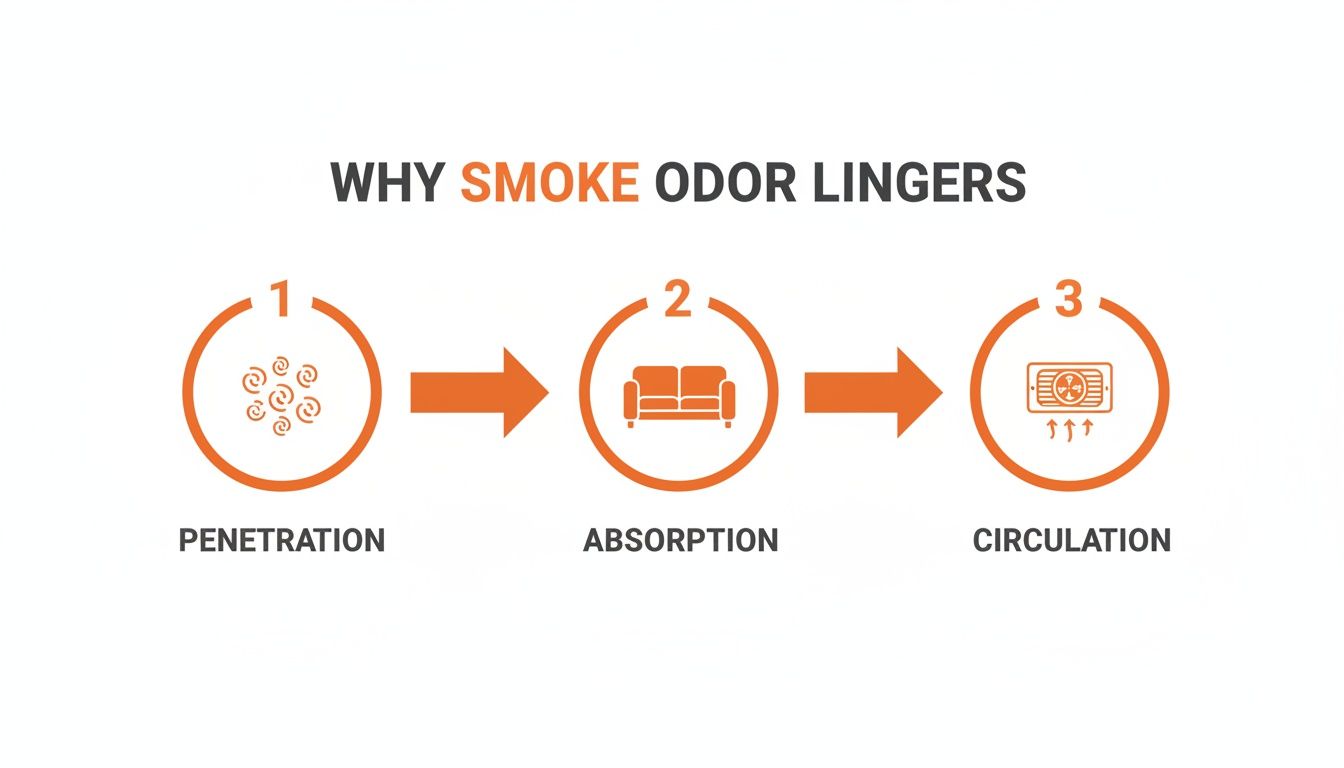
As you can see, smoke particles are tiny invaders. They penetrate porous surfaces, get absorbed by everything from drywall to upholstery, and then your home's own systems circulate them everywhere.
What to Touch and What to Leave Alone
The urge to start scrubbing and cleaning is completely natural. But trust me, cleaning the wrong way can make the damage permanent. Soot is greasy and acidic. If you just start wiping it, you'll smear it deeper into walls and furniture, causing stains that you'll never get out.
What You Can Safely Do:
- If they are in a safe, untouched area, go ahead and gather important documents, irreplaceable valuables, and any necessary medications.
- Is the power off? Empty the fridge and freezer immediately. The last thing you need is another source of bad odors from spoiled food.
- Collect any clothes or textiles you want to try and save and put them aside for a professional restoration cleaner.
What You Must Leave for the Professionals:
- Do Not try to wash walls, ceilings, or any other painted surfaces.
- Do Not attempt to clean your carpets or upholstery with a household vacuum or store-bought cleaners.
- Do Not plug in or turn on any electrical appliances until they’ve been professionally inspected and cleared as safe.
Navigating these first two days is a balancing act. You need to take quick, decisive action on some things while having the patience to leave others for the experts. It’s all about protecting your family, preserving your insurance claim, and preventing any more damage. For homeowners in Newport Beach, Irvine, and across Orange County, this is the time to call in an IICRC Master Certified expert. We bring a sense of calm to the chaos, making sure every step is done right, right from the start.
A Practical Guide to Cleaning Smoke-Damaged Surfaces
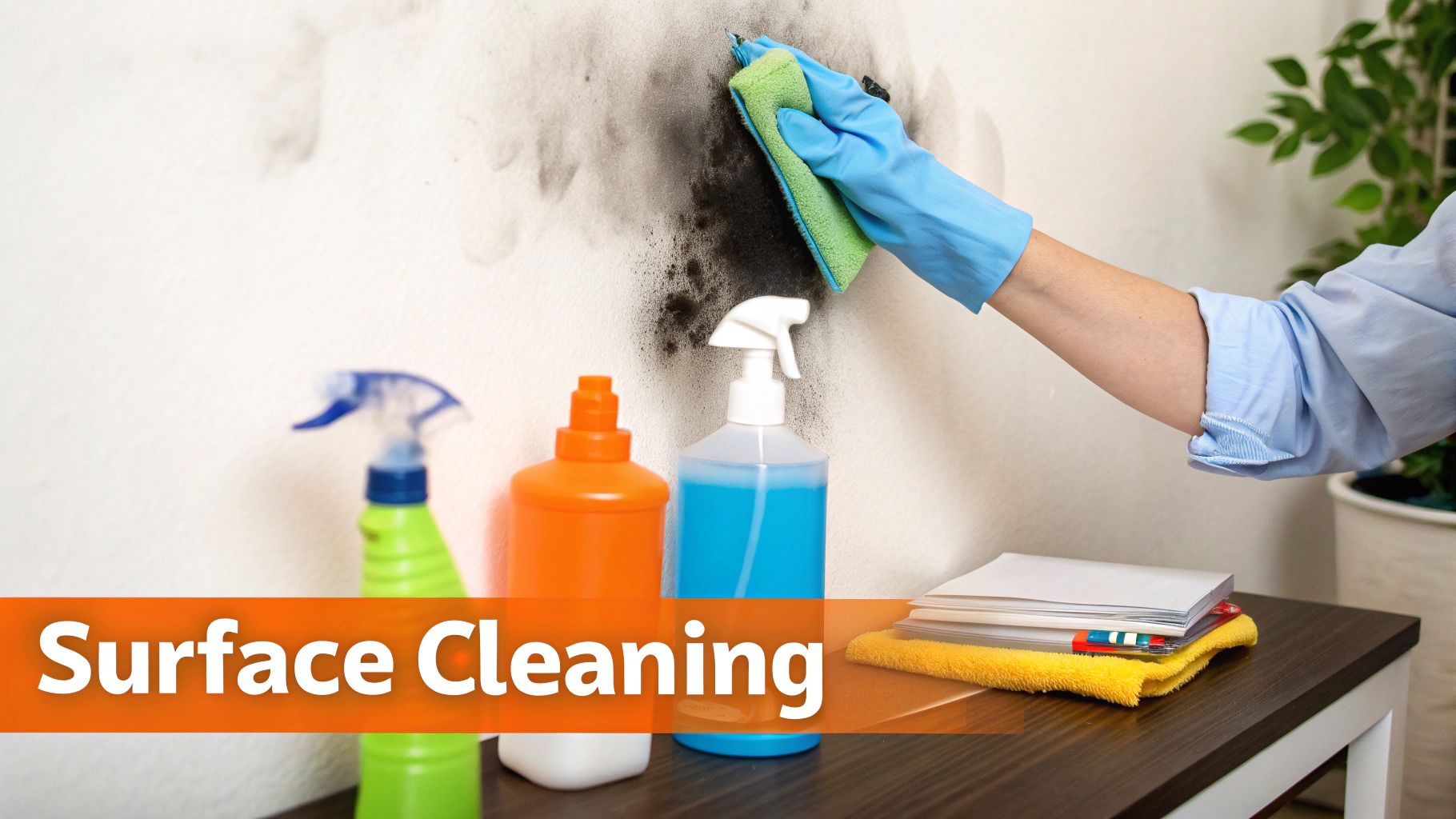
After you've dealt with the initial shock and secured your property, the real work begins. This is where you move from damage control to the meticulous process of cleaning. Knowing how to eliminate fire smoke odor in house spaces is all about understanding that every surface has its own set of rules.
You can’t just start wiping things down. Smearing greasy soot into a porous wall or using a wet cleaner on dry residue can quickly turn a fixable problem into permanent damage. For homeowners in Orange County, where custom finishes and high-end materials are the norm, this step is absolutely critical. One wrong move could ruin expensive stonework, delicate wallpaper, or custom cabinetry.
This guide breaks down the strategy, surface by surface, so you know the right techniques—and, just as importantly, when it’s time to call in the pros.
Tackling Hard Surfaces: Walls, Ceilings, and Floors
Hard, non-porous surfaces seem like the easiest place to start, but they require a specific approach to avoid making things worse. The goal is to lift the soot off the surface, not grind it in or scratch the finish.
For painted walls and ceilings, your first tool should always be a chemical dry sponge, often called a soot sponge. These are used completely dry and work by absorbing soot into their pores. It’s a classic mistake to wipe with a wet cloth first—that just creates a stubborn, muddy mess. Start at the top of the wall and work your way down, using straight, parallel strokes. When one side of the sponge is black with soot, you just slice it off to reveal a fresh cleaning surface.
Only after you’ve removed the loose, dry soot should you think about wet cleaning. A gentle degreaser like trisodium phosphate (TSP) or a specialized restoration cleaner mixed with warm water works well. Always test your solution on a small, hidden spot first to make sure it won’t damage the paint.
The process for wood floors and trim is similar:
- Start with a thorough HEPA vacuuming to pick up any loose soot particles.
- Follow up with a chemical dry sponge, gently lifting the residue without scratching the wood finish.
- For any lingering film, use a cleaner made specifically for finished hardwood, applying it with a soft microfiber cloth.
Expert Insight: Don't forget that soot is acidic. The longer it sits on metal fixtures, doorknobs, or appliances, the greater the risk of permanent etching and corrosion. These items should be a top priority, cleaned within hours of the fire if possible.
Cleaning Porous Materials: Textiles and Upholstery
Soft materials are a whole different ballgame. Things like carpets, drapery, and upholstered furniture are magnets for smoke particles, absorbing odors deep into their fibers. Surface cleaning here is completely useless. This is almost always a job for professionals to avoid setting the stain and smell permanently.
For the high-end, custom draperies or delicate upholstery you often find in Newport Beach homes, trying to clean them with water or household products can lead to shrinking, water stains, and irreversible color bleeding. These items need specialized dry-cleaning solvents and equipment that only restoration pros have.
Carpets pose a similar challenge. A rental steam cleaner might seem like a good DIY solution, but it usually lacks the suction power to pull out all the water and dissolved soot. You're often left with a damp, dirty mess that can breed mold and make the smoke odor even worse. Professional hot water extraction uses much higher temperatures and industrial-strength vacuums to completely flush contaminants out, leaving the carpet nearly dry.
The Overlooked Contamination Zones
Smoke is insidious; it finds its way into every nook and cranny. The spots you don't immediately see are often the ones that will keep releasing odors for months or even years. To truly get rid of the smell, you have to be relentless.
Check these hidden spots:
- Inside Cabinets and Drawers: Empty everything. Every single shelf, wall, and corner needs to be vacuumed and then wiped down with a degreasing cleaner.
- Light Fixtures: Soot loves to collect on light bulbs and inside fixtures. Carefully take them apart, wash any glass or plastic components, and wipe down all the metal parts.
- Electronics: Soot gets inside vents and ports, where it can cause short circuits and failures later on. Never turn on electronics that were exposed to a fire. They need to be cleaned by a specialist who can safely remove soot from the internal components.
- HVAC System: This is your home’s circulatory system for smoke. The ducts will be coated in soot and must be cleaned by a professional. Just changing the filter won’t cut it—the entire system needs to be decontaminated.
The cost of professional smoke remediation is an investment in your home’s health and future value. While the national average for smoke remediation is around $3,000, the price can range from a few hundred dollars for a minor incident to over $12,000 for a major house fire. This makes professional expertise crucial for getting the job done right and cost-effectively, especially since most fire-related claims are covered by insurance. Simple vinegar washes used by amateurs can't compete with commercial-grade air scrubbers that filter 99.97% of harmful particles. To learn more about what's involved, you can explore detailed information on smoke remediation services.
Advanced Deodorization That Actually Works
After you've cleaned every last surface, you might feel like the worst is over. But the most frustrating part of fire damage is often the enemy you can't see—those stubborn, microscopic odor particles that have worked their way deep into your home's structure. This is where basic cleaning hits a wall, and real restoration science has to take over.
To truly eliminate fire smoke odor in house spaces for good, you need professional-grade technology that goes where sponges and rags simply can't. We're not talking about masking the smell with air fresheners. We're talking about destroying the odor molecules at their source to protect your home's air quality and value.
Getting Into Every Nook and Cranny with Thermal Fogging
Think about how smoke travels. It seeps into the tiniest cracks, behind baseboards, and deep into porous materials like drywall and wood. How do you clean that? The answer is thermal fogging.
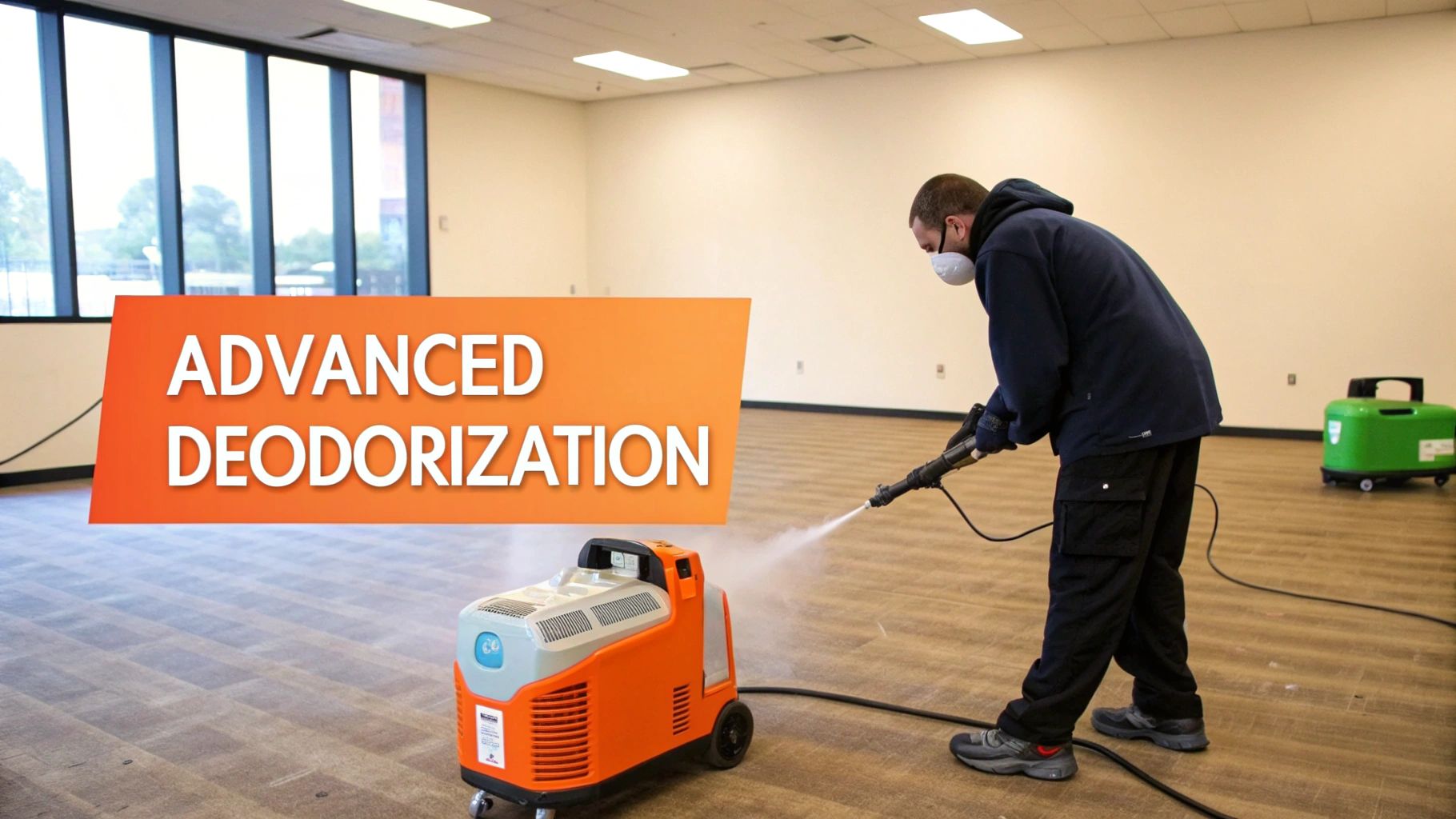
A thermal fogger is a specialized machine that heats a powerful, solvent-based deodorizer and turns it into a thick, fine mist. This fog behaves just like the original smoke, penetrating deep into every crevice it can find. As it travels, the deodorizing agent chemically bonds to the smoke particles, neutralizing them on the spot. It’s an incredibly effective way to eradicate odors permanently.
Our Client-Focused Approach: For homeowners in communities like Irvine or Newport Beach with high-end finishes, thermal fogging is a game-changer. It gets rid of the smoke smell without forcing us to tear out materials that are still structurally sound but smell terrible.
When You Need a More Aggressive Attack: Oxidizing Treatments
Sometimes, especially when synthetic materials have burned, the smoke residue is particularly nasty and requires a more powerful approach. That's when we bring in oxidizing treatments like ozone and hydroxyl generators. These machines don’t just cover up odors; they chemically dismantle the molecules causing them.
Ozone Generators
Ozone (O3) is a highly reactive gas that essentially obliterates smoke particles through oxidation. We use a generator to fill a sealed-off area with O3, which then hunts down and destroys odors in the air and on every surface. It’s extremely effective, but it comes with a major safety warning: ozone is toxic to breathe. The property has to be completely empty of people, pets, and even plants during treatment. Afterward, we have to air the space out completely before it's safe to go back inside.
Hydroxyl Generators
Hydroxyls (OH) are another powerful oxidizing agent, often called "nature's cleanser." The big difference is that hydroxyls are safe for people to be around. A hydroxyl generator uses UV light to create these radicals, which then circulate through the home, breaking down odor molecules and purifying the air without you ever having to leave.
Keeping the Air Clean with HEPA Air Scrubbers
Throughout the entire deodorization job, we’re also constantly cleaning the air itself. We run commercial-grade HEPA air scrubbers continuously on-site. These aren't your average home air purifiers; they are serious machines designed for remediation.
An air scrubber works by:
- Pulling in massive volumes of contaminated air.
- Forcing it through a series of filters, including a crucial HEPA filter that traps 99.97% of airborne particles as small as 0.3 microns.
- Pushing out clean, purified air.
This constant cycling removes any lingering soot and smoke particles from the air and also grabs anything we kick up during the cleaning process. It’s absolutely fundamental to restoring healthy indoor air quality after a fire.
Which Deodorization Method is Right for Your Home?
There’s no magic bullet for smoke deodorization. The right strategy depends on the type of fire, the materials that burned, and just how bad the damage is. This is where professional experience really matters.
To give you a clearer picture, here's a breakdown of the advanced tools we use and when they're most effective.
Professional Smoke Deodorization Methods Compared
| Method | How It Works | Best For | Safety Considerations | Professional Oversight |
|---|---|---|---|---|
| Thermal Fogging | Heats a deodorizer into a fine mist that penetrates porous surfaces like the original smoke. | Deep, lingering odors in drywall, wood, insulation, and fabrics. | Requires temporary vacancy during treatment. Proper ventilation is needed afterward. | Essential. Requires trained technicians to operate safely and ensure full coverage. |
| Ozone Generation | A generator fills a sealed space with O3 gas, which oxidizes and destroys odor molecules. | Severe, stubborn odors, especially from protein or synthetic fires. | Strictly for unoccupied spaces. Ozone is harmful to all living things (people, pets, plants). | Critical. Must be managed by certified professionals who can seal the area and verify safety upon re-entry. |
| Hydroxyl Generation | Uses UV light to create hydroxyl radicals that safely break down odors and VOCs in the air. | Moderate odors and situations where the property must remain occupied. | Generally safe for occupied areas, but placement and operation are key. | Recommended. A professional will ensure the unit is correctly sized and placed for maximum effectiveness. |
| HEPA Air Scrubbers | Continuously filters airborne particles, including soot and odor-causing molecules, through a HEPA filter. | All smoke damage projects, used throughout the cleaning and deodorization process. | Safe for occupied spaces. Filters must be changed regularly to remain effective. | Standard Practice. A core component of any professional restoration job to maintain air quality. |
Ultimately, a professional assessment is the only way to determine the right combination of techniques. For example, at Sparkle Restoration Services, our IICRC Master Certified team has been serving Orange County since 2002. We often rely on thermal fogging because it effectively gets into carpets, wall cavities, and furniture to neutralize odors without posing long-term health hazards. It’s a far more thorough approach than any DIY attempt, which often leaves homeowners wondering why the smell is still there weeks later.
While ozone generators can work faster, the safety risks mean they aren’t always the best first choice. For a deeper dive into the different technologies, check out these options for smoke odor removal on randrmagonline.com.
Restoring Your Home and Peace of Mind
Getting that lingering smoke smell out is a huge relief, but it’s really just one step on the journey back to feeling normal again. True recovery is about restoring your peace of mind and making sure your property is safe, healthy, and valuable for the long haul. For our clients across Orange County, this final phase is where we turn a genuinely stressful event into a chance for a fresh start.
Our job isn't over when the last air scrubber is packed up. As a BBB Torch Award Winner for Ethics, we believe in total transparency. Restoring your home means proving it's safe again, not just saying it is.
Verifying a Healthy Indoor Environment
You deserve more than just our word that the job is done right. The whole point is to get your indoor air quality back to a healthy state for your family. After we’ve finished our deep cleaning and deodorization, we can arrange for post-remediation verification.
This involves bringing in professionals to conduct air quality testing, confirming that harmful particulates and volatile organic compounds (VOCs) from the fire are gone. It’s scientific proof that the air you're breathing is clean. This provides the concrete assurance you need to truly relax in your home again, and it's especially critical for families with children, elderly members, or anyone with respiratory issues.
Turning Crisis into Opportunity: The Luxury Remodel
A fire, as awful as it is, sometimes opens up a unique opportunity. If structural repairs are on the table anyway, it’s the perfect moment to think about those upgrades you’ve always wanted. Instead of just putting things back the way they were, you can completely reimagine your space.
This is where Sparkle Restoration Services truly stands apart. We’re not just a restoration company; we are a licensed General Contractor with a full-service, in-house design-build team that specializes in luxury remodels. We make the transition from the chaos of restoration to the creativity of renovation completely seamless.
Imagine that smoke-damaged kitchen becoming a modern, open-concept culinary space with high-end appliances. Or a water-damaged master bath transforming into a spa-like retreat. Our team has the expertise to:
- Integrate modern design: We can update layouts, install custom flooring, and bring in the contemporary finishes you see in beautiful Newport Beach and Irvine homes.
- Incorporate smart home technology: Think automated lighting, advanced security systems, and climate control that make your home smarter and more efficient.
- Enhance form and function: Our designers work with you to create spaces that aren't just stunning but are perfectly tailored to how you actually live.
By managing every single step—from the initial emergency call to the final, high-end renovation—we take the stress of juggling multiple contractors completely off your plate. Our integrated approach guarantees a smooth process and a final result that doesn't just meet, but exceeds, your expectations.
Our entire mission is to be your partner in “Turning Chaos Into Calm, Fast.” We handle the insurance claim headaches, the technical side of restoration, and the creative vision of a beautiful remodel. This full-circle service means you have one trusted team guiding you from start to finish, ensuring your home isn't just restored, but truly enhanced.
Common Questions About Smoke Odor Removal
After a fire, homeowners are understandably left with a lot of questions and uncertainty. As Orange County's trusted restoration experts, we've walked countless families through this exact process. Here are some straightforward answers to the questions we hear most often.
How Long Does It Take to Get Rid of Fire Smoke Smell?
Honestly, there's no simple answer—it really depends on the scale of the fire. For a small, contained incident where the smoke was minimal, a professional deodorization process might only take a few days.
However, if you're dealing with a significant house fire that impacted multiple rooms and seeped into the HVAC system, the full-scale cleanup, repairs, and deep deodorization can take several weeks. After our team does a thorough, on-site assessment, we’ll give you a detailed project timeline. That way, you have a clear, realistic picture of the schedule, with no guesswork involved.
Will My Insurance Policy Cover Professional Smoke Odor Removal?
In almost every case, the answer is yes. A standard homeowner's insurance policy is designed to cover the cost of professional smoke damage restoration because it’s a direct result of a covered event, like a fire. This includes not just cleaning surfaces but also the advanced deodorization needed to make your home healthy and livable again.
As a licensed General Contractor with decades of experience here in Southern California, we work directly with all major insurance carriers. We take care of the complex paperwork and communication for you, managing the claims process to ensure everything goes smoothly and you get the full coverage you’re entitled to.
Is It Safe to Stay in My House If It Smells Like Smoke?
We strongly advise against it. That lingering smoke odor is much more than just an unpleasant smell; it's a clear sign that your indoor air is contaminated with toxic particles and soot. These microscopic irritants can lead to serious respiratory issues, headaches, and other health problems.
The health risks are especially high for children, the elderly, and anyone with asthma or other pre-existing conditions. Your family’s safety is always our first priority. We start by assessing the indoor air quality and will tell you exactly when the environment is safe for your return.
Can I Just Use Air Fresheners to Mask the Smell?
Using store-bought air fresheners, scented candles, or consumer-grade ozone machines is one of the most common mistakes we see people make. These products only cover up the odor temporarily. They do absolutely nothing to eliminate fire smoke odor in house structures permanently.
The smell will always creep back because the tiny, odor-causing particles are still embedded deep within porous materials like drywall, wood, carpet, and insulation. True, lasting removal requires a professional two-step approach: first, meticulous cleaning to remove the source (the soot), and second, using advanced deodorization technologies like thermal fogging to neutralize the microscopic particles for good.
When you're facing the overwhelming task of fire and smoke restoration, you need more than a simple cleaning crew—you need a dedicated partner. Sparkle Restoration Services has been the trusted, IICRC Master Certified expert for Orange County homeowners since 2002. We bring calm to the chaos, and we do it fast. Contact us 24/7 for an immediate response and a free consultation.
Ready to create a space that’s as beautiful as it is functional? Schedule your complimentary design consultation today by visiting Ready to Work with Sparkle?