



Knowing how to negotiate with an insurance adjuster isn’t about confrontation; it’s a business transaction where meticulous preparation is your most powerful asset. That first settlement offer is almost always a starting point, and your ability to counter it effectively hinges on the rock-solid, evidence-based case you build from day one. At Sparkle Restoration Services, we believe in empowering our clients, turning chaos into calm by equipping you with the expertise to navigate this process with confidence.
Setting the Stage for a Successful Negotiation
Facing an insurance adjuster after your Orange County home has been damaged can feel intimidating, but it doesn’t have to be. Adjusters are trained professionals whose primary goal is to resolve claims efficiently and cost-effectively for their company.
Grasping this fundamental dynamic is the first step toward leveling the playing field. When you are prepared, organized, and strategic, you shift the process from a source of stress into a structured negotiation where you hold the reins, protecting the value of your property.
Why Your Preparation Matters
Let’s be clear about the inherent imbalance. An insurance adjuster often juggles between 50 to 100 claims every month. This experience gives them a significant advantage, and they know the tactics to minimize settlements.
This immense workload, especially in a high-value area like Orange County, creates a powerful incentive to push for quick, low settlements simply to clear their desk. That first offer you see might only be 20-40% of your claim’s actual value. It’s an initial lowball offer, designed to test if you’ll accept it without question.
Your calm, organized, and persistent approach is your most powerful tool. It signals to the adjuster that you are a serious homeowner who understands your rights and the value of your claim. This mindset shifts the negotiation from an emotional reaction to a fact-based discussion.
This three-step preparation workflow is the core of building a strong foundation for your claim before you even pick up the phone.
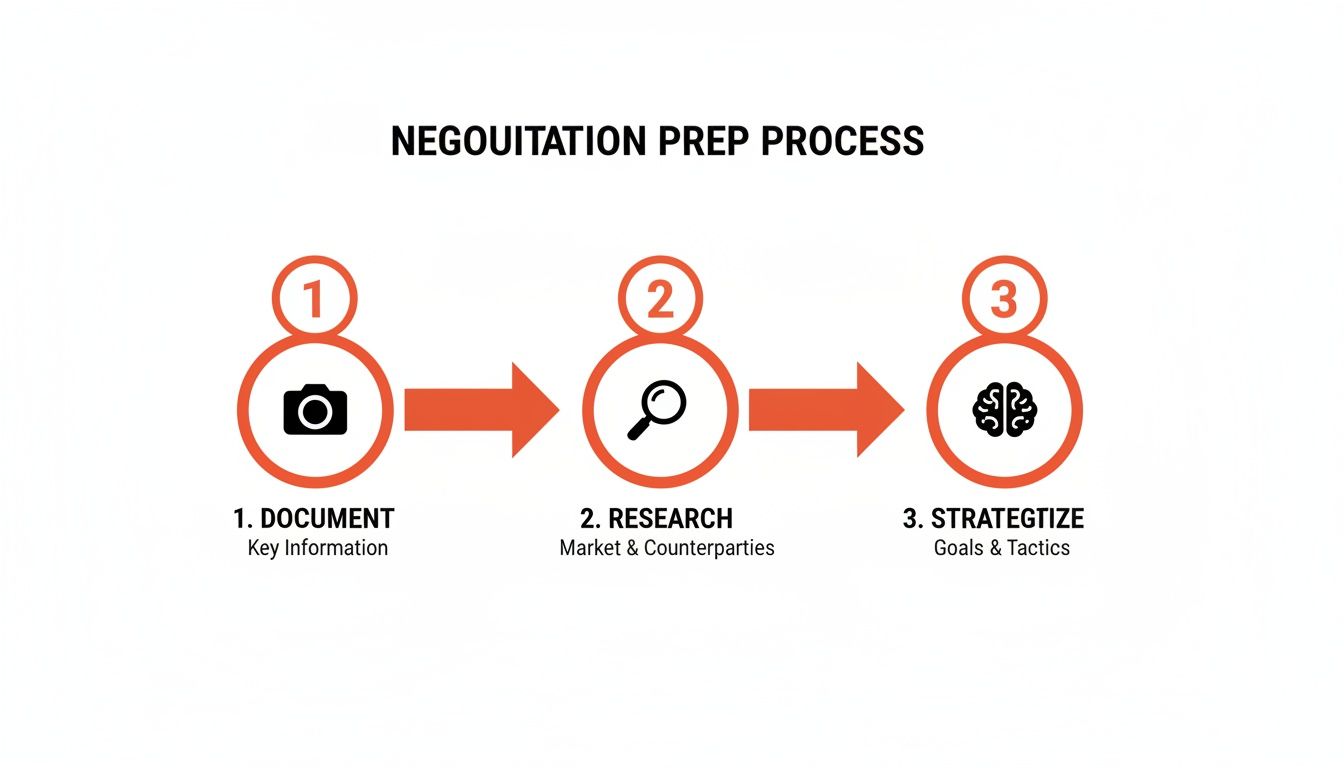
As you can see, a successful outcome starts long before you speak to an adjuster. It’s rooted in diligent documentation, thorough research, and a clear strategy.
Understanding the systems behind how claims are handled—even with technology like automated claims processing—gives you a real edge. It helps you appreciate how they generate initial offers and what data they’re likely using.
For a complete walkthrough of the entire claims journey, from the first call to the final check, our comprehensive property insurance claims for homeowners guide is an essential resource to help you navigate the process with confidence.
Your Initial Negotiation Checklist
Before that first call with the adjuster, you need a game plan. This checklist breaks down the absolute must-do actions to ensure you start the negotiation from a position of strength.
| Action Item | Why It’s Critical | Expert Pro-Tip |
|---|---|---|
| Review Your Policy | Your policy is the contract. You must know your coverage limits, exclusions, and duties. | Highlight the “Duties After a Loss” section. Insurers can deny claims if you fail to meet these obligations. |
| Document Everything | Photos, videos, and a detailed inventory create indisputable proof of your loss. | Narrate your videos. Walk through your home, pointing out damaged items and describing their original condition and value. |
| Get Independent Estimates | The adjuster’s estimate serves their interests. Yours serves yours. | Always get at least two detailed, itemized estimates from reputable local contractors who specialize in insurance restoration work. |
| Keep a Communication Log | A written record of every call, email, and conversation prevents “misunderstandings.” | After every phone call, send a brief follow-up email summarizing what was discussed. “Per our conversation…” is your best friend. |
| Never Give a Recorded Statement | These statements are often used to find inconsistencies and limit your claim. | You are not required to provide one immediately. Politely state you will communicate in writing or will provide one later after reviewing your documentation. |
This isn’t just a to-do list; it’s your armor. Walking into that first conversation with this groundwork done changes the entire dynamic of the negotiation.
Building an Airtight Case with Documentation
The absolute foundation of any successful insurance claim negotiation is proof. Cold, hard, irrefutable proof.
Your power to confidently reject a lowball offer comes directly from the quality and organization of your documentation. When you’re dealing with something like a water damage claim in your Newport Beach home, a few quick phone pics of the standing water won’t move the needle. You need to think like a prosecutor building a case for a jury.
Every piece of evidence must be crystal clear, meticulously detailed, and organized in a way that paints an undeniable picture of your loss. This isn’t just about proving what was damaged; it’s about proving its value and the true, full cost to bring your property back to its pre-loss condition.
Beyond Photos: A Strategic Approach to Evidence
Static images are the bare minimum, but they rarely tell the whole story. To build a case that leaves no room for an adjuster to argue or downplay the severity, you need to layer your evidence.
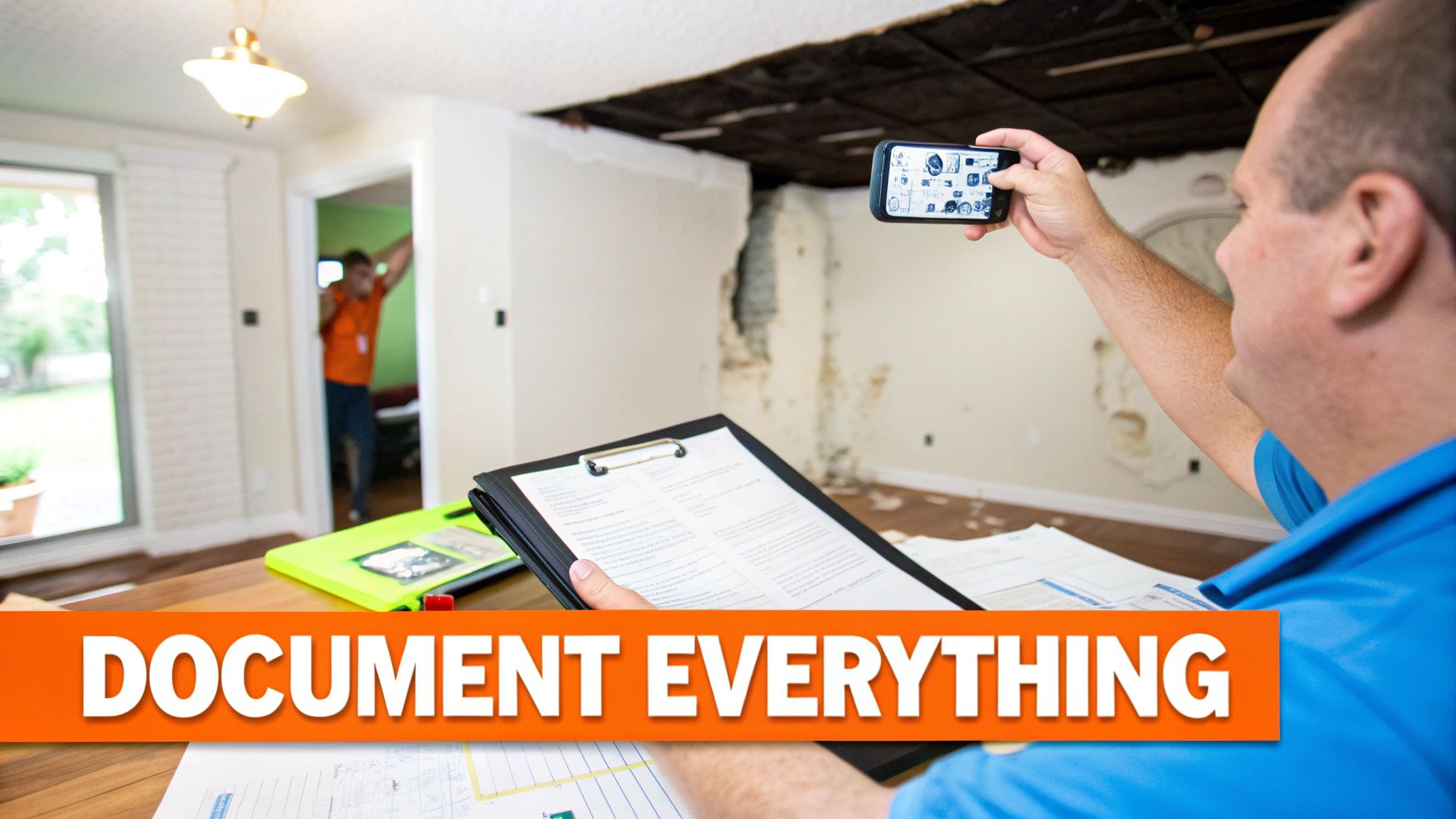
One of the most powerful things you can do is film a narrated video walkthrough. Don’t just point the camera; talk through what you’re seeing as you move through the damaged areas.
- Point out specific damage: “This is the custom wide-plank oak flooring in our living room. As you can see, it’s cupping and warped from the water saturation.”
- Describe the original condition: “Before the fire, these were pristine, custom-built maple cabinets with a hand-applied finish.”
- Capture sensory details: “Even on video, you can smell that musty, mildew odor behind this section of drywall, which points to microbial growth.”
This dynamic evidence breathes life into the damage in a way a stack of photos never will. It provides context and an emotional gravity that is very difficult for an adjuster to dismiss. It also helps establish a clear timeline, which is crucial for claims involving progressive issues like slow leaks. For a deeper dive on how that unfolds, check out our guide on the fundamentals of water damage.
Creating an Indisputable Damage Inventory
Your next move is to build a detailed inventory of every single item that was damaged or destroyed. Yes, it’s tedious. But it is 100% non-negotiable if you expect to be fully compensated. A vague list like “living room furniture” will get you a low, generic valuation every time.
Instead, fire up a spreadsheet. You need the following columns for each and every item:
- Item Description: Get specific (e.g., “Samsung 65-inch The Frame 4K Smart TV, Model QN65LS03A”).
- Brand/Manufacturer: List the brand name clearly.
- Model/Serial Number: Absolutely critical for electronics and appliances. Find it if you can.
- Original Purchase Date: An approximation is fine if you can’t find the exact date.
- Original Purchase Price: Dig for old receipts, check bank statements, or search email confirmations.
- Link to Replacement: Find a link to the exact or a comparable item for sale online today. This is your proof of current replacement cost.
This level of detail shuts down the adjuster’s questions before they can even ask them. It substantiates the real replacement cost value of your belongings, leaving very little room for debate.
Expert Insight: Adjusters love to apply standard depreciation tables to everything. For the high-value items common in Orange County homes—original art, antiques, custom furniture—this is completely inappropriate. You may need professional appraisals or even a statement from the original artisan to establish true value. Never let them treat a one-of-a-kind piece like it came from a big-box store.
The Power of an Independent Estimate
This might be the single most powerful tool in your entire negotiation toolkit: a detailed, line-item estimate from a trusted, independent restoration contractor.
The estimate from the insurance adjuster was created by someone whose job is to control costs for the insurance company. An estimate from an IICRC Master Certified firm like Sparkle Restoration serves your interests. It’s an honest accounting of what it really takes to do the job right.
This independent assessment needs to be exhaustive, covering not just the obvious fixes but all the hidden necessities.
- Material Quality: Does it specify materials that match your home’s original quality, or does it default to cheap, builder-grade replacements?
- Local Labor Rates: Does the estimate reflect the actual cost of skilled craftspeople in Southern California, or is it based on a low national average?
- Code Upgrades: Does it account for required updates to meet current building codes in your city? This is a big one that’s often “forgotten.”
- Scope of Work: Does it include every essential step, like professional structural drying, sealing for smoke odor, or post-remediation mold testing?
When you present your claim backed by this level of professional detail, you completely change the dynamic. You’re no longer just a homeowner asking for more money. You are presenting a credible, evidence-based plan for the complete and proper restoration of your property. This professional estimate becomes the benchmark you can use to logically and confidently challenge the adjuster’s valuation, line by line.
Communicating With Confidence and Control
Every single conversation you have with your insurance adjuster is a negotiation. It’s not just about the final numbers; it’s about setting the tone from day one. You need to communicate with confidence and control, turning what can be a stressful, one-sided conversation into a structured, professional dialogue. This isn’t about being aggressive—it’s about being prepared, purposeful, and persistent.
When you control the flow of information, you shield your claim from misinterpretation. You ensure the narrative is driven by the facts you’ve gathered, not the adjuster’s assumptions. It comes down to mastering not just what you say, but how you document every single interaction.
Mastering the Initial Call and Follow-Ups
That first phone call with the adjuster is your chance to establish yourself as an organized, serious homeowner. Our advice? Keep it brief, factual, and strictly professional.
Your main goal here is to gather information, not give it away. Get the adjuster’s full name, their title, direct phone number, email address, and the official claim number. You’ll only provide your basic contact information and confirm the date and location of the loss.
If they ask for a recorded statement, politely decline for now. A simple, “I’m still assessing the full extent of the damage and will communicate further in writing” is all you need to say. This is a standard and perfectly acceptable practice that protects you.
Creating an Unshakeable Paper Trail
From this point on, live by this mantra: if it isn’t in writing, it didn’t happen. After every single phone call, no matter how brief, send a concise follow-up email summarizing the key points.
This simple habit is a game-changer. It accomplishes several crucial goals:
- Creates a Record: It builds a detailed log of your entire claims process that you can refer back to. No more “he said, she said.”
- Prevents Misunderstandings: It clarifies any verbal agreements on the spot, making sure both of you are on the same page.
- Demonstrates Professionalism: It signals to the adjuster that you are meticulous and taking this claim very seriously.
Here’s a quick script you can adapt: “Hi [Adjuster’s Name], Thank you for your time on the phone today. Per our conversation at 2:15 PM, you confirmed you have received my initial photos and will be scheduling an inspection for next week. Please let me know if this summary is incorrect. Best, [Your Name].”
This paper trail becomes your best defense if disputes arise later. It’s a core part of protecting your position, and for Orange County homeowners, it’s critical. For a deeper dive into this, you can learn about what every policyholder should know about their insurance claim rights in our dedicated guide.
Responding to Common Adjuster Tactics
Adjusters are skilled negotiators. They have a playbook of tactics designed to manage claim payouts. When you can spot these tactics, you can respond calmly and effectively, without letting emotion get the best of you.
Expert Insight: An adjuster’s goal is often to build a friendly rapport to get you to open up and share information that might not be in your best interest. Always stay polite and professional, but remember this is a business transaction, not a new friendship. Stick to the documented facts.
Recognizing these moves is half the battle. Here’s a look at some of the most frequent tactics and how you can confidently counter them.
Common Adjuster Tactics and How to Respond
Adjusters use specific language to guide the conversation in their favor. The table below breaks down what you might hear and provides calm, fact-based responses to keep you in control of the negotiation.
| Adjuster’s Tactic | What It Sounds Like | Your Confident Response |
|---|---|---|
| Creating False Urgency | “If you sign this release today, I can get a check out to you by Friday.” | “Thank you for the offer. I will need adequate time to review your estimate and compare it with my own documentation before making any decisions.” |
| Downplaying Damage | “This looks like mostly cosmetic damage. A little paint should fix that right up.” | “My independent estimate from a certified restoration contractor details the necessary structural drying and repairs required beneath the surface.” |
| Using Vague Language | “We’ll cover the reasonable costs for the repair.” | “Could you please provide a written confirmation of the exact scope of work and the line-item costs you are approving?” |
| Requesting a Recorded Statement | “We just need a quick recorded statement for our records to move things along.” | “I am happy to provide all necessary information in writing. I will be sending over a detailed summary of the loss via email.” |
By responding this way, you’re not being difficult; you’re being diligent. This measured approach keeps the negotiation focused on the evidence you’ve so carefully prepared, paving the way for a settlement that truly reflects what it will cost to restore your home.
Analyzing the Offer and Crafting Your Counteroffer
When the adjuster’s first settlement offer lands in your inbox, take a breath. It’s a critical moment, but resist any urge to accept it quickly. Think of this initial figure as their opening bid in a negotiation—it’s almost never their final word. Now, it’s time to pull it apart, line by line.
To do this right, you first need to get a handle on how insurance companies calculate settlements. Understanding their playbook gives you the insight to see where they’ve likely shaved costs to protect their bottom line, not yours.

Deconstructing the Adjuster’s Estimate
Your best tool here is a direct comparison. Place the adjuster’s estimate right next to the detailed, independent one you got from your trusted contractor. The gaps you find between these two documents will form the foundation of your counteroffer.
You’ll quickly notice patterns, especially in high-value Orange County homes where finishes and labor costs are a cut above. Keep an eye out for these common lowball tactics:
- Material Quality: Did they budget for builder-grade laminate when your kitchen had quartz countertops? This is a classic move—specifying standard materials for a home filled with custom or high-end finishes.
- Labor Rates: Their software often spits out national average labor costs. Those numbers don’t come close to the rates for the licensed, skilled craftspeople you need in Southern California. It’s a major source of undervaluing.
- Scope Omissions: Adjusters can have selective memory. They might “forget” to include essential steps like sealing for smoke odor after a fire, post-remediation mold testing, or the very real costs of permits and mandatory code upgrades.
- Square Footage Errors: Always double-check their math. A seemingly small miscalculation in the square footage of damaged hardwood or drywall can add up to thousands of dollars in an instant.
Understanding Key Valuation Terms
The adjuster’s offer will be loaded with industry jargon designed to be a bit confusing. Getting fluent in their language is non-negotiable if you want to win this negotiation.
Replacement Cost Value (RCV): This is the big number—the full, total cost to repair or replace your property with materials of similar kind and quality, with zero deduction for age or wear. Your goal is to get the full RCV.
Depreciation: This is the amount the insurer subtracts from the RCV to account for the age and condition of your property before the damage. It’s often the most contentious part of a claim.
Actual Cash Value (ACV): This is simply RCV minus Depreciation. The first check the insurance company sends you will almost always be for the ACV. You get the rest (the depreciation) only after you prove you’ve completed the repairs.
Expert Insight: Depreciation is where adjusters get creative. An adjuster might try to depreciate a 10-year-old custom tile roof by 50%. But if that roof had a 30-year warranty and was meticulously maintained, that number is wildly excessive. This is a perfect area to challenge them with your own evidence.
Formulating a Powerful Counteroffer
Now it’s time to build your case. Your counteroffer shouldn’t be an emotional email—it’s a professional, evidence-backed business proposal. Draft it in a formal letter or email; don’t try to argue this out over the phone where things can be misconstrued.
Your letter needs to be methodical. Go through each point of disagreement one by one, referencing the specific line items from both your estimate and theirs.
For example: “Your estimate (line item #12) allocates $4.50/sq ft for LVP flooring. Our home was finished with hand-scraped engineered hardwood. As documented in our contractor’s estimate (attached, page 2), the correct replacement cost for a like-kind material is $12.00/sq ft.”
This structured, fact-based approach shows you’ve done your homework and are taking this seriously. It puts the ball back in their court and forces the adjuster to justify their low numbers against your credible, professional documentation. We saw just how critical this was in a recent water damage mitigation and restoration project in Irvine, where meticulous documentation was the key to securing a fair and complete settlement.
Remember, persistence is your best friend here. While few policyholders ever challenge a lowball offer, studies show that over 50% of those who do are successful. Appealing a claim can lead to payouts that are 30-50% higher because it forces a more serious review of the facts.
When It’s Time to Escalate and Bring in the Pros
Even with the best preparation and most organized documents, some negotiations hit a wall. Recognizing when to stop spinning your wheels and call in professional backup isn’t admitting defeat—it’s one of the smartest strategic moves you can make to protect your home and your finances.
Knowing the signs can save you from a long, draining battle that ends with you leaving significant money on the table.

This tipping point rarely announces itself with a single, dramatic event. It’s usually a slow burn—a pattern of frustrating behavior from the insurance company that tells you you’ve pushed as far as you can on your own.
The Red Flags That Say “Get Help Now”
If you run into any of these situations, it’s a flashing neon sign telling you to escalate. The adjuster is often betting that you’ll get tired and frustrated enough to just give up and take their lowball offer. Don’t fall for it.
- Going Silent: The adjuster who was once responsive suddenly stops returning your calls or emails for days or weeks on end. This “ghosting” is a classic tactic designed to wear you down.
- The Unmovable Offer: You’ve submitted a detailed, well-argued counteroffer, but the adjuster won’t budge from a ridiculously low number and can’t (or won’t) give you a line-by-line reason why.
- A Bogus Denial: Your claim is flat-out denied with vague references to “policy exclusions” or assertions that the damage isn’t covered, but they fail to point to the specific policy language that backs this up.
- High-Pressure Tactics: The adjuster starts leaning on you hard, saying their offer is “best and final” and suggesting it might be pulled off the table if you don’t accept it right now.
When the conversation stops being a negotiation over scope and price and turns into them just stonewalling you, the dialogue is over. This is the exact moment you need the leverage only a professional can provide to break that logjam.
Your Professional Allies: Who to Call and When
Bringing in an expert isn’t about losing a battle; it’s about bringing in reinforcements. Each professional plays a unique role, and knowing who to call is crucial, especially for complex water, fire, or mold claims in high-value Orange County homes.
1. The Licensed General Contractor
This is your first and most critical ally. A firm like Sparkle Restoration, which holds both an IICRC Master Certification and a General Contractor license, is your boots-on-the-ground technical expert. We provide the detailed, authoritative estimates that become the foundation of your entire claim negotiation.
2. The Public Adjuster
A public adjuster is a state-licensed professional who works only for you, the policyholder—never for the insurance company. They can take over the entire claims process for you, from documentation to negotiation, and work on a contingency fee (a percentage of the final settlement). They live and breathe policy language and claims strategy.
3. An Attorney
If you suspect your insurer is acting in bad faith—for example, by unreasonably delaying your claim or denying it without a valid reason—it’s time to talk to an attorney. They bring the threat of legal action to the table and can file a lawsuit if the insurance company is violating California law.
The difference these professionals can make is astounding. Recent data shows that policyholders who hire a public adjuster or attorney see their final settlements increase by an average of 747% compared to those who go it alone. Why such a dramatic jump? Because these experts immediately level the playing field. They take the insurance company’s institutional advantage and turn it into yours. You can learn more about the power of professional representation in claims to see how this works.
For a significant claim on a property in Newport Beach or Irvine, leveraging this kind of expertise isn’t just a good idea—it’s essential.
Common Questions About Insurance Negotiations
Navigating an insurance claim can feel like trying to learn a new language overnight. As restoration and remodeling specialists right here in Orange County, we’ve heard just about every question you can imagine from homeowners trying to get a straight answer.
We’ve put together clear, no-nonsense answers to the questions that come up most often. The goal is simple: to give you the clarity you need to handle your negotiation with confidence. If you’ve got more questions, our detailed Frequently Asked Questions page is always available.
Should I Accept the First Settlement Offer?
Let me make this simple: almost never. Think of the first offer as just that—an offer. It’s the insurance company’s opening bid, not the final word on what you’re owed. In our experience, it’s calculated to be the lowest number they think you might just say “yes” to.
Always take a step back and review it carefully. Compare it line-by-line against your own estimates and the documentation you’ve gathered. You need to be ready to come back with a detailed, well-supported counteroffer that shows the real cost to make your home whole again.
Accepting the first offer is a surefire way to leave money on the table. That’s money you are rightfully owed to restore your home to its proper condition.
How Long Does the Negotiation Process Take?
There’s no single answer here. The timeline can swing wildly depending on the claim’s complexity, your adjuster’s caseload, and frankly, how organized your paperwork is. A simple, cut-and-dry claim might wrap up in a few weeks.
But for complex claims—think significant fire, water, or mold damage in a custom Orange County home—it’s not unusual for a proper negotiation to take several months.
The best way to keep things moving is to hand the adjuster a complete and meticulously detailed claim package from day one. It minimizes the back-and-forth and shows them you mean business. But remember, rushing only helps the insurance company. Strategic patience is your best friend here.
What Is the Difference Between ACV and RCV?
This is one of the most critical concepts to grasp because it directly impacts how you get paid.
- Actual Cash Value (ACV): This is today’s replacement cost for your damaged property, minus depreciation for age and wear. The first check you get will almost always be for this ACV amount.
- Replacement Cost Value (RCV): This is the full cost to replace the item with a new, similar one at today’s prices, with no deduction for depreciation.
Most modern policies pay the ACV first. The leftover amount, which is called recoverable depreciation, is only paid out after you’ve finished the repairs and sent in the final invoices to prove it.
Can I Start Repairs Before the Claim Is Settled?
You should only perform emergency services needed to stop the damage from getting worse. We’re talking about critical actions like extracting standing water, boarding up broken windows, or tarping a leaky roof to prevent further interior damage.
Do not start any permanent reconstruction or major repairs until you have a signed, written agreement with your insurer on the full scope of work and the cost. If you jump the gun, the adjuster can argue they never got to see the original damage, which can seriously jeopardize your claim. Document everything, and get written approval before any major restoration begins.
When your property is damaged, you need more than just a contractor; you need a partner who can manage the chaos and fight for the settlement you deserve. Sparkle Restoration Services brings IICRC Master Certified expertise and a BBB Torch Award-winning commitment to ethics to every job. We turn chaos into calm—fast. Contact us today to schedule a free consultation and let us help you get the fair settlement you are owed.
Ready to create a space that’s as beautiful as it is functional? Schedule your complimentary design consultation today by visiting Ready to Work with Sparkle?