



The journey of learning how to remodel a small kitchen doesn't start with a sledgehammer. It begins with a clear, intentional vision. This foundational step is about identifying what frustrates you about your current space, defining your absolute non-negotiables, and choosing a style that will transform your compact kitchen into the functional, beautiful heart of your home. As Orange County’s premier full-service restoration and remodeling experts, we guide our clients through this process to ensure every decision is purposeful and value-driven.
Defining Your Vision for a Small Kitchen Remodel
Before a single cabinet is ordered or a countertop sample is viewed, the most successful remodels begin with honest reflection. After all, a stunning kitchen that doesn't function for your day-to-day life is a significant missed opportunity. This initial planning stage is about translating daily frustrations into a practical plan, ensuring every choice from here on out has a purpose.
For discerning homeowners throughout Orange County, from Newport Beach to Irvine, the goal is a kitchen that feels larger, brighter, and far more efficient than its actual footprint. This is not just possible—it's what we specialize in. The process starts with a frank assessment of what’s currently missing and a clear list of what the new space absolutely must deliver.
Pinpointing Your Kitchen's Pain Points
For the next week, become a detective in your own kitchen. Keep a running list of every annoyance, no matter how small it seems. Do you find yourself constantly juggling items on the counter just to find a spot to chop an onion? Has the "junk drawer" staged a hostile takeover of three other drawers? Perhaps the layout is so awkward that you and your partner perform a clumsy tango every time you try to cook together.
These observations are invaluable. They transform a vague complaint like "I hate my kitchen" into a specific, solvable problem, such as "I need at least 36 inches of uninterrupted counter space adjacent to the stove."
Common frustrations we often solve in Southern California homes include:
- Inefficient Workflow: The classic "work triangle" between the sink, stove, and fridge feels more like a chaotic obstacle course in tight layouts.
- Inadequate Storage: A lack of smart, organized storage is the number one cause of cluttered countertops and wasted potential.
- Poor Lighting: Dark corners and insufficient task lighting can make even a clean kitchen feel gloomy and claustrophobic.
- Outdated Finishes: Worn-out materials and dated styles can negatively impact the entire feel of your home.
Separating Must-Haves from Nice-to-Haves
With your list of pain points, you can begin building a list of solutions. This is the crucial moment to distinguish between absolute necessities and your wish-list items. This discipline keeps your vision and your budget aligned.
A "must-have" solves a daily functional problem. A "nice-to-have" adds a touch of luxury or a specific aesthetic but doesn't fundamentally change how you use the kitchen. Prioritizing function ensures your investment pays off in daily satisfaction for years to come.
For instance, a must-have could be deep drawers for pots and pans to eliminate the nightly clatter of unstacking. A nice-to-have might be that specific, hand-painted backsplash tile you saw on Pinterest. Both are excellent, but knowing the difference empowers you to make smart trade-offs if the budget gets tight. This strategic planning is a cornerstone of our design-build services at Sparkle Restoration, where we help clients connect their vision to a practical, executable plan right from the start.
Choosing a Style That Complements Your Home
Your kitchen should feel like a natural extension of your home's overall aesthetic. Here in Southern California, the most popular styles for smaller kitchens are all about creating a bright, open, and airy atmosphere.
You might consider one of these approaches:
- Coastal Modern: Picture light-colored cabinets, touches of natural wood, and reflective surfaces like a glossy backsplash to bounce light around.
- Transitional: This is a perfect blend of timeless and new, mixing traditional elements like Shaker cabinets with modern touches like sleek hardware and simple countertops.
- Minimalist: With its focus on clean lines, integrated appliances, and handle-free cabinets, this style is a masterclass in making a small space feel uncluttered and expansive.
By identifying your frustrations, prioritizing your needs, and landing on a cohesive style, you've created a powerful blueprint. This vision will be your guide for every decision, ensuring your small kitchen remodel results in a space that isn't just new—it's genuinely better.
Creating a Realistic Budget for Your Small Kitchen Remodel
You have a vision board filled with ideas. Now for the less glamorous but absolutely critical step: financial planning. A well-thought-out budget is the single most important tool in your remodeling arsenal. It's your roadmap, the key to minimizing stress and ensuring every dollar is invested wisely.
For anyone wondering how to remodel a small kitchen in Orange County, understanding the true cost breakdown is what separates a smooth, successful project from one filled with regret. This isn't just about guessing the price of cabinets and countertops. It’s about mapping out labor, permits, materials, and—most importantly—planning for the unexpected. A realistic financial plan puts you in control from day one.
Breaking Down the Major Costs
In any kitchen remodel, your budget will be allocated across a few key areas. Understanding this distribution helps you decide where to save and where to invest for long-term value.
Nationally, small kitchen remodels in 2025 often fall within the $10,000–$25,000 range. This can vary significantly based on location and finish choices. In a competitive market like Orange County, costs trend toward the higher end due to local labor rates and material demands.
For a mid-range project in our area, here’s a typical allocation of funds:
- Cabinetry and Hardware (30-35%): This is typically the largest line item, defining the kitchen's look and daily functionality.
- Labor and Installation (20-25%): As Licensed General Contractors, we know that quality craftsmanship is paramount. The skilled labor of licensed plumbers, electricians, and installers is a non-negotiable investment in quality and safety.
- Appliances (10-15%): In a small kitchen, smart, space-efficient appliances are essential.
- Countertops (10-15%): Materials like quartz or granite significantly impact the kitchen's aesthetic and durability.
- Flooring (5-7%): The right flooring must be both durable and stylish, setting the foundation for the room.
- Fixtures and Lighting (5-7%): This includes the sink, faucet, and a well-designed, layered lighting scheme.
- Permits and Design Fees (3-5%): These are necessary costs to ensure your project is properly planned and compliant with local codes.
These percentages are a reliable starting point, but your final numbers will shift based on material selections and project complexity. To help homeowners plan effectively, we created a guide that covers prioritizing home improvement projects and how to approach their budgets strategically.
To illustrate this, here is a sample budget for a typical mid-range small kitchen project in Orange County.
Sample Budget Breakdown for a Small Kitchen Remodel
| Expense Category | Average Percentage of Total Budget |
|---|---|
| Cabinetry and Hardware | 30% |
| Labor and Installation | 25% |
| Appliances | 15% |
| Countertops | 10% |
| Flooring | 7% |
| Fixtures and Lighting | 5% |
| Permits and Design Fees | 3% |
| Contingency Fund | 5% |
This table provides a solid framework for allocating your funds. Remember, these are averages—your project may require adjustments, but it’s a reliable starting point for planning.
The All-Important Contingency Fund
No matter how meticulous the planning, remodels can present unforeseen challenges, especially in older homes. Opening up walls may reveal outdated plumbing or electrical wiring that isn't up to code. This is precisely why a contingency fund is not just a suggestion—it's your safety net.
We consistently advise our clients to set aside an extra 15-20% of their total budget as a contingency. If it goes unused, wonderful! You can apply it toward that faucet upgrade you were considering. But if it's needed, you’ll be relieved it’s there. It turns a potential crisis into a manageable hiccup, aligning with our promise of "Turning Chaos Into Calm, Fast."
This fund prevents an unexpected cost from derailing the project or forcing you to make compromises you'll regret. Consider it your project's insurance policy.
Where to Invest and Where to Save
A smart budget isn't about choosing the cheapest option for everything; it's about being strategic. Knowing where a greater investment will pay dividends in the long run is key to loving your new kitchen for years to come.
Splurge-Worthy Investments:
- Durable Countertops: A high-quality quartz countertop is a workhorse. It’s non-porous, resists stains, and will maintain its beauty for decades. It's an investment in longevity.
- Quality Faucets and Hardware: These are high-touch items used every day. Investing in solid, well-made fixtures prevents the frustration of wobbly handles or a dripping faucet down the line.
- Professional Installation: This is crucial. Hiring a licensed and insured General Contractor ensures that every element, from electrical to plumbing, is installed correctly, safely, and to code. It is the foundation of a lasting remodel.
Smart Savings Opportunities:
- Stock Cabinets with Custom Touches: Achieve a high-end look without the custom price tag. Start with quality stock cabinetry and elevate it with unique hardware, crown molding, or strategically placed glass-front doors.
- Standard-Size Appliances: Sticking to standard appliance dimensions can save you a significant amount. Custom cabinetry modifications for non-standard refrigerators or ovens can become costly.
Smart Layouts and Storage to Maximize Your Space
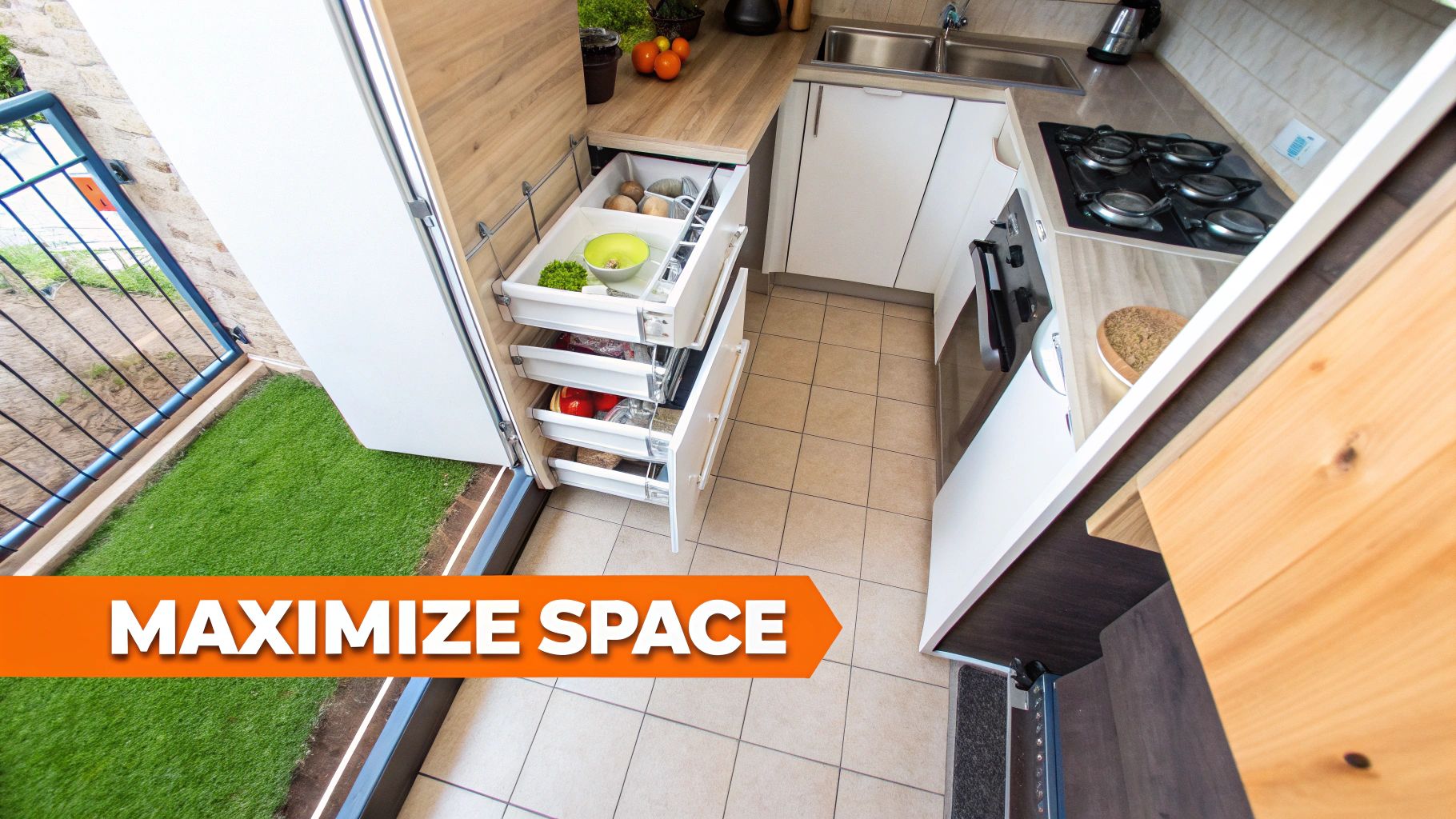
In a small kitchen, particularly the compact ones common in Orange County homes, every square inch is valuable real estate. This is where clever design becomes a powerful tool for enhancing your daily life. The goal isn't just to cram everything in; it's to create a space that feels open, functions intuitively, and is remarkably efficient. A limited footprint does not have to limit your kitchen's potential.
Mastering a small kitchen remodel is about mastering space. It means selecting a layout that streamlines cooking and cleaning, integrating storage that feels nearly invisible, and using visual techniques to make the room feel larger and brighter. With the right strategy, a cramped kitchen can become a high-performance workspace you truly enjoy.
Choosing the Right Layout for Your Footprint
While the classic "work triangle" is a good starting point, smaller kitchens often require more innovative thinking. The room's shape dictates the optimal layout, and each option offers distinct practical advantages.
The Galley Kitchen: This layout features two parallel walls of cabinets and counters. It’s incredibly efficient for a single cook, keeping everything within a few steps. The key is to maintain at least 48 inches of clearance between the two sides to avoid feeling confined.
The Single-Wall Kitchen: Common in lofts and smaller condos, this design aligns all appliances and workspaces along one wall, saving space and opening up the rest of the room. The primary challenge is ensuring sufficient counter space between the sink and stove.
The L-Shaped Kitchen: A highly popular and flexible choice, this layout utilizes two adjacent walls. It naturally opens the kitchen to another room, making the entire area feel more spacious and sociable. It also provides an excellent location for a corner pantry or a lazy Susan to optimize corner storage.
Any of these layouts can be successful. The final decision depends on how you move and work in your kitchen—a factor we help our clients determine during the design-build phase.
Unlocking Hidden Storage Potential
Clutter is the enemy of a small kitchen. The secret to maintaining clear countertops is to integrate smart, organized storage into the design itself. This means thinking vertically and utilizing every forgotten nook and cranny.
Think beyond standard shelves. We often recommend a suite of solutions that can dramatically increase a kitchen's capacity without increasing its size.
Game-Changing Storage Solutions
- Floor-to-Ceiling Cabinetry: These tall cabinets draw the eye upward, creating a sense of height. More importantly, they provide invaluable storage for less frequently used items.
- Deep Drawers for Pots and Pans: Replacing lower cabinets with deep, full-extension drawers is a revelation. No more kneeling to dig through a dark cabinet—everything is visible and easily accessible.
- Toe-Kick Drawers: The often-wasted space beneath your base cabinets can be repurposed. Installing shallow drawers here is a brilliant solution for storing flat items like baking sheets, serving platters, or pet bowls.
- Pull-Out Pantry: A tall, narrow cabinet with pull-out shelves can hold a surprising amount of food in a minimal footprint, allowing you to see everything at a glance.
"The most successful small kitchen designs are those that anticipate storage needs before they become clutter. By integrating solutions like vertical pantries and deep drawers from the start, we can create a space that stays effortlessly organized."
— Sparkle Restoration Design-Build Team
We’ve seen firsthand how these features can completely transform a kitchen's feel and function. You can see seamless storage solutions in our project gallery for this kitchen remodel in Huntington Beach, CA.
Creating the Illusion of Space
Once the layout and storage are finalized, the final layer involves using design techniques to make the room feel larger and brighter. These visual strategies are subtle but have a powerful psychological impact.
Start with your color palette. Light colors are your greatest asset—think soft whites, pale grays, and muted blues. They reflect light and make walls appear to recede, creating an airy, open ambiance.
Next, incorporate reflective surfaces. A glossy subway tile backsplash or polished quartz countertops can bounce light throughout the room, adding depth. Even cabinet hardware with a bit of shine, like polished chrome or brass, contributes to this effect.
Finally, lighting is your most powerful tool. A single overhead fixture is insufficient. A well-designed, layered lighting plan should include:
- Ambient Lighting: General overhead light from recessed cans or a flush-mount fixture.
- Task Lighting: Focused light for your workspaces, such as under-cabinet LED strips that perfectly illuminate your counters.
- Accent Lighting: The finishing touches—a decorative pendant over the sink or in-cabinet lighting to add a touch of drama.
By combining an efficient layout, clever storage, and smart visual tricks, your small kitchen can achieve a level of style and function that rivals spaces twice its size.
Choosing Materials and Appliances That Last
With the layout finalized, it's time for the exciting part—selecting the materials and appliances that will define your small kitchen's personality. This stage is about defining the look, feel, and resilience of your new space. For a hardworking Orange County kitchen, the key is to find the perfect balance of beauty, durability, and value.
Making smart investments here is critical. These choices will have a significant impact on your daily experience and the long-term performance of your kitchen.
Selecting Countertops for Style and Durability
Your countertops are the workhorse of the kitchen, so they must be durable. While aesthetics are important, let real-world maintenance and resilience guide your decision.
Here’s a quick overview of popular choices for compact kitchens:
- Quartz: This engineered stone is a top performer for good reason. It's non-porous, resisting stains from coffee, wine, and oil. It’s also incredibly durable and requires virtually no maintenance, making it ideal for busy families.
- Granite: A classic natural stone, granite offers one-of-a-kind beauty, as no two slabs are identical. It handles heat well but requires periodic sealing (typically annually) to prevent staining.
- Butcher Block: For a warmer, more traditional aesthetic, wood countertops are a fantastic choice. They're great for prep work but require regular oiling and diligent cleaning to prevent water damage and bacteria.
Smart Cabinetry Choices for a High-End Look
Cabinetry is almost always the largest line item in a kitchen remodel budget. Understanding your options helps you invest your money for maximum impact. Together, cabinetry and countertops can easily account for 40% of your total budget.
We generally advise clients to invest between 5–15% of their home’s value into a kitchen project to see a solid return.
There are three main tiers of cabinets to consider:
- Stock Cabinets: The most budget-friendly option, available from big-box stores in standard sizes. While selection is limited, they can be enhanced with custom hardware or crown molding for a more high-end appearance.
- Semi-Custom Cabinets: This middle-ground option offers more flexibility in sizes, finishes, and styles than stock, without the full cost of custom.
- Custom Cabinets: Built precisely for your space, custom cabinets are the ultimate solution for maximizing every inch of a small or awkwardly shaped kitchen. They are the priciest option, but the quality and personalization are unmatched.
And don't overlook the prep work. For a finish that lasts, using the best primer for kitchen cabinets is a non-negotiable first step. A quality primer ensures your paint job can withstand the daily demands of a busy kitchen.
Maximizing Function with Space-Saving Appliances
In a small kitchen, selecting appliances is a strategic challenge. Bulky models can overwhelm a small footprint, making the room feel cramped. The goal is to find appliances that deliver powerful performance without dominating the space.
As a licensed General Contractor, we consistently advise clients to prioritize function-first appliances. An appliance that saves space and performs multiple duties is always a smarter investment in a small kitchen than a single-function, oversized model.
Look for these space-saving features when shopping:
- Counter-Depth Refrigerators: These models are designed to sit nearly flush with your cabinets, typically around 24-25 inches deep. This prevents the fridge from protruding and disrupting the kitchen's flow, creating a clean, built-in aesthetic.
- Slim 18-Inch Dishwashers: For smaller households or tight cabinet runs, an 18-inch dishwasher is a game-changer. It provides the convenience of a standard model while freeing up a precious 6 inches of cabinet space.
- Over-the-Range Microwaves: A classic space-saving solution, this combines your microwave and range hood into one unit, immediately clearing valuable counter space.
Finally, consider the foundation of the room—the floor. Your kitchen flooring must handle spills, constant foot traffic, and occasional dropped items. Materials like luxury vinyl tile (LVT) and porcelain tile are excellent choices, offering incredible durability and a vast array of styles. You can explore modern options in our guide to flooring sales and installation.
Navigating the Construction Process From Start to Finish
With materials selected and a solid plan in place, it's time for construction. Understanding the sequence of events is what transforms a potentially chaotic period into an exciting, predictable transformation. This is when your vision starts becoming a reality.
Before the first hammer swings, the space must be cleared. The first step is always emptying your existing kitchen. For helpful tips on this process, check out this guide on how to pack a kitchen. Once everything is packed, the real work begins.
The Typical Remodel Sequence
While every project is unique, a small kitchen remodel generally follows a standard sequence. Understanding this order of operations helps you anticipate what’s next and why, for instance, drywall must be installed before the new floors.
The major milestones typically unfold as follows:
- Demolition and Prep: The old kitchen is carefully dismantled. This includes removing cabinets, countertops, appliances, flooring, and sometimes drywall to expose the framing.
- Structural and Rough-Ins: This is the "behind-the-walls" phase. If you're moving plumbing or adding new outlets, this is when it happens. Plumbers and electricians run new pipes and wiring for your sink, dishwasher, and lighting.
- Inspections and Drywall: Before walls are closed, a city inspector—a requirement in all Orange County municipalities—will approve the rough plumbing and electrical work. After receiving this approval, new drywall is hung, taped, and textured.
- Painting and Flooring: With a blank canvas, we always paint the room before major installations to ensure clean, crisp lines. Next, the new flooring is installed, setting the stage for everything else.
- Cabinet and Countertop Installation: This is a major visual transformation. Your new cabinets are set in place, followed by the precise templating and installation of your countertops.
- Finishing Touches: Finally, the details that personalize the space are added. This includes installing the backsplash, appliances, sink, faucet, light fixtures, and all cabinet hardware.
The Critical Role of a Licensed General Contractor
Orchestrating this intricate process on your own is a massive undertaking filled with potential pitfalls. This is why partnering with a licensed and insured General Contractor is not just a recommendation—it’s essential for a successful, code-compliant remodel in Orange County.
A skilled General Contractor is the conductor of your project's orchestra. They ensure every trade professional, from the plumber to the tile setter, performs their job correctly and on schedule. They also manage the complexities of permits and inspections, protecting you from liability and ensuring your investment is built to last.
As an IICRC Master Certified and licensed General Contractor, Sparkle Restoration manages this entire process for you. Our deep knowledge of local building codes and our long-standing relationships with the best local tradespeople are at the core of our remodeling and construction services.
Practical Tips for Living Through the Renovation
Let's be realistic: living without a functioning kitchen is challenging. However, a little preparation can make this temporary disruption far more manageable.
Set Up a Temporary Kitchen:
- Designate a corner in another room (the garage or dining room works well) as your temporary kitchen hub.
- Move your old refrigerator there, along with a microwave, a coffee maker, and perhaps a small portable cooktop.
- Stock up on paper plates and disposable utensils to avoid washing dishes in a bathroom sink.
This infographic offers great ideas for choosing smart, space-saving appliances, which are also perfect for a temporary setup.
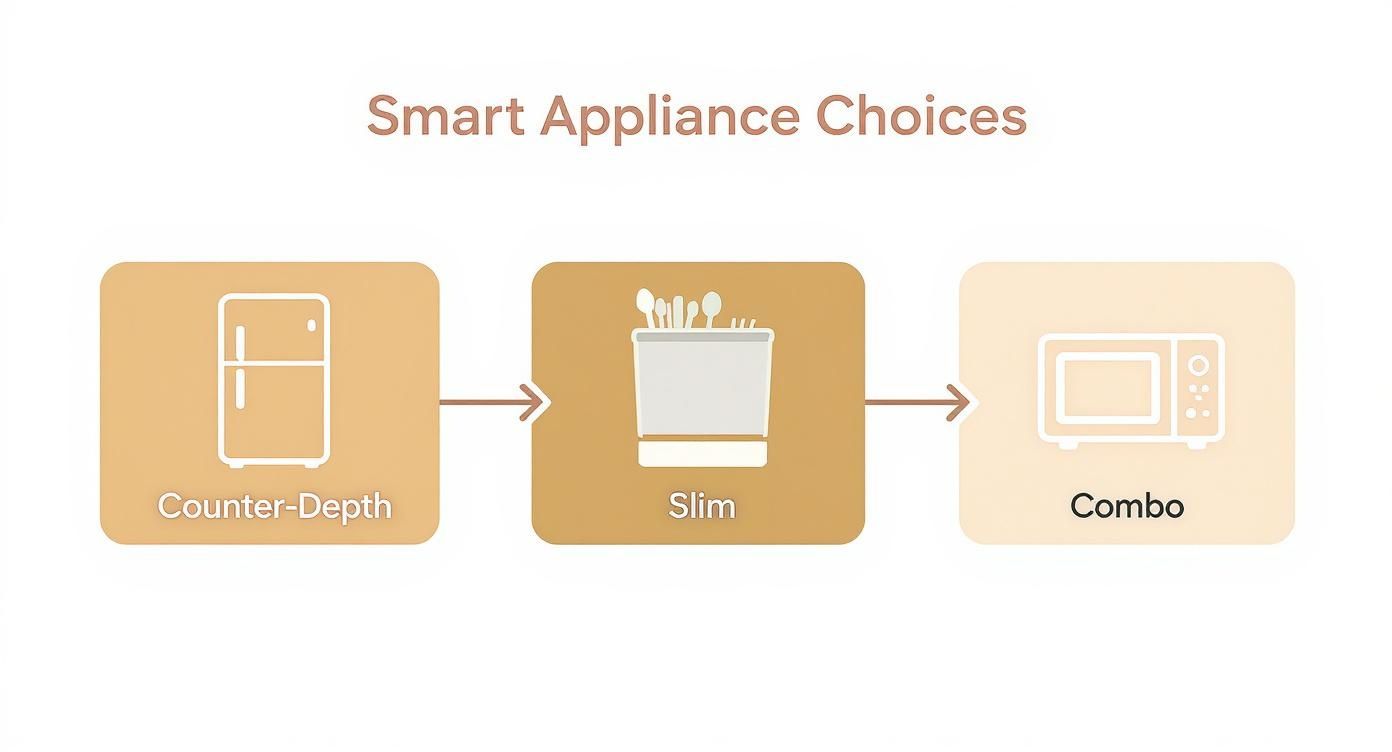
As the graphic shows, prioritizing items like counter-depth refrigerators or combination microwave ovens can make a significant difference in a makeshift space.
Beyond the setup, clear communication with your project manager is vital. A reputable contractor will provide regular updates so you know what to expect each week. Remember, this phase is temporary. A well-managed construction process will feel surprisingly smooth, and soon you'll be enjoying your beautiful new kitchen.
Your Small Kitchen Remodel Questions Answered
Taking on a remodel, especially in a compact space, always raises many questions. As Orange County's trusted design-build experts and licensed general contractors, we have heard them all. Here are straightforward answers to the most common questions from homeowners planning a small kitchen remodel.
How Long Does a Small Kitchen Remodel Typically Take?
For a small kitchen, a realistic timeline is between four to eight weeks from demolition to your final walkthrough.
This timeframe depends on one critical factor: having all your materials on-site before we begin. This means your cabinets, countertops, appliances, and tile have all been delivered and are ready for installation.
Several factors can extend this timeline:
- Permitting Process: Obtaining the necessary permits in cities like Irvine or Newport Beach can sometimes take several weeks before work can commence.
- Inspection Schedules: We will need to pause for mandatory electrical and plumbing inspections, which are non-negotiable for safety and code compliance.
- Custom Orders: Lead times for fully custom cabinets or special-order countertop slabs can add significant waiting time to the pre-construction phase.
Can I Save Money by Doing Some of the Work Myself?
While the DIY spirit is admirable, it's crucial to be honest about which tasks are homeowner-friendly and which require a licensed professional. You can certainly save on labor costs by tackling tasks like painting, demolition, or installing cabinet hardware.
However, we strongly advise against DIY electrical or plumbing work. These systems are complex and carry serious safety risks. A licensed professional is required to meet local building codes for a reason—one mistake can lead to expensive and dangerous problems.
As a BBB Torch Award Winner for Ethics, we believe in complete transparency. The smartest investment you can make is hiring certified professionals for critical systems. It's the foundation of a successful remodel that you'll be happy with for years to come.
What is the Biggest Mistake Homeowners Make?
One of the most common pitfalls is underestimating the total cost and failing to establish a contingency fund. It's easy to focus on the visible items like appliances and cabinets, but homeowners often forget the behind-the-scenes costs—labor, permits, and materials like drywall, plumbing fittings, and wiring.
Another frequent misstep is changing your mind after work has started. Deciding on a different layout after the walls are open can throw the schedule and budget into a tailspin. Your best defense is a rock-solid, detailed plan finalized before demolition day.
Will a Small Kitchen Remodel Add Value to My Home?
Absolutely. A thoughtfully executed kitchen remodel consistently delivers one of the highest returns on investment of any home improvement project. In a competitive market like Southern California, a modern, functional, and stylish kitchen is a significant selling point.
Even minor kitchen remodels can recoup a large portion of their cost at resale, making it a sound financial investment. By focusing on smart, high-impact upgrades—like durable quartz countertops, clever storage solutions, and quality appliances—you're not just improving your daily life; you're boosting your home's long-term value. This is how to remodel a small kitchen for the greatest return.
Planning a remodel can feel overwhelming, but you don’t have to do it alone. The experts at Sparkle Restoration Services are here to guide you through every step, from the first design sketch to the final inspection, turning remodel chaos into a calm, seamless process.
Ready to create the small kitchen you've been dreaming of? Contact us today for a complimentary consultation.
Ready to create a space that’s as beautiful as it is functional? Schedule your complimentary design consultation today by visiting Ready to Work with Sparkle?