



Think you might have a mold problem? That faint, musty smell in the basement or a discolored patch of drywall is enough to set off alarm bells for any discerning homeowner in Orange County. When your property and your family’s well-being are at stake, you need clear, trustworthy information.
The first question is always, how do I test for mold exposure? The answer, however, doesn’t start with a store-bought kit. It begins with a careful, methodical assessment of your home and an understanding of the symptoms mold can cause.
Conducting Your Initial Home Assessment
Before calling in a certified professional, a little detective work on your own can provide invaluable clues. This isn’t about diagnosing the type of mold—it’s about identifying the red flags that point to a moisture problem, which is always the root cause of mold growth.
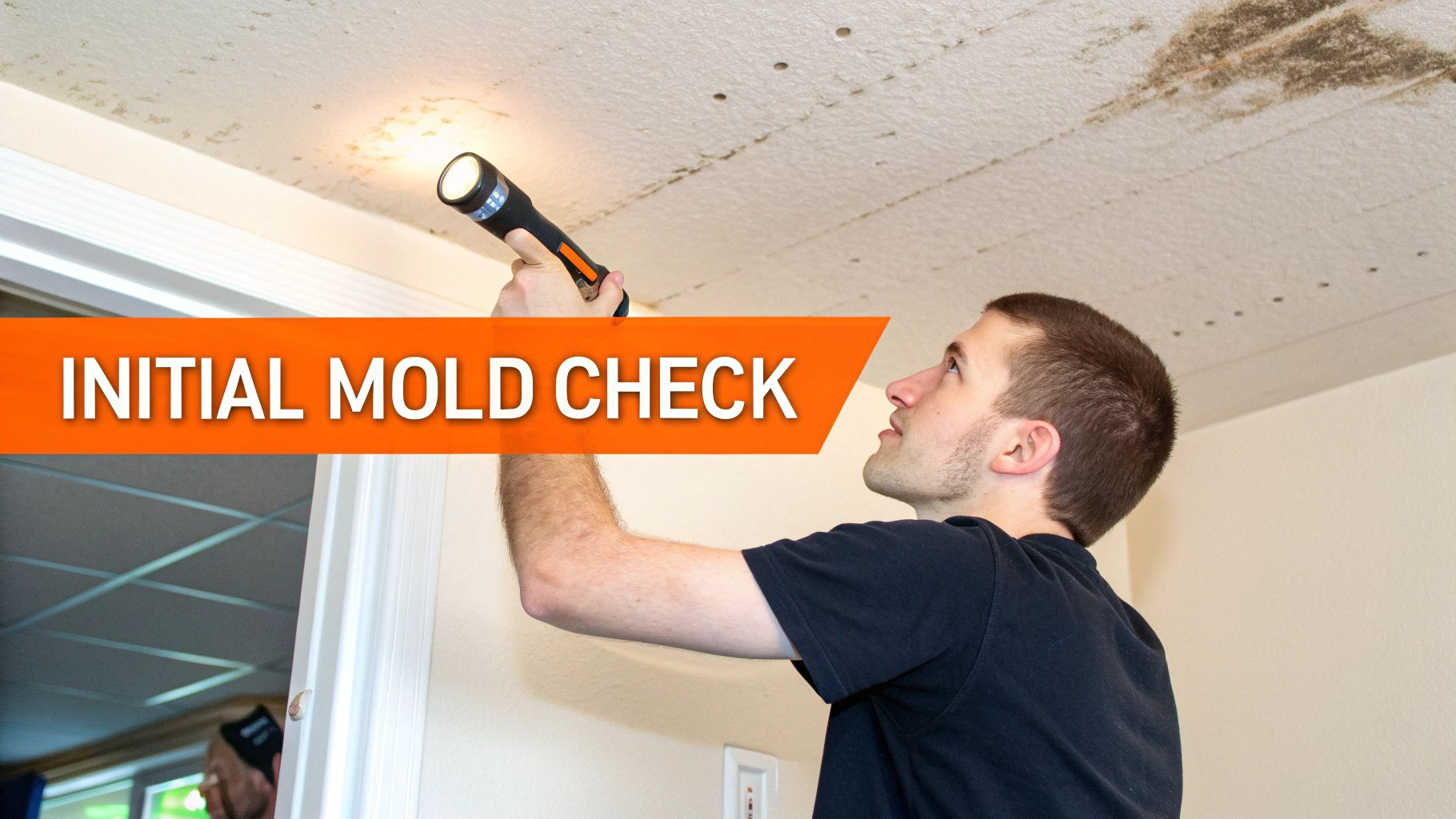
Start by methodically checking high-risk areas: kitchens, bathrooms, laundry rooms, basements, and around window sills. You’re looking for more than just obvious fuzzy growth. The subtle signs often tell the real story.
Keep an eye out for these tell-tale indicators of a hidden moisture issue:
- Peeling paint or bubbling wallpaper: These are classic signs that the drywall behind them is holding moisture.
- Warped baseboards or flooring: Wood and laminate materials swell and distort when they’ve been absorbing water over time.
- Persistent musty odors: If an earthy smell lingers even after airing out the room, it’s a strong indicator that mold is growing somewhere nearby.
- Condensation buildup: Consistent moisture on windows, pipes, or walls signifies high humidity—the perfect breeding ground for mold.
One of the most common culprits we see is a slow, unnoticed leak. It’s incredibly helpful to know how to identify and address water leaks from your AC unit, as these are frequent contributors to mold problems. Any leak, no matter how small, can cause significant damage if not resolved promptly.
As an IICRC Master Certified firm serving Orange County, we always emphasize that mold is just a symptom. The real disease is water intrusion. Finding and professionally repairing the source is just as critical as the mold remediation itself.
When to Trust the Professionals
Think of your initial inspection as building a case. By documenting what you see and smell, you’re gathering essential information for a certified expert. If you find any of these warning signs, it’s a strong signal that it’s time to bring in a professional.
Understanding the signs of water intrusion is your first step; making sure your home is leak-proof is the next. An IICRC-certified specialist from Sparkle Restoration can then use advanced tools to confirm the extent of the problem, turning chaos into calm with a clear, data-driven action plan.
Decoding Health Symptoms of Mold Exposure
That nagging cough you can’t shake, the allergies that persist long after spring, or unexplained headaches—it’s easy to dismiss these symptoms. But for many Orange County homeowners we assist, these are often the first clues that a hidden mold problem is affecting their indoor air quality.
Learning to recognize these signals from your body is a critical first step in understanding how to test for mold exposure.
The challenge is that mold sensitivity varies greatly. One person in your family might feel perfectly fine, while another deals with constant discomfort. This depends on individual sensitivity, the duration of exposure, and the specific type of mold present.
This is why it’s so important to connect unexplained symptoms with what might be happening inside your home. At Sparkle Restoration, our first piece of advice is always the same: your family’s health is the top priority.
Common Allergic and Respiratory Reactions
Most often, the initial health complaints we hear about mimic seasonal allergies, which is why they are frequently overlooked. When you inhale mold spores, your immune system can overreact, triggering an inflammatory response.
Watch for these tell-tale signs:
- Persistent Sneezing and Congestion: A stuffy or runny nose that doesn’t clear up, even with standard allergy medicine.
- Itchy, Watery Eyes: That classic hay fever look—redness and irritation—but it’s happening indoors.
- Chronic Coughing and Wheezing: A dry, hacking cough or a faint whistling sound when you breathe. This is a significant red flag, especially for individuals with asthma.
- Skin Irritation: Experiencing mysterious rashes or hives after spending time inside.
A simple litmus test: if you leave for a vacation and these symptoms vanish, it strongly suggests your home’s environment is the source of the problem. For a deeper dive, review our guide on the health risks and prevention of mold contamination.
More Serious Neurological and Systemic Symptoms
While less common, long-term exposure to certain molds can lead to more serious, systemic health issues. These symptoms can be truly debilitating and are often misdiagnosed because they mimic other chronic illnesses.
Be aware of these more severe indicators:
- Chronic Fatigue: This isn’t just feeling tired. It’s a profound exhaustion that sleep doesn’t resolve.
- Headaches and Migraines: Frequent, intense headaches that lack a clear trigger and don’t respond to typical pain relievers.
- Brain Fog or Cognitive Issues: Difficulty concentrating, memory lapses, or a general feeling of being mentally “off.”
- Joint and Muscle Pain: Aches and stiffness that can’t be attributed to physical activity or injury.
Your well-being is paramount. While this information is vital for awareness, it is not a substitute for medical advice. Always consult a healthcare professional for a proper diagnosis if you are experiencing persistent health issues.
The science validates these concerns. One study found that 41% of people with documented mold exposure tested positive for elevated mold-specific IgE antibodies, compared to just 17% of a non-exposed group. For asthmatics with known exposure, that number jumped to 78%. This research, detailed in these quantifiable serological findings on PMC, underscores the significant impact of mold. Listening to your body isn’t just a suggestion—it’s your best early-warning system.
How to Conduct a Thorough Home Inspection
If you’re beginning to connect your health symptoms to a potential mold problem, the next step is a logical one: search for the source inside your Orange County home.
This is where you play detective. A systematic, top-to-bottom inspection helps you gather clues, understand the potential scale of the issue, and arm yourself with information before calling in a professional. You aren’t trying to identify specific mold species—you are connecting the dots between moisture and the warning signs it leaves behind.
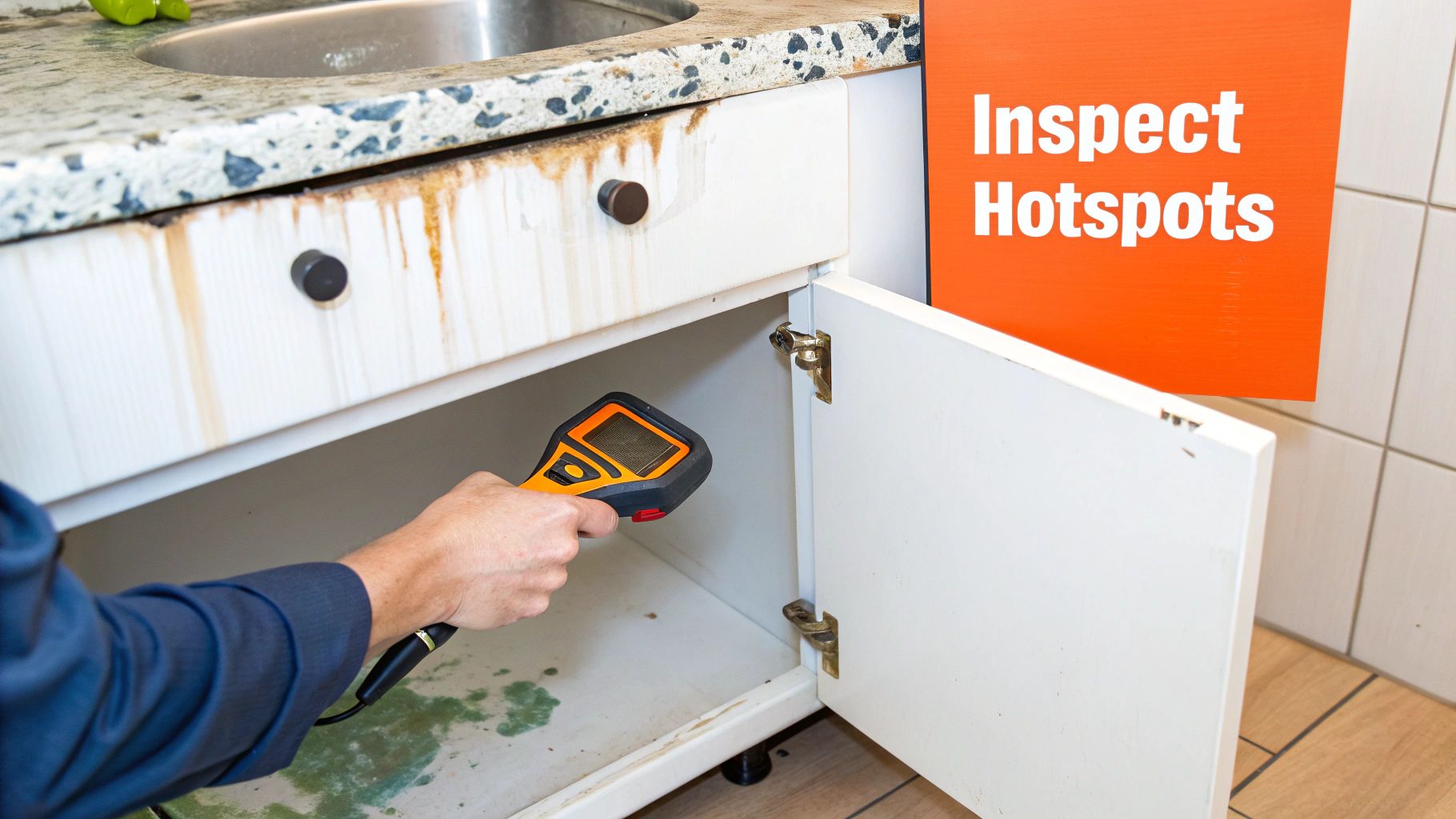
Before you begin, remember that mold often hides where you least expect it. Grab a good flashlight and prepare to look in those out-of-sight, out-of-mind places.
Follow Your Senses: What to Look and Smell For
Your most effective tools for this initial walkthrough are your eyes and your nose. While fuzzy black, green, or white growth is an obvious giveaway, the subtle clues often tell the real story.
Look for the secondary signs of water damage. These are the breadcrumbs that lead directly to a hidden mold colony.
- Discoloration and Staining: Yellowish or brown water stains on ceilings or walls are a smoking gun for a past or present leak.
- Material Degradation: Is paint peeling? Wallpaper bubbling? Are your baseboards warped? These materials only change shape after absorbing moisture over time.
- Condensation: Persistent moisture beading on window frames, sills, or uninsulated pipes indicates high humidity—the perfect environment for mold.
Beyond sight, trust your sense of smell. A persistent musty, earthy, or damp odor is a huge red flag, even if you can’t see a single spot of mold. This smell comes from microbial volatile organic compounds (MVOCs), gases released by active mold growth.
A common mistake we see is homeowners dismissing a musty smell because they can’t find visible mold. That odor is often your first and only clue that a problem exists behind a wall, under flooring, or within your ventilation system. Never ignore it.
Pinpointing Common Mold Hotspots
Mold needs three things to thrive: moisture, darkness, and a food source (like drywall or wood). This recipe makes certain areas in every home far more vulnerable. Focus your search on these key hotspots.
Kitchens and Bathrooms:
Get on your hands and knees to check under every sink for slow drips or old water stains. Look closely at the caulking around tubs, showers, and sinks. Don’t forget the base of the toilet and the dark corners inside vanity cabinets.
HVAC Systems and Vents:
Your home’s HVAC system can become a superhighway for mold spores, distributing them into every room. Inspect the visible parts of your AC units and check air vents for dark spotting or musty smells when the system activates. Routine maintenance is critical, and our guide to professional HVAC system cleaning explains how it improves air quality and efficiency.
Attics and Basements:
In the attic, scan the underside of the roof sheathing for dark stains that signal a roof leak. In the basement or crawl space, inspect foundation walls for any signs of water seepage and look for issues around sump pumps.
Windows and Exterior Walls:
Examine the areas around window frames for condensation buildup. Pay close attention to walls containing plumbing, looking for even the most subtle signs of moisture.
As you go, take clear photos of anything suspicious. This documentation is invaluable. It creates a detailed record that helps a certified professional—like the IICRC Master Certified team at Sparkle Restoration—diagnose the source and scope of the problem much faster, getting you closer to a solution.
DIY Mold Kits vs. Professional Mold Testing
When you find something that looks like mold, the immediate impulse is to get answers—fast. It’s tempting to head to the local home improvement store and purchase a DIY mold test kit. They promise a quick, affordable way to identify what you’re dealing with.
Unfortunately, these kits often create more confusion than clarity.
The fundamental issue is that mold spores are everywhere. They are a natural part of our environment, both indoors and out. A DIY kit that simply confirms the presence of mold spores is like a weather report that only states, “There is air outside.” It’s not incorrect, but it’s not useful. It cannot tell you if you have an active, growing colony, how severe it is, or where the water feeding it is coming from.
This is a critical blind spot. In fact, both the CDC and the EPA specifically advise against using these kits to assess your home’s air quality. Their unreliability can either provide a false sense of security or cause unnecessary panic, neither of which helps you solve the real problem.
The Limitations of DIY Mold Test Kits
Most at-home kits consist of a petri dish left out to capture airborne spores. While this looks scientific, the results are easily contaminated and lack the context needed for informed decisions.
Here’s why these kits almost always fall short:
- They deliver false positives. Since mold spores are always present, a DIY kit is virtually guaranteed to grow something. This doesn’t distinguish between a hidden infestation and normal background levels of spores from an open window.
- They can’t measure the scale of the problem. A positive result confirms mold exists but offers no sense of scale. Are you dealing with a few harmless spores or a massive colony behind your drywall?
- They can’t find the source. The kit has zero ability to locate the hidden pipe leak or moisture issue fueling the growth. Without fixing the underlying water problem, any cleanup is merely a temporary band-aid.
The shortcomings of these kits are well-documented. Consumer Reports tested several popular DIY mold kits and rated all of them as ‘Not Recommended’ due to major flaws. This aligns with federal agency guidance, which has long stated that one-off air samples cannot be used to reliably assess health risks.
To separate fact from fiction, you can explore the real facts and myths about mold and mold remediation in our comprehensive guide.
The Precision of a Professional Assessment
When you engage an IICRC-certified firm like Sparkle Restoration, you aren’t just buying a test; you’re investing in a full diagnostic investigation. Our approach is rooted in proven scientific methods and years of hands-on experience in homes right here in Orange County.
A professional assessment is a multi-step process designed to provide a complete picture of your home’s indoor environment.
The most important thing to understand is that a professional inspection isn’t really about finding mold—it’s about finding out why the mold is there in the first place. We use specialized tools and a systematic process to trace the problem back to its source, giving you a clear and definitive action plan.
The EPA is very clear on this: if sampling is needed, it must be performed by trained professionals who can design a proper testing strategy. Mold levels fluctuate with humidity, airflow, and even the time of day, so expertise is essential to collect meaningful data.
Before you spend money on a hardware store kit, consider what you are—and are not—getting.
DIY Test Kits vs. Professional Mold Inspection
| Feature | DIY Mold Test Kit | Professional Mold Assessment (Sparkle Restoration) |
|---|---|---|
| Accuracy | Prone to false positives and negatives; results easily skewed by environmental factors. | Uses calibrated equipment and controlled sampling methods for scientifically valid data. |
| Scope | Only indicates the presence of spores in a small, localized area. | Determines the full extent and concentration of mold, identifying hidden sources behind walls. |
| Analysis | Provides a simple positive/negative result, often without identifying the mold type. | Includes lab analysis to identify specific mold species and spore counts, offering crucial context. |
| Root Cause | Offers zero insight into the underlying moisture problem causing the growth. | Utilizes moisture meters and thermal imaging to pinpoint the exact source of water intrusion. |
| Action Plan | Leaves you guessing about the next steps, often leading to improper or ineffective cleanup. | Delivers a detailed remediation protocol and repair plan based on data-driven findings. |
Ultimately, opting for a professional assessment from a BBB Torch Award winner like Sparkle Restoration means replacing guesswork with a clear, actionable solution. It ensures you’re not just treating a symptom—you’re solving the core problem to protect your home and family for the long term.
What to Expect from Professional Mold Testing
Deciding to bring in a certified professional is a significant step toward regaining your peace of mind. But what actually happens during a professional mold assessment? It is far more than a simple swab test. Think of it as a systematic investigation to uncover the complete story of what’s happening inside your home, swapping uncertainty for clear, actionable data.
Here at Sparkle Restoration, our IICRC Master Certified technicians don’t just look for visible mold; we hunt for the moisture that feeds it. This comprehensive process combines a trained eye with advanced diagnostic tools to ensure nothing is missed. Our goal isn’t just to find the “what,” but to understand the “why” and “how” behind the growth so we can provide a permanent solution.
The entire philosophy is a structured process: careful observation leads to precise testing, which then informs a targeted remediation plan.
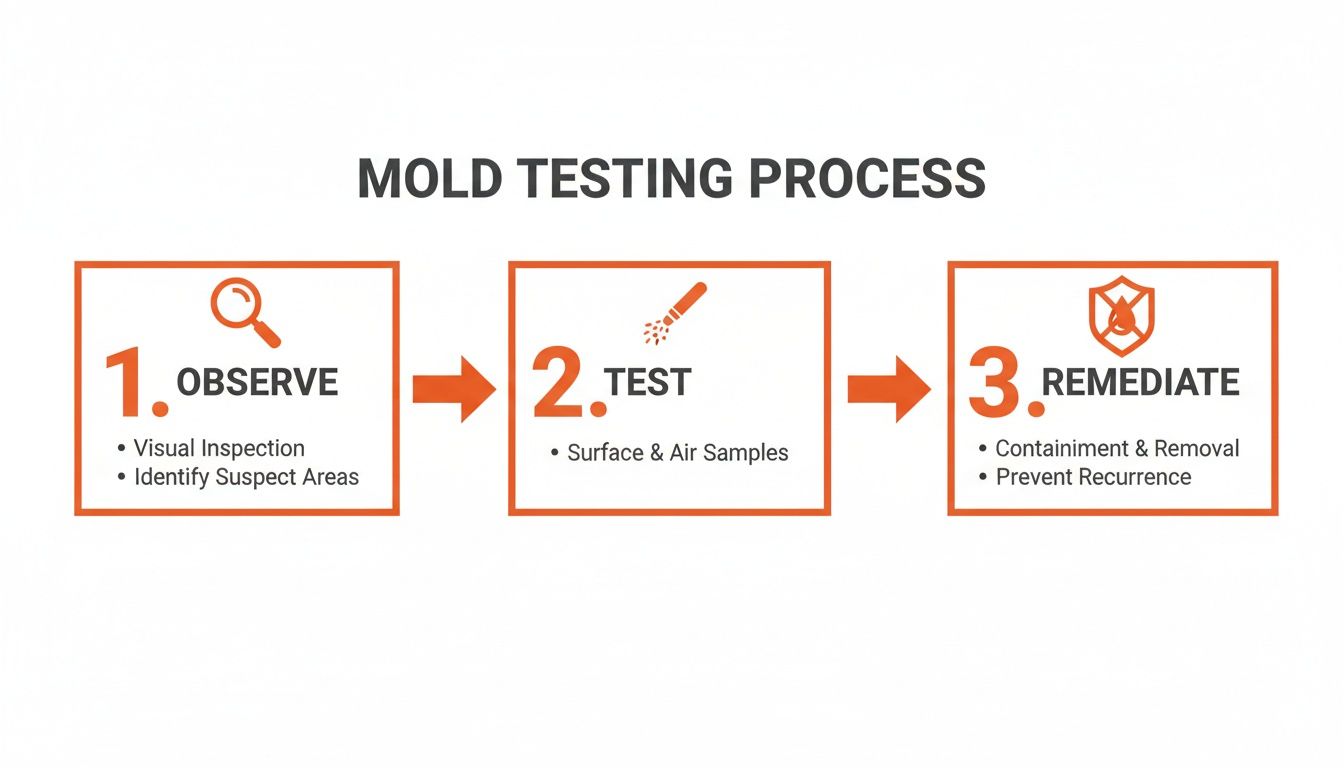
This workflow illustrates why testing is such a critical middle step. It’s the bridge connecting problem discovery to permanent resolution, ensuring your home becomes a healthy environment once again.
The Investigative Toolkit
A true professional arrives with more than a flashlight. Our team is equipped with a suite of specialized gear to see what the naked eye can’t, allowing us to trace moisture right to its source.
- Moisture Meters: These are essential for measuring the moisture content inside building materials like drywall and wood framing, pinpointing hidden dampness without destructive measures.
- Thermal Imaging Cameras: An infrared camera is one of our most powerful tools. It reveals subtle temperature differences on surfaces. Since wet areas are typically cooler, they appear clearly on screen, helping us map the full extent of water intrusion behind walls and ceilings.
- Hygrometers: These devices measure the relative humidity in the air, telling us if the ambient moisture in a room is high enough to support mold growth, even without an active leak.
A professional assessment is fundamentally a moisture investigation. Finding the mold is often the easy part; finding and resolving the water source that allows it to thrive is what truly protects your home for the long term.
Scientific Sampling Methods
Once we’ve identified the moisture source and mapped the affected areas, we proceed with targeted sampling. This provides the hard, scientific data needed to build a precise remediation plan. Each method serves a specific purpose, and a certified expert knows which combination is right for your situation.
Air Sampling
This is the most common method we use to determine what your family is breathing. A calibrated air pump pulls a specific volume of air through a sterile cassette, which traps airborne spores. We then send it to an accredited, third-party lab for analysis.
The lab report provides two critical pieces of information: the types of mold present and their spore concentration (spores per cubic meter of air). We always take an outdoor “control” sample to compare against indoor results. This tells us if spore counts inside your home are abnormally elevated compared to the natural environment.
Surface Sampling
When we find visible growth, surface sampling helps identify the exact mold species. There are a couple of ways to do this:
- Swab Samples: A sterile cotton swab is wiped across the surface, collecting a sample for the lab to culture and analyze.
- Tape Lifts: A special, clear adhesive tape is pressed against the surface. This lifts spores and fungal structures for direct microscopic examination.
Bulk Sampling
In some situations, a small physical piece of contaminated material—like a section of drywall or carpet—is needed. This sample is carefully removed, bagged, and sent to the lab for a detailed analysis of the mold growth within the material. As a more invasive method, we reserve it for cases when other techniques are insufficient.
While we test the environment, it’s interesting to see medical science advancing in parallel. For instance, a blood test for invasive mold disease developed at Stanford Medicine, available since late 2020, has shown remarkable accuracy, matching diagnoses from traditional invasive testing 88.5% of the time. It works by detecting mold DNA directly from a blood sample, with results in a single day. You can read the research about these advancements in mold exposure blood tests on Stanford Medicine’s news site, highlighting the growing synergy between environmental testing and medical diagnostics.
Your Action Plan After Getting Mold Test Results
Receiving a detailed lab report can feel overwhelming. The pages of data, spore counts, and scientific names can seem like a foreign language. But this report isn’t the problem—it’s the critical first step toward a permanent solution.
Think of it as the blueprint for taking back your home. Seeing names like Stachybotrys chartarum (the infamous “black mold”) or elevated levels of Aspergillus may be alarming, but this specific information is precisely what a certified professional uses to design an effective remediation strategy.
Building a Comprehensive Remediation Plan
A true solution goes far beyond wiping down visible mold. Proper remediation is a multi-step process designed to contain the problem, completely remove the contamination, and—most importantly—prevent it from returning. It’s about treating both the symptom (the mold) and the root cause (the moisture).
This is where having a Licensed General Contractor like Sparkle Restoration makes all the difference for our clients in Orange County. We don’t just clean up the mold; we manage the entire project from start to finish.
An integrated plan like ours typically involves:
- Containment: The first step is to isolate the affected area. We establish physical barriers and use negative air pressure machines to prevent spores from spreading to other parts of your home.
- Safe Removal: Following strict IICRC protocols, we safely remove any materials, like drywall or insulation, that are too contaminated to be salvaged.
- Detailed Cleaning: All non-porous surfaces receive a thorough cleaning with HEPA vacuums and EPA-registered antimicrobial agents to eliminate any lingering spores.
- Source Repair: This is the most critical step. We identify and repair the underlying moisture issue, whether it’s a hidden plumbing leak, a roof issue, or an HVAC malfunction, to ensure the mold does not return.
At Sparkle Restoration, we see the complete picture. Our ability to handle both the specialized mold remediation and the necessary structural repairs means you have one trusted, accountable partner guiding you. We expertly turn chaos into calm, fast.
For stubborn mold, especially in bathrooms, understanding the details of professional bathroom mould remediation can highlight how meticulous this process must be.
Armed with a clear lab report and a strategic action plan, you’re no longer just dealing with a problem. You’re empowered to restore not just your property, but your peace of mind. It’s time to make your home a safe, healthy sanctuary again.
Your Top Mold Testing Questions Answered
When you suspect mold in your home, it’s natural to have questions. It’s a stressful situation, and you need clear, direct answers from an authority you can trust. Here’s what we hear most often from homeowners in Orange County about mold testing.
How Much Does Professional Mold Testing Cost?
The cost of professional mold testing is not a single, flat-rate number; it depends on the size of your property and the number of air or surface samples required to obtain a scientifically accurate assessment.
Think of it as an investment in a correct diagnosis. A comprehensive inspection with proper sampling provides the hard data needed to address the problem correctly the first time, preventing much larger costs and complications down the road.
Can I Just Use Bleach to Clean a Small Mold Spot?
This is one of the most persistent myths in home maintenance. While bleach may remove the visible stain from a non-porous surface like tile, it does not kill the mold’s roots embedded in porous materials like drywall, grout, or wood.
More importantly, bleach does absolutely nothing to fix the moisture problem that allowed the mold to grow. For anything more than a tiny, isolated spot, a professional assessment is necessary to ensure the problem is fully resolved and won’t return.
At Sparkle Restoration, we see countless cases where improper cleanup has made a small problem worse. The goal isn’t just to clean the spot—it’s to eliminate the conditions that created it.
Is Mold Testing Covered by Homeowners Insurance?
Insurance coverage for mold is complex and almost always depends on the root cause of the moisture. Coverage is more likely if the mold resulted from a sudden, covered event, such as a burst pipe that caused water damage.
However, problems that develop slowly over time—like a gradual, undetected leak or persistent high humidity—are often excluded from standard policies. We always advise homeowners to review their policy documents and speak directly with their insurance agent to understand their specific coverage.
If you suspect mold in your Orange County home, don’t leave it to guesswork. The IICRC Master Certified team at Sparkle Restoration Services provides comprehensive mold testing and remediation to turn chaos into calm, fast. Contact us today for a professional consultation by visiting us at Ready to Work with Sparkle?