



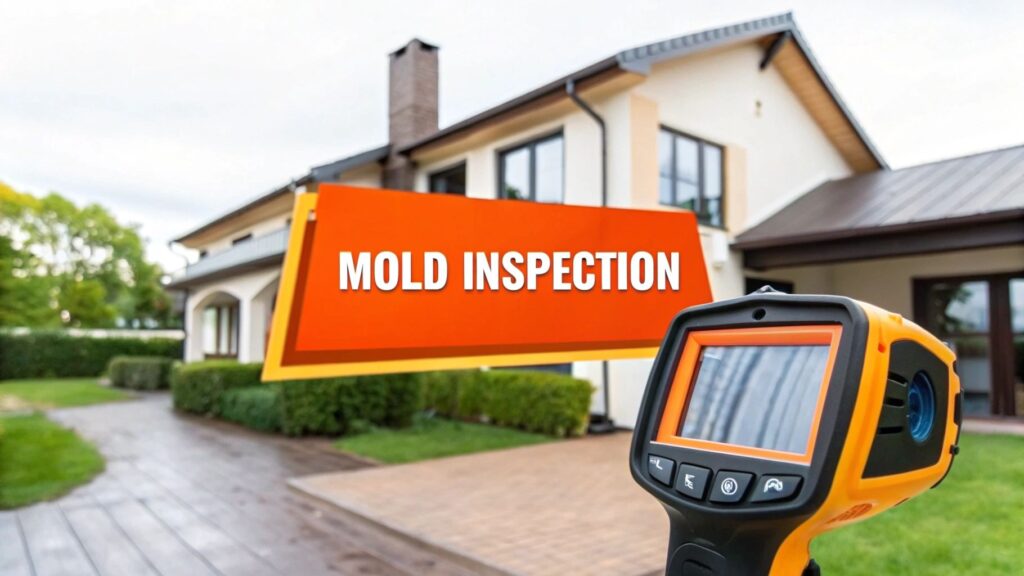
When you suspect a problem, a professional mold inspection in Orange County is the definitive step to move from worrying to having a clear, actionable plan. It's a comprehensive process involving a visual assessment, high-tech diagnostic tools, and often lab testing to find out exactly what you're dealing with. This isn't just about spotting a problem; it's about defining its scope to ensure the solution—and your peace of mind—is complete and lasting.
Why Mold Is a Hidden Threat in Orange County Homes

We all love Orange County's coastal climate—the ocean breezes, the year-round mild temperatures. But those same conditions create the perfect environment for mold to thrive, even inside the most immaculate luxury homes in Newport Beach, Irvine, and Laguna Niguel. It's a common misconception that newer or well-kept properties are immune, but mold doesn't discriminate.
A tiny, slow leak behind a shower wall, poor ventilation in an attic, or even just a window left open during a damp evening can provide enough moisture for mold to take hold. It often grows completely undetected behind drywall or under high-end flooring, silently causing damage and degrading your indoor air quality long before you notice anything is wrong.
From Reactive Repairs to Proactive Protection
Too many homeowners only seek help after they see visible mold or smell that unmistakable musty odor. By that point, the contamination has likely been spreading for weeks or even months. The key is to shift your mindset from reactive to proactive.
Think of a professional mold inspection not as a last resort, but as a crucial part of maintaining your home's health and protecting your investment.
"The absence of visible mold doesn't mean your home is in the clear. Hidden moisture is the true enemy, and a professional inspection is the only way to uncover it before it becomes a crisis."
As an IICRC Master Certified and BBB Torch Award-winning firm, our goal is to empower you with the knowledge to spot subtle warnings, understand the inspection process, and act on the results with confidence. We're here to turn potential chaos into calm with expertise you can trust.
The Impact of Local Weather Events
In a region defined by high-value real estate, the speed at which mold can grow is a serious financial risk. After the intense storms that soaked Southern California in recent years, local inspection companies saw a massive spike in calls. Certified experts know that mold can start growing in as little as 72 hours after a water intrusion—a startlingly short window.
To truly get ahead of this, homeowners need to be proactive. Simple prevention strategies can make a world of difference, like these 10 tips on how to avoid mold in your home. Understanding how to prevent moisture buildup is the first line of defense. You can also dive deeper into the health risks in our guide, https://sparklerestoration.com/the-truth-about-mold-contamination-health-risks-and-prevention-tips/.
Spotting the Subtle Red Flags for Mold
When you think of mold, you probably picture obvious black spots on a wall. But in our experience with Orange County homes, the most serious mold problems are often the ones you can’t see at all. The first step in protecting your property and your family’s health is learning to trust your own senses.
A persistent, musty smell that you just can’t pinpoint is almost always a tell-tale sign of hidden mold. If you're catching a damp, earthy odor that gets stronger in certain areas or when the air conditioning kicks on, that’s a major warning. That smell is caused by Microbial Volatile Organic Compounds (MVOCs)—gases that mold releases as it grows.
Beyond the Obvious Signs
Sometimes, the clues aren't about smell but about how you feel in your own home. Pay close attention if family members suddenly start having more allergy-like symptoms—sneezing, coughing, itchy eyes, or a scratchy throat—that seem to fade when they leave the house. When health issues are tied directly to being on your property, it’s a strong indicator of an indoor environmental problem.
Another subtle but critical sign is unusual condensation. While a little bit of moisture on windows can be normal, if you're seeing excessive condensation on high-end, well-insulated windows, it often means the humidity inside your home is too high. This creates the perfect breeding ground for mold to thrive behind walls, in an attic, or in a crawl space.
Real-World Scenarios We See in Orange County
Over the years, we've seen how even the smallest issues in high-end homes can spiral into major mold situations. These aren't just hypotheticals; they happen more often than you would think:
- The Slow Appliance Leak: A luxury refrigerator with an icemaker has a tiny, slow drip from its water line. It goes completely unnoticed for months, seeping under expensive custom cabinets and hardwood floors, feeding a huge mold colony that's entirely out of sight.
- The Custom Shower Flaw: A gorgeous master bathroom shower, beautifully tiled, wasn't sealed perfectly behind the wall. With every single use, a little bit of moisture gets into the wall cavity, leading to a major mold problem that's only discovered years later during a renovation.
- HVAC System Contamination: A powerful HVAC unit in a large Newport Beach home has minor condensation building up inside the ductwork. Over time, this constant moisture allows mold to grow throughout the ducts, effectively spreading spores through the entire home every time the system runs.
Here’s the most important takeaway: trust your instincts. If something just feels off in your home, whether it’s a strange smell or a shift in your family’s health, it’s worth investigating. Just because you don’t see mold doesn’t mean it isn’t there.
This is precisely why a professional mold inspection in Orange County, using advanced tools like thermal imaging cameras and moisture meters, is so critical. An IICRC-certified expert can see what you can’t, using science to either confirm or rule out a hidden threat.
Understanding the difference between mold myths and reality is key to protecting your home. For a deeper dive, you can learn about the facts and myths surrounding mold and its remediation in our guide. Catching these subtle signs early is the best way to stop a small issue from turning into a massive restoration project.
What to Expect During a Professional Mold Inspection
Knowing what happens during a professional mold inspection in Orange County can demystify the process and give you confidence from start to finish. Our goal is always to be incredibly thorough while ensuring minimal disruption to your home and life. It’s a systematic investigation that combines our IICRC-certified expertise with advanced diagnostic technology to give you clear, data-driven answers.
It all starts with our first conversation. When you call, we listen carefully to your concerns—whether it’s a musty smell you can’t place, a recent water leak, or unexplained health issues. This initial discussion helps our technicians arrive prepared and focus on the areas that worry you most.
The On-Site Assessment
Once our certified inspector arrives at your home, they’ll begin a comprehensive visual assessment. This isn’t just a quick glance around. It's a methodical examination of your property, inside and out, looking for any current or past signs of moisture intrusion.
We assess all the high-risk areas: attics, crawl spaces, basements, and the areas around plumbing and appliances. Our technicians are trained to spot subtle clues that are easy to miss, like faint discoloration on baseboards or a slight warp in your hardwood floors. This detailed visual sweep lays the groundwork for the entire process, telling us exactly where to focus our specialized equipment.
This infographic breaks down the key sensory clues—what you smell, see, and feel—that often point to a hidden mold problem.
Trusting your instincts on these signs is often the first step in catching an issue before it evolves into a major restoration project.
Using Advanced Diagnostic Tools
To see what the naked eye can't, we utilize a suite of advanced diagnostic tools. This is where a true professional inspection stands apart from a simple walkthrough. Our primary equipment includes:
- Thermal Imaging Cameras: These powerful cameras allow us to "see" temperature differences inside your walls. Wet areas are typically cooler than dry areas, creating distinct patterns on the screen. This is how we find hidden moisture behind drywall or under floors without destructive measures.
- Moisture Meters: After thermal imaging flags a potential area of concern, we use moisture meters for a precise reading. These devices have probes that measure the exact moisture content in materials like wood and drywall, confirming the presence of water that mold needs to grow.
Using this technology provides hard scientific data, removing all guesswork from the equation.
Strategic Mold Sampling and Testing
If the visual inspection and instrument readings indicate a high probability of mold, the next logical step is sampling. This is a critical piece of the puzzle that confirms the presence of mold, identifies its specific type, and determines the concentration of spores in your air.
The purpose of sampling isn't just to find mold—it's to understand the scope and type of contamination. This data is essential for creating a safe, effective remediation plan tailored specifically to your property.
We typically collect two primary types of samples:
- Air Samples: Using a specialized pump, we pull a measured amount of air through a collection cassette. We almost always take a "control" sample outside your home to establish a baseline, then take one or more samples inside, focusing on problem areas. The lab compares these to see if your indoor spore counts are abnormally elevated.
- Surface Samples: If we observe what appears to be mold, we may take a direct sample with a sterile swab or a tape lift. This is the most accurate way to identify the exact species of mold growing on a surface.
Every sample is sent to an independent, accredited laboratory for analysis. This third-party verification ensures the results are completely unbiased and accurate, giving you a report you can trust. Throughout this process, we focus on clear communication, explaining every step so you understand why we’re conducting a test and what the results mean.
For answers to other common questions, feel free to check out our FAQs page.
What to Expect: Mold Inspection Costs and Timelines
One of the first questions homeowners in Orange County ask about is the cost of a mold inspection and how long it takes. It's a fair question, as you need to understand the investment in both time and money. An inspection isn't a quick walkthrough; it's a deep dive into the health of your home, and the price reflects the level of expertise, advanced technology, and detailed analysis involved.
When you partner with an IICRC Master Certified firm like Sparkle Restoration, you're investing in a specialist's understanding of building science, moisture dynamics, and mold biology. For high-value homes, that level of expertise is non-negotiable for obtaining an accurate assessment of the situation.
A Breakdown of Inspection Costs
The cost for a professional mold inspection in Orange County depends on factors like the size of your home and the complexity of the investigation. It's important to distinguish between a basic visual check and a comprehensive assessment that includes scientific sampling and laboratory analysis.
A professional inspection fee typically covers:
- The Inspector's Expertise: You're paying for the time and skill of a certified technician who can spot the subtle signs of water intrusion that others miss.
- Specialized Equipment: This includes the use of high-tech tools like thermal imaging cameras and professional moisture meters that can find problems hiding behind walls and under floors.
- Lab Analysis: The cost also includes sending any collected air or surface samples to an independent, accredited laboratory for unbiased, scientific data.
For a typical U.S. home, inspections can range from $300 to $1,000, but this can climb for larger luxury homes or more complex situations. In Southern California, a standard inspection with an IICRC-certified professional using thermal imaging might be in the $150 to $500 range, which often includes lab fees to identify the types and concentrations of mold spores. You can find more general cost info from resources like gpmoldinspection.com.
Managing Timelines from Start to Finish
Just as important as the cost is the timeline. We work efficiently to provide answers without dragging out the process.
The on-site inspection is relatively quick. For an average-sized home in Orange County, our technician will typically be there for 1 to 3 hours. During this time, they will conduct the full visual walkthrough, use their diagnostic tools, and collect any necessary samples.
The real value isn't just in the on-site visit; it's in the scientific certainty that follows. Quick, cheap inspections that skip lab testing often miss the full picture, leading to failed remediation and recurring problems.
After the visit, we securely package any samples and send them to the lab. This is the part that takes a little time, but it's absolutely crucial for accurate results. You can typically expect your detailed report back within 2 to 4 business days.
This report isn't just a set of numbers; we translate the scientific data into plain English. It will clearly outline what we found, the spore counts, the specific mold types present, and our professional recommendations for the next steps.
This entire process is designed to take you from a place of uncertainty to having a clear, actionable plan. The detailed report we provide is also incredibly useful if you need to file an insurance claim. For more on that, check out our homeowners' guide to navigating the property insurance claims process. We ensure the entire experience is professional, transparent, and built on trust.
How to Read Your Mold Report and Plan Next Steps

Once the on-site inspection is complete and the lab has analyzed the samples, you'll receive a detailed report. These documents can seem intimidating at first glance, packed with scientific terms, mold species you’ve never heard of, and columns of numbers. Our job is to cut through the jargon and explain exactly what it means for your home and your family.
Think of this report as your roadmap. It takes you from a vague suspicion to having concrete, objective data. With this information, we can address the issue correctly the first time and bring your home back to a state of health and calm.
Decoding Your Lab Results
The core of the report comes down to two key elements: spore counts and mold types. Together, they tell the full story.
Spore counts are measured in "spores per cubic meter of air" (spores/m³). The lab will compare the air samples taken inside your home to the "control" sample taken outside. This comparison is the most critical piece of data.
Mold exists everywhere in nature, so finding some spores indoors is normal. The red flag goes up when the indoor counts are significantly higher than the outdoor baseline, or when specific types of mold are found inside that are not present in the outside air.
The goal isn't a sterile, zero-spore environment—that’s impossible. We aim to return your home to a normal fungal ecology. This means the types and levels of mold inside should closely mirror what's naturally occurring in the Orange County air right outside your door.
Common Mold Types and What They Mean
Your report will identify the specific species of mold found in the samples. While thousands exist, they generally fall into a few categories based on their potential health effects.
- Allergenic Molds: These are common types like Penicillium and Aspergillus. For sensitive individuals, they can trigger classic allergy symptoms—sneezing, coughing, and itchy eyes.
- Pathogenic Molds: This group can cause infections, but typically only in individuals who are immunocompromised.
- Toxigenic Molds: This category receives the most attention, and for good reason. It includes species like Stachybotrys chartarum (often called "black mold"), which can produce mycotoxins that may lead to more serious health concerns.
Finding a toxigenic mold doesn't automatically mean you are being exposed to toxins. It does mean the situation requires immediate and professional attention from an IICRC-certified remediation team. No exceptions.
From Report Findings to a Remediation Protocol
After we review the report with you and confirm an issue exists, the next step is to develop a formal remediation protocol. This is not a loose plan; it's a highly detailed, written scope of work that specifies precisely how the mold will be removed safely and completely.
This protocol serves as the blueprint for the entire project. For high-value homes in Orange County, having this professional documentation is non-negotiable for ensuring the job is done correctly and for supporting any potential insurance claims.
A proper protocol will detail:
- Containment measures to prevent cross-contamination.
- Specific personal protective equipment (PPE) for our technicians.
- The exact methods for removing contaminated building materials.
- HEPA filtration and vacuuming procedures.
- Standards for post-remediation verification testing to prove the project's success.
Addressing the Root Cause: The Moisture Source
Here's a critical point: cleaning up the mold is only half the battle. If you don't find and permanently fix the source of the moisture, the mold will come back. It's that simple.
This is where Sparkle’s expertise as a licensed General Contractor truly makes a difference. We don't just treat the symptom; we diagnose and repair the underlying problem, whether it's a hidden pipe leak, a roofing issue, or inadequate ventilation. Our integrated approach delivers a lasting solution, not a temporary patch.
By pairing a scientific mold inspection in Orange County with expert remediation and construction knowledge, we guide you through the entire process from start to finish. You can learn more about our systematic approach in our professional mold remediation services. We ensure your property is not only clean but also structurally sound and protected from future growth.
Answering Your Orange County Mold Inspection Questions
When you're dealing with potential mold, questions arise quickly. With decades of experience serving Orange County’s most discerning homeowners, we’ve heard them all. Here are direct answers to give you the clarity you need to protect your home and family.
If I Can See Mold, Do I Still Need a Professional Inspection?
Yes, absolutely. Visible mold is often just the tip of the iceberg. What appears as a small spot on a wall could signify a much larger, hidden colony thriving inside the wall cavity, under your flooring, or spreading through your HVAC system.
A professional mold inspection in Orange county by an IICRC-certified expert is the only way to understand the full scope of the problem. It’s not about confirming what you can already see; it’s about uncovering what you can’t.
Furthermore, professional testing is the only way to identify the specific type of mold and its concentration in the air. This data is critical for assessing health risks and developing a remediation plan that is both safe and effective. For high-value properties in Newport Beach and Irvine, this documentation is also vital for insurance claims and protecting your investment.
What's the Difference Between a Mold Inspection and Mold Testing?
This is a common and important question. Think of it this way: the inspection is the detective work, and the testing provides the hard evidence.
- Mold Inspection: This is the hands-on visual assessment of the property. Our certified technicians use their training and advanced equipment, like thermal imaging cameras and moisture meters, to hunt for signs of water intrusion and potential mold growth.
- Mold Testing: This is the scientific process of collecting physical samples. These might be air samples to measure the spore count in your air or surface samples (taken with swabs or tape) to identify mold growing on a specific material. These are then sent to an independent lab for analysis.
A truly reliable service always integrates both. The inspection identifies where the problem might be, and the testing confirms what it is and how severe it is. Together, they provide the concrete data needed to create a precise action plan and remove all guesswork.
A thorough inspection followed by targeted testing is the gold standard. It provides an objective, science-backed picture of your home’s indoor environment, which is the only way to ensure a remediation plan is built on facts, not assumptions.
How Often Should My Orange County Home Be Inspected for Mold?
Unlike annual HVAC servicing, a mold inspection isn't typically done on a set schedule—unless your home has specific risk factors. We generally recommend scheduling a comprehensive inspection when certain events occur.
It’s a smart move to call for a professional inspection:
- After any water event: This includes a burst pipe, leaking appliance, roof leak, or any flooding. Mold can start growing in as little as 24-48 hours.
- If you notice a persistent musty smell: That distinct, earthy odor is a classic red flag for hidden mold.
- If a family member has unexplained respiratory issues: When allergy-like symptoms worsen at home but improve when you leave, it often points to an environmental trigger inside the house.
- Before buying a new property: A mold inspection is a crucial part of your due diligence, helping you uncover hidden problems before you close the deal.
For homes in our coastal communities like Laguna Niguel or Huntington Beach, the higher humidity and salt air create a riskier environment. In these areas, a proactive inspection every few years is a wise, preventative step that provides lasting peace of mind.
If you see signs of mold or have recently dealt with water damage, don’t wait for the problem to get worse. The expert team at Sparkle Restoration Services is here to provide the clarity and solutions you need with an IICRC-certified mold inspection. We turn chaos into calm, fast. Schedule your consultation today by visiting https://www.sparklerestoration.com.
Ready to create a space that’s as beautiful as it is functional? Schedule your complimentary design consultation today by visiting Ready to Work with Sparkle?