


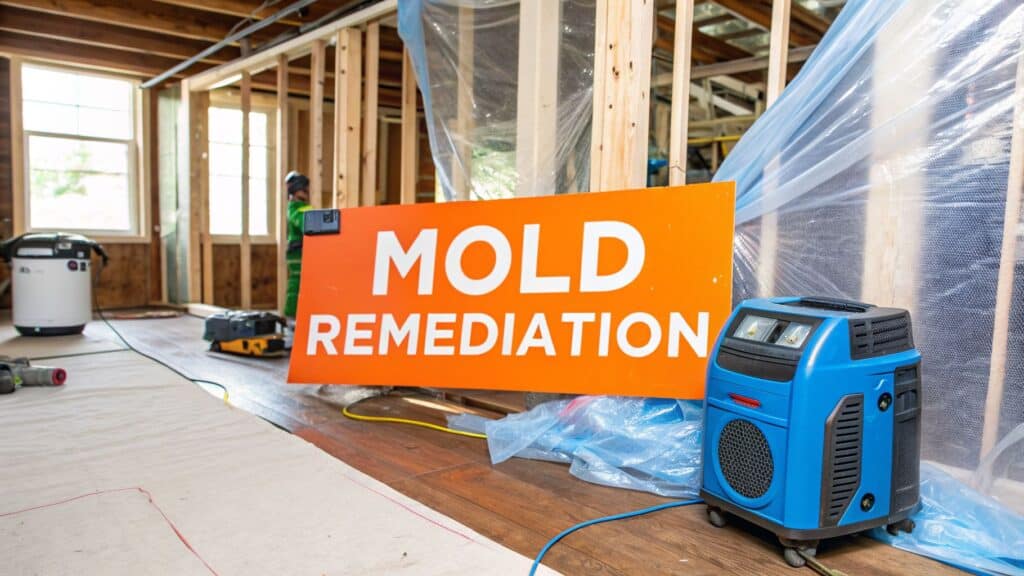
Discovering mold in your Orange County home is more than just an inconvenience—it's a genuine threat to your property's integrity and your family's health. Understanding the professional mold remediation steps is crucial for ensuring the problem is handled correctly. This isn't a simple cleanup job; it's a precise, multi-stage process that a certified firm breaks down into three core phases: a thorough inspection to pinpoint the moisture source, a safe remediation to remove the contamination, and a full restoration to make your home whole again.
Navigating this process can feel overwhelming, but this guide will provide the clarity and confidence you need. We'll outline how experts approach mold remediation, empowering you to move from stress to control.
Understanding the Expert Approach to Mold Remediation
When you partner with a premier firm like Sparkle Restoration Services, you're not just hiring a crew to scrub walls. You are entrusting your home to IICRC Master Certified professionals trained to restore its environmental safety. This expertise is a world away from DIY attempts, which often worsen the situation by spreading spores throughout your home. For discerning homeowners in communities like Newport Beach and Irvine, where property values and quality of life are paramount, the difference between a professional and an amateur job is everything.
This guide pulls back the curtain on the systematic, science-backed approach we use to protect high-value properties and the families within them. We’ll walk through the entire process, so you can feel confident and make informed decisions every step of the way.

This process flow shows that proper remediation is a complete solution designed to ensure the problem is resolved permanently.
Why Certified Professionals Are Essential
Attempting to clean up a mold problem without the right training is a recipe for disaster. A single wrong move can disturb a colony, releasing millions of microscopic spores into the air. Before you know it, they've circulated through your HVAC system, establishing new colonies in other parts of your house.
A certified team understands how to prevent this. We follow strict, industry-mandated protocols for containment, removal, and verification. These aren't just "best practices"—they are proven methods that safeguard your property, your health, and your peace of mind.
At Sparkle Restoration Services, our entire process is built on precision and safety. As a BBB Torch Award Winner for Ethics, we believe doing the job right means adhering to the highest industry standards, meticulously documenting every step, and providing our clients with absolute confidence.
This commitment is what separates a real, lasting solution from a temporary fix. To understand the rigorous training our technicians complete, explore our guide on what IICRC certification means and why it's non-negotiable for your project.
Uncovering the Root Cause with Expert Inspection
Effective mold remediation is less about demolition and more about sophisticated detective work. The absolute first step—before any cleaning begins—is to identify the exact moisture source feeding the mold. Simply cleaning visible spots without fixing the underlying water problem is like painting over rust; the issue will return, often worse than before.
In a luxury Orange County home, the culprit can be incredibly elusive. We've seen it all: a slow, hidden leak from a custom Sub-Zero refrigerator, condensation building up in a poorly ventilated attic, or coastal humidity seeping into a wine cellar in Newport Beach. The visible mold is just a symptom; our mission is to cure the underlying disease by eliminating the moisture.

Advanced Diagnostics for Hidden Problems
Guesswork has no place in professional mold remediation. To pinpoint hidden water sources, our IICRC-certified technicians use specialized diagnostic tools that allow us to see what the naked eye cannot.
- Thermal Imaging Cameras: These are a game-changer. They reveal temperature differences behind walls and under floors. A cool spot on a warm wall is a clear indicator of trapped moisture, enabling us to locate a leak without invasive demolition.
- Moisture Meters: We use both penetrating and non-penetrating meters to get precise moisture readings in materials like drywall, wood studs, and concrete. This data is critical for accurately mapping the extent of the water damage.
- Hygrometers: These devices measure airborne humidity. They help us identify rooms or pockets with elevated humidity that could support new mold growth, even without an active leak.
This methodical, data-driven approach ensures we target the problem at its origin, delivering a real, lasting solution. Before we even think about removal, it’s crucial to know what you're up against. Be on the lookout for these unmistakable signs of mold in your house so you know when to bring in a pro.
Establishing Preliminary Containment
Once we’ve identified the moisture source and the scope of the contamination, our immediate next move is to prevent it from spreading. Mold spores are microscopic and become airborne with the slightest disturbance. To keep the rest of your home safe, we promptly establish containment around the affected area.
This involves sealing off doorways and HVAC vents with heavy-duty plastic sheeting and professional-grade tape, creating a completely isolated work zone. Any spores that are disturbed during our work remain trapped within this controlled environment.
This proactive containment is a non-negotiable step that distinguishes true professionals from undertrained crews. It is a critical measure to protect your family's health and prevent a localized issue from becoming a whole-house contamination event.
More and more homeowners are realizing that mold requires a specialized skill set far beyond simple cleaning. This dedication to finding the root cause first and protecting your home is the foundation for a successful remediation project.
Setting Up a Lockdown Zone: Full Containment and Air Filtration
Once we've tracked down the mold and its water source, the next crucial move is to trap it. This isn't just about hanging up some plastic sheeting; it's a precise, scientific process that draws a line between a permanent fix and a recurring problem. Failed attempts almost always end up scattering spores, turning a small, contained issue into a whole-house contamination nightmare.
For our clients here in Orange County, protecting their beautiful homes and, more importantly, their families is everything. That’s why we don't just "work" in the area—we construct a fully controlled containment zone, effectively transforming the affected space into a secure bubble where mold has no chance of escape.

Building the Containment Barrier
First things first, we build the physical barrier. This is a far cry from just taping a plastic sheet over a doorway.
- We use heavy-duty, 6-mil polyethylene sheeting to completely isolate the work area. This means sealing off every single doorway, window, and any other opening that leads to the rest of your home.
- The sheeting is locked down with specialized containment tape to create a truly airtight seal. We also build a decontamination chamber, which functions as an airlock. This double-barrier entry allows our technicians to safely put on and take off their Personal Protective Equipment (PPE) without ever tracking contaminants into clean areas.
- Every HVAC vent inside the containment zone is completely sealed off. This is non-negotiable. If you skip this, your heating and AC system instantly becomes a high-speed delivery service for mold spores, spreading them to every room in your house.
This disciplined setup guarantees that whatever happens inside the containment zone stays inside the containment zone.
Creating Negative Air Pressure
Building the barrier is only half the battle. To truly control the environment, we establish negative air pressure inside the containment. This is an absolute cornerstone of professional mold remediation and a step we never skip.
It works like a gentle vacuum. We bring in powerful machines called air scrubbers, each fitted with a High-Efficiency Particulate Air (HEPA) filter. These units are vented directly outside your home, constantly pulling air out of the contained area.
This process creates lower air pressure inside the bubble than in the rest of the house. Because of that pressure difference, air can only flow into the work zone, never out. It’s a one-way street, ensuring that any spores we disturb during removal are immediately captured by the air scrubbers instead of escaping under a door.
Key Takeaway: Simply scrubbing or spraying a moldy wall without proper containment and negative air pressure is one of the most dangerous shortcuts you can take. It’s like setting off a bomb of mold spores, putting your family’s health at risk and all but guaranteeing the mold will find new spots to thrive.
The difference between a DIY attempt at containment and the protocols followed by a certified firm is vast. It's often the single biggest factor separating a successful remediation from a failed one that costs more in the long run.
DIY vs. Professional Containment Methods
| Containment Aspect | Typical DIY Approach | Sparkle's IICRC-Certified Professional Standard |
|---|---|---|
| Barrier Material | Thin plastic drop cloths or painter's plastic. | Heavy-duty, 6-mil polyethylene sheeting for a tear-resistant, airtight seal. |
| Sealing Method | Standard duct tape or painter's tape. | Specialized containment tape and pressure-fit poles to create a truly sealed environment. |
| Entry/Exit | A simple slit in the plastic. | A dedicated decontamination chamber (airlock) with a double-barrier system. |
| Airflow Control | Opening a window, maybe a box fan. | Establishing negative air pressure with commercial-grade air scrubbers vented outdoors. |
| HVAC System | Often overlooked or vents are loosely covered. | All HVAC supply and return vents within the containment are meticulously sealed. |
| Filtration | A consumer-grade air purifier, if any. | Commercial HEPA air scrubbers running 24/7, capturing 99.97% of airborne particles. |
As you can see, professional containment isn't just about blocking a doorway; it's about controlling the entire environment on a microscopic level.
The Power of HEPA Filtration
The HEPA filter is the real hero of this entire operation. To earn the name, a true HEPA filter must be rated to capture 99.97% of airborne particles down to 0.3 microns in size. For scale, a single mold spore is usually between 3 and 40 microns—making it an easy target for a HEPA filter.
Our industrial-strength air scrubbers run nonstop throughout the entire remediation project. They constantly "scrub" the air, trapping not just mold spores but also dust and any other microscopic debris kicked up during the work. This protects the rest of your home and creates a much cleaner, safer environment for our technicians.
If you want to dive deeper into the technology, our article on choosing the best air purifier for mold spores explains why professional-grade equipment makes such a profound difference.
This strict, multi-layered approach to containment and air filtration is how an IICRC Master Certified and BBB Torch Award-winning firm like ours turns a chaotic situation back into a calm, safe home. It’s the only way to do the job right and ensure the mold is gone for good.
Executing a Safe and Thorough Mold Removal
Once the work area is completely sealed off and under negative air pressure, we can begin the physical removal of the mold. This phase requires precision, the right approach for different materials, and an absolute commitment to safety.
A critical point to understand is that not all mold-infested materials can be treated the same way. The method that works perfectly for a hard surface like bathroom tile would be useless—and reckless—on a porous material like drywall or insulation.
Dealing with Non-Porous Surfaces
Hard, non-porous surfaces are the most straightforward part of the job. These are materials that don't absorb water, such as:
- Glass and mirrors
- Metals (e.g., stainless steel appliances, plumbing fixtures)
- Glazed ceramic tiles
- Sealed concrete
On these items, mold grows only on the surface. Our technicians begin by carefully HEPA-vacuuming the area to capture any loose spores before they can become airborne.
After vacuuming, we meticulously clean the surfaces with professional-grade, EPA-registered antimicrobial agents. These are not typical store-bought cleaners; they are formulated to kill mold at the source and inhibit its return. This detailed cleaning process usually allows us to save and fully restore these materials.
Removing Contaminated Porous Materials
The situation changes entirely when mold infiltrates porous materials. These items act like a sponge, drawing moisture deep inside where surface cleaning cannot possibly reach.
These materials include:
- Drywall and plaster
- Insulation (fiberglass, cellulose, etc.)
- Carpet and padding
- Ceiling tiles
- Unsealed wood and framing studs
When these materials are contaminated, cleaning is no longer an option. Mold extends root-like structures, known as hyphae, deep into the material. Wiping the surface leaves this root system intact, guaranteeing the mold will grow back.
The only industry-approved method for dealing with contaminated porous materials is careful removal and disposal. This is not a suggestion; it's a critical step for ensuring the mold is gone for good.
Our licensed general contracting team carefully cuts out affected drywall, bags contaminated insulation, and removes compromised carpeting. Every piece is immediately sealed in heavy-duty, 6-mil polyurethane bags before it leaves the containment area.
Specialized Cleaning and Treatment
With all contaminated materials gone, the work is not yet finished. The remaining structural elements, like wood studs or the subfloor, require a deep, multi-step decontamination process.
- HEPA Vacuuming: We start by going over every single exposed surface inside the containment—studs, subflooring, even the plastic sheeting—with vacuums equipped with certified HEPA filters. This captures any remaining microscopic spores.
- Damp Wiping: Next, we damp-wipe all those surfaces with a specialized cleaning solution. This removes any final traces of mold and dust that the vacuum might have missed.
- Antimicrobial Application: The final, crucial step is often applying an EPA-registered antimicrobial treatment. This powerful solution doesn't just kill any remaining spores; it makes the area hostile to future mold growth, providing an essential layer of protection. If you want to dive deeper into how these treatments work, you can learn more about antimicrobial treatment in our detailed guide.
Upholding Uncompromising Safety Protocols
Throughout this entire process, nothing is more important than the safety of your family and our team. Our technicians wear full Personal Protective Equipment (PPE) from the moment they enter the containment zone until they leave.
This PPE always includes:
- Full-face respirators with P-100 cartridges
- Full-body disposable coveralls
- Gloves and foot coverings
Every bag of contaminated material is decontaminated before being moved through the clean areas of your home. We strictly adhere to all local Orange County and state regulations for proper disposal, without exception. This meticulous focus on every detail ensures that when the mold is gone, it’s truly gone—with zero risk of cross-contamination. It’s how we deliver on the Sparkle promise of turning chaos into calm, fast.
Drying and Dehumidifying to Prevent Regrowth
With all mold-contaminated materials removed, we reach one of the most critical stages: eliminating the moisture that fueled the mold in the first place. This step is non-negotiable. Mold simply cannot survive without water.
Cutting out visible mold and calling it a day is a rookie mistake and a surefire way to get a callback when the mold returns. We must fundamentally change the environment by aggressively drying not just the air but the very structure of your home.

Deploying Professional Drying Equipment
This is where professional-grade equipment truly proves its worth. A small dehumidifier from a big-box store is no match for serious structural drying. We deploy a strategic arsenal of tools to systematically reduce moisture levels to a safe, normal state.
- Industrial Dehumidifiers: These are workhorses, capable of pulling gallons of water vapor from the air daily. We size and place them based on the specific square footage and humidity readings of the space.
- High-Velocity Air Movers: More than just "fans," these machines are strategically angled to create a powerful vortex of air that flows directly over damp surfaces—like wood framing, subfloors, and concrete—dramatically accelerating evaporation.
These tools work in a powerful tandem. The air movers force moisture out of materials and into the air, and the dehumidifiers immediately capture that moisture, condense it, and pump it away. If you're curious about the technology, you can learn more in our guide on the best dehumidifiers for water damage and see why professional models are in a different league.
Verifying Dryness with Precision
So, how do we know when the job is really done? We don’t guess. Our IICRC-certified technicians use professional-grade, calibrated moisture meters to get exact readings from every affected material.
We establish a "dry standard" by taking readings from an identical, unaffected area of your home. The drying equipment runs until the drywall, wood studs, and even the concrete slab have all returned to their normal, pre-damage moisture content. This data-driven method leaves no room for error and guarantees the environment no longer supports mold growth.
A common mistake we see from less experienced companies is relying on touch or sight. A wall can feel dry on the surface but still hold enough moisture deep inside to fuel a new mold colony within weeks. Scientific verification isn't optional; it's essential.
The Importance of Post-Remediation Verification
Once our team is confident that the mold is gone and the structure is completely dry, we always recommend a final, crucial step: Post-Remediation Verification (PRV), also known as clearance testing.
To ensure total transparency and avoid any conflict of interest, this test must be performed by an independent, third-party Indoor Environmental Professional (IEP). They arrive after we have completed our work to conduct their own visual inspection and take air and surface samples.
Those samples are sent to an accredited laboratory to prove that the spore count inside the work area has returned to normal, healthy levels—indistinguishable from the rest of your home or the outside air.
Receiving a passing clearance report is a significant milestone for any homeowner. Here's why:
- Peace of Mind: It provides unbiased, scientific proof that the job was done right and your home's air is safe.
- Documentation: This report is invaluable for your records, especially when dealing with insurance or for future property disclosures.
- Accountability: It confirms that we, as your contractor, delivered on our promise to restore a healthy environment.
As a BBB Torch Award Winner for Ethics, we welcome this level of third-party scrutiny. We believe independent verification is the ultimate sign-off, confirming we've truly turned chaos back into calm for our clients.
Bringing Your Home Back to Its Original Beauty
For us, the job isn't finished until your house feels like home again. Once we receive the all-clear from an independent clearance test confirming your home's safety, our role transitions from remediation specialists to master craftsmen. As a licensed General Contractor, our expertise extends far beyond cleanup and drying—we specialize in restoring your home to its original beauty, often making it even better than before.
This final phase is where we turn the chaos of a remediation project into the calm and comfort you deserve. It’s not just about patching a hole in the wall; it’s about restoring the luxury, peace, and sense of security you expect in your home.
Rebuilding with Precision and Care
Our in-house team manages the entire restoration process, ensuring every detail meets the high standards expected in an Orange County home.
Here's a glimpse of what our build-back services cover:
- Structural Integrity: We begin by installing fresh, new insulation and hanging high-quality drywall. Our finishing work is flawless, creating the perfect canvas for paint.
- Flooring and Finishes: Whether we need to perfectly match your existing hardwood floors or you’re looking to upgrade to custom tile, our flooring experts handle it with absolute precision.
- Painting and Millwork: Nothing revives a room like a professional paint job. We also expertly install baseboards, trim, and crown molding to restore the architectural character of your home.
We manage every trade—from plumbing to electrical—so you have one dedicated, accountable team overseeing your project from day one to the final walkthrough.
At Sparkle Restoration Services, we are a true design-build firm. This gives us the unique ability to not only repair the damage but to help you completely reimagine your space if you choose to.
From Simple Repair to a Full-Scale Remodel
Sometimes, an unfortunate water damage event can present an unexpected opportunity. What starts as a necessary repair can evolve into the stunning kitchen or bathroom remodel you’ve always wanted. Because we are both a top-tier restoration company and a luxury remodeler, we can seamlessly pivot to fit your vision.
For example, if a leaking pipe required us to remove your old bathroom vanity, it could be the perfect moment to think bigger. We can help you design a brand-new layout, choose beautiful custom cabinetry, and install the high-end fixtures you've been dreaming of. Our dual expertise, recognized by our 2024 BBB Torch Awards for Ethics, ensures we manage the entire process with complete transparency and an unwavering commitment to quality.
The final result won't just fix the problem—it will elevate your home's beauty and increase its value.
Answering Your Mold Remediation Questions
Even with a detailed guide, it's completely normal to have questions. As a BBB Torch Award Winner for Ethics, we believe in being a transparent resource for Orange County homeowners, ensuring you feel confident and informed from start to finish.
How Long Does Professional Mold Remediation Take?
The timeline depends on the scale of the problem. A small, contained issue—like mold behind a bathroom vanity—might only take 1-3 days.
However, a more extensive problem that has penetrated structural materials could take a week or more. The timeline must account for the critical drying period and any necessary reconstruction. After our initial assessment, we provide a clear, detailed project schedule, so you know exactly what to expect.
Is It Safe to Stay in My Home During the Process?
Your family's safety is our top priority. We require that everyone stays out of the contained work area at all times.
For larger projects, or if anyone in your household has asthma, respiratory sensitivities, or a compromised immune system, we strongly recommend temporarily relocating. It is the safest and most responsible choice. We will provide a direct, honest recommendation based on your specific situation.
A major question for many homeowners is, "Does homeowners insurance cover mold?" Coverage often depends on the original source of the water. Mold damage from a sudden and accidental event, like a burst pipe, is usually covered. Conversely, problems stemming from slow leaks or a lack of maintenance may not be. We have years of experience working with insurance carriers in Southern California and know precisely what documentation is needed to build a strong claim on your behalf.
If you suspect you have a mold issue or simply have more questions, don't wait for the problem to get worse. The IICRC Master Certified team at Sparkle Restoration Services is available 24/7 to provide clarity and expert solutions. Schedule your free consultation today at https://www.sparklerestoration.com and let us turn chaos into calm—fast.
Ready to create a space that’s as beautiful as it is functional? Schedule your complimentary design consultation today by visiting Ready to Work with Sparkle?