


The moments after a fire dies down are often the most disorienting. The immediate chaos of flames and sirens gives way to a quiet, unsettling aftermath. What you can see—the charred walls and debris—is only part of the story. The real, lingering threats come from the invisible dangers: corrosive soot, toxic smoke, and a structure that may no longer be sound. For Orange County homeowners, tackling this isn't just a cleanup job.
Professional smoke and fire restoration is a meticulous, science-driven process designed to safely and completely bring your home back to its pre-loss condition. It’s a systematic approach, executed by certified experts, to contain the damage, neutralize contaminants, and rebuild with precision and care. At Sparkle Restoration Services, our mission is to turn chaos into calm, fast, and this guide will show you how.
Your First Steps After a Fire in Your Home
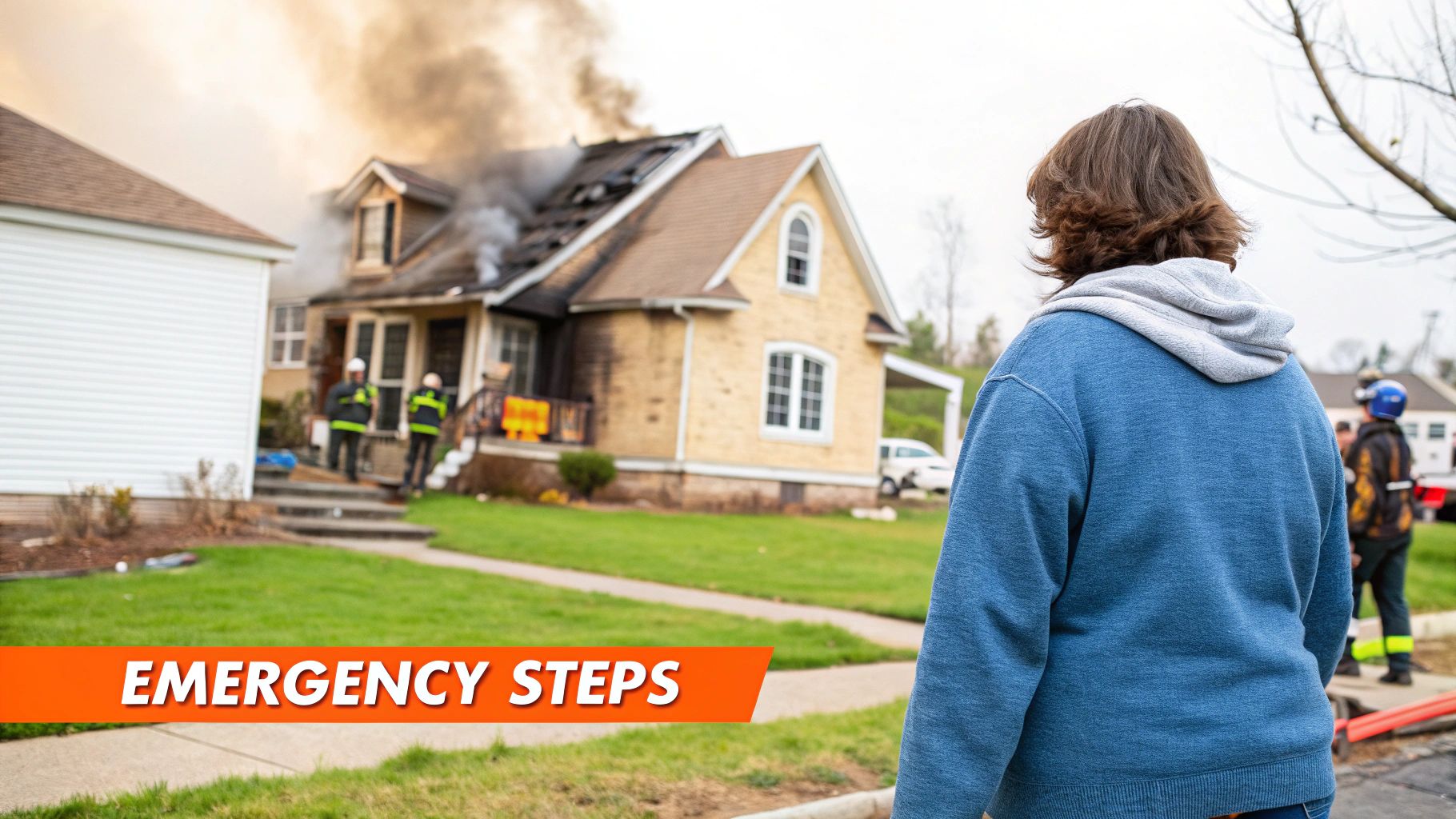
In the immediate aftermath, your first priority is simple: ensure everyone is safe. The situation is incredibly stressful, but taking a few clear, methodical steps can make a world of difference in reducing long-term damage and making the recovery process smoother. Think of this as your expert roadmap for turning chaos into calm, starting right now.
The main goal is to secure both your family and your property. Even a small kitchen fire can compromise your home’s structural integrity and fill it with hazardous air, creating hidden risks that stick around long after the last ember is out.
Prioritize Personal Safety Above All Else
Before you do anything else, confirm that every member of your family and every pet is safe and accounted for. Once you know everyone is okay, resist the urge to go back inside. Do not re-enter the property until the fire department has given you the official all-clear.
Even after the flames are gone, your home is not the same. It’s full of hidden dangers:
- Structural Weakness: Intense heat can warp and weaken foundational elements. Floors, ceilings, and walls that look fine could be unstable and on the verge of collapse.
- Toxic Atmosphere: The air is thick with more than just a bad smell. Soot and smoke particles are microscopic but carry toxic compounds that can cause serious respiratory problems if inhaled.
- Electrical Hazards: Firefighting efforts mean a lot of water. That water, combined with wiring that may have been damaged by the heat, creates a serious risk of electrocution.
Navigating the aftermath of a fire requires a calm, deliberate approach. Your immediate actions set the stage for a successful restoration, protecting both your family's health and your property's value.
Secure Your Property and Mitigate Further Damage
Once emergency services have declared the home safe to approach (not necessarily to live in), your next move is to protect it from any more harm. This could be anything from vandalism to weather damage, and it's a vital first step in the smoke and fire restoration process.
If windows are shattered or doors are broken, they need to be boarded up immediately. If the roof has been damaged, it should be tarped to keep rain out. While the firefighters' water was necessary to save your home, it can unfortunately lead to secondary problems like mold if not addressed quickly. If you're dealing with significant water, our guide on creating a water emergency first aid kit has some valuable tips for those first few hours.
This is also the moment to make two crucial phone calls. The first is to your insurance company to get the claims process started. The second is to a certified, licensed restoration expert like Sparkle Restoration Services. As a BBB Torch Award winner known for our integrity, we are the trusted choice for discerning homeowners throughout Orange County. Our 24/7 emergency team can be on-site quickly to begin the essential work of assessment and mitigation, stopping a bad situation from getting any worse.
Decoding the Different Types of Soot and Smoke
After a fire, it’s easy to assume that all the black, dusty residue is the same. But that couldn't be further from the truth. To properly restore a high-end Orange County property, a true IICRC Master Certified expert must first identify the specific type of smoke and soot they’re up against.
Treating all smoke damage identically is one of the most common—and costly—mistakes we see. It’s like trying to clean a red wine stain on a silk blouse with the same heavy-duty cleaner you’d use on a garage floor. The wrong approach doesn't just fail; it can cause permanent staining, etching, and irreversible harm to delicate finishes and custom materials.
The Science Behind the Smoke
What determines the kind of smoke and soot left behind? It all comes down to two things: what materials burned and how much oxygen was available to fuel the fire. A fast, hot fire burning through natural wood creates a completely different residue than a slow, smoldering fire involving plastics and synthetic fabrics.
Recognizing these distinctions is the absolute cornerstone of a successful restoration plan. Each type of soot has unique chemical properties that dictate how it sticks to surfaces, how stubborn it will be to remove, and which professional cleaning agents will actually work.
Wet Smoke Residue
This is the tough one. Wet smoke comes from low-heat, smoldering fires, which are common when modern synthetic materials like plastics, rubbers, and foams burn. The residue it leaves is notoriously sticky, greasy, and smears easily, making it one of the most challenging types to clean properly.
- Its Appearance: You’ll often see a thick, black or dark brown film that clings tightly to every surface it touches.
- Its Odor: It produces a sharp, acrid smell that is incredibly pervasive and difficult to get rid of.
- Its Removal: This isn't a simple wipe-down job. It demands specialized degreasing solvents and meticulous techniques. Just trying to wipe it away will spread the greasy film, driving it deeper into porous materials like stone and wood.
Dry Smoke Residue
By contrast, dry smoke is the byproduct of high-temperature, fast-burning fires—think natural materials like wood and paper going up in flames. The soot it creates is powdery, fine, and non-greasy.
While it might seem easier to handle, its powdery nature allows it to travel everywhere, settling into the tiniest cracks, inside electronics, and deep within your HVAC system. Attempting to clean it with a wet cloth is a disaster waiting to happen; it just creates a muddy mess that can cause permanent stains. The professional approach always starts with specialized HEPA-filter vacuums to carefully lift the particles before any wet cleaning begins.
Understanding the distinct behaviors of wet and dry smoke is non-negotiable for a successful restoration. Applying the wrong method doesn't just fail to clean—it can permanently damage marble, custom cabinetry, and fine fabrics, turning a recoverable situation into an irreversible loss.
Less Common But Equally Damaging Types
Beyond the two main culprits, a couple of other specialized residues require an expert’s touch, especially after kitchen or furnace-related incidents.
- Protein Residue: This is the result of burning organic matter, like in a kitchen fire involving meat or poultry. It's virtually invisible, but it leaves behind an incredibly strong, foul odor and can permanently discolor paints and varnishes if not treated correctly.
- Fuel Oil Soot: Often caused by furnace puff-backs, this residue is dense, sticky, and can blanket surfaces in a thick, oily film. It requires very specific solvents designed to break down its petroleum base.
The table below offers a quick-reference guide to help you understand the smoke damage in your home and the professional methods required to fix it correctly.
How Different Smoke Types Require Unique Restoration Methods
| Smoke Type | Common Source | Residue Characteristics | Professional Restoration Technique |
|---|---|---|---|
| Wet Smoke | Low-heat fires, burning plastics, rubber, synthetics | Sticky, greasy, smeary, pungent odor | Degreasing agents, specialized chemical sponges, thermal fogging for odor |
| Dry Smoke | High-heat fires, burning wood, paper, natural fibers | Powdery, fine, non-greasy, travels easily | HEPA vacuuming, dry cleaning sponges, careful wet cleaning post-vacuum |
| Protein Residue | Kitchen fires, burning food (meat, poultry) | Virtually invisible film, extremely foul odor | Specialized enzyme cleaners to break down proteins, thermal fogging |
| Fuel Oil Soot | Furnace puff-backs, oil-based fires | Dense, sticky, oily, difficult to remove | Petroleum-based solvents, meticulous multi-step cleaning process |
Each of these soot types is more than just a mess; their microscopic particles can pose significant health risks. To learn more about how these contaminants can affect your home’s environment, you can explore our detailed resources on the hidden dangers of indoor air pollution.
This is why choosing an IICRC-certified expert is so critical. It’s your assurance that a scientific, methodical approach will be used to protect not just your property, but your family’s health and well-being.
Your Step-By-Step Guide to Professional Restoration
Recovering from a fire isn't a single, chaotic event—it's a journey with a clear, methodical path. For homeowners here in Orange County, understanding this process can turn feelings of uncertainty into confidence. Professional smoke and fire restoration is a multi-stage operation, meticulously planned and executed by IICRC-certified experts to safely and completely bring your property back to life.
Think of this as your roadmap. Each phase builds upon the last, ensuring no detail is overlooked, from the immediate emergency response to the final, beautiful rebuild.
Phase 1: Emergency Response and Site Security
The moment you call, the clock starts. A premier restoration firm offers 24/7 emergency services because the damage from fire, soot, and water doesn't wait for business hours. The absolute first priority is to stop the damage from getting worse.
Once on-site, the team's initial actions are critical:
- Initial Assessment: A certified project manager quickly inspects the property to grasp the full scope of fire, smoke, and water damage. This initial read is what forms the strategic plan of action.
- Securing the Property: Damaged windows, doors, or roofs are immediately boarded up or covered with heavy-duty tarps. This prevents further damage from the elements and secures your home from unauthorized entry while the restoration is underway.
- Water Mitigation: If firefighters used water, the team begins water extraction and drying right away. Using industrial-grade dehumidifiers and air movers, they work to prevent secondary damage like mold, which can start to grow in as little as 24-48 hours.
Phase 2: Soot and Debris Removal
With the site secure, the meticulous cleanup begins. This is far more than a simple cleaning job; it requires a scientific understanding of how different types of soot behave. Using the wrong technique can permanently embed acidic soot into surfaces, causing more harm than good.
This is where the real expertise comes in. Not all soot is the same, and identifying the type is the first step to proper cleaning.
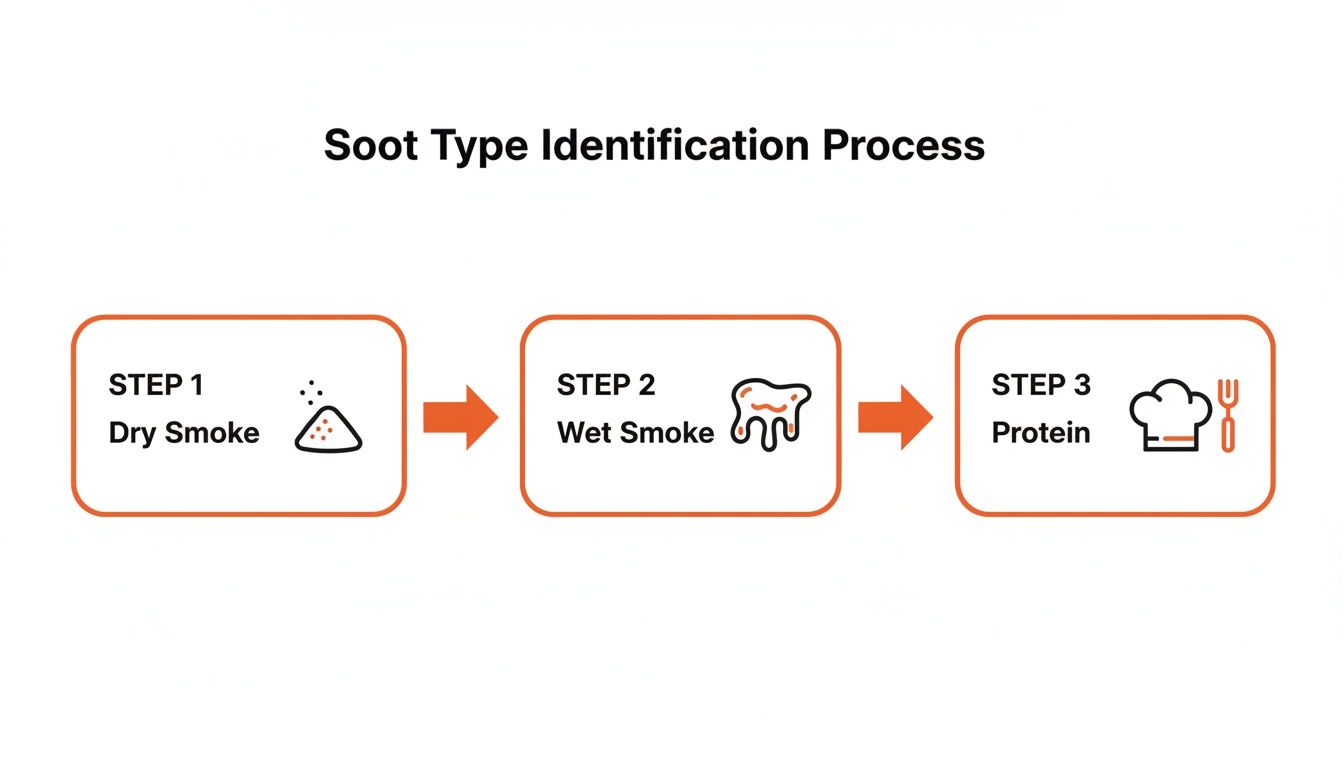
Whether dealing with the powdery residue of a fast-burning fire (dry smoke) or the greasy, stubborn film from a slow, smoldering one (wet smoke), the approach has to be just right.
IICRC-trained technicians use specialized tools like HEPA vacuums and chemical dry sponges to carefully lift soot particles without smearing them. Anything burned beyond repair is carefully documented for your insurance claim and then properly disposed of, clearing the way for the deep cleaning to come.
Phase 3: Deep Cleaning and Odor Neutralization
Once the loose soot and debris are gone, the focus shifts to cleaning and sanitizing every affected surface—walls, ceilings, floors, and even the air ducts. But the biggest challenge is often the pervasive smell of smoke.
Smoke odor molecules are microscopic. They penetrate deep into porous materials like drywall, wood, and upholstery. Simply airing out the house or using household cleaners will only mask the smell temporarily. True odor elimination requires advanced technology.
Professionals use powerful deodorization techniques that attack odors at the molecular level. This isn't about covering up the smell; it's about destroying it. Common methods include:
- Thermal Fogging: This process heats a deodorizing agent into a fine mist. The mist follows the exact same path the smoke did, penetrating deep into materials to neutralize trapped odor particles.
- Ozone or Hydroxyl Generation: These technologies use powerful oxidizing gases to break down smoke molecules in the air and on surfaces, effectively destroying the source of the smell for good.
This comprehensive approach is the only way to ensure the smoke odor is gone permanently.
Phase 4: Pack-Out and Contents Restoration
What about your personal belongings? For furniture, art, clothing, and priceless heirlooms, a white-glove pack-out service is essential. Items are carefully inventoried, packed with care, and moved to a secure, climate-controlled facility for specialized cleaning.
This off-site restoration allows for more detailed and delicate work, like ultrasonic cleaning for intricate items or specialized laundering for textiles damaged by smoke. Once fully restored, your belongings are stored safely until your home is ready for their return. It's also worth noting that comprehensive restoration can uncover issues needing specialized trade skills; exploring expert blogs can offer Insights on specialized repairs like glass replacement and other unique challenges.
Phase 5: Structural Repairs and Remodeling
This is where the value of a full-service restoration and remodeling firm truly shines. A company that holds a Licensed General Contractor designation, like Sparkle Restoration Services, can seamlessly transition from cleaning and mitigation directly into the complete structural repair and remodeling phase.
This completely eliminates the stress of you having to find, vet, and manage multiple contractors. The same trusted team that handled the emergency cleanup now oversees the rebuilding of your home. Whether it's replacing drywall and installing new flooring or a full-scale kitchen or bathroom remodel, the entire process is managed under one roof. This integrated approach ensures consistent quality, clear communication, and a much faster timeline from disaster back to a beautifully restored home. You can learn more about our comprehensive restoration and remodeling services and see how we manage every detail for our clients.
From that first emergency call to the final walkthrough, this step-by-step process is designed to turn chaos into calm, fast. It’s a testament to the expertise, technology, and care that defines truly professional smoke and fire restoration.
How to Navigate Fire Damage Insurance Claims
After a fire, the path to recovery almost always runs straight through your insurance company. Honestly, that process can feel just as overwhelming as the restoration work itself. For homeowners in Orange County, adding a complex insurance claim to an already stressful situation is the last thing you need. The first step toward getting the full and fair settlement you're entitled to is understanding the landscape.
The language of insurance can be a minefield of confusing terms, but there are a few you absolutely need to know. Replacement Cost Value (RCV) is what it would cost to repair or replace your damaged property today, using materials of a similar kind and quality, without any deduction for age or wear. This is very different from Actual Cash Value (ACV), which does subtract for depreciation.
Another critical term is Additional Living Expenses (ALE), sometimes called "Loss of Use." This is the coverage that pays for temporary housing, meals, and other necessary expenses you incur while your home is uninhabitable.
Documenting Everything Is Your Top Priority
In an insurance claim, thorough documentation isn't just important—it's everything. It is the single most powerful tool you have. While your restoration partner should take the lead here, your involvement is crucial. Every single item touched by fire or smoke, from the framing of your house down to the smallest personal belonging, must be meticulously photographed, cataloged, and valued.
This inventory needs to be exhaustive. Don't throw anything away until it has been documented and your insurance adjuster has given you the green light. A truly professional restoration firm will use specialized software like Xactimate—the very same system most insurance carriers rely on—to build a detailed, line-item estimate that justifies every single cost. This professional approach is your best defense against being underpaid and ensures your claim truly reflects the full scope of your loss.
Partnering with a restoration expert who speaks the language of insurance is a massive strategic advantage. They become your advocate, translating the complex realities of the damage into the precise documentation your carrier needs to approve a comprehensive settlement.
Communicating with Your Insurance Adjuster
Your insurance company will assign an adjuster to assess the damage and determine the value of your claim. While they ultimately work for the insurer, building a professional and collaborative relationship is the best path forward. You’ll want to provide them with the detailed documentation prepared by your restoration team and keep your own log of all communications, noting dates, times, and what was discussed.
A high-caliber restoration company will communicate directly with your adjuster. They’ll conduct on-site walkthroughs to explain the necessary scope of work, step-by-step. They can justify why specific techniques for smoke and fire restoration are required, heading off potential disputes before they even start.
The global market for fire damage restoration is projected to hit around $7,500 million by 2025. This number gives you a sense of the significant financial stakes involved. For affluent homeowners with high-value properties in Orange County communities like Newport Beach or Irvine, a single fire can lead to an exceptionally complex and high-value claim. This is precisely where professional expertise becomes invaluable for protecting your investment.
Working with an expert team simplifies this entire ordeal. For a deeper dive into the specifics of filing a claim, check out our complete guide on navigating property insurance claims for homeowners. When you let professionals handle the technical documentation and negotiations, you can focus on what truly matters: your family and your recovery.
Choosing the Right Restoration Expert in Orange County

After a fire, the single most important decision you'll make is choosing the right restoration contractor. This choice will shape everything that follows—the quality of the repairs, how smoothly your insurance claim goes, and your peace of mind during an incredibly stressful time.
In a market like Orange County, the gap between a basic cleanup crew and a premier, full-service firm is vast. Your home isn't just an asset; it's where your life happens. The company you bring in must have elite technical skills, uncompromising ethics, and a proven history of handling complex projects with the care and precision luxury properties demand.
Non-Negotiable Qualifications
When you start looking at smoke and fire restoration companies, a few credentials aren't just nice to have—they are absolutely essential. Think of these as your first line of defense, the qualifications that guarantee a baseline of quality, safety, and accountability.
Without them, you're rolling the dice on subpar work that could leave you with lingering odors, hidden structural problems, or even long-term health hazards.
-
IICRC Master Certifications: The Institute of Inspection, Cleaning and Restoration Certification (IICRC) sets the global standard for our industry. When a firm holds IICRC Master Designations in Fire & Smoke, Water, and Textile Cleaning, it shows they’ve reached the pinnacle of expertise. Their team has gone through intensive training in the actual science behind restoration.
-
Licensed General Contractor (CSLB): This is a huge differentiator. A company that only handles the cleanup phase will pack up and leave you to find another contractor for all the structural repairs and rebuilding. A firm holding a valid California State License Board (CSLB) General Contractor license, like Sparkle Restoration Services, can manage the entire process seamlessly, from the initial emergency call to the final remodel.
Choosing a firm that is both an IICRC Master Certified Restorer and a Licensed General Contractor isn't just about convenience—it's about ensuring a single point of accountability for the entire restoration journey, from emergency response to the final coat of paint.
Asking the Right Questions
Once you’ve confirmed those core credentials, it’s time to dig deeper. The answers to the following questions will tell you a lot about a company's real-world experience and whether they're the right fit for your home.
Come to the conversation prepared. A top-tier firm will appreciate your diligence and provide clear, confident answers.
Here’s what you should be asking:
- Experience with High-Value Properties: "Can you share examples of homes you have restored in communities like Newport Beach, Irvine, or Laguna Beach?"
- Protecting Your Belongings: "What's your process for inventorying, packing out, and restoring valuable contents like artwork, high-end furniture, or electronics?"
- Insurance Claim Advocacy: "How do you partner with insurance adjusters to make sure the full scope of damage is documented and fairly covered?"
- Project Management and Communication: "Who will be my dedicated point of contact, and what can I expect in terms of regular progress updates?"
The restoration industry is facing some real challenges, like a shortage of skilled labor and a flood of uncertified outfits that drive down quality standards. For discerning homeowners, telling the difference between a true professional and an unqualified operator is more important than ever. It’s why established firms with impeccable reputations are the go-to for affluent clients who want a turnkey solution that delivers quality and peace of mind.
Ultimately, you’re looking for a partner who not only has the technical skill but also the integrity to turn a chaotic situation into a calm, controlled process. At Sparkle, our many awards and certifications, including the BBB Torch Award for Ethics, reflect this deep-seated commitment. To see what sets us apart, we invite you to review our certifications and credentials.
Got Questions? We Have Answers About Smoke and Fire Restoration
When your Orange County home is hit by fire, the way forward can feel completely overwhelming. You're suddenly faced with dozens of questions and an urgent need for clear, trustworthy answers. Here at Sparkle Restoration Services, we know that an informed homeowner is an empowered one. This is where we answer the most pressing questions we hear from clients just like you, giving you the expert insight needed to move forward with confidence.
Our job is to cut through the chaos and give you a clear plan of action, built on decades of hands-on experience restoring high-end properties.
How Long Does the Fire Restoration Process Take?
This is always the first question, and understandably so: "When can our lives get back to normal?" The truth is, the timeline for smoke and fire restoration depends entirely on the scale of the damage. A small kitchen fire that was quickly contained might only take a few days of deep cleaning and professional deodorization. On the flip side, a major fire that caused significant structural damage could easily take several months to fully restore and rebuild.
The secret to a faster, smoother recovery is a truly integrated process.
The biggest time-saver is hiring a single firm that is both an IICRC Master Certified Restorer and a Licensed General Contractor. This simple choice eliminates the huge delays and communication breakdowns that happen when a cleanup company has to hand the project off to a separate builder. It creates a seamless flow from initial mitigation all the way through to the final remodel.
A thorough, professional assessment right at the start will give you a detailed scope of work and a realistic project timeline. You'll always know what to expect.
Is It Safe to Go Back Inside My Home After a Fire?
The short answer is a hard no—not until the fire department and a certified restoration expert have given the official all-clear. The visible damage you can see is just the tip of the iceberg. Stepping into a fire-damaged home too soon exposes you to serious, often invisible, dangers.
- Toxic Air Quality: Smoke and soot aren't just messy; they're a toxic cocktail of chemicals and cancer-causing particles that can lead to severe respiratory problems.
- Structural Instability: The intense heat of a fire can seriously weaken crucial structural elements like floor joists and roof trusses. A collapse is a very real threat.
- Electrical and Slip Hazards: Water used to fight the fire creates a dangerous mix with compromised electrical wiring, posing a severe risk of electrocution. Plus, wet floors covered in soot and debris are a major slip-and-fall hazard.
The very first thing our team does is secure the property, board up any exposed areas, and perform a full safety assessment to make the site safe for the restoration work to even begin.
Can Smoke Odor Really Be Removed Permanently?
Absolutely, but it’s a science. It requires a lot more than just opening the windows or spraying air freshener. Smoke odor particles are microscopic—often less than one micron in size. This allows them to work their way deep into porous materials like drywall, wood studs, carpets, and even into the subfloor.
This is exactly why the smell hangs around and seems to get stronger on humid days. To get rid of it for good, we use advanced deodorization technologies that don't just mask the smell—they destroy the odor molecules at their source. Techniques like thermal fogging, ozone treatments, and hydroxyl generation are designed to follow the exact path the smoke took, neutralizing odor particles wherever they've landed. It’s not about covering up the smell; it’s about chemically changing it so it can never come back.
Will My Insurance Cover the Entire Cost of Restoration?
For the most part, a standard homeowner's insurance policy will cover fire and smoke damage. The devil, however, is in the details of your specific policy limits and terms. Homeowners often have questions about specific items, like understanding what floor restoration entails and if their policy covers it.
This is where having a true restoration expert in your corner makes all the difference. An experienced team will:
- Use industry-standard software to build a meticulous, line-by-line estimate that adjusters understand and respect.
- Document every bit of damage with hundreds of photos and detailed notes.
- Communicate directly with your insurance adjuster to explain and justify the necessary work.
Think of them as your advocate, fighting to ensure every last detail is accounted for. This professional documentation is the key to getting a fair settlement that covers the true cost of bringing your home back to its pre-fire condition—or even better.
At Sparkle Restoration Services, we understand the stress and uncertainty you're facing. Every single question you have is important. Our team of IICRC Master Certified experts is on standby 24/7 to provide the answers and the professional help you need to turn chaos back into calm. For a free, no-obligation consultation to discuss your home's needs, contact us today.
Ready to create a space that’s as beautiful as it is functional? Schedule your complimentary design consultation today by visiting Ready to Work with Sparkle?