


Discovering water damage in your Orange County home is a stressful, chaotic experience. The path to restoration is often complicated by the insurance claim process, a journey filled with potential pitfalls that can cost homeowners and property managers thousands in undervalued settlements. This guide provides essential water damage insurance claim tips to empower you to navigate this complex process with confidence and secure the compensation you deserve.
At Sparkle Restoration Services, our IICRC Master Certified and licensed general contracting experts have helped discerning clients turn chaos into calm for over two decades. As a BBB Torch Award Winner for ethics, we understand that for high-value properties in communities like Newport Beach and Irvine, a successful claim is not just about repairs; it's about protecting your investment and restoring your peace of mind without compromise. This article distills our deep industry knowledge into actionable strategies for meticulous property owners.
We will cover everything from immediate, time-stamped documentation and professional damage assessments to navigating adjuster communications and maximizing your coverage for secondary damages. You will learn precise, practical steps for creating detailed inventories, coordinating with certified restoration contractors, and understanding when to engage a public adjuster. By following these proven tips, you can transform an overwhelming challenge into a well-managed recovery, safeguarding your property's value and ensuring a full and fair settlement. Let's begin the process of restoring your property to its pre-loss potential.
Document Water Damage Immediately with Time-Stamped Photos & Videos
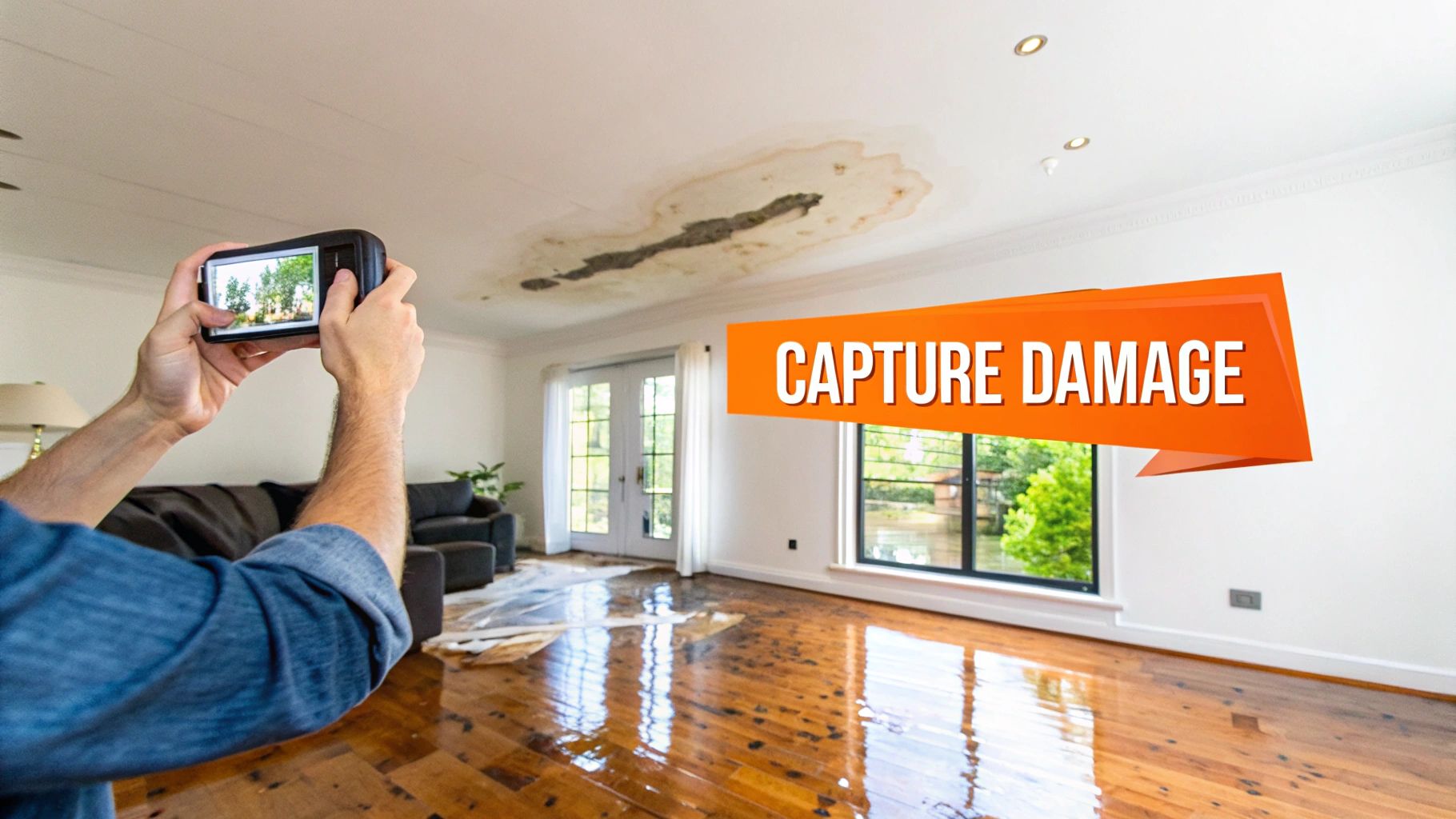
The single most critical action you can take in the moments following water damage is to create an exhaustive visual record. Before any mitigation or cleanup begins, your smartphone is your most powerful tool. For high-value properties in Orange County, where custom finishes and significant investments are at stake, this immediate documentation forms the irrefutable evidence your insurance carrier requires, setting the foundation for a successful claim and protecting your property's value.
This initial record serves as your primary proof of loss, creating a clear "before" snapshot that prevents disputes over the extent or cause of damage. A Newport Beach homeowner, for instance, documented a burst pipe's devastation within minutes. This swift, detailed record-keeping led to a full claim approval without the typical delays that can plague complex claims for high-end properties.
Actionable Documentation Checklist
To maximize the effectiveness of your visual evidence, follow these IICRC-endorsed best practices:
- Capture the Big Picture First: Begin with a slow, panoramic video of each affected room. Narrate what you are seeing, including the date, time, and the source of the water if known. This provides critical context for the claims adjuster.
- Focus on Individual Items: Photograph and video every damaged item individually. For electronics, appliances, and high-end furniture, capture close-ups of brand names, model numbers, and serial numbers. This is non-negotiable for accurate valuation.
- Show Progression Over Time: One of the most effective water damage insurance claim tips is to document the damage as it evolves. Take photos immediately after discovery, then again at four-hour and 24-hour intervals to show how water has spread and damage has worsened. This helps justify the full scope of restoration needed.
- Time-Stamp Everything: Ensure your smartphone’s camera settings include a date and time stamp on all photos and videos. This creates an objective timeline that is difficult for an insurer to dispute.
- Back Up Immediately: Upload all photos and videos to a secure cloud service (like Google Drive, Dropbox, or iCloud) immediately. This prevents accidental data loss if your device is damaged or lost during the chaos.
This disciplined approach transforms a stressful event into a manageable, evidence-based process. It is a key strategy to avoid the common pitfalls that can lead to claim complications; you can learn more about insurance claim denial reasons to better prepare yourself.
2. Create a Detailed Inventory of Damaged Personal Property with Valuations
While structural damage is often the most visible consequence of a water event, the loss of personal property frequently represents a substantial portion of the claim, particularly for high-end Orange County homes. A detailed, itemized inventory of every damaged or destroyed possession is not just a list; it is a critical financial tool that directly impacts your final settlement. For affluent homeowners, where contents claims involving art, designer furnishings, and custom pieces can easily exceed structural repair costs, this meticulous documentation is essential for securing a fair and accurate payout.
This inventory serves as the definitive proof of your personal property loss, moving your claim from abstract estimates to concrete, verifiable figures. For example, a Laguna Niguel art collector’s initial insurer offer was far below value. By providing a professionally appraised inventory, they successfully negotiated a settlement that fully covered the restoration and diminished value of their prized pieces. This methodical approach is one of the most effective water damage insurance claim tips for protecting your investments.
Actionable Inventory Checklist
To build a compelling and undeniable contents claim, follow this systematic process endorsed by the National Association of Insurance Commissioners (NAIC):
- Go Room by Room: Create a separate spreadsheet or list for each affected room. Systematically list every single damaged item, from large furniture and electronics down to smaller decor and textiles.
- Gather Proof of Value: For each item, compile any available documentation, such as original purchase receipts, credit card statements, warranties, or manuals. For high-value items, note the brand, model, and serial number. This helps establish Replacement Cost Value (RCV) over a depreciated Actual Cash Value (ACV).
- Secure Professional Appraisals: For any item of significant value, such as fine art, antiques, jewelry, or collectibles, obtain a formal appraisal from a certified expert. This third-party valuation is incredibly difficult for an insurance carrier to dispute.
- Document Original Cost: When listing items like designer furniture or custom decor, always record the original retail price, even if you purchased it on sale. This figure represents the true replacement cost and is a key negotiating point.
- Photograph Items Individually: After your initial "big picture" photos, take clear, well-lit pictures of each damaged item individually. If possible, place them against a neutral background to highlight the extent of the damage. This visual evidence complements your written list.
By transforming a chaotic pile of damaged belongings into a structured, evidence-backed inventory, you empower yourself in the claims process. This ensures your insurance settlement accurately reflects the full value of what you have lost, not just an arbitrary estimate.
3. File Your Claim Within the Insurance Policy's Notice Requirement Window
Every insurance policy contains a strict "notice of loss" provision, a critical deadline for informing your carrier about a damaging event. This is not a suggestion; it is a contractual obligation. For high-value properties in Orange County, where extensive damage can escalate quickly, failing to meet this window (often 30-60 days) can be a technicality used to deny an otherwise valid claim, leaving you responsible for significant out-of-pocket costs.
Adhering to this timeline is a foundational element of successful water damage insurance claim tips. Prompt notification signals to your insurer that the damage is serious and allows them to authorize immediate mitigation, which is essential for protecting a luxury home's value. An Irvine property manager's immediate filing for a commercial building leak enabled a coordinated response with Sparkle Restoration within hours, preventing extensive additional structural and mold-related damages. In contrast, a late filing can jeopardize your entire claim from the start.
Actionable Claim Filing Checklist
To ensure your claim is filed correctly and your rights are protected, follow this protocol immediately upon discovering water damage:
- Notify Your Insurer Immediately: Contact your insurance agent or the carrier's 24/7 claims hotline the same day you discover the water damage. Do not wait for a full damage assessment. The goal is to get the claim officially opened and on the record.
- Create a Multi-Channel Paper Trail: File your claim over the phone, but immediately follow up with a written notice via email and certified mail. This creates redundant, time-stamped proof of your notification that is impossible to dispute.
- Request Emergency Mitigation Authorization: During your initial call, explicitly ask for authorization to begin emergency water mitigation services. This protects your property from further harm, like mold growth, and confirms the insurer is aware of your proactive steps. Document the name of the person who gave you authorization.
- Obtain a Claim Number and Adjuster Details: Do not end the initial call without a claim number. Ask for the assigned adjuster's name, contact information, and the expected timeline for their initial contact. This is your primary point of reference for all future communications.
- Document Every Interaction: Keep a detailed log of every communication with your insurer. Note the date, time, person you spoke with, and a summary of the conversation. This organized record is invaluable if disputes or delays arise.
This proactive and meticulous approach to filing is non-negotiable. It establishes your compliance with policy terms and sets a professional, urgent tone for the entire claims process. You can discover more about how to file an insurance claim to ensure you cover every essential step.
4. Obtain Professional Damage Assessment and Written Estimates from Certified Restoration Companies
While your initial photos provide a crucial "before" snapshot, a professional damage assessment from an IICRC-certified restoration company is the authoritative evidence that validates your claim. For high-value properties in Orange County, where custom finishes and complex systems are the norm, this expert report establishes the full, often hidden, scope of damage, providing the insurer with the irrefutable data needed for a comprehensive settlement that protects your investment.
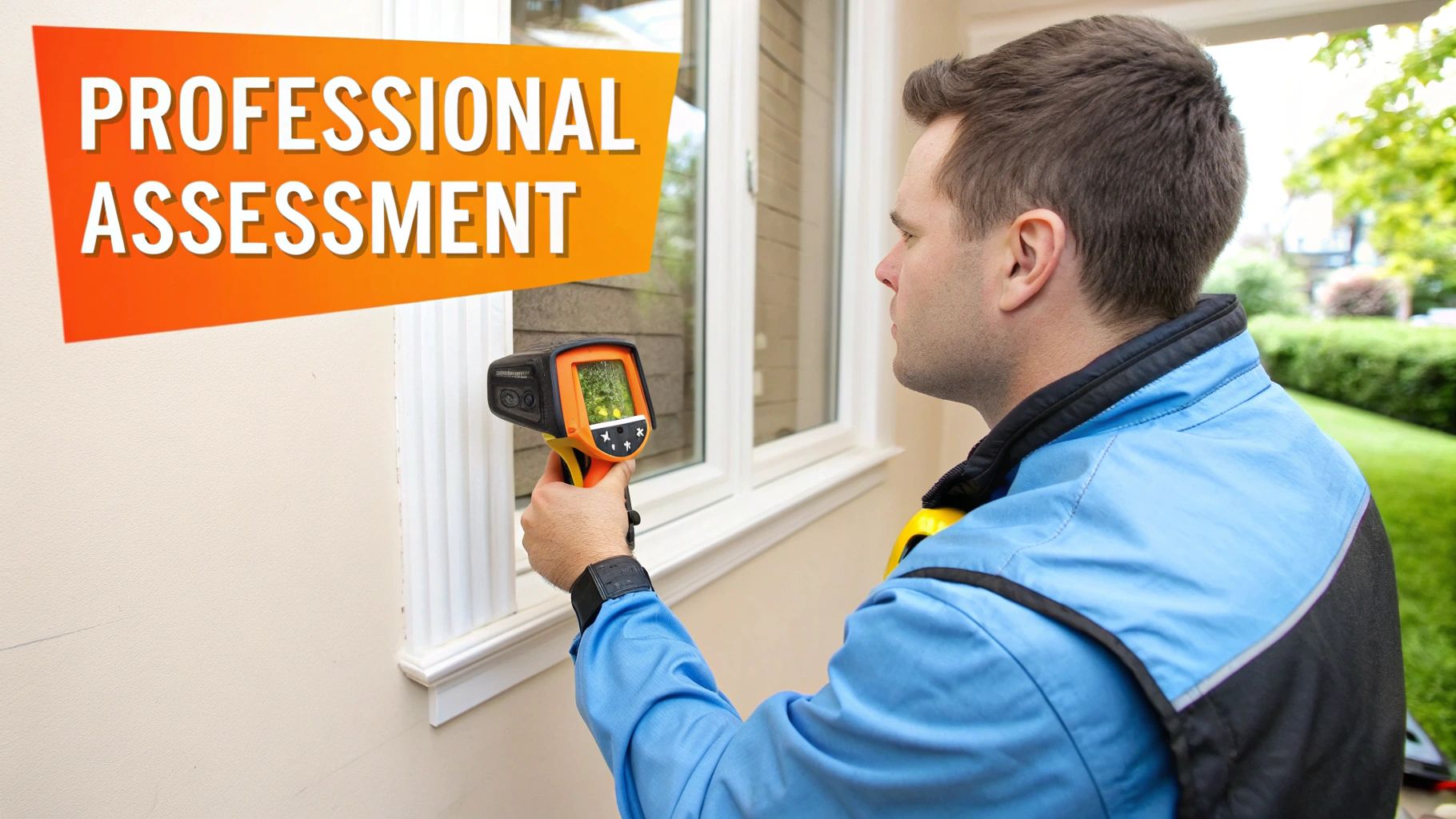
An insurer's adjuster works for the insurance company; a certified restoration expert works to identify the complete extent of the damage to your property. A professional assessment by Sparkle Restoration for an Irvine homeowner, for example, uncovered significant hidden structural damage behind walls, which increased the final settlement from an initial offer to a comprehensive amount that covered a full, proper restoration. This is one of the most vital water damage insurance claim tips for ensuring you are made whole.
Actionable Assessment Checklist
To secure a credible and effective professional assessment, follow these industry-endorsed steps:
- Verify IICRC Certification: Before allowing anyone on your property, demand proof of IICRC certification. This is the gold standard in the restoration industry and a non-negotiable credential for ensuring expertise. You can learn more about what IICRC certification means and why it's critical for your claim.
- Request an Itemized Estimate: The assessment must result in a detailed, line-item estimate formatted for insurer submission. This should break down costs for mitigation, labor, materials, and equipment.
- Insist on Advanced Diagnostics: Ensure the report includes data from tools like thermal imaging cameras and moisture meters. These instruments detect hidden water behind walls and under floors that the naked eye cannot see.
- Document Potential for Secondary Damage: The assessment should explicitly identify areas at risk for future mold growth or structural issues, justifying immediate and thorough mitigation actions. This step helped a Newport Beach client avoid a potential, costly mold remediation project down the line.
- Include a Detailed Restoration Timeline: The report should outline a clear, phased plan for mitigation and restoration, giving the insurance adjuster a logical roadmap for the project's scope and duration.
- Use the Estimate as a Baseline: Treat the professional assessment as the starting point for negotiation, not the final word. It is your expert-backed evidence to counter a low initial offer from your insurer.
5. Maintain an Organized Documentation System with Claim-Related Communications
A meticulously organized documentation system is the administrative backbone of a successful insurance claim. For complex water damage events in high-value properties, which often involve multiple contractors, adjusters, and extensive correspondence, this centralized hub is non-negotiable. It prevents critical information from being lost, streamlines communication with your insurer, and provides the unassailable evidence needed to justify a full and fair settlement.
This systematic approach transforms a chaotic paper trail into a clear, chronological narrative of your claim. For example, a Laguna Niguel estate owner's comprehensive communication archive was instrumental in a successful appeal after their insurer's initial offer was significantly below the professional damage assessment. The organized file proved the full scope and cost of necessary repairs, leaving no room for dispute.

Actionable Documentation Management Checklist
To create a robust and defensible claim file, implement these best practices recommended by the Insurance Information Institute (III) and other industry leaders:
- Create a Master Digital Folder: Establish a main claim folder on your computer and a secure cloud service. Create logical subfolders for: Photos/Videos, Estimates & Quotes, Insurance Correspondence, Receipts & Invoices, and Timeline & Notes.
- Use a Consistent Naming Convention: Save every file with a clear, uniform format, such as
YYYY-MM-DD_[Document Description]_[Sender]. For example,2024-10-26_MitigationInvoice_SparkleRestoration. This makes searching and sorting effortless. - Maintain a Claim Communication Log: Keep a running spreadsheet or document detailing every interaction. Log the date, time, contact person, their title, and a summary of the conversation. This timeline is invaluable for tracking progress and holding all parties accountable.
- Digitize All Physical Documents: Immediately scan or photograph all paper documents, including receipts, business cards, and letters. Store these digital copies in the appropriate folder and keep critical originals like adjuster reports and signed contracts in a secure location.
- Create a Claim Summary Sheet: Keep a one-page document at the top level of your folder with essential information for quick reference: your policy number, claim number, adjuster's contact details, date of loss, and other key dates.
This disciplined file management is one of the most vital water damage insurance claim tips, ensuring you are always prepared, professional, and in control of the process from start to finish.
6. Hire a Public Adjuster for Large Claims When the Insurer's Initial Offer Seems Inadequate
When facing a substantial water damage claim, particularly one exceeding $50,000, your insurance company's adjuster is working to protect their employer's financial interests, not yours. A Public Adjuster is a state-licensed professional you hire to advocate exclusively on your behalf, leveling the playing field. For high-value Orange County properties where custom materials and complex systems are the norm, a Public Adjuster's expertise is often essential to secure a fair settlement that covers the true cost of restoration.
Their role is to meticulously review your policy, document every detail of the loss, and negotiate directly with the insurer to maximize your payout. Consider a Laguna Niguel waterfront estate whose insurer initially offered a low settlement for extensive water damage. A Public Adjuster uncovered undervalued custom finishes and overlooked structural issues, ultimately increasing the settlement significantly. After their fee, the homeowner realized a substantial net gain, ensuring a complete and proper restoration.
Strategic Engagement Checklist for a Public Adjuster
Hiring a Public Adjuster is a strategic decision, not a first step. Use these guidelines to determine if and when it's the right move for your claim:
- Assess the Discrepancy: Only engage a Public Adjuster if the insurer's initial offer is significantly lower than the detailed estimate provided by a trusted restoration contractor like Sparkle Restoration.
- Verify Credentials: Before signing any agreement, verify the adjuster's license is active and in good standing with the California Department of Insurance. This is a non-negotiable step to protect yourself from unqualified individuals.
- Check Relevant References: Ask for and contact references from past clients in your area (e.g., Newport Beach, Irvine) who had claims of a similar size and scope. This helps validate their expertise with luxury properties.
- Negotiate the Fee: While fees often range from 10-20% of the settlement, they can often be negotiated down, especially for larger claims. Aim for a rate between 12-15% and ensure the fee structure is clearly defined in a written agreement.
- Maintain Open Communication: Provide your Public Adjuster with all your documentation and maintain direct, regular contact. Request periodic updates on negotiation progress and strategy to stay informed throughout the process.
This calculated approach ensures you leverage an expert advocate precisely when you need one, turning a lowball offer into a comprehensive settlement. Understanding the intricacies of this process is a key part of successful negotiations; you can discover more tips on how to negotiate with an insurance adjuster to further empower your claim.
7. Document All Mitigation and Restoration Costs with Detailed Invoices and Receipts
Meticulous financial record-keeping is the backbone of a successful and fully compensated water damage insurance claim. While visual evidence establishes the existence of damage, detailed invoices and receipts provide the irrefutable proof of the cost to restore your property. For high-value homes in Orange County, where restoration costs can easily surpass six figures, this organized financial documentation is non-negotiable for securing full and fair reimbursement.
This detailed tracking prevents disputes over the cost of labor, materials, and specialized equipment. For example, a Laguna Niguel estate owner's highly organized invoicing system, detailing every subcontractor and premium material, enabled a rapid reimbursement settlement within just 30 days of project completion. This diligence is a critical water damage insurance claim tip that protects your financial investment and ensures you are made whole after a loss.
Actionable Financial Documentation Checklist
To build a powerful financial case for your claim, follow these best practices endorsed by the Insurance Information Institute (III) and the IICRC:
- Request Separate, Itemized Invoices: Ask your restoration contractor to provide separate invoices for each phase of the project: emergency mitigation, structural repairs, and cosmetic finishes. Each invoice should detail hourly rates, hours worked per task, and specific materials used.
- Photograph Materials and Equipment: Take photos of all premium materials delivered to the site, such as custom cabinetry or high-end hardwood flooring, alongside their purchase receipts. Document all specialized drying equipment on-site and ensure rental periods on invoices match the actual time they were in use.
- Secure Subcontractor Invoices: Obtain detailed invoices from every subcontractor involved, including plumbers, electricians, HVAC specialists, and flooring installers. This creates a transparent paper trail that justifies the total claim amount.
- Manage Change Orders: For any changes or additions to the original scope of work, insist on a signed change order. This document should clearly outline the new work and its associated cost, preventing surprise expenses and providing justification to your insurer.
- Create a Master Summary: Compile a master spreadsheet or summary document that lists every single expense. This summary should reconcile all contractor invoices, subcontractor bills, and material receipts, tying them back to the total claim amount you are submitting.
8. Coordinate Between the Insurer's Adjuster and Restoration Contractor to Prevent Scope Disputes
One of the most frequent and costly roadblocks in a water damage insurance claim is a scope of work dispute. This occurs when your restoration contractor and the insurance company’s adjuster disagree on what needs to be repaired, the methods required, and the associated costs. For high-value Orange County properties with custom materials and complex systems, this misalignment can halt progress, leading to secondary damage and significant underpayment of your claim.
Proactively managing the relationship between these two key parties is a critical strategy. By establishing a unified plan before major work begins, you prevent scenarios where the insurer refuses to cover work already completed by your contractor. For example, a Sparkle Restoration project in a Newport Beach property prevented a major dispute when our pre-work coordination meetings and documented mold assessment secured adjuster pre-approval for remediation, a crucial step initially overlooked in their estimate.
Actionable Coordination Checklist
To ensure all parties are aligned and prevent costly disputes, implement these IICRC-endorsed project management protocols:
- Schedule a Pre-Work On-Site Meeting: Before any significant demolition or restoration begins, arrange a meeting at the property with both the insurance adjuster and your lead restoration contractor. This allows them to walk the site together, discuss the visible damage, and agree on an initial scope.
- Insist on a Written Scope Agreement: Request that the adjuster provide written confirmation of the approved scope and any associated cost limits. This document, often called an "Agreed Scope of Work," becomes the foundational guide for the project.
- Establish a Change Order Protocol: Complex restoration often uncovers hidden damage. Create a clear process requiring your contractor to document any necessary additions to the scope and obtain written approval from the adjuster before performing the additional work.
- Maintain a Detailed Communication Log: Document every conversation, decision, and approval involving the adjuster and contractor. Follow up on verbal agreements with a summary email to create a written record. This log is invaluable if disputes arise later.
- Schedule Key Milestone Inspections: Arrange for the adjuster to visit the site at critical project milestones, such as after demolition or before reconstruction. This keeps them informed and allows them to approve work in stages, minimizing the risk of a large-scale disagreement at the end.
9. Request Insurer Coverage Review for Secondary Damages and Business Interruption Costs
A standard water damage insurance policy often covers more than just the initial, visible destruction. Many affluent homeowners overlook crucial entitlements for secondary damages like mold growth and structural decay, as well as business interruption costs, leaving substantial compensation unclaimed. For high-value properties in Orange County, where loss of rental income or the need for comparable temporary housing represents significant financial loss, these additional coverages are paramount.
The financial impact of these overlooked areas can be immense. For example, an Irvine luxury rental property owner successfully claimed significant lost rental income for a vacancy during restoration by providing detailed lease documentation. Similarly, a Newport Beach homeowner’s claim for mold assessment and remediation triggered thousands in secondary damage coverage that was initially missed, proving the value of a thorough policy review.
Actionable Checklist for Secondary and Interruption Claims
To ensure you receive full compensation, proactively address these often-neglected coverage areas with your insurer. This is a critical water damage insurance claim tip that protects your total investment.
- Request a Specific Policy Language Review: Ask your adjuster to identify the exact clauses and coverage limits for "secondary damage," "additional living expenses" (ALE), and "loss of use" or "fair rental value." Get this clarification in writing.
- Document Emerging Threats: Photograph any signs of potential mold growth, warped structural supports, or deteriorating subflooring. Understanding what causes mold in air ducts can help you articulate the full extent of the damage and justify the need for professional assessment.
- Obtain Professional Estimates: Commission a certified mold inspection and remediation estimate. Submit this professional report to your insurer as evidence to justify a secondary damage claim.
- Detail All Interruption Costs: For temporary housing, keep meticulous records of all hotel receipts, short-term rental agreements, and associated costs. A Laguna Niguel homeowner secured full reimbursement for a temporary housing claim by providing daily, itemized receipts.
- Prove Loss of Rental Income: If the property is a rental, provide copies of the lease agreement, historical rental income statements, and documentation showing the property was untenantable. This substantiates your "fair rental value" claim.
By formally requesting a review of these specific coverages, you shift the conversation from simply repairing the primary damage to making you whole financially. To better prepare, you can explore the nuances of water damage insurance coverage and what your policy should include.
10. Maintain Detailed Proof of Payment and Payment Method Documentation Throughout the Claim Process
While documenting damage is critical, proving you paid for repairs is equally essential for reimbursement. Your insurance carrier will not simply take your word for it; they require an immaculate financial paper trail that connects every claimed expense to a verified payment. For substantial restoration projects common in Orange County, where costs can easily exceed six figures, this meticulous financial record-keeping is the mechanism that ensures a smooth, undisputed reimbursement process.
This documentation serves as the final, non-negotiable proof that you have fulfilled your financial obligations for the restoration work, enabling the insurer to release funds. An Irvine client, for example, successfully secured a large reimbursement just 30 days after project completion by presenting organized payment records that perfectly matched bank transfers to itemized invoices, leaving no room for insurer disputes. This systematic approach is a cornerstone of effective water damage insurance claim tips.
Actionable Payment Documentation Checklist
To create an indisputable financial record for your claim, implement these best practices:
- Insist on Itemized Invoices: Before remitting any payment, require contractors to provide a detailed, itemized invoice. Vague descriptions like "water damage repair" are insufficient; demand line items specifying labor, materials, and services rendered.
- Use Traceable Payment Methods: Avoid cash transactions at all costs. Pay via bank transfer, credit card, or check. These methods create an automatic, third-party-verified record of the payment date, amount, and recipient.
- Verify Contractor Credentials on Invoices: Ensure every invoice includes the contractor's full business name, address, and state license number. This validates their legitimacy and is a standard requirement for most insurance carriers.
- Create a Master Tracking Spreadsheet: Maintain a simple spreadsheet to log every transaction. Include columns for the invoice number, payment date, payment amount, contractor name, and payment method (e.g., "Chase CC ending in 1234").
- Request Proof of Payment on Invoices: After paying an invoice, ask the contractor to mark it "Paid in Full," sign it, and date it. This signed acknowledgment serves as a powerful receipt, confirming they have received the funds. To meticulously track all financial transactions, understanding how to make a payment receipt for any services or purchases can significantly bolster your claim documentation.
10-Point Water Damage Claim Tips Comparison
| Strategy / Item | Implementation Complexity 🔄 | Resource Requirements ⚡ | Expected Outcomes 📊⭐ | Ideal Use Cases 💡 | Key Advantages ⭐ |
|---|---|---|---|---|---|
| Document All Damage Immediately with Time-Stamped Photography and Video | Low 🔄 — immediate homeowner action required | Low–Moderate ⚡ — smartphone, cloud storage (large video files) | High 📊⭐ — strong visual evidence; faster processing; timeline proof | All water-damage events, essential for high-value homes | Creates irrefutable timeline; prevents causation/dispute issues |
| Create a Detailed Inventory of Damaged Personal Property with Valuations | High 🔄 — thorough itemization and appraisal work | Moderate–High ⚡ — receipts, spreadsheets, professional appraisals | High 📊⭐ — increases contents settlement; prevents undervaluation | Large estates, collectors, contents-heavy claims | Maximizes contents reimbursement; supports replacement-cost claims |
| File Your Claim Within the Insurance Policy's Notice Requirement Window | Low 🔄 — procedural but time-sensitive | Low ⚡ — policy review, contact methods, documented filing | High 📊⭐ — preserves coverage; triggers adjuster assignment | Any claim; critical when owner may be delayed (travel) | Maintains eligibility and enables prompt mitigation authorization |
| Obtain Professional Damage Assessment and Written Estimates from Certified Restoration Companies | Moderate 🔄 — scheduling and technical assessment | Moderate–High ⚡ — assessment fees, moisture/thermal testing, certifications | Very High 📊⭐ — identifies hidden damage; strengthens insurer acceptance | Claims >$50K, suspected hidden damage, luxury restorations | Credible, insurer-recognized documentation; detailed scope for negotiation |
| Maintain an Organized Documentation System with Claim-Related Communications | Moderate 🔄 — initial setup + ongoing maintenance | Low–Moderate ⚡ — cloud backup, indexing, time to organize | High 📊⭐ — enables rapid responses; supports appeals and audits | Complex claims with multiple contractors/long timelines | Prevents info loss; creates clear timeline and audit trail |
| Hire a Public Adjuster for Large Claims When the Insurer's Initial Offer Seems Inadequate | Moderate–High 🔄 — selection, coordination, negotiation process | High ⚡ — contingency fees (10–20%), time for negotiation | High 📊⭐ — often significant settlement increases for undervalued claims | Complex or disputed claims >$50K–$100K | Expert negotiation; levels playing field with insurer resources |
| Document All Mitigation and Restoration Costs with Detailed Invoices and Receipts | Moderate 🔄 — continuous administrative tracking | Moderate ⚡ — itemized invoices, subcontractor documentation | High 📊⭐ — supports full reimbursement; reduces disputes | High-cost restorations, premium materials, multi-contractor jobs | Facilitates full cost recovery; justifies premium materials/labor |
| Coordinate Between the Insurer's Adjuster and Restoration Contractor to Prevent Scope Disputes | High 🔄 — three‑way coordination and approvals | Moderate ⚡ — meetings, signed scopes, progress documentation | High 📊⭐ — prevents disputes; accelerates completion | Complex restorations, premium finishes, projects with hidden damage | Aligns expectations; reduces rework and payment disagreements |
| Request Insurer Coverage Review for Secondary Damages and Business Interruption Costs | Moderate 🔄 — policy interpretation and additional claims work | Moderate ⚡ — mold assessments, housing receipts, income docs | High 📊⭐ — can add 20–40% to total settlement if approved | Rental/income properties, mold risk, long restorations requiring housing | Recovers often-overlooked costs (mold, temporary housing, lost income) |
| Maintain Detailed Proof of Payment and Payment Method Documentation Throughout the Claim Process | Moderate 🔄 — ongoing payment tracking and reconciliation | Low–Moderate ⚡ — bank/CC statements, receipts, spreadsheets | High 📊⭐ — proves payment; speeds reimbursement; prevents denials | Large, multi-month projects and high-value invoices | Prevents reimbursement denial; creates verifiable audit trail |
Partner with Orange County’s Premier Restoration Experts
Navigating the aftermath of a water intrusion is a complex, high-stakes endeavor. The financial and emotional toll can be significant, particularly for owners of high-value properties in communities like Newport Beach, Irvine, and Laguna Niguel. The journey from initial damage to a fully restored home is paved with critical decisions, meticulous documentation, and strategic communication. Mastering the water damage insurance claim tips detailed in this guide is not just about recovering losses; it’s about protecting your investment, preserving your property's value, and restoring your peace of mind.
From the immediate, time-stamped documentation of every saturated floorboard to the final proof of payment for a high-end custom remodel, each step you take is a building block for a successful claim. A well-organized, comprehensive claim file transforms you from a passive victim of circumstance into an empowered advocate for your own interests. This proactive approach ensures you can substantiate every aspect of your loss, from the replacement cost of custom cabinetry to the necessity of professional mold remediation.
The True Value of a Strategic Approach
The difference between a frustrating, drawn-out claims process and a smooth, fair settlement often comes down to preparation and expertise. Think of your claim not as a simple request for funds but as a meticulously prepared business case. When you present your insurer with irrefutable evidence, professional assessments from certified experts, and a clear communication trail, you fundamentally change the dynamic. You are no longer just reporting a problem; you are presenting a solution backed by credible data.
This strategic mindset is your most powerful asset. It allows you to anticipate common pitfalls, such as disputes over the scope of work or undervalued initial settlement offers. By understanding when to engage a public adjuster or how to coordinate effectively between your contractor and the insurance company's representative, you retain control over the outcome.
Your Roadmap to a Successful Recovery
Let’s distill the most critical takeaways from this guide into a final, actionable checklist:
- Act with Urgency and Precision: Immediate, thorough documentation is non-negotiable. Your initial photos, videos, and detailed inventory of damaged items form the bedrock of your entire claim.
- Assemble Your A-Team: You cannot do this alone. Aligning with an IICRC Master Certified restoration company and, when necessary, a reputable public adjuster provides the technical and strategic expertise needed to level the playing field.
- Become the Master of Your Domain: Maintain a centralized, organized file for every single document: every email, every invoice, every estimate, and every receipt. This discipline is your best defense against delays and disputes.
- Communicate with Confidence: Always communicate in writing. This creates an unimpeachable record of your interactions and ensures there are no misunderstandings about coverage, timelines, or approved work.
Ultimately, these water damage insurance claim tips are designed to empower you to navigate this challenging process with confidence and clarity. The goal is not merely to repair the damage but to ensure the restoration is completed to the highest standard, protecting the integrity and aesthetic of your home for years to come. By taking these proactive steps, you are not just filing a claim; you are executing a strategy to turn chaos into calm and restore your property to its pre-loss, or even better, condition.
Don’t navigate the complexities of restoration and insurance claims alone. Sparkle Restoration Services provides the expert guidance and IICRC-certified execution needed to support your claim and restore your property with unparalleled craftsmanship. Contact us 24/7 for a seamless, white-glove experience that turns chaos into calm, fast.
Ready to create a space that’s as beautiful as it is functional? Schedule your complimentary design consultation today by visiting Ready to Work with Sparkle?