



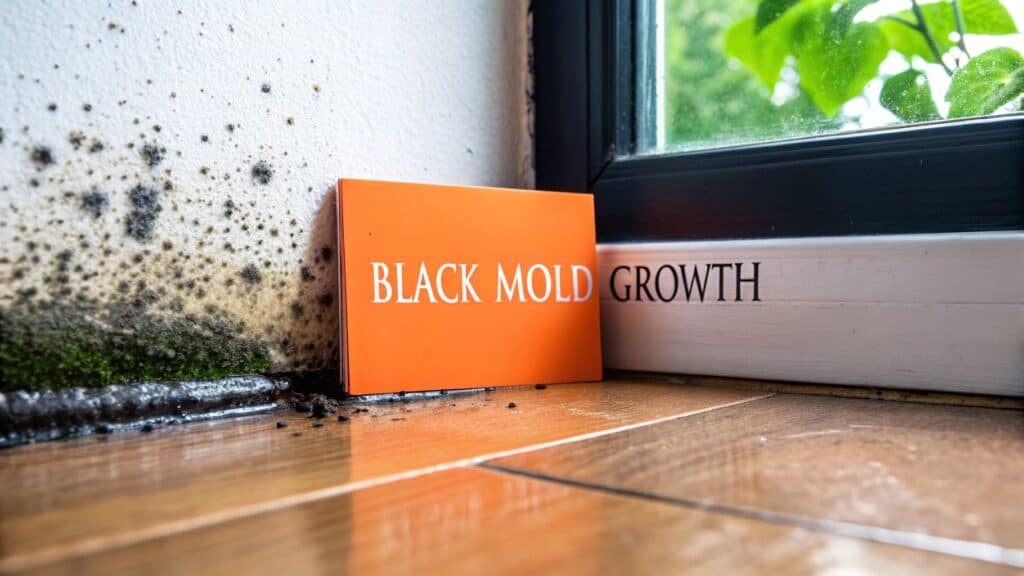
The simple answer? Moisture. Mold spores are a natural, unavoidable part of our environment, floating harmlessly in the air inside and outside our Southern California homes. They only become a problem when they land on a damp, organic surface and begin to grow.
Think of spores as tiny, invisible seeds scattered everywhere, just waiting for the right amount of water to spring to life. For homeowners in Orange County, understanding what causes black mold growth is the first step toward preventing it.
The Recipe For A Mold Infestation
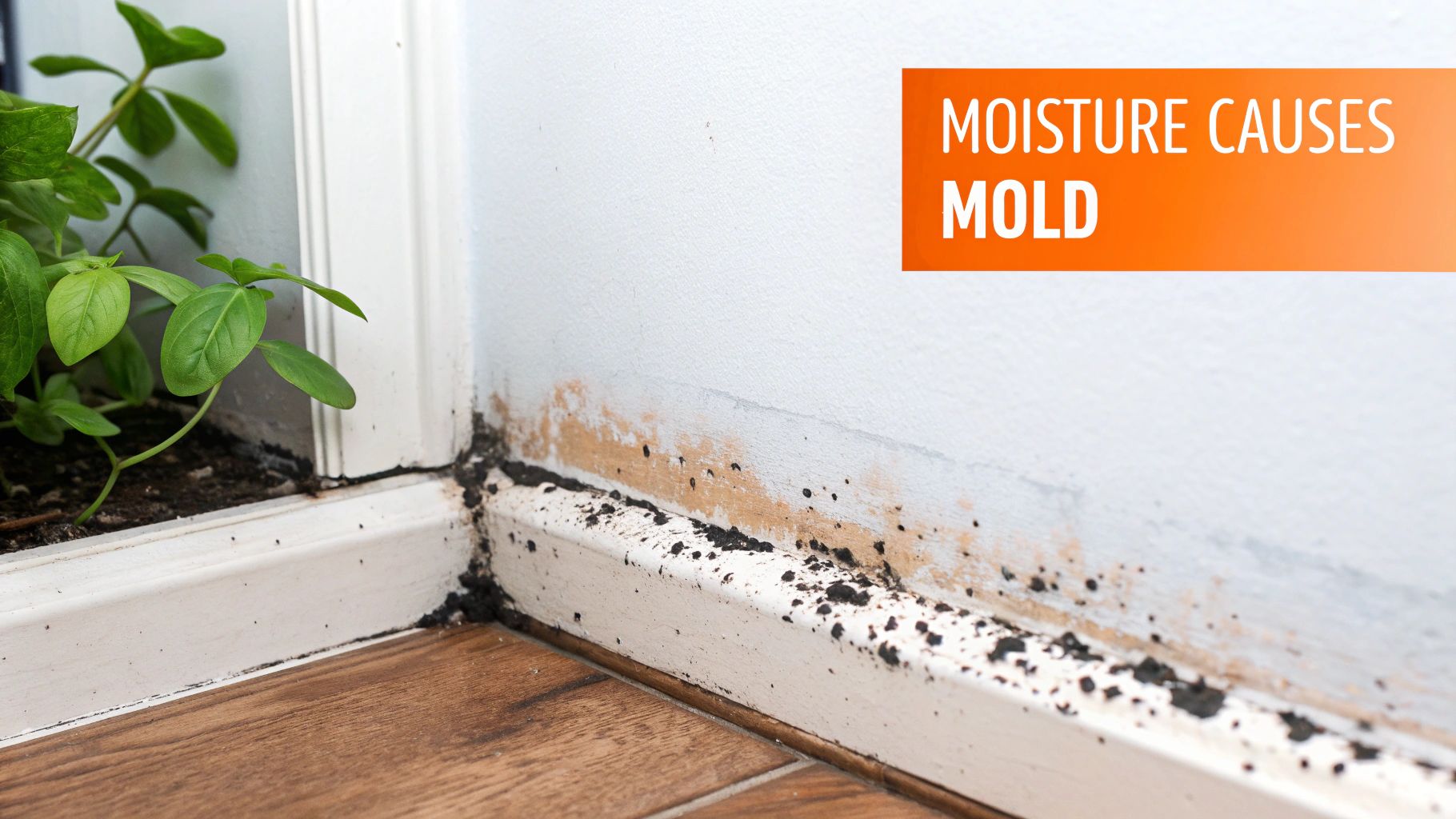
Discovering mold is a stressful moment for any Orange County homeowner or property manager. It’s more than just an ugly stain; it’s a red flag signaling an underlying moisture issue that can compromise your property's structure and indoor air quality. Here at Sparkle Restoration Services, our IICRC Master Certified team believes that understanding why an infestation started is the first step toward a permanent solution.
The Four Essential Ingredients For Black Mold Growth
For a mold colony to take root in your home, it needs four specific things to come together. Think of it like a simple recipe—if you take away even one of these ingredients, mold can't survive, let alone start growing in the first place.
This table breaks down exactly what mold needs to thrive.
| Ingredient | Why It Matters | Common Household Sources |
|---|---|---|
| Moisture | This is the non-negotiable activator. Without water, dormant mold spores can't begin to grow, period. | Leaky pipes, roof damage, condensation, high indoor humidity, appliance failures, flooding. |
| Food Source | Mold needs to eat, and it feeds on organic materials. Unfortunately, many common building materials are a perfect meal. | Drywall, wood studs, wallpaper, ceiling tiles, carpet backing, dust, insulation. |
| Temperature | Mold loves the same temperatures we do, which is what makes our homes such an ideal habitat. | Most indoor spaces between 60 and 80 degrees Fahrenheit create the perfect climate for growth. |
| Oxygen | Just like us, mold needs oxygen to live and multiply. | The standard air inside your home provides more than enough oxygen for a colony to flourish. |
This simple combination explains exactly why mold so often appears right after a water damage event. A sudden leak or flood introduces the final missing ingredient—moisture—and activates the spores that were already there all along.
This isn't just a local issue, either. Rising humidity and extreme weather are causing concern nationwide. This past August alone, there were over 697,000 online searches for 'black mold' in the United States, as excess moisture created the perfect breeding grounds.
To truly get rid of a black mold problem for good, you have to dig into its root causes, much like understanding the causes of common household pest infestations is key to stopping them from coming back. As a trusted, licensed general contractor serving Orange County, our mission is to pinpoint and fix the source of the moisture, turning chaos into calm and keeping your property safe and healthy.
How Moisture Trumps Everything When It Comes to Mold
Moisture is the undisputed ingredient number one for any mold problem. While mold spores are pretty much everywhere, all the time, they’re basically asleep—harmless and dormant until water shows up. Think of it like a seed in the desert waiting for rain. Once moisture activates that spore, the clock starts ticking on an infestation, and it happens a lot faster than most Orange County homeowners realize.
Figuring out where that water is coming from is the absolute first step in protecting your property. It’s not always about a dramatic flood or a burst pipe. More often than not, the real culprits are the subtle, persistent moisture sources working behind the scenes, creating the perfect environment for mold to thrive.
The Obvious Culprits: Sudden Water Events
The most dramatic sources of water are, thankfully, usually the easiest to spot. These are the sudden intrusions that dump a significant amount of water into your home quickly, completely saturating building materials and rolling out the red carpet for mold to move in.
- Plumbing Failures: A leaky pipe under the kitchen sink, a toilet supply line that gives way, or a cracked drainpipe can unleash a surprising amount of water in no time.
- Appliance Malfunctions: Your dishwasher, washing machine, and even the ice maker line for your fridge are all common failure points. A slow leak behind one of these can go unnoticed for weeks, quietly feeding a huge mold problem in the wall behind it.
- Roof and Window Leaks: Southern California storms are great at finding the weak spots in a roof or around window seals. Water then has a direct path into your attic and wall cavities, creating hidden pockets of moisture.
- HVAC System Issues: A clogged AC condensate drain line is a classic. It causes water to overflow, often in an attic or a closet where you won't see it right away.
When you’re hit with one of these events, speed is everything. Dealing with the immediate aftermath of water damage isn't just about cleaning up puddles; it's about stopping a secondary, and frankly more sinister, mold invasion before it even has a chance to start.
The Hidden Threat: High Humidity and Condensation
While a big leak is a clear emergency, the more insidious threat—especially in coastal communities like Newport Beach and Irvine—is persistent high humidity. This ambient moisture in the air can be just as destructive over time, creating a slow-burn environment where mold doesn't just survive, it flourishes.
As a licensed General Contractor, I’ve walked into countless Orange County homes where a massive mold problem wasn't caused by a flood, but by months of unchecked humidity. It’s a silent destroyer that can compromise your home’s structure and air quality without a single visible drip.
This is where being a proactive homeowner and knowing the subtle signs really pays off.
Common Sources of Chronic Moisture:
- Poor Ventilation: That steam from your hot shower has to go somewhere. In bathrooms without an effective exhaust fan, it settles on the walls, ceiling, and behind the vanity. That daily dose of dampness is more than enough to get a mold colony going.
- Condensation: In our coastal climate, the temperature difference between your cool indoor air and the warm, humid air outside creates condensation. You'll see it on windows, metal pipes, and even concrete slabs. For mold spores, this consistent dampness is a perpetual feast.
- Crawl Space Moisture: Many older homes have dirt crawl spaces, which naturally let moisture from the ground evaporate up into the structure. Without a proper vapor barrier, that moisture wicks right into your home, cranking up the indoor humidity.
The key takeaway is that you have to control your home's indoor environment. You can explore effective humidity control solutions that actively manage the moisture in your air. The goal is to keep your home's relative humidity below 50%. At that level, you're creating an environment where mold simply can't get the water it needs to grow. Getting a handle on these hidden moisture sources is the secret to long-term prevention.
The Black Mold Growth Timeline: From Spore To Colony
It’s shocking how quickly a small, unnoticed damp spot can explode into a full-blown mold infestation. If you’ve ever wondered just how fast it all happens, understanding the timeline is key. It highlights why acting on any water issue immediately isn’t just a good idea—it’s essential. The lifecycle of mold is a rapid race from a single, invisible spore to a thriving colony that can put your property and your health at risk.
Think of a mold spore as a microscopic seed. It can lie dormant for years, just floating in the air or sitting on a surface, completely harmless. But the second it gets wet, it activates. That simple contact with water kicks off a biological chain reaction that can spiral out of control if you don’t stop it in its tracks.
The Critical First 48 Hours
That initial window right after a water event is everything. Once a spore lands on a good food source—like the paper facing on drywall or the wood inside your walls—and gets wet, the clock starts ticking.
Studies show that mold can begin to grow in as little as 24 to 48 hours after materials are exposed to water from a flood, a burst pipe, or even just ongoing condensation. The growth really takes off in poorly ventilated areas where the humidity is over 60%.
At this early stage, the growth is microscopic. You can’t see it, but it’s the foundation for everything that comes next.
This timeline shows just how fast a single spore can become a very visible problem.

The main takeaway here is the sheer speed of it all. What starts as an invisible threat can become a visible colony needing professional help in under three weeks.
From Microscopic Growth To A Visible Colony
After that first 48-hour activation period, the mold starts putting down roots. It develops a network of tiny, thread-like structures called hyphae, which dig into whatever material it’s on, digesting it for food and fueling its expansion.
Even at this stage, the colony is still probably hidden behind a wall or under your floorboards, growing undetected.
In our experience as IICRC Master Certified professionals, the worst damage often happens in the days right after the water event. Homeowners think the problem is gone because the surface feels dry, but trapped moisture is the perfect fuel for hidden mold growth.
Within one to two weeks, the colony has grown large enough to become visible. You’ll start to see those tell-tale dark, splotchy patches on a wall or ceiling. By the time you can actually see mold, the problem is already well-established. Worse, it has likely started producing new spores to send into the air, setting the stage for it to spread to other damp spots in your home. It’s important to separate the truth from popular fiction, which you can do by exploring common facts and myths about mold and mold remediation.
This rapid timeline is exactly why a "wait and see" approach is so dangerous with water damage. A fast response from an experienced team isn't just about cleaning up the water; it's about breaking the mold growth cycle before it even has a chance to start. By calling in experts like Sparkle Restoration Services right away, you prevent a simple water issue from turning into a complex, expensive mold remediation project. We specialize in turning chaos into calm, and when it comes to mold, speed is everything.
Common Mold Hotspots In Orange County Homes

Mold is an opportunist. It doesn't need an invitation; it just needs a little moisture and a quiet, overlooked corner to set up shop. Knowing where it likes to hide is your first line of defense in proactive home maintenance.
For our clients across Orange County, from the coastal estates of Newport Beach to the beautiful planned communities of Irvine, we see the same problem areas time and time again. Let’s take a practical tour through the typical Southern California home to pinpoint these hotspots before they escalate into major problems.
Bathrooms: The Epicenter Of Humidity
It's no surprise that bathrooms are, hands down, the #1 hotspot for mold. The daily combination of steam, splashes, and often subpar ventilation creates a perfect tropical microclimate where mold spores feel right at home.
This constant moisture doesn't just stay in the air. It settles on every surface, seeps into porous grout lines, and gets trapped behind sinks and toilets, often completely out of sight.
Where to Look in the Bathroom:
- Grout and Caulk: Take a close look at the sealant around your shower, tub, and sinks. If it’s discolored, cracked, or peeling away, that’s a flashing red light. Water is likely getting behind those fixtures and into your wall cavity.
- Under the Sink: That tiny, slow drip from a P-trap or supply line can go unnoticed for months. It quietly saturates the cabinet floor and the drywall behind it. Look for water stains, warped wood, or a persistent musty smell you just can’t place.
- Behind the Toilet: The area around the base of the toilet is a magnet for condensation and the occasional hidden leak. Check for any discoloration on the flooring or the baseboards right behind it.
- Exhaust Fans and Ceilings: A dusty, clogged exhaust fan isn't removing moist air; it's just stirring it around. Spotting or peeling paint on the ceiling, especially directly above the shower, is a sure sign of trapped humidity.
Kitchens: Hidden Leaks And Appliance Issues
Your kitchen is another prime location for the kind of water problems that lead directly to black mold. With water lines running to sinks, dishwashers, and refrigerators, there are multiple points of potential failure. A small leak behind a heavy appliance can cause thousands in damage before you ever see a single drop of water.
As a BBB Torch Award Winner for Ethics, we believe in arming our clients with knowledge. One of the most common calls we get is for a "mysterious musty odor" in the kitchen. In well over 50% of those cases, the culprit is a slow, hidden leak from a dishwasher or ice maker line that has been feeding a mold colony for months.
Where to Look in the Kitchen:
- Under the Sink: Just like in the bathroom, this cabinet is a top priority. Check for drips from the garbage disposal, faucet connections, and drain lines. A damp, cluttered cabinet is a mold paradise.
- Behind and Under the Refrigerator: If your fridge has an ice maker or water dispenser, its thin plastic supply line can become brittle and crack over time. It's worth the effort to pull the unit out every so often to inspect the line and the floor beneath it.
- Dishwasher Area: The connections and seals on a dishwasher are under constant stress and can fail. Keep an eye out for any signs of water damage on the flooring or adjacent cabinets, like warping or discoloration.
Attics And Crawl Spaces: Out Of Sight, Out Of Mind
Because we don't live in them, attics and crawl spaces are often completely neglected. This allows moisture problems to fester for years, silently compromising your home’s structural integrity and indoor air quality. These areas are absolutely critical checkpoints.
High-Risk Zones to Inspect:
- Attics: Look for dark stains on the underside of the roof sheathing, particularly around vents, chimneys, and skylights. This is a dead giveaway of a roof leak. Also, confirm that bathroom exhaust fans are vented all the way outside—not just into the attic space. Dumping warm, moist air directly into the attic is like rolling out the red carpet for mold.
- Crawl Spaces: Poorly sealed or unconditioned crawl spaces can trap ground moisture, creating a perpetually damp environment ideal for fungal growth. Shine a flashlight on the floor joists and look for any discoloration. A musty, earthy odor is another tell-tale sign of a problem.
Here’s a simple way to assess the risk level in different parts of your home:
Mold Risk Assessment By Room
| Room/Area | Primary Moisture Source | Key Prevention Tip |
|---|---|---|
| Bathroom | Shower steam, sink splashes, toilet condensation | Run the exhaust fan for 30 minutes after every shower. |
| Kitchen | Leaky pipes (sink, dishwasher, fridge line) | Regularly check under the sink and behind appliances for any signs of moisture. |
| Attic | Roof leaks, improper ventilation | Ensure all vents (especially from bathrooms) terminate outside the home. |
| Crawl Space | Ground moisture, poor sealing | Install a vapor barrier to prevent moisture from seeping up from the soil. |
| Laundry Room | Washer hose leaks, dryer vent humidity | Inspect washer supply hoses annually and ensure the dryer vent is clear. |
| Basement | Foundation leaks, high humidity | Use a dehumidifier and check for cracks or water intrusion after heavy rains. |
| Window Sills | Condensation from temperature differences | Wipe down condensation promptly and check window seals for degradation. |
Being vigilant about these hotspots can save you an incredible amount of stress and expense down the road. For more on this, our guide on how to determine if is your home leak-proof offers valuable insights. A regular, ten-minute inspection is your best defense, turning potential chaos into calm by stopping mold before it ever gets a foothold.
Health Concerns: Separating Mold Fact From Fiction
Hearing the words “toxic black mold” can instill a sense of panic in any homeowner. While the concern is absolutely valid, it’s important we approach this with facts, not fear. As IICRC Master Certified professionals, our team at Sparkle Restoration Services wants to provide clear, authoritative information so you can protect both your family and your property.
Here's the truth: the mold itself isn't "toxic." The real issue comes from certain species, like the infamous Stachybotrys chartarum or "black mold," which can produce microscopic compounds called mycotoxins. It's the prolonged inhalation or exposure to these mycotoxins that can lead to health problems.
Understanding The Real Health Risks
For most healthy people, a bit of exposure to common indoor mold might not trigger any symptoms at all. For others, however, the effects can range from mildly irritating to quite severe, especially if the exposure is prolonged. The reaction ultimately depends on an individual's sensitivity.
Often, the initial symptoms mimic seasonal allergies or a nagging cold. You might notice:
- A persistent cough or wheezing
- Itchy, watery eyes
- Chronic nasal congestion or a runny nose
- Unexplained skin irritation or rashes
- A sore throat that won't go away
These symptoms are your body’s inflammatory response to breathing in mold spores and mycotoxins. The challenge is that these signs are so general, making it difficult to pinpoint mold as the culprit without a professional assessment of your indoor environment. To get a better handle on this, you can learn more about the specifics of mold contamination and its associated health risks.
Vulnerable Groups And Heightened Sensitivity
While anyone can be affected, some people are at a much higher risk of developing more serious health issues from mold exposure. We have a responsibility to protect the most vulnerable members of our families and communities.
This includes infants, young children, the elderly, and anyone with a compromised immune system. People with pre-existing respiratory conditions like asthma or COPD are also particularly susceptible to severe reactions. For them, mold exposure isn't just an annoyance—it can trigger serious asthma attacks and significant breathing difficulties.
The statistics really bring the connection between indoor environments and respiratory health into focus. Approximately 40% of asthma episodes in the U.S. are set off by household irritants like mold. Furthermore, an estimated 4.6 million asthma cases are directly linked to dampness and mold exposure in homes. You can discover more insights about mold's impact on respiratory health from Real Time Lab.
This data makes one thing crystal clear: tackling what causes black mold growth—which is always moisture—isn't just about property maintenance. It's a critical component of maintaining a healthy home. By controlling moisture and ensuring excellent indoor air quality, you're taking a proactive step to safeguard everyone under your roof. If you suspect a problem, don't wait. An authoritative inspection is the first step toward restoring your peace of mind.
Why Professional Mold Remediation Is Essential
When you first spot mold, the instinct to grab a bottle of bleach and start scrubbing is completely understandable. But what seems like a simple cleanup can quickly spiral into a much bigger, more complex problem. The real danger isn't what you can see; it's the millions of invisible spores that get launched into the air the moment you disturb a mold colony.
Think of it this way: trying to scrub away mold without the right equipment is like shaking out a dandelion puff in a light breeze. You might get rid of the stem, but you’ve just sent seeds scattering everywhere. Those microscopic spores will travel through your HVAC system, settling in new areas and starting the whole cycle over again. This is where a DIY job goes wrong, turning a localized issue into a whole-house contamination event.
The Professional Difference
As IICRC Master Certified professionals, we don’t just "clean" mold—we follow a strict, scientific protocol designed to contain and eliminate the threat for good. It's a systematic process that you simply can't replicate with household products.
Our approach is built around several non-negotiable steps:
- Containment: The first thing we do is build a fortress around the affected area. We use heavy-duty plastic sheeting to create a physical barrier and set up negative air pressure systems. This ensures not a single spore can escape the work zone and contaminate the rest of your home.
- HEPA Filtration: While we work, powerful High-Efficiency Particulate Air (HEPA) scrubbers are running constantly. These aren't your average air purifiers; they are industrial-grade machines that capture 99.97% of airborne particles, literally scrubbing the air clean of mold spores.
- Safe Removal: We don’t just treat the surface. Contaminated materials that can't be salvaged, like drywall or insulation, are carefully cut out, bagged, and disposed of following strict industry regulations.
- Detailed Cleaning: Once the contaminated materials are gone, every remaining surface within the containment area—from wall studs to flooring—is meticulously cleaned with professional-grade antimicrobial agents.
A common mistake we see is homeowners painting over a moldy surface. This does nothing to kill the mold. It simply hides the problem while the colony continues to thrive and release spores from behind the new layer of paint.
Verification and Peace of Mind
How do you know the job is truly done? This is where the final, and most critical, step comes in: post-remediation verification. We bring in an independent, third-party industrial hygienist to conduct air quality testing. Their job is to verify that our work was successful and that your home's spore count has returned to safe, normal levels.
This isn't just an opinion; it's scientific proof that the threat has been neutralized and your indoor air quality is restored. It's the ultimate assurance that you and your family can breathe easy again—a level of certainty that only comes with professional remediation.
If you even suspect a mold issue, don't risk making it worse. Call in experts who can provide a thorough inspection and a permanent solution. You can learn more about our rigorous mold remediation process and how we bring calm back to chaotic situations for our clients across Orange County.
Your Top Questions About Black Mold Answered
Homeowners and property managers across Orange County often have the same pressing questions when they suspect a mold issue. As industry experts, we want to provide the straightforward, authoritative answers you need.
Can Black Mold Grow Without A Water Leak?
Yes, absolutely. While a burst pipe or a roof leak is a common culprit, it’s not the only way mold gets started. All black mold really needs to thrive is consistent moisture, and it can find that in places with stubbornly high humidity—generally anything above 60%.
Think about those chronically steamy bathrooms, laundry rooms, or stuffy basements. These areas can easily trap enough moisture in the air for mold to take hold on walls, ceilings, and other surfaces. This is a big issue in our beautiful coastal communities here in Orange County, where the ocean air alone can create the perfect humid conditions for mold, no dripping pipe required.
What Does Black Mold Smell Like?
That distinct, unpleasant odor is one of the first red flags. Black mold releases microbial volatile organic compounds (MVOCs), which create a persistent smell that’s hard to ignore. Most people describe it as musty and earthy, a lot like damp soil, rotting leaves, or a pile of wet towels that’s been forgotten for too long.
This musty smell is one of the most reliable clues you have a hidden mold problem. If your nose is picking up that scent but you can't see any mold, it’s a strong signal that moisture is trapped somewhere out of sight—behind a wall, under the floorboards, or in a crawl space. That’s when it’s time to call in a professional to investigate.
Is It Safe To Live In A House With Black Mold?
Living with an active black mold colony is a significant health risk and is never recommended. The mycotoxins it can release into the air may trigger everything from allergic reactions to serious respiratory problems, especially for the most vulnerable: children, the elderly, and anyone with asthma or a compromised immune system.
For the well-being of your family or tenants, any suspected mold infestation needs to be handled immediately. Getting it addressed by IICRC Master Certified technicians is the only way to guarantee the mold is removed completely and safely.
How Can I Tell If Mold Is The Dangerous Black Mold?
Here’s the thing: you can’t tell just by looking at it. Many common household molds are black, but that doesn't automatically make them Stachybotrys chartarum (the infamous "toxic black mold"). The only way to know for sure is to have a professional take a sample and send it to an independent lab for analysis.
However, at Sparkle Restoration Services, our advice is always the same: treat all visible indoor mold as a potential hazard. Regardless of its specific type, its presence means you have an underlying moisture issue that is damaging your property and compromising your indoor air quality. Don’t wait to find out what kind it is—take action.
Don’t let questions and uncertainty about mold disrupt your life. If you think you might have a mold problem in your Orange County home or business, the expert team at Sparkle Restoration Services is ready to help. As an IICRC Master Certified, licensed general contractor, we offer thorough inspections and professional remediation to restore your property and your peace of mind.
Contact us today to schedule your free consultation. We’re here 24/7 to turn chaos into calm, fast. Visit us at https://www.sparklerestoration.com.
Ready to create a space that’s as beautiful as it is functional? Schedule your complimentary design consultation today by visiting Ready to Work with Sparkle?