



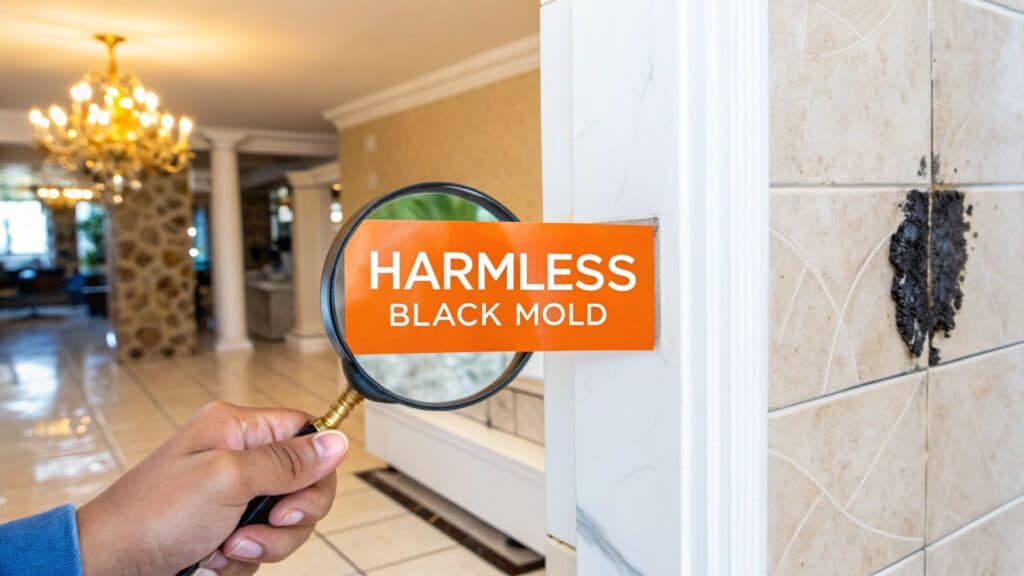
When you discover a dark, splotchy patch growing somewhere in your home, the first question that usually pops into your mind is, what does harmless black mold look like? It’s a natural reaction. But here’s the simple, critical truth you need to know: you absolutely cannot determine if a mold is "harmless" just by its appearance.
Many common, less-concerning molds can show up looking black, while some of the more infamous types can appear in other colors entirely. The bottom line is that any visible mold indicates a moisture problem that requires a professional solution.
Understanding The Myth Of "Black Mold"
Finding what looks like black mold in your Orange County home is stressful, to say the least. That term alone conjures up scary stories about "toxic black mold," and it's easy to jump to the worst conclusions about your family's health and your home's integrity.
Before panic sets in, it's important to understand a key distinction. "Black mold" isn't a single, specific type of fungus. It’s a catch-all term for any mold that happens to be dark or black in appearance.
Dozens of different mold species can grow black under the right conditions. Here in coastal communities like Newport Beach and Irvine, the constant battle with humidity creates the perfect breeding ground for all sorts of molds, not just the notorious ones. Some are relatively benign, while others can cause significant problems. This is exactly why a quick visual check is never enough to know what you're dealing with.
As a BBB Torch Award for Ethics Winner, our philosophy at Sparkle Restoration Services is to arm homeowners with real information, not scare tactics. While this guide will help you understand the realities of mold, it is not a substitute for a professional diagnosis. Telling one type of mold from another requires the trained eye and specialized tools of an IICRC Master Certified technician.
The single most important takeaway for any homeowner is this: visible mold, regardless of color, means you have an underlying moisture problem. Finding and fixing the source of that water is every bit as critical as removing the mold itself.
Before you consider a DIY cleanup, it's crucial to get a handle on the basic facts and myths about mold and mold remediation. Our mission is to "Turn Chaos Into Calm, Fast" by providing clear answers and expert solutions, making sure your home isn't just clean, but truly safe.
Visually Identifying Common Dark Molds
When you find a dark, unsettling patch of mold growing in your home, it's natural to feel a jolt of alarm. But before you panic, it helps to understand what you're looking at. Think of it like identifying plants in a garden—some are invasive weeds, some are harmless, but their presence always tells you something about the underlying conditions.
The one everyone's heard of, Stachybotrys chartarum, often has a distinct slimy or wet appearance and a greenish-black color. It thrives on materials with high cellulose content—think drywall, wood framing, or ceiling tiles—that have been saturated for an extended period. You'll often notice a very strong, musty smell, almost like rotting leaves or damp soil, that accompanies its growth.
However, not every dark mold is the infamous "toxic black mold." In fact, many common lookalikes you'll find in Southern California homes have different characteristics entirely.
Common Lookalikes You Might Find
One of the most frequent types you'll encounter is Cladosporium. Unlike the slimy texture of Stachybotrys, Cladosporium usually appears more velvety, almost like suede, or even powdery. Its color palette is also broader, ranging from olive green to dark brown or black. You're likely to find this one on painted surfaces, wood, or even fabrics in your Newport Beach home. While it's a known allergen, it doesn't produce the potent mycotoxins associated with Stachybotrys.
Another common sight is Alternaria, which also has a velvety texture, sometimes with long, fuzzy-looking hairs. It’s typically dark greenish-brown or black and loves damp spots like shower stalls, the area under leaky sinks in Irvine kitchens, or window frames where condensation gathers.
When homeowners discover these dark spots after a leak, that initial fear is completely understandable. But here’s a critical fact: most dark-colored molds are not the notorious Stachybotrys chartarum. Research data from indoor air samples shows that Stachybotrys appears in only 16% of homes, ranking third behind much more common mold types. This is a big reason why you can't just rely on what you see.
This graphic really helps put the common fears around "black mold" into perspective by separating the myths from reality.

As the infographic shows, public fear tends to fixate on the idea of "black mold," but the truth is that color isn't a reliable sign of danger, and many less harmful molds can look just as intimidating.
To make these distinctions clearer, here’s a side-by-side comparison of what you might be seeing.
Visual Comparison Of Common Dark Molds
| Mold Type | Typical Color | Texture | Common Location | Associated Risk Level |
|---|---|---|---|---|
| Stachybotrys chartarum | Greenish-black to black | Slimy or wet when fresh, sooty when dry | Water-damaged drywall, wood, ceiling tiles | High (potential for mycotoxins) |
| Cladosporium | Olive green, brown, or black | Powdery or velvety | Painted walls, wood, fabrics, HVAC vents | Low to Moderate (common allergen) |
| Alternaria | Dark greenish-brown or black | Velvety with fuzzy hairs | Showers, under sinks, window frames | Low to Moderate (common allergen) |
This table provides a general guide, but remember, these are just typical appearances. Mold can look different depending on its environment and food source.
Key Takeaway: Visual clues like texture (slimy vs. powdery) and location can offer hints, but they are never definitive proof. The bottom line is that any visible mold signals a moisture problem that needs professional attention to protect both your property and your family's health.
Ultimately, a visual check is just the starting point. The only way to be certain about the potential health risks and the right way to fix the problem is with a professional assessment. For a deeper dive, you can learn more about mold contamination and health risks in our article. This ensures your home is restored safely and correctly, with the precision and care a luxury property deserves.
Why You Can’t Judge Mold by Its Color
One of the most persistent myths we hear from homeowners in Orange County is that you can tell how dangerous mold is just by looking at its color. This is completely false. Relying on color to gauge a mold problem is like assuming all red cars are fast—it’s an unsafe assumption that ignores what’s really going on under the hood.
The truth is, a wide variety of mold species can appear black. Its look is heavily influenced by the environment it's in. Factors like the amount of moisture, the material it’s feeding on (like wood versus drywall), and even its age can drastically change its appearance. A single type of mold might look dark green on a patch of drywall but appear jet black on a damp 2×4 inside a wall.
This means a common, allergenic mold could look identical to a more concerning species. Color is just a superficial trait; it's not a reliable fingerprint for toxicity.
The Truth About Mycotoxins
The real concern behind the infamous "toxic black mold" isn't about the color black at all. It's about the potential for certain mold species to produce something called mycotoxins. These are microscopic chemical compounds that some molds, like Stachybotrys chartarum, can release under very specific conditions.
But here’s the key: not all molds can produce them, and even the ones that can, don't do it all the time.
Think of it this way: a bee has a stinger, but it doesn't sting everything it flies past. It only stings when it feels threatened. Similarly, a mold capable of producing mycotoxins only does so when its environment—the specific combination of temperature, humidity, and food source—triggers that response. This variability is why trying to identify it by sight alone is impossible and, frankly, a dangerous gamble with your family’s health. The potential for these compounds is a major reason why any mold growth can impact your home's indoor air quality and overall health.
The term "black mold" itself is scientifically vague and has been fueling homeowner anxiety since the 1990s when it was incorrectly linked to a number of health scares. What we know for sure is that many common indoor molds can trigger allergic reactions in sensitive individuals. This fact alone makes the presence of any visible mold a legitimate health concern.
The critical takeaway for any homeowner is to stop focusing on the mold’s color and start focusing on the conditions that allowed it to grow in the first place. All visible mold, no matter what it looks like, is a red flag signaling an active and unwelcome moisture problem.
Ultimately, that moisture is the real enemy here. It’s what compromises your home's structure and creates the perfect breeding ground for mold of any color to flourish. The only permanent solution is to address the water source with professional precision. That's how you restore your home to a safe, healthy state and gain true peace of mind.
A Homeowner's Guide to Safe Mold Inspection
Finding what looks like mold in your home can be alarming, but a calm, methodical inspection is your best first step. Before you do anything else, remember the golden rule: do not touch or disturb the suspected mold. For this initial walkthrough, your eyes and your nose are your most important tools.
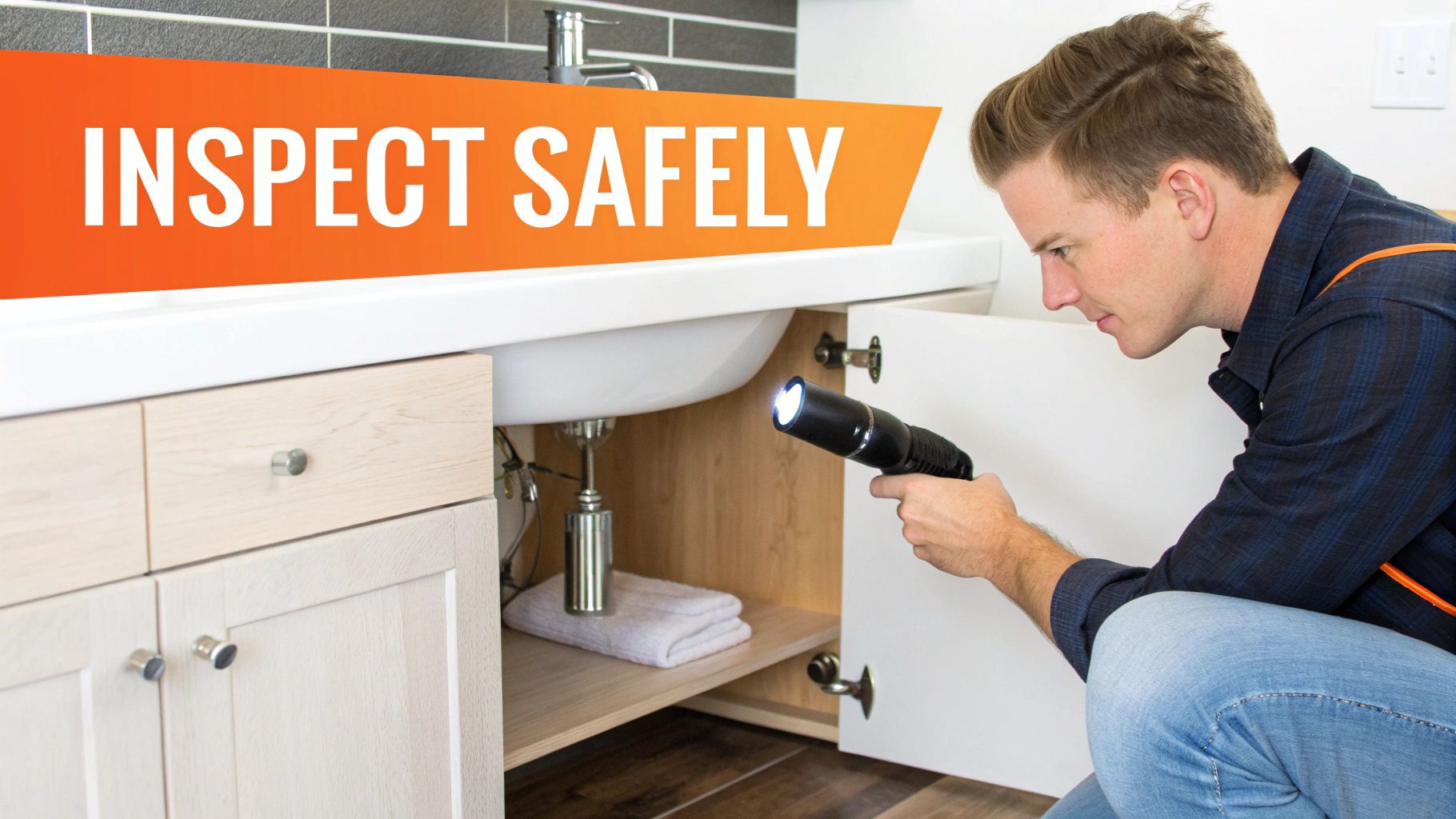
Start by visually scanning areas where moisture is common. Look for subtle clues that point to water issues—things like faint discoloration on a ceiling, wallpaper that’s starting to peel, or paint that’s bubbling up. The objective here is to pinpoint problem areas without accidentally sending a cloud of spores into the air.
Key Areas To Check In Your Home
In high-end Orange County homes, moisture has a knack for hiding in unique spots, allowing mold to grow completely out of sight. Be sure to add these locations to your inspection list:
- Behind and Under Appliances: Check the spaces behind built-in appliances like your Sub-Zero refrigerator or wine cooler. It’s also a good idea to pull out the drawers under sinks in your kitchen and bathrooms and use a flashlight to get a good look at the plumbing inside custom cabinetry.
- Luxury Bathroom Features: The walls and floors around steam showers, jetted tubs, and complex multi-head shower systems are hotspots for moisture. Pay close attention to wall cavities next to these features, as slow, hidden plumbing leaks are a very common source of mold.
- Window and Door Casings: For coastal properties from Newport Beach to Laguna Niguel, the combination of condensation and salty air often leads to moisture buildup around window sills and door frames, especially where heavy drapes might trap it.
- HVAC Systems: Take a look at the system's drip pans. Also, check the air vents for any dark spotting or a musty smell that gets stronger when the system kicks on.
Next, rely on your sense of smell. Mold produces a very distinct musty, earthy odor, often described as smelling like damp soil or rotting leaves. If you catch a whiff of that smell but don't see any visible growth, it’s a strong sign it's hidden behind a wall, under your flooring, or in a crawl space. Once you've done an initial check, you might be looking for ways to handle smaller issues. For example, if you find spots on a rug, here's a quick, safe guide on how to remove mould from carpet.
Crucial Safety Warning: Never, under any circumstances, try to clean or remove what you suspect is mold. Scrubbing at a mold colony without the proper professional containment protocols will release millions of spores, contaminating your entire home and destroying your indoor air quality.
The purpose of a homeowner's inspection isn't to figure out what type of mold you have. It's to identify potential moisture problems. Finding and fixing the source of the water is everything. Our guide on making sure your home is truly leak-proof can give you some valuable pointers. Ultimately, protecting your family and your property investment means letting IICRC-certified experts handle the professional assessment and removal. They have the equipment and training to manage the situation safely from start to finish.
When To Call A Mold Remediation Expert
While a bit of surface mold in the shower grout can often be handled with some elbow grease, knowing when to put down the scrub brush and pick up the phone is the most important decision you can make. Trying to tackle a serious mold problem yourself is a recipe for disaster. You can accidentally send billions of spores airborne, turning a localized issue in one corner into a whole-house contamination nightmare.
A key rule of thumb is the 10-square-foot guideline. If you find a patch of mold that’s bigger than a small dinner plate (roughly 3 ft x 3 ft), it’s time to stop. That amount of growth is a sure sign of a significant, ongoing moisture problem that you simply can’t solve with a spray bottle. It requires professional containment and specialized equipment to handle safely.
Clear Signs You Need Professional Help
Beyond just the size of the patch, there are other tell-tale signs that scream "call an expert." These are the red flags that suggest the problem is bigger than what you can see on the surface:
- That Persistent Musty Smell: If your home has a damp, earthy odor that you can't seem to pin down, that’s a classic sign of hidden mold. It's likely thriving behind drywall, under expensive flooring, or even deep within your HVAC system where you'd never find it.
- Unexplained Allergy-Like Symptoms: Are you or your family constantly sneezing, coughing, or dealing with watery eyes only when you're at home? This is a huge indicator that hidden mold could be damaging your indoor air quality.
- A History of Water Damage: If your home has ever had a leaky roof, a burst pipe, or even just a chronically humid basement, you’re on high alert. Mold can lie dormant for years and then reactivate the second it gets a little moisture.
A true professional assessment is far more than just eyeballing a stain on the ceiling. It’s a comprehensive investigation, sometimes including air quality testing, to understand the full extent of the contamination. This is the only way to create a formal remediation plan that doesn't just clean the mold but actually fixes the source for good.
The goal of professional mold remediation isn’t just to clean what you can see; it’s to eliminate the contamination at its source and restore your home to a safe, healthy condition.
This is where Sparkle Restoration Services truly excels. We hold ourselves to a higher standard because we aren’t just mold experts—we’re also a licensed General Contractor with IICRC Master Certification. We don’t just handle the cleanup; we provide a seamless, white-glove solution from start to finish. After we’ve completely eliminated the mold, our skilled craftsmen step in to flawlessly restore and remodel the area, turning a moment of chaos into an opportunity for renewal.
Sparkle's White-Glove Approach To Mold Remediation
Spotting what you think might be mold is just the first step. The real challenge—and what truly matters for your family's health and property value—is ensuring it is removed with precision and genuine care. Here at Sparkle Restoration Services, we know our Orange County clients expect more than just a quick cleanup. Remediation isn't simply about removal; it's about restoring your home to its original state with minimal disruption and an unwavering focus on the details.
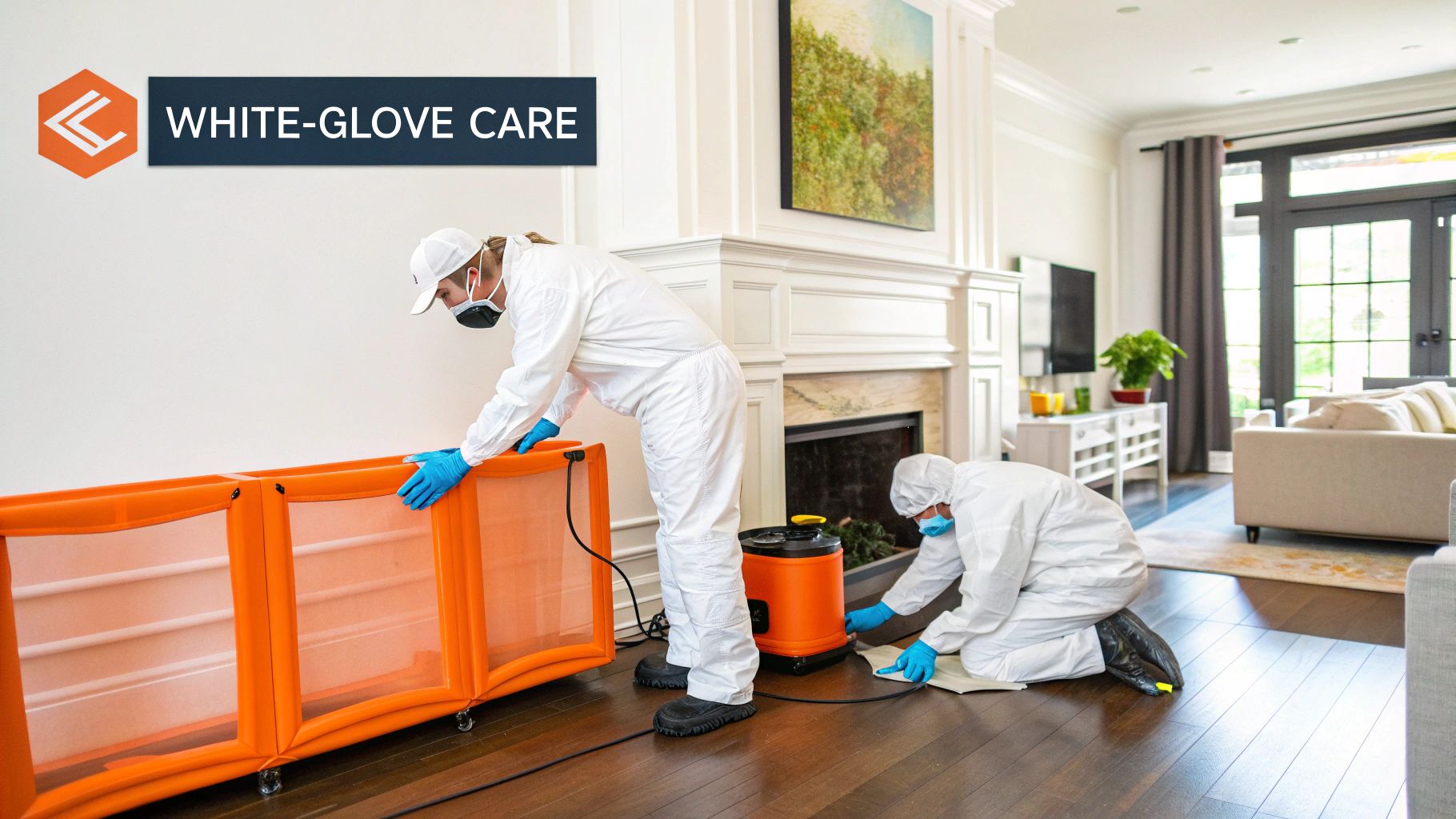
Our process starts by creating an impenetrable containment zone. Think of it like a cleanroom in a high-tech lab. We use heavy-duty plastic barriers and powerful negative air pressure machines to completely seal off the affected area. This guarantees that not a single rogue spore can drift into other parts of your home during the process.
From there, our IICRC Master Certified technicians deploy state-of-the-art HEPA air scrubbers and vacuums. These aren't your everyday shop vacs; they're designed to capture microscopic particles, purifying the air while we meticulously clean every surface. This dedication to doing things the right way is at the core of everything we do, a philosophy that extends even to our partners, like Sparkle Tech's commitment to redefining clean.
From Remediation To Renovation
Here's what truly sets Sparkle apart: our work doesn't stop once the mold is gone. As a licensed General Contractor, we view a remediation project not just as a repair, but as a genuine opportunity to elevate your living space.
A necessary repair can become the catalyst for the luxury bathroom or kitchen remodel you’ve been dreaming of. We seamlessly transition from technical remediation to high-end renovation, managing every detail in-house.
This integrated design-build approach means you have one trusted, accountable team guiding you from the initial discovery to the final, beautiful result. There's no need to juggle multiple contractors. We manage everything—from replacing drywall and sourcing custom cabinetry to installing new flooring and applying the final coat of paint—ensuring a flawless outcome that exceeds your expectations.
If you've found something concerning in your home, don't settle for a basic cleanup crew. You deserve the peace of mind that comes with a true white-glove service. Contact Sparkle Restoration Services today to schedule your comprehensive consultation and let us transform a stressful situation into a beautifully restored reality.
Still Have Questions About Mold?
Even after learning more about mold identification, most homeowners in Orange County still have questions. That's completely normal. Here are some of the most common ones our IICRC Master Certified team gets asked, with practical, straightforward answers.
Can Harmless Mold Still Cause Allergies?
Yes, absolutely. Just because a mold doesn't produce mycotoxins doesn't mean it gets a free pass. These so-called "harmless" molds still release spores, and for anyone with allergies, asthma, or chemical sensitivities, that's bad news.
These spores can easily trigger symptoms like sneezing, itchy eyes, a runny nose, and general respiratory discomfort. That's why we always say any type of mold growth, regardless of color or species, needs to be handled by a certified professional. It’s about protecting your home's air quality for everyone inside.
Is It Safe To Clean A Small Amount Of Mold Myself?
We strongly advise against this. It’s one of the most common mistakes we see. When you try to scrub a mold spot, you disturb the colony. This can cause it to release a massive cloud of spores into the air, spreading the problem far beyond the initial area.
On top of that, household cleaners like bleach often just clean the surface. They don't touch the "roots" of the mold, meaning it's almost guaranteed to grow back. Professionals use specialized equipment and containment procedures to remove it completely and safely the first time.
A well-intentioned DIY cleaning attempt is the number one way a small, contained mold issue explodes into a widespread contamination problem. It almost always ends up costing far more in time, stress, and money to fix.
Does Homeowners Insurance Cover Mold Removal?
This is a complex question, as coverage for mold remediation varies wildly from one policy to the next.
Generally, if the mold is a direct result of a "covered peril"—like a sudden pipe burst that you couldn't have predicted—you'll likely have some coverage. However, if the mold grew over time due to a slow leak, high humidity, or lack of maintenance, it's almost always excluded. We have worked with countless insurance providers in Orange County and can help you make sense of your policy and navigate the claims process.
How Can I Prevent Mold In My Coastal Home?
Living in a beautiful coastal community like Newport Beach means you're in a constant battle against moisture. Winning that battle is the key to preventing mold.
The strategy is all about moisture control.
- Ventilation is critical. Make sure your bathrooms and kitchen have high-quality exhaust fans that you actually use.
- Run a dehumidifier, especially during those humid summer months or in below-grade spaces.
- Fix leaks immediately. Even a tiny drip can create the perfect environment for mold to thrive.
- Service your HVAC system regularly to ensure it's removing humidity from the air efficiently.
Don’t leave your property’s health and your family's well-being to guesswork. You need a definitive assessment and a white-glove approach that turns chaos into calm. Trust the IICRC Master Certified and BBB Torch Award-winning experts at Sparkle Restoration Services.
Schedule a professional mold inspection today and experience the peace of mind that comes with proven, certified expertise.
Ready to create a space that’s as beautiful as it is functional? Schedule your complimentary design consultation today by visiting Ready to Work with Sparkle?