


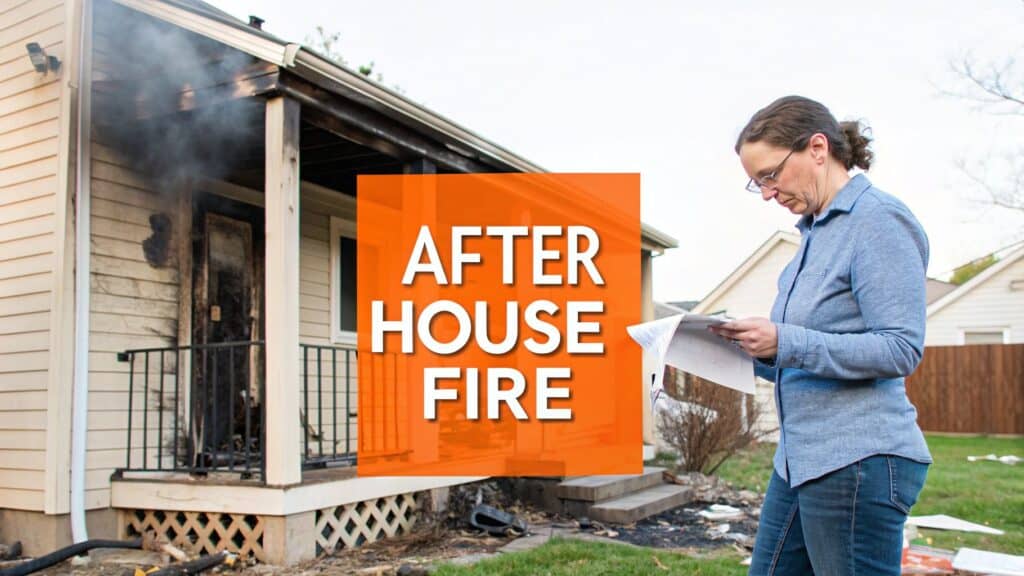
When you're figuring out what to do after a house fire, your immediate focus must be on two things: safety first, then securing your property. After ensuring everyone is accounted for and in a safe location, your next calls are critical. First to your insurance agent to start the claim, and second to a certified restoration professional who can prevent further damage and begin the recovery process. As an IICRC Master Certified firm and licensed General Contractor serving Orange County for over 20 years, we've guided countless families through this exact crisis.
Your First 24 Hours: Navigating the Aftermath
The first few hours after a fire are a blur of chaos and disorientation. Your top priority is the well-being of your loved ones. Find a safe place to land, whether that’s with family, friends, or at a nearby hotel.
It's essential to have everyone checked by a doctor, even if no one seems hurt. The effects of smoke inhalation can manifest later, and it's a risk not worth taking.
Once the fire department has done its job and officially cleared the scene, you’ll feel a powerful urge to re-enter your home. You must resist it. The structural integrity could be compromised, and the air is filled with toxic particles. This is a crucial moment where taking the right, decisive actions will set the stage for a much smoother recovery.
To help you stay focused during this overwhelming time, here is a quick-reference checklist of the most important steps to take immediately.
Immediate Post-Fire Action Checklist
| Priority Action | Key Contact | Important Note |
|---|---|---|
| Confirm Everyone's Safety | Family, Friends | Get to a secure location away from the property. |
| Seek Medical Attention | Doctor or ER | Have everyone evaluated for smoke inhalation, even if there are no visible injuries. |
| Notify Your Insurance Company | 24-Hour Claims Hotline | Get your claim number and ask about "Additional Living Expenses" (ALE) coverage for immediate needs. |
| Secure the Property | Certified Restoration Company | Hire a professional to board up windows/doors and tarp the roof to prevent vandalism and weather damage. |
| Find Temporary Housing | Family, Red Cross, Hotel | Your ALE coverage should help with the cost of a hotel or temporary rental. |
| Do NOT Re-enter the Home | N/A | Wait until it has been officially declared safe by professionals. The structure could be unstable. |
Following these steps will help you regain a sense of control and ensure you're protecting both your family and your property from the very beginning.
Taking Control with Key Phone Calls
Your first call must be to your insurance company's 24-hour claims hotline. Inform them of the fire, provide your policy number, and be sure to ask about your "Additional Living Expenses" (ALE) coverage. This is the part of your policy that typically covers temporary housing and other essentials you'll need right away. Document the name of the representative you speak with and, most importantly, your claim number.
Your second call, which is just as critical, is to a trusted, IICRC Master Certified restoration company. If you're in Orange County, this means finding a team that can respond immediately. They must board up windows and tarp the roof to prevent vandals or weather from making things worse. This first step is vital for protecting what’s left of your home and belongings. A premier restoration partner won't just secure the site; they'll become your advocate, guiding you through the entire complex journey ahead.
This flow chart gives a clear visual of these crucial first steps: ensuring safety, notifying your insurer, and bringing in a professional restorer.
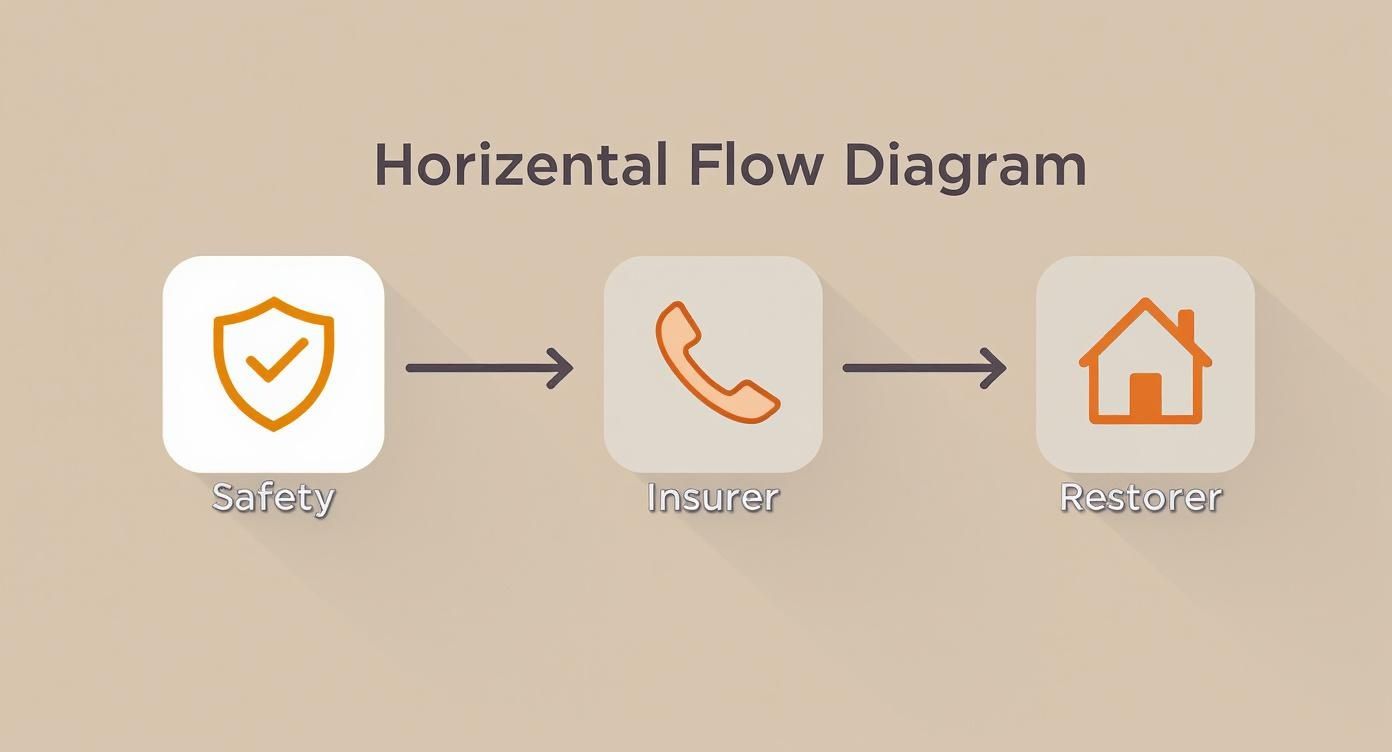
Having a visual roadmap like this helps turn a chaotic situation into a more manageable, step-by-step process.
Prioritizing Health and Safety Above All
The immediate aftermath isn't just about the building; it’s about protecting your health. Lingering smoke and soot aren't just an unpleasant smell—they're loaded with harmful compounds. In 2023, there were over a million fires in the United States, and the vast majority of civilian deaths occurred in home fires. It's a sobering statistic that underscores why safety must be the top priority.
At Sparkle Restoration Services, we understand this is more than a project; it’s your life. As a BBB Torch Award Winner for Ethics, our promise is to guide you with integrity and compassion, “Turning Chaos Into Calm, Fast.”
How you handle these first few hours lays the foundation for your entire recovery. By focusing on safety and making those two critical phone calls, you establish control when you need it most. If you're in Orange County and need immediate help, you can schedule a free consultation with our emergency response team 24/7.
Untangling Your Insurance Policy and Claim
Navigating an insurance claim after a house fire can feel like learning a new language, filled with complex jargon and procedures. However, this is the financial foundation of your recovery, so understanding the key components is absolutely critical to rebuilding your life.
At its core, your insurance policy is a contract. Your adjuster’s job is to evaluate your claim based on the terms of that contract, which is why understanding a few key concepts from the outset is so important.
The first you’ll likely hear about is Additional Living Expenses, or ALE. This is the part of your policy that covers the extra costs you incur when you cannot live in your home. It’s not a blank check—it’s meant to maintain your normal standard of living.
For example, if your monthly mortgage is $4,000, and the only suitable temporary rental you can find in Newport Beach costs $5,500, ALE is designed to cover that $1,500 difference. It also helps with other reasonable expenses that arise, such as:
- Hotel bills for the first few nights.
- The cost of renting furniture for your temporary home.
- Increased gas expenses if your temporary home adds miles to your commute.
- Boarding for your pets if your rental doesn’t allow them.
Mastering Communication and Documentation
Your communication with your insurance adjuster can make a significant difference. From the very first phone call, aim for a professional and organized approach. We always advise our clients to follow up every phone conversation with a brief email summarizing what was discussed. This creates a clear paper trail and prevents "he said, she said" confusion down the line.
Your most powerful tool in this process is meticulous documentation. Every single receipt for every expense related to the fire—no matter how small—must be saved. Start a dedicated folder or a digital file to track everything from the clothes you had to purchase to the meals you eat out because your kitchen is gone.
An insurance claim is won or lost in the details. A meticulously organized file with receipts, photos, and a log of every conversation empowers you to advocate for the full and fair settlement you are rightfully owed.
Here's a pro tip that has saved our clients countless headaches: keep a detailed log of all your interactions. Note the date, time, who you spoke with, and the key points of the conversation for every call, email, and meeting. This log becomes your memory bank, helping you hold your insurer accountable for promises and timelines.
Understanding Your Settlement Options
As your claim moves forward, you'll hear acronyms like Actual Cash Value (ACV) and Replacement Cost Value (RCV). The difference between them is significant.
ACV is what your damaged property was worth right before the fire, meaning it subtracts for depreciation—the wear and tear from age. RCV, on the other hand, is the cost to purchase a new, similar item today, with no deduction for depreciation.
Most policies will pay out the ACV portion first. Then, once you've actually replaced the item and can show a receipt, they'll release the remaining funds (the depreciation). Knowing this is crucial for budgeting your rebuild. For a much deeper dive into this, check out our complete guide to navigating property insurance claims for homeowners.
Ultimately, the goal is to secure the resources needed to restore your home to the way it was, or even better. As an IICRC Master Certified firm and a licensed General Contractor, we at Sparkle Restoration Services work directly with insurance carriers across Orange County. We advocate for our clients, ensuring the scope of work truly reflects the full extent of the damage. We handle the complexities so you can focus on what matters most—moving forward.
Documenting Your Loss Like a Pro
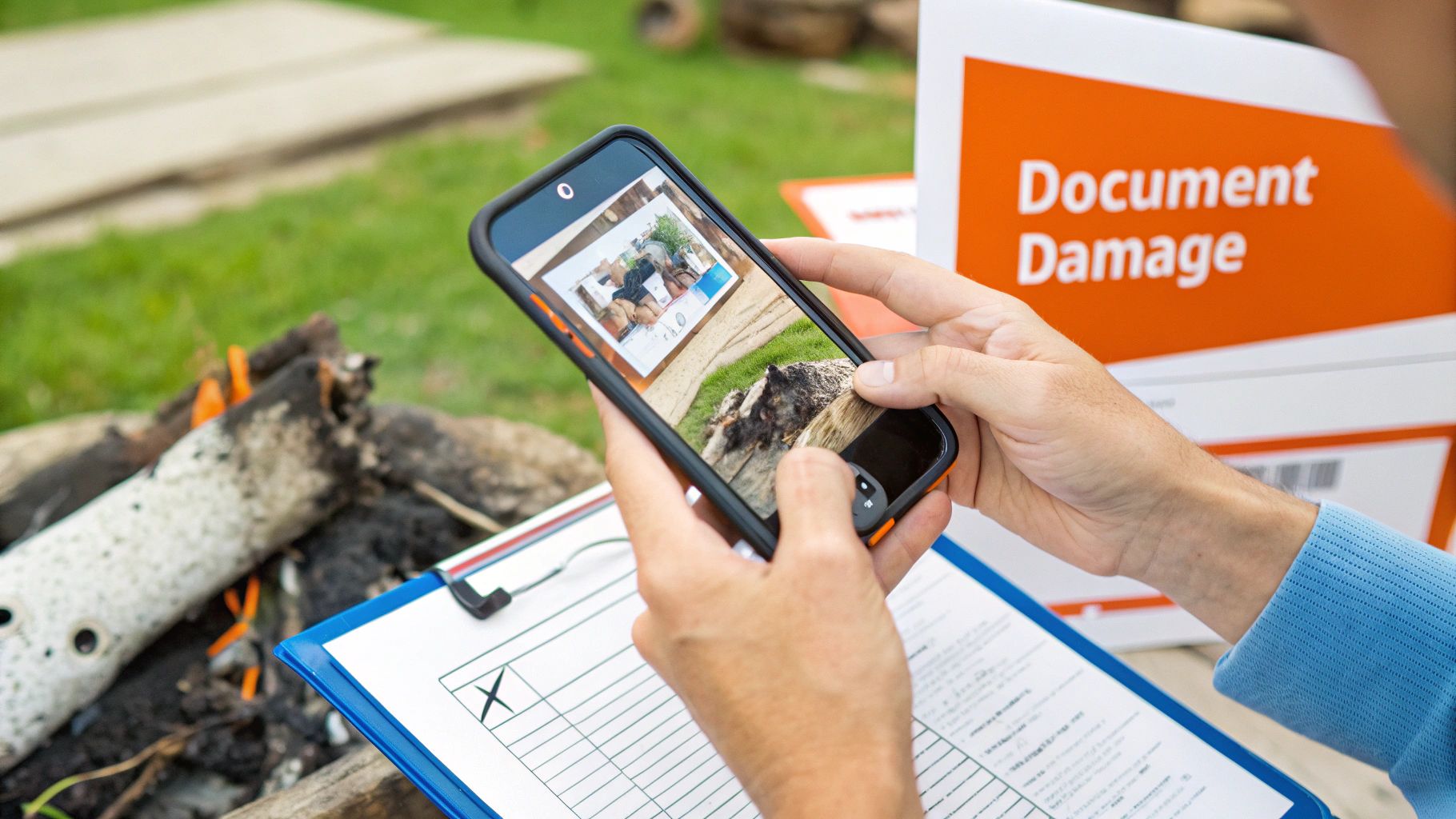
After the initial shock of a fire subsides, your path to recovery hinges on one critical task: documentation. A well-documented insurance claim is a successful one. It provides your adjuster with the clear, undeniable proof required to process your settlement fairly and without unnecessary delays.
This methodical approach does more than strengthen your financial position; it also gives you a structured way to process what’s happened during an incredibly emotional time.
Before you touch or move a single item (and only after professionals have given the all-clear to enter), grab your smartphone. It is now your most important tool. Go through every room and capture absolutely everything with photos and video.
Don't just take wide shots. Get close-ups. Show the melted plastic, the soot on the walls, and the water damage from fire hoses. Open cabinets and drawers to document the smoke damage that seeped inside. This visual record is your baseline, proving the condition of your home and belongings immediately after the fire. A continuous video where you walk through the house and narrate what you’re seeing can be incredibly powerful for your claim.
Creating a Detailed Home Inventory
Once you have your photos and videos, it’s time to create an inventory of everything that was damaged or destroyed. While this sounds like a monumental task, breaking it down room by room makes it manageable.
For help with this, you can use a detailed guide for creating a home inventory. For each item, you’ll want to list:
- Item Description: Be specific. Note the brand name, model, and any unique features.
- Age of the Item: Provide your best estimate.
- Original Cost: If you have receipts or credit card statements, that's ideal. If not, a reasonable estimate is sufficient.
- Estimated Replacement Cost: Research what it would cost to buy a similar new item today.
This detailed list is absolutely essential. Consider this: fire departments in the U.S. respond to a fire every 23 seconds, and a home fire is reported roughly every 95 seconds. The sheer frequency of these events demonstrates why having an organized, buttoned-up claims process is so important.
Understanding Key Insurance Terms
As you build your inventory, you’ll encounter two very important insurance concepts: Replacement Cost Value (RCV) and Actual Cash Value (ACV). The difference directly impacts your final settlement, so it’s crucial to understand what they mean.
Replacement Cost Value (RCV) is what it would cost to replace a damaged item with a new, similar one at today's prices. Actual Cash Value (ACV) is that replacement cost minus depreciation for age and wear.
Most policies will pay out the ACV first. You only receive the remaining funds (the depreciation) after you’ve actually bought the replacement item and sent the receipt to your insurance company.
This is why keeping meticulous records of every single purchase you make during the rebuilding process is non-negotiable. If you need more clarification on terms like these, you can always explore our frequently asked questions page. Your detailed inventory, combined with a clear understanding of these terms, gives you the power to advocate for the full value you're owed.
Sorting Through Belongings and Addressing Soot Damage
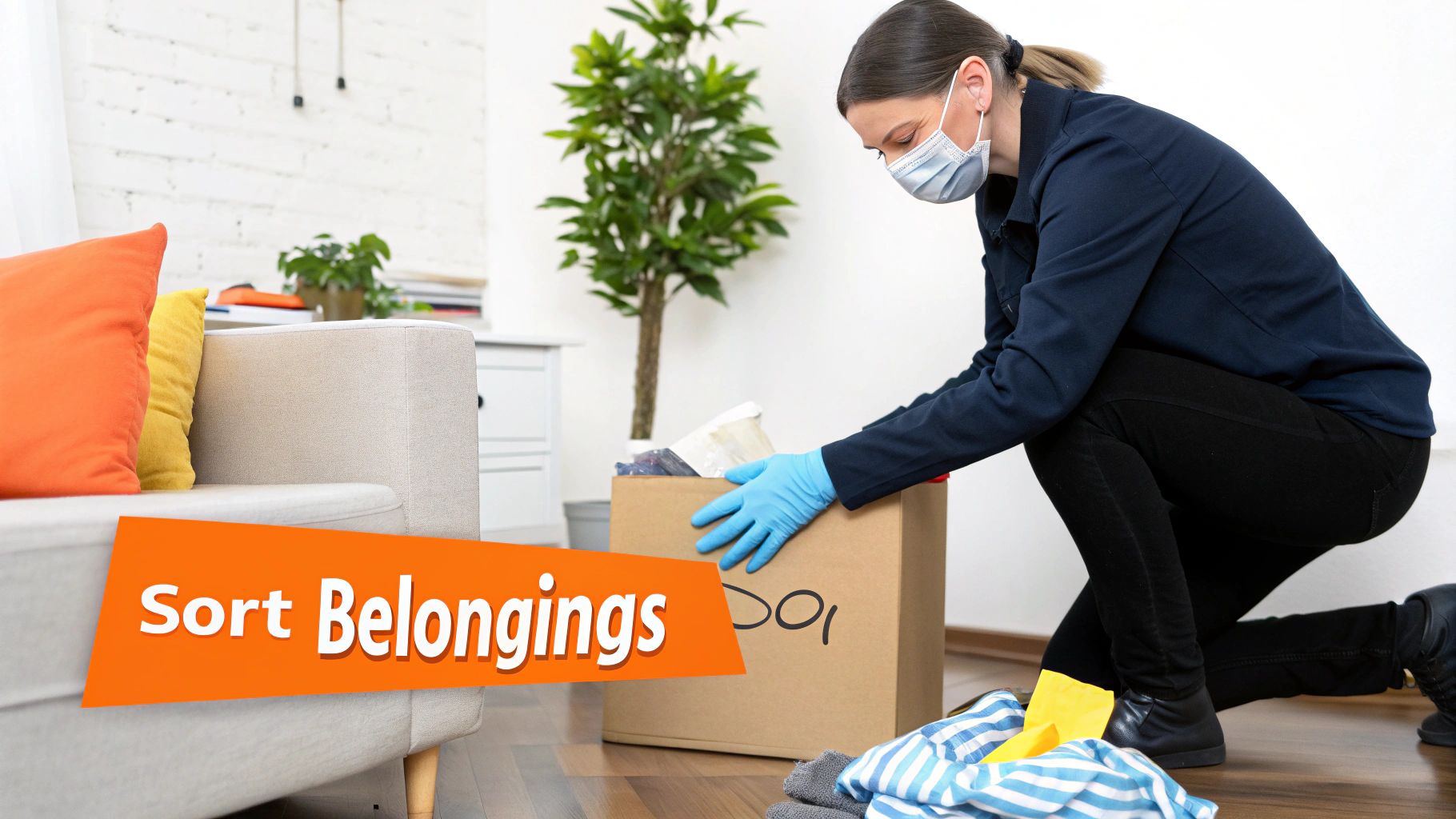
Walking back into your home to sort through what remains is, for most people, the hardest part of this ordeal. It's a gut-wrenching collision of memories and harsh reality. The key to getting through it is understanding what can realistically be saved and what poses a danger.
A common mistake is assuming that if something didn't burn, it's fine. The real enemy is often invisible. Soot and smoke residue aren't just messy; they are acidic and corrosive, often laced with toxic chemicals that eat away at surfaces over time.
These microscopic particles work their way deep into porous materials—fabric, wood, drywall—making any DIY cleanup attempt both unsafe and largely ineffective. That stubborn smoky smell is the signature of volatile organic compounds (VOCs) that have settled on everything and will continue to off-gas for weeks, if not months. This is why a professional assessment isn't an upsell; it's a critical step for your family's health.
Making Smart Salvage Decisions
When it's time to decide what stays and what goes, you must approach it with a clear, strategic mindset. Non-porous items like metal, glass, and some hard plastics have the best chance of being fully restored by a professional. Porous items are a completely different story.
To help you get a quick sense of what you're dealing with, here's a simple guide we use to help homeowners make initial assessments.
Item Salvageability Guide After a Fire
This table provides a starting point for categorizing your belongings, but always defer to a professional's on-site evaluation for a final determination.
| Item Type | Salvage Potential | Recommended Action |
|---|---|---|
| Hard Surfaces (Metal, Glass) | High | Can often be professionally cleaned and deodorized. |
| Hardwood Furniture | Medium | May be restorable by a specialist if smoke and soot damage is not too deep. |
| Upholstered Furniture | Low | Soot, water, and odors penetrate deeply, making full restoration nearly impossible. |
| Clothing & Textiles | Medium | Specialized cleaning processes can sometimes remove smoke, but success varies. |
| Electronics | Low | Corrosive soot gets inside vents, causing short circuits and long-term failure. |
| Food & Medicine | Very Low | Discard everything, including canned goods. Heat can compromise seals and cause spoilage. |
These decisions feel incredibly final, but you must prioritize safety over sentimentality right now. Contaminated items, especially soft goods like mattresses, pillows, and stuffed animals, can harbor harmful residues and pose long-term health risks if not handled by certified technicians.
The Role of Certified Contents Cleaning
For those irreplaceable items that might have a chance—heirlooms, important documents, artwork—it’s time to bring in the professionals. IICRC-certified contents cleaning specialists use technology and techniques that are worlds apart from anything you could do at home.
These advanced methods often include:
- Ultrasonic Cleaning: Using high-frequency sound waves to gently dislodge soot from intricate items like jewelry, collectibles, or window blinds.
- Ozone Treatment: A powerful gas-based process that penetrates materials to neutralize smoke molecules at their source, effectively killing the odor.
- Specialized Drying Chambers: These carefully control temperature and humidity to save water-damaged papers, books, and precious photos without causing more harm.
The purpose of professional contents restoration isn’t just to make things look clean. It's about ensuring they are truly safe to bring back into your living space. It’s a painstaking process that safeguards both your belongings and your well-being.
Trying to eliminate a pervasive smoke odor with store-bought sprays is a losing battle. To understand why, you can learn more about professional fire damage odor removal services. As a firm holding IICRC Master Certifications, we have the expertise and technology to determine what's truly salvageable, helping you make the right calls during this critical time.
Choosing Your Fire Damage Restoration Partner
Hiring the right team is the single most important decision you'll make for your home's recovery. This goes far beyond simple cleanup. You're entrusting your biggest asset to experts who must navigate everything from emergency board-ups to the final coat of paint. In Orange County, the stakes are high, and your choice of partner will directly impact the quality, timeline, and stress level of the entire ordeal.
Do not let anyone rush this decision. While your insurance company might provide a list of "preferred vendors," you are never obligated to use them. Your first priority is finding a company whose credentials, experience, and ethics align with your standards.
The Credentials That Truly Matter
Not all restoration companies are created equal. You need a team with specific, dual expertise: certified restoration science and licensed general contracting. This combination is critical because it ensures they can not only clean up the damage but also expertly rebuild your home from the ground up.
Here’s what you should be looking for:
- IICRC Master Certification: This is the pinnacle of certification in the restoration industry. An IICRC Master Fire & Smoke Restorer has proven comprehensive knowledge in damage assessment, soot removal, odor control, and structural restoration.
- Licensed General Contractor: A California General Contractor's license is non-negotiable. It is required by law and proves the company is legally qualified to perform structural repairs and major remodeling, ensuring all work meets local building codes in places like Newport Beach and Irvine.
A company holding both credentials, like Sparkle Restoration Services, can manage the entire project from start to finish. This eliminates the headache and finger-pointing that comes from hiring separate contractors for mitigation and reconstruction. Our integrated approach to fire damage restoration in Orange County means a smoother, faster, and higher-quality recovery for you.
Critical Questions to Ask Potential Partners
Before signing a contract, you must conduct a thorough interview. Any reputable company will welcome your questions and provide direct answers. To ensure you're hiring a credible and effective service, it's vital to know the essential questions to ask a fire damage restoration contractor.
Arm yourself with these critical questions:
- Are you both IICRC Master Certified and a licensed General Contractor in California?
- Can you provide local references and show me examples of similar fire damage projects you’ve completed in Orange County?
- Who will be my dedicated project manager, and how will we maintain communication?
- How do you handle the cleaning and storage of our salvageable belongings?
- What is your process for working with my insurance adjuster to agree on the scope of work?
Pay close attention to how they answer. A confident, professional team will provide clear, direct responses. If you receive vague answers, high-pressure sales tactics, or a demand for a large upfront payment, consider those major red flags and walk away.
Choosing your restoration partner is about finding a team you trust to restore not just your property, but also your peace of mind. As a BBB Torch Award Winner for Ethics, Sparkle Restoration Services is built on a foundation of transparency and top-tier craftsmanship, ready to turn the chaos of a house fire into the calm of a beautifully restored home.
Your Top Fire Recovery Questions Answered
When you’re reeling from a house fire, your mind is likely racing with a thousand questions. It's a chaotic and stressful time, and getting clear, straightforward answers is one of the first steps toward regaining control.
We've been helping Orange County homeowners navigate this process for decades, and we hear the same concerns time and time again. Here are our expert answers to the questions that are likely on your mind.
How Long Does Fire Restoration Take?
This is the most common question, and the honest answer is: it depends. The timeline for returning to your home can vary dramatically.
A small, contained kitchen fire might take only a few weeks to restore. However, a major fire with serious structural damage will have a longer recovery road. If extensive reconstruction is needed in a city like Irvine or Newport Beach, you must factor in architectural plans, engineering, and city permits, which could stretch the project to several months.
The schedule ultimately depends on a few key variables:
- The Extent of Damage: This is the primary factor. We must assess the combined impact of fire, smoke, and water damage.
- Insurance Claim Process: How quickly your insurance carrier approves the scope of work and releases funds can impact the start of reconstruction.
- Permitting: Navigating the permitting process with your local city for any structural repairs can add weeks, or even months, to the timeline.
A professional restoration expert will provide a detailed project schedule after a thorough inspection so you are never left guessing.
Should I Try to Clean Up the Soot Myself?
Absolutely not. We cannot stress this enough: avoid any DIY cleanup of soot and smoke. This isn't like dusting your shelves. Soot is a hazardous mixture of acidic, toxic particles that pose a real health risk. Inhaling it can cause significant respiratory problems, and even skin contact can lead to irritation.
Furthermore, attempting to clean it with the wrong products almost always backfires. You can accidentally drive soot deeper into porous surfaces like drywall, wood, and furniture, making professional cleaning more difficult and more expensive.
Our certified technicians use specialized equipment like HEPA vacuums and industrial air scrubbers, all while wearing OSHA-approved personal protective equipment (PPE). It’s the only way to safely remove contaminants and restore the air quality in your home to a healthy state.
Is Restoration the Same as Remodeling?
That’s an excellent question, and there's a crucial difference.
Fire restoration is a highly technical process focused on one goal: returning your home to its pre-loss condition. Think of it as hitting the "undo" button. Our job is to clean, repair, or replace everything damaged by the fire, smoke, and water to make your home exactly as it was before the incident.
Remodeling, on the other hand, is about making intentional changes and upgrades. Since walls might be open and fixtures already removed during restoration, it often presents a silver-lining opportunity. This could be the perfect moment to finally create that open-concept kitchen or design the luxury master bathroom you've always wanted.
As a firm that is both an IICRC Master Certified Restorer and a Licensed General Contractor, we handle both seamlessly. We can restore your home and, if you choose, help you seize the opportunity to build it back even better than before.
The journey to recovery after a fire can feel like a mountain to climb, but you don’t have to do it alone. Since 2002, Sparkle Restoration Services has been the team Orange County homeowners trust to bring order back from chaos.
If you’re facing the aftermath of a fire, contact us. We’ll provide a clear, comprehensive assessment and a solid plan to move forward.
Schedule Your Free Consultation and Damage Assessment Today
Ready to create a space that’s as beautiful as it is functional? Schedule your complimentary design consultation today by visiting Ready to Work with Sparkle?