



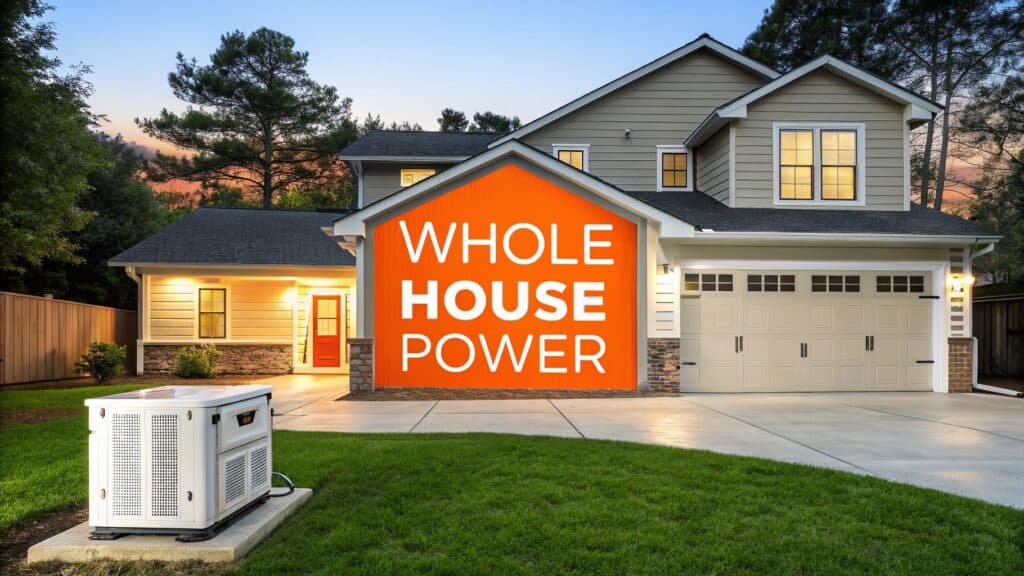
For discerning homeowners in Orange County, a whole house generator installation is not just about convenience—it’s an essential investment in home security and continuity. When unpredictable power outages or rolling blackouts occur, your home seamlessly transitions to its own private power source. Lights stay on, security systems remain active, and your daily life continues without interruption. At Sparkle Restoration Services, we specialize in turning the potential chaos of a power loss into a calm, controlled experience.
Why Whole House Generators Are a Smart Upgrade for Orange County Homes
In Southern California, a stable power supply is the backbone of our modern lifestyle. A sudden outage can disrupt more than just the lights; it can:
- Bring work-from-home operations to a complete stop
- Disable critical security cameras and smart home systems
- Risk permanent damage to sensitive, high-end electronics
A professionally installed standby generator acts as your personal power grid, ensuring everything from your HVAC system to your home office operates flawlessly. As a licensed General Contractor and IICRC Master Certified firm, Sparkle Restoration delivers the expertise needed to safeguard your property with a reliable power solution.

Beyond Convenience: The Core Benefits of Uninterrupted Power
When the grid fails, a standby generator provides more than just comfort—it delivers comprehensive protection for your home and family.
- Protecting Your Valuables: Clean, stable power shields computers, entertainment systems, and smart appliances from the damaging effects of power surges and abrupt shutdowns.
- Maintaining Home Security: Your cameras, alarms, and automated locks remain fully operational, ensuring your property is never left vulnerable.
- Ensuring Health and Safety: For those relying on medical equipment like CPAP machines or refrigerated medications, continuous power is non-negotiable and provides invaluable peace of mind.
The growing demand for this resilience is clear. The residential generator market, valued at $8.8 billion in 2024, is projected to reach $14.8 billion by 2032, reflecting a widespread commitment among homeowners to secure their energy independence.
Real-World Scenarios in Orange County
Imagine a blistering summer heatwave in Irvine. The statewide grid is strained, and rolling blackouts are announced. While neighbors contend with the heat and uncertainty, your air conditioning continues to run, your food remains safely preserved, and your day proceeds as planned.
“A whole house generator doesn’t just restore power; it restores normalcy within seconds, turning chaos into calm.”
Extended power outages can also lead to secondary damage, such as flooded basements from a failed sump pump or food spoilage. For homeowners weighing their options for backup energy, reviewing a variety of Home Backup Power Solutions can offer insights into solar, batteries, and hybrid systems.
Choosing the Right Generator for Your Orange County Home
Selecting the right generator is the most critical decision in your whole house generator installation journey. The goal is to invest in a system that aligns perfectly with your lifestyle, whether you need to power your entire Newport Beach estate during a heatwave or simply keep essential circuits active in your Irvine home.
The process begins with a professional assessment of your specific power requirements. A common misstep is underestimating the home's total electrical load, which results in an undersized unit that fails when you need it most. Our client-focused approach ensures this won't happen.
Calculating Your Power Needs
A professional load calculation is essential for a successful outcome. This is a technical analysis that goes beyond simply listing your appliances; it accounts for the significant starting wattage (inrush current) required by large systems like your air conditioner, well pump, or pool equipment.
An expert from our team, a licensed General Contractor, will consult with you to determine the best solution for your needs, which typically falls into one of three categories:
- Essential Circuits Only: This approach powers critical systems: your refrigerator, key lighting, security, and any necessary medical devices.
- Managed Whole-House Power: A popular, intelligent solution that powers most of your home. It uses smart power management modules to prevent overloads by prioritizing electricity allocation to different appliances.
- Complete Whole-House Power: The premier option, allowing you to live without compromise during an outage. This system is sized to run everything simultaneously, from your oven to your home theater.
Comparing Fuel Types for Southern California
Your generator's fuel source is another critical choice that impacts cost, maintenance, and convenience. In Orange County, there are three primary options to consider.
Your generator's fuel is its lifeline. Choosing the right one for our local area ensures your system is always ready to perform, whether the outage lasts for an hour or a week.
During a whole house generator installation, the fuel type decision requires careful consideration of your property's infrastructure and your desire for independence from the grid.
Generator Fuel Type Comparison for Southern California Homes
| Fuel Type | Pros | Cons | Best For |
|---|---|---|---|
| Natural Gas | – Unlimited fuel supply (no refueling) – Quieter operation – Lower emissions | – Requires an existing utility gas line – May be unavailable during earthquakes – Lower power output than diesel | Homeowners in established neighborhoods with reliable utility access who prioritize convenience and low maintenance. |
| Liquid Propane (LP) | – Stored on-site, independent of utility grid – Longer shelf life than diesel – Cleaner burning than diesel | – Requires a large storage tank – Tank needs periodic refilling – Fuel delivery can be an issue in disasters | Properties without natural gas access or for homeowners who desire complete energy independence from the grid. |
| Diesel | – Most power-dense and fuel-efficient – Extremely reliable and durable – Widely available fuel source | – Louder operation – Higher emissions and smell – Fuel requires stabilizers and can degrade | Larger luxury estates with very high power demands or for those who require the most robust backup solution available. |
Ultimately, the right fuel depends on your property, budget, and local availability.
In the $7.82 billion residential generator market of 2024, diesel generators command a significant 48.2% market share. While often used commercially, this highlights their power and reliability for high-demand applications. You can find more details on the residential generator market on futuremarketinsights.com.
For most homeowners in our service area, natural gas is the most convenient choice, providing a continuous fuel supply without the need for storage tanks or refueling. Propane offers an excellent alternative for true grid independence.
As a licensed General Contractor, Sparkle Restoration possesses the expertise to guide you through these decisions, ensuring your whole house generator installation is perfectly tailored to your home and lifestyle.
Navigating Orange County Permits and Regulations
A successful whole house generator installation is built on a foundation of safety and compliance. For homeowners across Orange County, from Newport Beach to Irvine, navigating local building codes and permitting is a non-negotiable step. This process ensures your system is safe, reliable, and legally installed.
Permits are not bureaucratic hurdles; they are your assurance of quality and safety. An unpermitted installation can create significant fire and electrical hazards, void your homeowner's insurance policy, and create complications when selling your home.
Why Permits Are Essential
A generator installation is a complex project involving licensed electrical work, gas line plumbing, and often structural concrete work. Each trade requires a separate permit and inspection to verify that the work meets stringent city and state safety standards.
This is precisely why partnering with a licensed General Contractor is paramount. A reputable firm like Sparkle Restoration understands the specific requirements of each municipality and manages the entire permitting process on your behalf.
"Proper permitting is the line between a professional, secure installation and a dangerous liability. As a BBB Torch Award winner for ethics, we handle every detail with integrity, so our clients have total peace of mind."
We believe in complete transparency. As a company that proudly showcases its credentials, we invite you to view our CSLB license information and see for yourself what it means to work with a fully accredited, trustworthy team.
The Typical Permitting Workflow
While specifics vary by city, the permitting process follows a clear path. When you partner with Sparkle Restoration Services, our team manages this entire workflow, transforming a potentially stressful task into a seamless part of your project.
Here is what you can expect:
- Plan Submission: Our team prepares detailed plans, including electrical diagrams, site placement specifications, and gas line schematics, and submits them to your local building department for review.
- Permit Issuance: Once the city's plan checkers approve the designs, they issue the required permits, officially authorizing the work to commence.
- Scheduled Inspections: A city inspector will visit your property at key milestones—such as after the concrete pad is poured or once main electrical connections are made—to ensure all work complies with the approved plans and local codes.
- Final Inspection and Approval: After the generator is fully installed and commissioned, a final inspection is scheduled. Passing this inspection confirms your whole house generator installation is 100% compliant, safe, and officially complete.
The Professional Installation Process Explained
With permits secured, the physical work of your whole house generator installation begins. This is where skilled craftsmanship and technical expertise converge to create a reliable backup power system. Our process is meticulous and transparent, prioritizing safety at every stage.
This is far more than setting a box next to your house; it's a sophisticated integration into your home’s most critical systems. As your licensed General Contractor, we oversee every detail, from the foundation to the final electrical tie-in, ensuring excellence from start to finish.
Site Preparation and Foundation
Our first on-site task is preparing the optimal location for your generator. The placement is strategically chosen to comply with local codes for clearance from windows, vents, and property lines, ensuring both safety and noise mitigation.
We then pour a reinforced concrete pad, an engineered foundation designed to support the generator's weight and dampen operational vibrations. This ensures smooth, quiet performance and longevity. A substandard foundation is a shortcut that inevitably leads to premature wear and tear.
Fuel and Electrical Connections
Once the generator is securely mounted, our certified technicians execute the critical utility connections. For natural gas models, safely and correctly installing natural gas lines is a specialized skill performed by our licensed plumbers, guaranteeing a leak-free, reliable fuel supply.
Simultaneously, our electricians install the heart of the system. They run heavy-gauge electrical conduit from the generator to your home’s main electrical panel, making every connection with meticulous care to eliminate electrical hazards. The global whole house generator market is projected to grow at a CAGR of nearly 7% through 2033, driven by increasing power grid instability and homeowner demand for this level of reliability.
This integrated approach is the hallmark of our work, similar to our luxury design-build services, where we seamlessly blend new technology with your home's existing infrastructure.
The Automatic Transfer Switch: The Brain of the Operation
The most critical component we install is the Automatic Transfer Switch (ATS). This device is the intelligent command center of your entire backup power system.
The ATS continuously monitors the power coming from the utility grid. The instant it detects an interruption, it performs two functions simultaneously:
- It safely disconnects your home from the utility grid to prevent dangerous "back-feeding," which could endanger utility workers.
- It signals the generator to start and then smoothly transfers your home's electrical load to the generator's power.
This entire sequence occurs automatically within 10 to 20 seconds—you don’t have to do a thing. When utility power is restored and stable, the ATS switches your home back to the grid and signals the generator to cool down and return to standby mode.
This infographic provides an overview of the crucial planning and permitting stages that occur before our team arrives on-site.
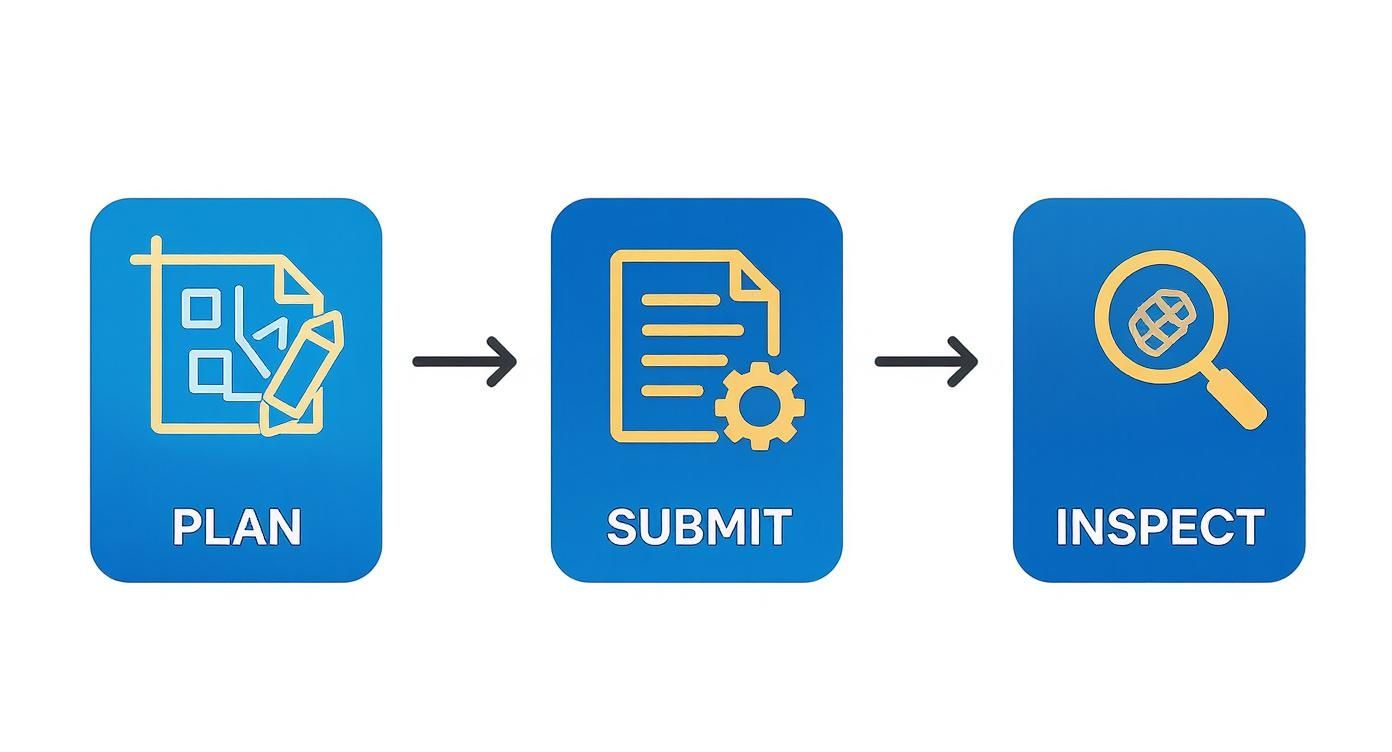
As you can see, a successful installation begins long before a shovel hits the ground. Proper planning, professional permitting, and passing all inspections are the true foundation of a reliable system.
Keeping Your Generator Ready for Anything
You've made a significant investment in your home's security and your family's comfort with a whole house generator. Like any high-performance piece of equipment, it requires routine maintenance to ensure it performs flawlessly the moment it’s needed. Proactive care is the key to protecting that investment.
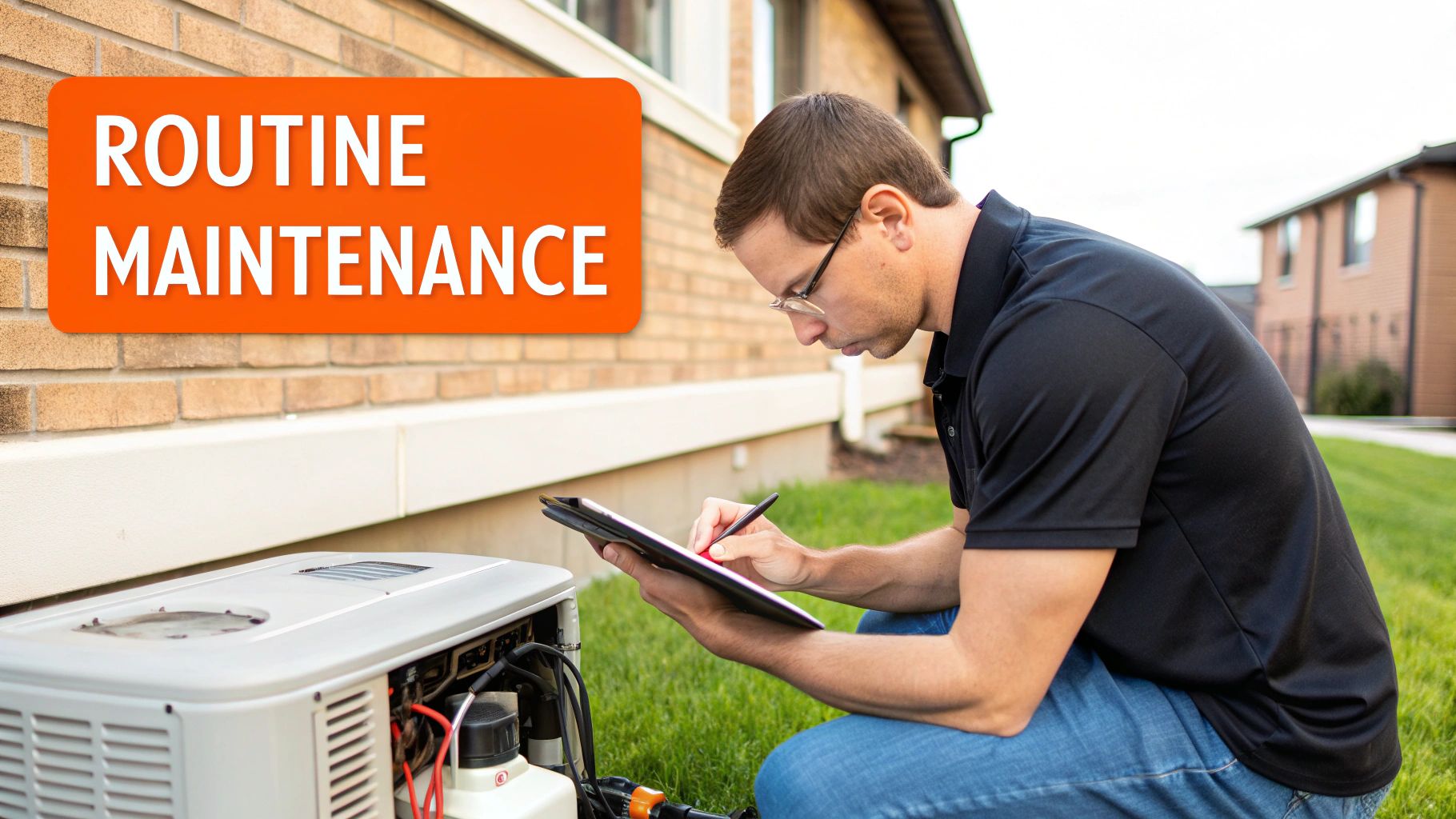
Fortunately, modern standby generators are designed for low-maintenance ownership. Most units perform a weekly self-test, running for about 10-15 minutes to circulate engine oil and verify that all mechanical and electrical systems are operational. This provides a baseline of confidence that your system is ready.
As a homeowner, your role is simple but important: keep the area around the generator clear of leaves, shrubs, and any obstructions that could impede airflow. This simple habit prevents overheating and ensures easy access for professional servicing.
The Critical Role of Professional Servicing
While automated tests and a clear perimeter are excellent first steps, they are no substitute for professional annual service. This is a comprehensive system check-up, allowing a certified technician to identify and address minor issues before they become major failures during an emergency.
"Annual professional maintenance is the single most effective way to ensure your generator starts instantly and runs efficiently when you need it most. It's not just a recommendation; it's essential for long-term reliability and performance."
Our IICRC Master Certified technicians follow a meticulous checklist designed to keep your unit in peak condition. This is a comprehensive diagnostic and preventative maintenance appointment, not just a quick inspection.
Annual Generator Maintenance Checklist
Understanding what occurs during a professional service call helps illustrate its value. This checklist outlines typical tasks, differentiating between homeowner responsibilities and those requiring an expert's touch.
| Maintenance Task | Frequency | Performed By (DIY or Pro) | Purpose |
|---|---|---|---|
| Clear Debris Around Unit | Monthly | DIY | Ensures proper airflow and prevents fire hazards. |
| Check for Warning Lights | Weekly | DIY | Alerts you to any system faults detected during self-tests. |
| Change Engine Oil & Filter | Annually | Pro | Prevents engine wear and ensures smooth operation. |
| Replace Air & Fuel Filters | Annually | Pro | Guarantees clean fuel and air intake for optimal combustion. |
| Inspect Spark Plugs | Annually | Pro | Ensures reliable engine startup and efficient performance. |
| Test Battery & Connections | Annually | Pro | Confirms the starting battery is strong and free of corrosion. |
| Perform Load Bank Test | Annually | Pro | Simulates a real power outage to verify the generator can handle a full electrical load. |
The load bank test is particularly crucial, as it is the only way to confirm your generator can perform under the real-world stress of powering your home. This proactive approach to maintaining your whole house generator installation ensures that when the lights go out in your Orange County neighborhood, yours will be the one that stays on.
Common Questions About Generator Installation
Deciding on a whole house generator installation is a major step toward ensuring your family’s comfort and security. As Orange County's trusted restoration and remodeling experts, we have addressed nearly every question from homeowners evaluating their options. Here, we provide clear, straightforward answers to help you move forward with confidence.
Our goal is to resolve any remaining questions you may have. We believe an educated client is an empowered and confident one.
How Loud Are Modern Generators?
This is often the primary concern for homeowners. Fortunately, the era of noisy, disruptive generators is over. Today's residential standby units are engineered for quiet operation, housed within sound-dampening enclosures and equipped with advanced low-noise engines.
A quality modern generator operates at a sound level between 60 and 70 decibels—roughly equivalent to a central air conditioning unit. As part of our client-focused installation process, we strategically place the unit to further minimize sound impact, ensuring that all you notice during an outage is a feeling of security, not a noisy distraction.
How Long Does The Installation Take?
From our initial consultation to the final city inspection, a typical whole house generator installation takes approximately one to three weeks. The precise timeline depends on several factors:
- Permitting Times: Each municipality in Orange County has its own schedule for reviewing and approving plans.
- Site Complexity: Properties requiring more extensive site preparation, such as a new concrete pad or longer utility runs, may take longer.
- Equipment Availability: Lead times for specific generator models can occasionally influence the project start date.
As a full-service General Contractor, we manage every one of these variables. We maintain clear communication throughout the project, ensuring a smooth and predictable process for you.
We believe a well-informed client is a confident client. Our process is designed to be transparent, turning the complexities of an installation into a stress-free project that protects your home and lifestyle.
Will a Generator Increase My Home Value?
Absolutely. In Southern California, where power grid reliability is an increasing concern, a whole house generator is a powerful selling feature for discerning homebuyers. It signals that a home is secure, well-maintained, and prepared for any eventuality.
A professionally installed system is considered a premium upgrade that significantly enhances a property's appeal and market value. It is an investment in your home’s resilience that delivers peace of mind now and a tangible return later. If you have more questions about home improvement and maintenance, we invite you to explore our comprehensive FAQ page.
Ready to ensure your Orange County home is protected from power outages? The experts at Sparkle Restoration Services are here to design and install the perfect backup power solution tailored to your needs. As a BBB Torch Award winner for ethics and an IICRC Master Certified firm, we are committed to excellence. Contact us today for a complimentary consultation and experience the peace of mind that comes with being prepared.
Schedule Your Free Consultation with Sparkle Restoration Services
Ready to create a space that’s as beautiful as it is functional? Schedule your complimentary design consultation today by visiting Ready to Work with Sparkle?