


Knowing how to prepare for a natural disaster boils down to three key areas: establishing a robust family communication plan, assembling both immediate “Go-Bags” and comprehensive home survival kits, and fortifying your property against the specific threats we face in Southern California. This structured approach transforms overwhelming “what-ifs” into a confident, actionable plan that protects your family and your most valuable asset.
Your First Steps in Disaster Preparedness
The thought of a major disaster hitting Southern California can be daunting, but effective preparation begins with a few fundamental, manageable steps. As an IICRC Master Certified firm and a licensed general contractor serving Orange County, we’ve seen firsthand how proactive planning can dramatically alter outcomes. This guide isn’t about creating fear—it’s about building resilience and ensuring you have peace of mind.
This framework will provide a clear, step-by-step process to protect your family and your home, focusing on three core pillars:
- Family Communication Plan: Determining how you’ll connect with loved ones when standard methods like cell service fail.
- Smart Survival Kits: Assembling practical kits for both immediate evacuation and sheltering in place.
- Home Fortification: Strengthening your property against regional threats like earthquakes and wildfires.
By taking these steps, you create a buffer against the unexpected. It’s how you turn potential chaos into calm, controlled action when every second counts.
Why Proactive Planning Matters in Orange County
Here in Orange County, we live with the real possibility of earthquakes, wildfires, and severe storms that can cause significant flooding. Waiting for an official warning is almost always too late. Nationally, the threat is clear: in 2024 alone, there were 27 separate billion-dollar disasters across the U.S. This is a powerful reminder that preparation is not optional. The goal is to build a “muscle memory” for safety, enabling you to react with confidence rather than panic.
At Sparkle Restoration, our experience has shown that the best recovery starts long before a disaster ever strikes. A well-prepared home not only withstands the event more effectively but also streamlines the insurance and restoration process, helping you return to normal much faster.
Foundational Actions for Every Property Owner
Your journey to preparedness begins with a few simple but crucial actions. It is wise to start by securing your home against common vulnerabilities. This goes beyond major projects like seismic retrofitting or brush clearance—it also means addressing everyday risks that can be amplified by a disaster.
For example, protecting your home from water intrusion is critical. A small, ignored leak can become catastrophic during a heavy storm. A great place to start is by learning how to make your home leak-proof, which builds a strong foundation for your overall disaster readiness.
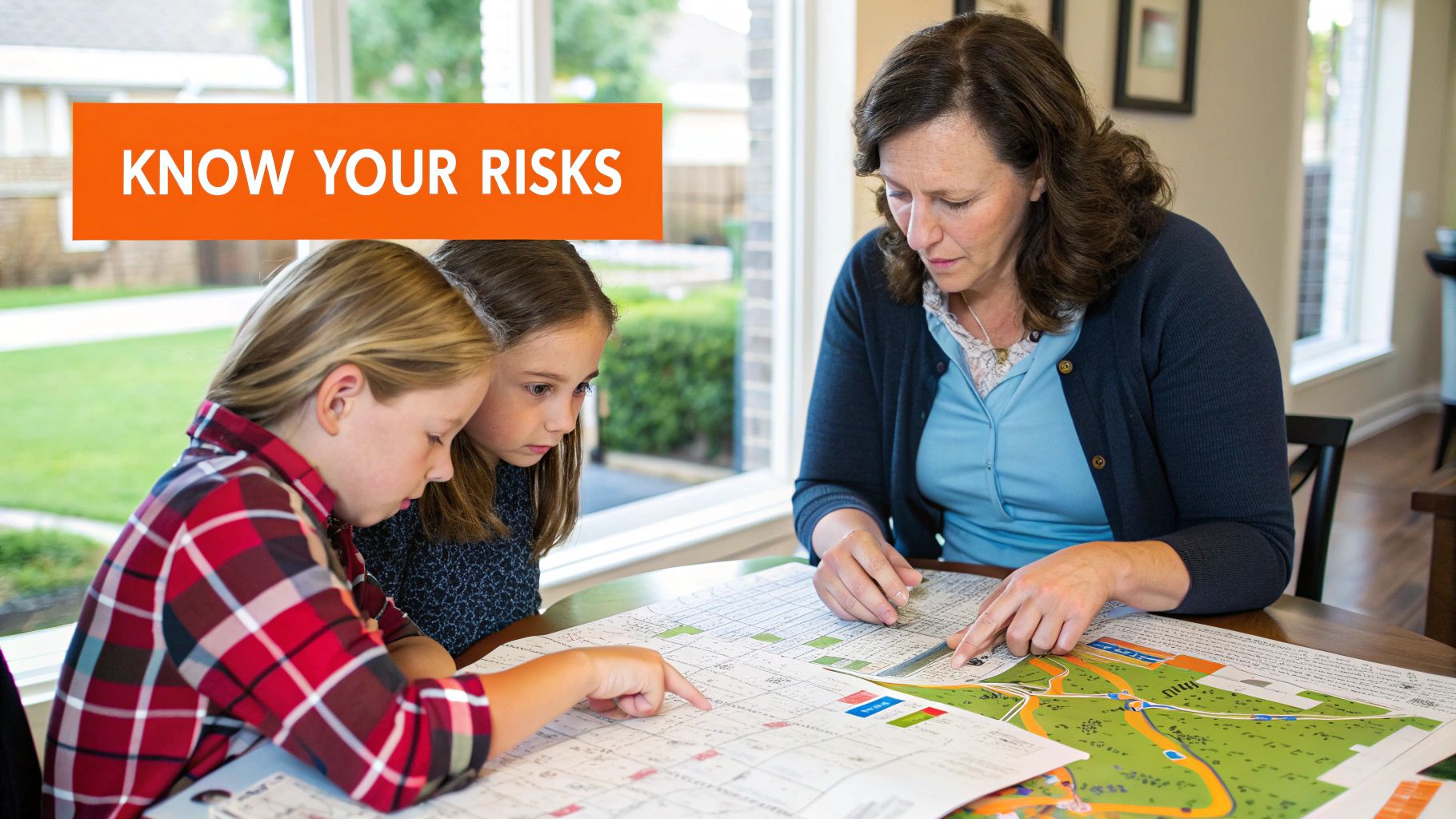
Next, turn your focus to your family’s immediate needs. Create an emergency plan that everyone, including children, understands and has practiced. Consider assigning specific roles: Who grabs the emergency kits? Who is in charge of pets? Who is the designated out-of-state contact for check-ins? These details, seemingly small now, become invaluable in a real emergency.
Finally, begin gathering your supplies. Don’t feel pressured to build a perfect two-week kit all at once. Start with a 72-hour “Go-Bag” for each person in your household. It’s an achievable first step that provides an immediate layer of security. From there, you can methodically build your larger at-home supply cache. The most important thing is to start now.
Disaster Preparedness Quick-Start Checklist
Getting started is often the most challenging part. This simple checklist breaks down the most critical first steps into manageable actions you can take this week.
| Preparation Area | Key Actions | Why It’s Critical |
|---|---|---|
| Communication | Designate one out-of-state contact for everyone to call. | Local phone lines will be jammed. A long-distance contact is easier to reach. |
| Evacuation | Pack a 72-hour “Go-Bag” for each family member and pet. | You may need to leave with only minutes to spare. This bag has your essentials ready. |
| Home Safety | Learn how to shut off your home’s gas, water, and electricity. | Prevents fires from gas leaks and stops water damage after an earthquake or storm. |
| Information | Obtain a hand-crank or battery-powered emergency radio. | When power and internet are out, this is your only link to official updates. |
Tackling these four items will give you a significant head start and provide immediate peace of mind. It’s about taking control, one step at a time.
Creating Your Family Emergency Plan
When a crisis hits, a well-rehearsed plan is the single most valuable asset your family possesses. It is the tool that transforms chaos and confusion into calm, decisive action. Thinking through these scenarios now, during times of quiet, builds the muscle memory you’ll need to act effectively when it truly matters.

This is not about generic advice; it’s about building a detailed, personalized strategy for your household. The goal is to create a simple, clear playbook that covers communication, evacuation, and the specific roles each person will have.
Establishing Clear Communication Protocols
In the minutes and hours following a disaster, local communication networks are almost always the first to fail. Cell towers become overloaded and phone lines are cut, making it nearly impossible to reach family members, even those just across town. That’s why having a communication plan is non-negotiable.
The most reliable strategy is to designate a single out-of-state contact. This person becomes the central communication hub for your entire family. Why out-of-state? Because it’s often far easier to place a long-distance call than a local one during a regional emergency. Each family member simply needs to check in with that one person, who can then relay everyone’s status to the rest of the family.
A simple text message stating “I’m safe at [location]” is often more likely to get through than a voice call. Practice this with your family so it becomes an automatic response in a crisis.
Mapping Evacuation and Meeting Points
Knowing who to call is half the battle; knowing where to go is the other. Your plan needs multiple evacuation routes and two distinct types of meeting points to account for various disaster scenarios.
- Neighborhood Meeting Spot: This should be a close, unmistakable landmark right outside your immediate area—think the large oak tree at the corner park or the front steps of the local library. This spot is for sudden events, like a house fire, where you must get out quickly and regroup.
- Regional Meeting Spot: For larger disasters like a wildfire or an earthquake that forces an evacuation of the entire neighborhood, you need a backup location farther away. This could be a relative’s house in a neighboring city like Irvine or Newport Beach, or a well-known public building well outside the potential disaster zone.
When mapping your routes, do not rely solely on main roads. Identify at least two alternate ways to exit your neighborhood and two different paths to your regional meeting spot in case your usual route is blocked by debris or emergency vehicles.
Assigning Roles and Responsibilities
An effective emergency plan ensures everyone has a job. This simple step prevents panic and indecision, as each person can focus on their specific task. Assigning roles also empowers children, helping them feel like active participants in keeping the family safe.
Consider assigning these key roles:
- Go-Bag Coordinator: This person is responsible for grabbing the pre-packed emergency kits for everyone.
- Pet Wrangler: Their job is to secure the pets, their carriers, and their own go-bags.
- Documents Guardian: This person grabs the waterproof bag or portable safe containing all your important papers.
- Utilities Manager: An adult who knows how to shut off the gas, water, and electricity at the mains, but only if it is safe to do so and authorities advise it.
Practice makes perfect. Run through these roles in family drills at least twice a year. This builds the instinct to act quickly and calmly when under pressure.
Tailoring Your Plan for Orange County Threats
Different disasters require different responses. Here in Orange County, our primary threats are earthquakes, wildfires, and severe rainstorms that can trigger floods and mudslides. Your family’s plan must be flexible enough to handle each of these unique situations.
An earthquake, for example, typically means you shelter in place and check for structural damage. A wildfire warning, on the other hand, means you evacuate immediately. Discussing how these different weather patterns could affect your home is critical, as we’ve covered in our look at Orange County’s first rain storms of the year. A truly effective plan is one that accounts for these regional dangers, ensuring your family is ready for what’s most likely to come your way.
Building Your Go-Bags and Home Survival Kits
When an evacuation order is issued, you may only have minutes to react. This is the moment when your planning becomes a critical lifeline. A well-stocked survival kit is not a random collection of items; it’s your key to security and self-sufficiency, giving you a sense of control when everything else feels chaotic.
The key is to think in layers. You need two types of kits: a lightweight, portable “Go-Bag” for rapid evacuation and a much larger “Stay-at-Home” kit for sheltering in place. Each serves a distinct, vital role in your family’s safety plan.
The 72-Hour Go-Bag: Your Grab-and-Go Lifeline
Think of your Go-Bag as your emergency eject button. If you must leave your home at a moment’s notice, this is what you grab. Every member of your family needs one, including children and pets. The purpose is to have enough essentials to be self-sufficient for at least 72 hours.
Keep these bags where you can access them instantly—a closet by the front door or in the trunk of your car are ideal locations. The contents should be comprehensive yet light enough to carry.
What to pack in your Go-Bag:
- Water and Food: You’ll need one gallon of water per person for three days. Pack high-energy, non-perishable foods like protein bars, nuts, and dried fruit.
- First-Aid: A compact yet thorough first-aid kit is non-negotiable. For a detailed guide, check out our post on assembling a water emergency first aid kit.
- Light and Communication: Pack a hand-crank or battery-powered radio and a flashlight, plus extra batteries.
- Personal Items: A change of clothes, sturdy shoes, a week’s supply of prescription medications, spare eyeglasses, and essential hygiene items are a must.
- Important Documents: Keep digital copies of IDs, insurance policies, and bank records on an encrypted USB drive, and have physical copies in a waterproof bag.
Pro Tip: Use vacuum-sealed bags for clothing and documents. It not only makes them waterproof but also compresses everything, freeing up a surprising amount of space in your bag.
The Two-Week Stay-at-Home Kit: Your Shelter-in-Place Fortress
Sometimes, the safest course of action is to stay put, especially after a major earthquake that renders roads impassable. This is where your Stay-at-Home kit is essential. It is a much larger supply cache designed to sustain your family for up to two weeks without external assistance.

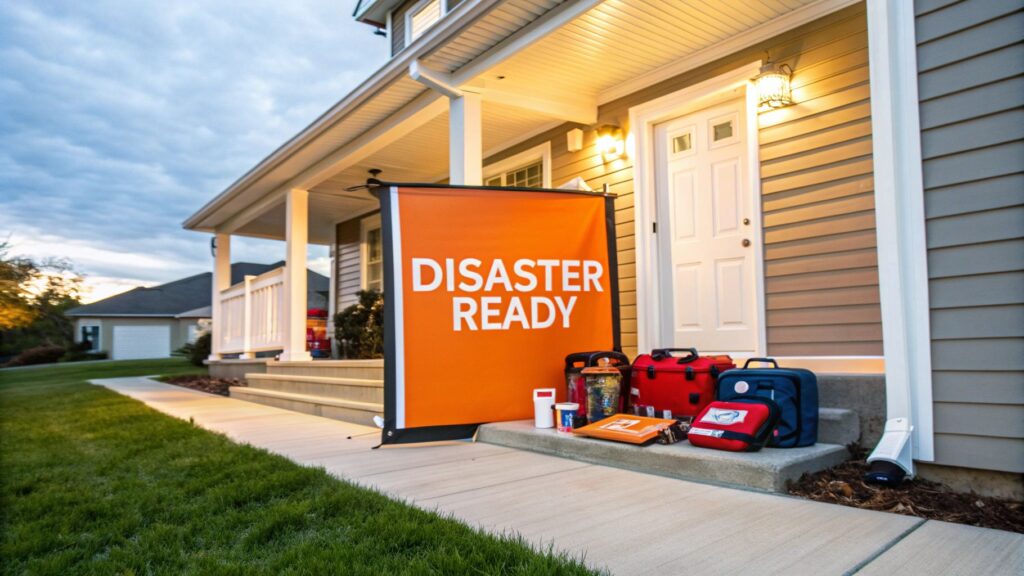
This image perfectly illustrates the foundational trio for any emergency kit: water, food, and tools. These three pillars are essential for surviving both the immediate and longer-term aftermath of a disaster.
Unlike a Go-Bag, this kit can be stored in your garage, basement, or a dedicated closet. Think of it as your family’s personal, self-sufficient mini-market.
Core components for your Stay-at-Home Kit:
- Water: The absolute golden rule is one gallon of water per person, per day. For a family of four, that means you need to store at least 56 gallons for a two-week supply.
- Food: Stockpile two weeks of non-perishable foods that are easy to prepare. Canned goods like soups, vegetables, and meats are excellent, as are staples like rice, pasta, and peanut butter. Don’t forget a manual can opener!
- Sanitation: Items such as moist towelettes, garbage bags with plastic ties, and a small bucket with a lid are crucial for personal sanitation.
- Tools and Safety: Have a fire extinguisher readily available, along with a wrench or pliers to shut off utilities. A whistle to signal for help is also a smart addition.
To make it clearer, let’s break down the key differences between these two essential kits.
Go-Bag vs. Stay-at-Home Kit Breakdown
| Item Category | Go-Bag (72-Hour Evacuation) | Stay-at-Home Kit (2-Week Supply) |
|---|---|---|
| Purpose | Immediate evacuation, portability is key | Sheltering in place, long-term self-sufficiency |
| Water | 1 gallon per person, for 3 days | 1 gallon per person, per day (14-day supply) |
| Food | Lightweight, high-energy (bars, nuts) | Canned goods, dry staples (rice, pasta) |
| Documents | Copies (digital & physical) | Originals in a fire/waterproof safe |
| Tools | Multi-tool, flashlight, radio | Wrench for utilities, fire extinguisher, axe |
| Clothing | 1-2 changes, sturdy shoes | Several changes for varied conditions |
| Sanitation | Travel-size toiletries, wipes | Full-size supplies, bucket toilet |
Understanding this distinction is crucial. Your Go-Bag gets you out the door fast, while your Stay-at-Home kit ensures you can ride out the storm safely where you are.
Keeping Your Kits Ready for Action
Assembling your kits is a significant first step, but the job isn’t finished. Maintenance is equally critical. Supplies expire, batteries lose their charge, and your family’s needs change over time.
We recommend setting a recurring calendar reminder—perhaps twice a year when the clocks change—to review your kits. Rotate out food and water, check expiration dates on medications, and test your batteries.
This ongoing commitment ensures that when you need your lifeline, it is ready for action. It’s a small investment of time that provides priceless peace of mind, turning potential panic into a calm, controlled response.
How to Fortify Your Home Against Disasters
Your home is your family’s fortress, and strengthening it before a disaster strikes is one of the most powerful investments you can make in your peace of mind. As a licensed general contractor and IICRC Master Certified restoration firm here in Orange County, we’ve seen the difference it makes firsthand. Proactive home fortification can drastically reduce damage and make recovery so much faster.
This isn’t just about massive, expensive projects. It’s about implementing smart, strategic upgrades that address Southern California’s unique threats—earthquakes, wildfires, and floods. These measures create a stronger line of defense, ensuring that when the unexpected happens, your home is as prepared as you are.
Preparing for Seismic Activity
Living in Southern California means living with the constant possibility of earthquakes. While we cannot prevent the ground from shaking, we can take decisive steps to minimize the damage inside and out. The primary goal is to secure anything that can fall, break, or rupture during a quake.
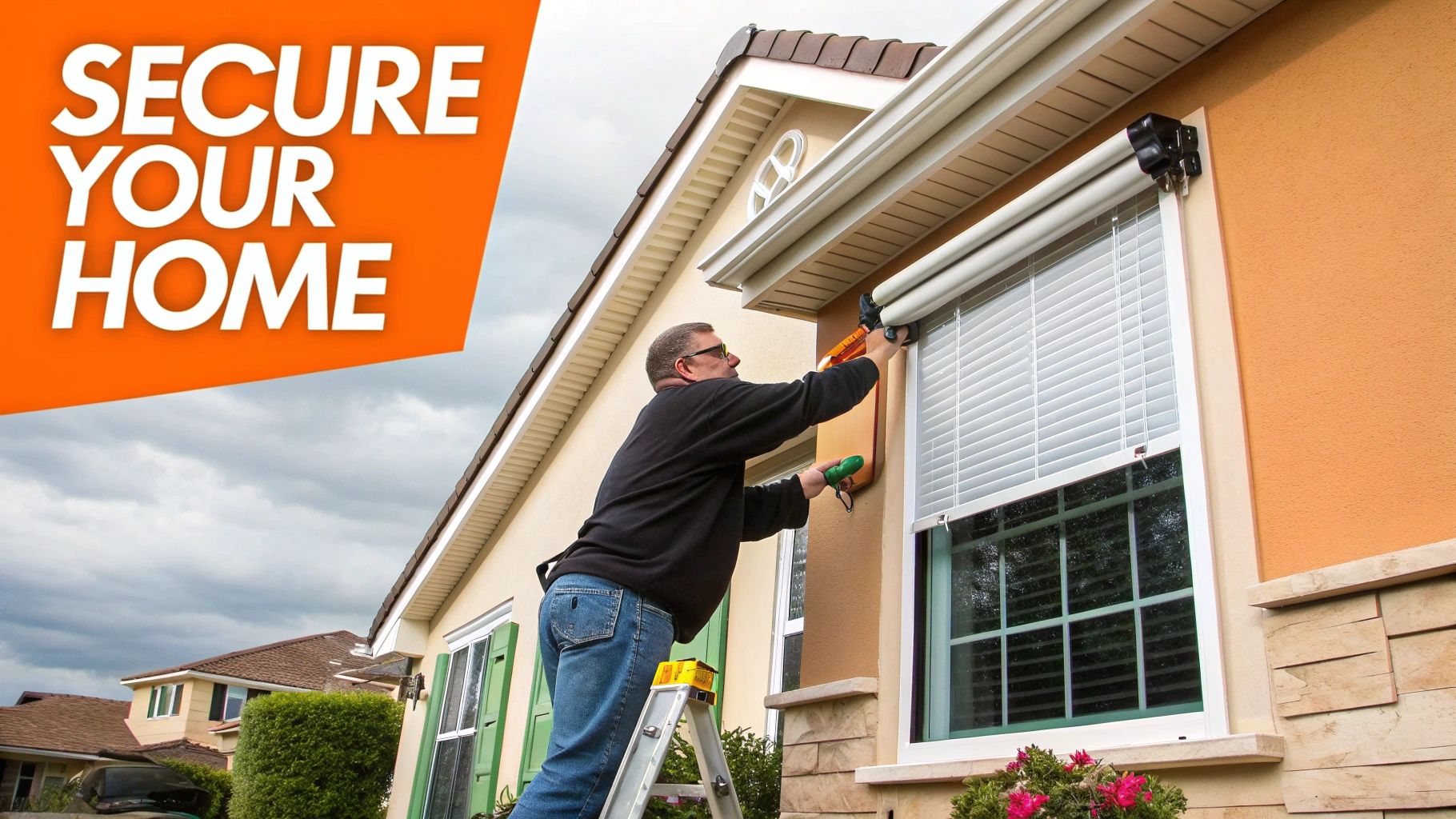
Begin with the basics inside your home. Secure tall, heavy furniture like bookcases and entertainment centers to wall studs using flexible fasteners. In the kitchen and garage, installing safety latches on cabinets is a small weekend project that prevents a mountain of shattered glass and a dangerous mess.
A critical, often overlooked step is securing your water heater, a common source of both fire and flooding after an earthquake. Brace it to the wall studs with heavy-gauge metal straps. Even better, consider installing an automatic gas shut-off valve. These devices sense seismic activity and immediately cut the gas supply, preventing one of the most dangerous post-earthquake hazards: fire.
Creating a Wildfire Defensible Space
Wildfire season is a serious reality for many Orange County communities. Your best defense is creating a defensible space around your property, which acts as a buffer zone between your home and an advancing fire. It’s a multi-layered approach that is proven to be effective.
- Zone 1 (0-5 feet from the home): This is your most critical area. Think non-combustible. Use materials like gravel or concrete pavers against the house foundation. Clear all dead vegetation, remove tree branches overhanging the roof, and eliminate flammable items stored nearby.
- Zone 2 (5-30 feet): Focus on breaking up fuel sources. Keep lawns mowed and irrigated. Prune trees to create at least 10 feet of space between their canopies. Choose fire-resistant plants like succulents for landscaping.
- Zone 3 (30-100 feet): The goal here is to slow the fire down. Thin out dense vegetation and remove highly flammable plants like eucalyptus and certain pines.
For an extra layer of safety, it is wise to understand interconnected smoke alarms and QLD legislation. These systems are a game-changer because if one alarm detects smoke, all alarms in the house sound simultaneously, giving your family precious extra time to escape.
Mitigating Potential Flood and Water Damage
While our focus is often on fire and earthquakes, intense rainstorms can lead to significant flooding and water damage. The good news is that simple landscaping and routine maintenance can make a huge difference in protecting your foundation and preventing costly repairs.
Start by ensuring your gutters are clean and that downspouts direct water at least five feet away from your home’s foundation. The ground around your house should slope away from the structure. If you are in a low-lying area, installing a sump pump is a fantastic last line of defense. Knowing how to respond in the first few minutes is critical, which is why we created a guide on the basics of water damage restoration to help homeowners act effectively.
Documenting Your Assets for a Smoother Recovery
After fortifying your home, there is one final, crucial step: creating a detailed home inventory. This is one of the most important things you can do to ensure a smooth insurance claims process. Without proof of ownership, it can be incredibly difficult to get reimbursed for your belongings.
The easiest way to create a home inventory is to walk through every room with your smartphone, recording a video. Narrate as you go, opening drawers and closets to document everything you own. Store this video securely in the cloud.
This simple act can be invaluable. A recent report from Aon revealed a staggering global protection gap estimated at 75%, meaning only a quarter of total economic losses from disasters were insured. A detailed inventory ensures you can claim what you are rightfully owed and avoid becoming part of that statistic.
By taking these proactive steps—from securing furniture to documenting assets—you transform your property from a potential liability into a resilient sanctuary.
Navigating Insurance and Financial Readiness
After a disaster, your ability to recover hinges on your financial resilience. In our years as Orange County’s trusted restoration and remodeling experts, we’ve seen that homeowners with a solid financial plan are better equipped to rebuild their lives. Getting a handle on your insurance and organizing your finances now is what turns chaos into calm when it matters most.
Many homeowners are shocked to discover what their standard policy doesn’t cover. Here in Southern California, major risks like earthquakes and floods almost always require separate, specialized policies. Without them, you could be personally responsible for devastating repair costs.
Conducting an Annual Insurance Policy Review
The single most important step is to schedule an annual policy review with your insurance agent. Do not let your policy auto-renew without careful consideration. Life changes, construction costs rise, and your coverage must keep pace.
During that meeting, focus on these key points:
- Confirm Coverage for Local Risks: Ask directly about earthquakes, floods, and wildfires. Understand the limitations and seriously consider adding endorsements or separate policies.
- Clarify Your Deductibles: Know exactly what you will pay out-of-pocket for different types of damage. A high deductible may lower your premium, but it can be a painful surprise when filing a claim.
- Verify Your Coverage Type: Ensure you have Replacement Cost Value (RCV), not just Actual Cash Value (ACV). RCV pays to rebuild your home as it was, while ACV only pays its value after depreciation—a massive difference in your settlement.
Learning how to choose insurance coverage that fits your life is key to building a truly solid financial safety net.
The High Cost of Underinsurance
The financial stakes are immense. In the first quarter of 2025 alone, natural disasters caused global economic losses of around $83 billion, with insured losses at $53 billion. The United States accounted for an incredible 95% of those insured losses, driven largely by catastrophic wildfires right here in California.
Having the right insurance isn’t just about protecting a building; it’s about protecting your financial future. It’s the tool that allows you to hire a certified expert like Sparkle to rebuild your home with excellence and integrity.
Organizing Your Financial First-Aid Kit
Beyond insurance, your critical documents must be organized and accessible. You won’t have time to search through file cabinets in a crisis.
Gather these essentials and store them for maximum accessibility:
- Digital Copies: Scan everything and save it to a password-protected cloud service like Google Drive or Dropbox. Also, put copies on an encrypted USB drive that you keep in your go-bag.
- Physical Copies: Keep originals or hard copies in a fireproof, waterproof safe at home or in a bank safe deposit box.
Essential Documents to Secure:
- Identification: Passports, driver’s licenses, birth certificates, Social Security cards.
- Property Records: Deeds to your home, vehicle titles, and mortgage statements.
- Financial Information: Bank account numbers, credit card information, and retirement account details.
- Insurance Policies: A complete copy of every single policy—home, auto, flood, and earthquake.
Finally, establish a dedicated emergency fund. This liquid fund is meant to cover immediate costs like a hotel, food, or your insurance deductible before claim checks arrive. Aim for at least three to six months of living expenses.
Your Top Disaster Prep Questions, Answered
Even with the best plan in place, homeowners often have lingering questions. As an IICRC Master Certified firm and a licensed general contractor in Orange County, we’ve guided countless families through the intricacies of preparing for the unexpected. Here are our direct, expert answers to the most common concerns.
How Often Should I Update My Emergency Kits and Plan?
The gold standard is to review everything—your entire plan and all your kits—at least once a year. An easy way to remember is to tie it to an existing routine, like changing your clocks for daylight saving time.
This annual check-in is about more than just swapping out expired food, water, or batteries, though that is critical. It’s an opportunity to sit down with your family and ensure the plan itself remains relevant.
- Have any phone numbers or emergency contacts changed?
- Is your out-of-state contact still the right person?
- Are your designated meeting spots still accessible and safe?
- As children get older, do their go-bags need different items? A teenager’s needs are far different from a toddler’s.
A plan is only as good as its last update. Keeping it current is every bit as important as creating it in the first place.
What Are the Most Important Documents to Protect?
When deciding which documents to safeguard, focus on anything that would be a nightmare to replace. These are the papers that prove your identity, property ownership, and financial standing.
We always recommend a three-layer strategy for complete peace of mind:
- Hard Copies: Your original documents—birth certificates, passports, social security cards, property deeds, car titles—should be stored in a waterproof and fireproof safe.
- Cloud Storage: Scan every one of those documents and upload them to a secure, password-protected cloud service like Dropbox or Google Drive.
- Portable Digital Copies: Save another set of these digital files onto a password-encrypted USB drive. This drive should live permanently in your primary go-bag.
This comprehensive approach ensures you can access vital information whether you’re at home, evacuated to a shelter, or miles away from the disaster zone.
My Home Was Damaged. What’s the Very First Thing I Should Do?
After a disaster, your first and only priority is safety. Do not re-enter your property until emergency officials have given the official all-clear. The risks of structural damage, gas leaks, or live electrical wires are simply too high.
Once you know it’s safe to proceed, make two phone calls in this order:
- First Call: Contact your insurance agent immediately to start the claims process. The sooner you report the damage, the better.
- Second Call: Contact a certified, 24/7 emergency restoration company like Sparkle Restoration. Our team can respond immediately to assess the damage and, more importantly, secure your property to prevent further harm.
This second step is absolutely crucial. Most insurance policies require you to take “reasonable steps” to mitigate further loss. This could mean tarping a damaged roof or boarding up shattered windows. Acting fast protects both your home and your insurance claim.
How Much Water and Food Do I Really Need?
FEMA and other agencies recommend a baseline of one gallon of water per person, per day. For a family of four, that means you need at least 12 gallons for a basic 3-day supply in your go-bags. For your at-home kit, however, we strongly urge our clients to store a two-week supply if space permits.
When it comes to food, the goal is non-perishable items your family will actually eat with little to no cooking. Think practical:
- Protein or granola bars
- Dried fruit, nuts, and trail mix
- Peanut butter
- Canned tuna, chicken, fruits, and vegetables
And please, don’t forget a non-electric, manual can opener. It’s one of the most commonly overlooked items, and without it, your canned food supply is useless.
When disaster strikes, you need a partner you can trust to restore not just your property, but your peace of mind. As a BBB Torch Award Winner for Ethics, Sparkle Restoration Services is dedicated to guiding Orange County homeowners through the recovery process with integrity and expertise. If your home has suffered damage, don’t wait. Contact us 24/7 for an immediate response and a free consultation to start turning chaos into calm.
Schedule Your Free Consultation with Sparkle Restoration Services Today
Ready to create a space that’s as beautiful as it is functional? Schedule your complimentary design consultation today by visiting Ready to Work with Sparkle?